Question
What is interference of light? Find an expression for fringe width in 'Young's double slit experiment.

Answer

When two waves of light having same frequency and same ampliitude propagate in a medium simultaneously in the same direction then due to their superposition the resultant intensity in the region of superposition is, in general, different from the sum of intensities due to each wave separately. This modification in the distribution of intensity of light in region of superposition is called interference. In the region of superposition there are certain points at which waves superimpose in such a way that resultant intensity is greater than the sum of intensities due to separate waves. Interference at such points is called constructive interference. At other points in the region of superposition the resultant intensity is less than the sum of intensities due to separate waves and interference at these points is called as destructive interference.
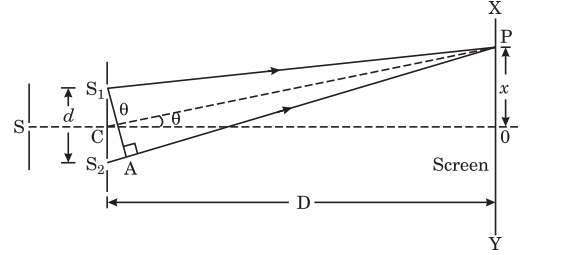
Expression for Fringe Width : In Fig. S is a narrow slit illuminated by monochromatic light. S1 and S2 are two parallel narrow slits placed very close to each other. Each of S₁ and S₂ is at equal distance from S. The light waves from S reach at S1 and S2 in the same phase.
Image
According to Huygen's principle, S1 and S2 act as new light-sources from which secondary wavelets originate. These wavelets form interference fringes on a screen XY placed at a distance D from double slit arrangement. S1S2, i.e., CO = D. Suppose the distance between the two slits is d i.e., S1S2 = d.
Let the right bisector CO of distance S1S2 meet the screen XY at a point. D and let P be a point on the screen at a distance x from O, where both waves starting from S1 and S2 reach simultaneously, traversing different distances S1P and S2P. Hence the path difference between them is $\left( S _2 P - S _1 P \right)$. Let a perpendicular S1A be drawn from S1 on S2P. Then S2A will be equal to the path difference between two waves. Therefore,
$\left( S _2 P - S _1 P \right)= S _2 A$.
The right angled triangles $\triangle S _1 AS _2$ and $\triangle POC$ are similar. Therefore
$\frac{ S _2 A}{ S _1 S_2}=\frac{ OP }{ CP }$
The distance CO is large in comparison to S1S2 and so CP may be taken equal to CO.
$\therefore \quad \frac{ S _2 A}{ S _1 S_2}=\frac{ OP }{ CO } \Rightarrow \frac{ S _2 A}{d}=\frac{ x }{ D }$
$\therefore \quad S _2 A=\frac{ x d }{ D }$
i.e. Path difference $=\frac{x d}{D}$
Now, according to the value of path difference bright or dark fringes will be obtained at P.
Locations of Bright Fringes : Bright fringes will be obtained at those points on the screen where the path difference between two interfering light waves will be 0, $\lambda, 2 \lambda, \ldots$ ... Hence for constructive interference i.e. bright fringe, we have
Path difference $\frac{x d}{ D }=m \lambda$
(where $m=0,1,2,3, \ldots$ )
$\Rightarrow \quad x = m \left(\frac{ D \lambda}{ d }\right)$ ...(1)
Thus equation (1) gives the location of mth bright fringe.
Hence the location of various bright fringes will be as follows :
For $m=0$; $x_0=0$
which is the position of central bright fringe which is called zero order bright fringe also.
For m = 1 ; $x_1= D \lambda / d$
which gives the location of first bright fringe.
For m = 2 ; $x_2=2 D \lambda / d$
which gives the location of second bright fringe and so on.
Location of Dark Fringes : Dark fringes will be obtained at those points on the screen where the path difference between two interfering light waves will be $\lambda /$ $2,3 \lambda / 2,5 \lambda / 2, \ldots$ ... Hence for destructive interference i.e., dark fringe, we have
Path difference : $\frac{x d}{ D }=(2 m-1) \frac{\lambda}{2}$
(where $m=1,2,3, \ldots$.)
$\Rightarrow \quad x=\frac{(2 m-1) D \lambda}{2 d}$ ...(2)
Thus, equation (2) gives the location of mth dark fringe.
Hence the locations of various dark fringes will be as follows :
For $m=1$ ; $x_1=\frac{ D \lambda}{2 d}$,
which gives the location of first dark fringe.
For $m=2$; $x_2=\frac{3 D \lambda}{2 d}$.
which gives the location of second dark fringe.
For $m=3$; $x_3=\frac{5 D \lambda}{2 d} ;$
which gives the location of third dark fringe and so on.
From the above discussion about the location of bright and dark fringes it is obvious that the bright and dark fringes are located alternately in interference pattern.
Fringe Width : Since it is equal to the distance between two consecutive bright or dark fringes, hence if $x_n$ and $x_{n+1}$ be the distances of the $n$th and $(n+1)$ th fringes respectively then fringe width :
$W =x_{n+1}-x_n$
For mth bright fringe :
$x_m=\frac{m D \lambda}{d}$
$\Rightarrow \quad x_n=\frac{n D \lambda}{d}$ and $x_{n+1}=\frac{(n+1) D \lambda}{d}$
$\therefore \quad W =x_{n+1}-x_n$
$\Rightarrow \quad W =\frac{(n+1) D \lambda}{d}-\frac{n D \lambda}{d}$
$\Rightarrow \quad W =\frac{ D \lambda}{ d }$ ...(3)
For mth dark fringe :
$x_m=\frac{(2 m-1) D \lambda}{d}$
$\Rightarrow \quad x_n=\frac{(2 n-1) D \lambda}{d}$
and $x_{n+1}=\frac{\{2(n+1)-1\} D \lambda}{2 d}$
$\Rightarrow \quad x_{n+1}=\frac{(2 n+1) D \lambda}{2 d}$
$\therefore \quad W =x_{n+1}-x_n$
$\Rightarrow \quad W =\left[\frac{(2 n+1) D \lambda}{2 d}\right]-\left[\frac{(2 n-1) D \lambda}{2 d}\right]$
$\Rightarrow \quad W =\frac{ D \lambda}{ d }$ ...(4)
From equations (3) and (4) it is obvious that the bright and dark fringes are of equal fringe width.
In this way in interference pattern obtained on the screen bright and dark fringes are equally spaced in alternate order.

Need a full question paper?

Generate a complete, print-ready paper with questions like this in minutes — across 16+ boards, with answer keys.

Start Generating Free

Similar questions

A thin prism of angle $6.0^\circ,\omega=0.07$ and $\mu_\text{y}=1.50$ is combined with another thin prism having $\omega=0.08$ and $\mu_\text{y}=1.60.$ The combination produces no deviation in the mean ray.
  1. Find the angle of the second prism.
  2. Find the net angular dispersion produced by the combination when a beam of white light passes through it.
  3. If the prisms are similarly directed, what will be the deviation in the mean ray
  4. Find the angular dispersion in the situation described in (c).
A servo voltage stabiliser restricts the voltage output to $220V ± 1\%$. If an electric bulb rated at $220V, 100W$ is connected to it, what will be the minimum and maximum power consumed by it?
Figure shows a charge array known as an electric quadrupole. For a point on the axis of the quadrupole, obtain the dependence of potential on r for r/a >> 1, and contrast your results with thatdue to an electric dipole, and an electric monopole (i.e., a single charge).
Differentiate between self induction and mutual induction with examples.
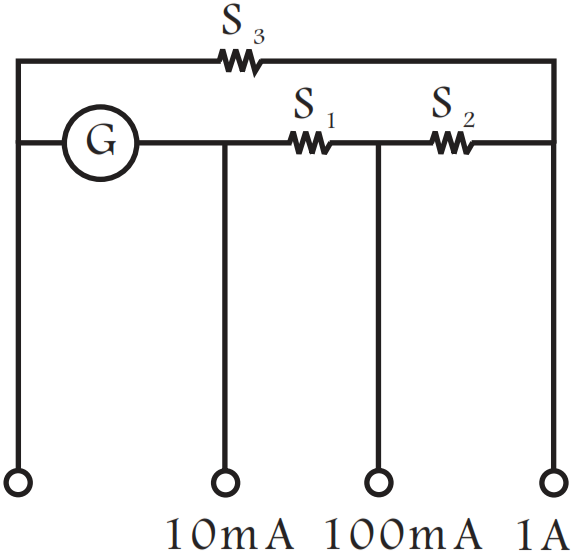
A multirange current meter can be constructed by using a galvanometer circuit as shown in Fig. We want a current meter that can measure $10mA,$ $100mA$ and $1A$ using a galvanometer of resistance $10\Omega$ and that prduces maximum deflection for current of $1mA.$ Find $S_1, S_2$ and $S_3$ that have to be used.
A certain element emits $\text{K}_\alpha$ X-ray of energy 3.69keV. Use the data from the previous problem to identify the element.
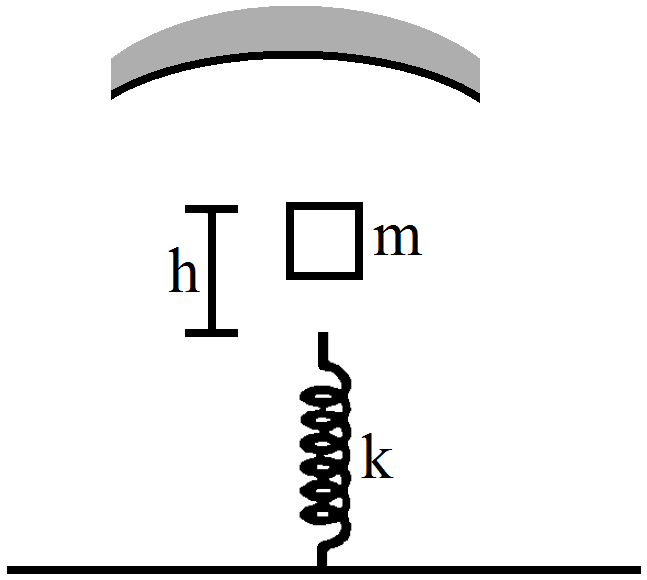
A mass $m = 50g$ is dropped on a vertical spring of spring constant $500\ N/m$ from a height $h = 10\ cm$ as shown in figure. The mass sticks to the spring and executes simple harmonic oscillations after that. A concave mirror of focal length $12\ cm$ facing the mass is fixed with its principal axis coinciding with the line of motion of the mass, its pole being at a distance of $30\ cm$ from the free end of the spring. Find the length in which the image of the mass oscillates.
For a circular coil of radius R and N turns carrying current I, the magnitude of the magnetic field at a point on its axis at a distance x from its centre is given by,
$\text{B}=\frac{\mu_{0}\text{IR}^{2}\text{N}}{2(\text{x}^{2}+\text{R}^{2})^{\frac{3}{2}}}$
  1. Show that this reduces to the familiar result for field at the centre of the coil.
  2. Consider two parallel co-axial circular coils of equal radius R, and number of turns N, carrying equal currents in the same direction, and separated by a distance R. Show that the field on the axis around the mid-point between the coils is uniform over a distance that is small as compared to R, and is given by,$\text{B}=0.72\frac{\mu_{0}\text{NI}}{\text{R}}$, approximately.
[Such an arrangement to produce a nearly uniform magnetic field over a small region is known as Helmholtz coils.]
Quite often, connecting wires carrying currents in opposite directions are twisted together in using electrical appliances. Explain how it avoids unwanted magnetic fields.
(I) (a) Write two limitations of ohm’s law. Plot their I-V characteristics.
(b) A heating element connected across a battery of 100 V having an internal resistance of $1 \Omega$ draws an initial current of 10 A at room temperature 20.0 °C which settles after a few seconds to a steady value. What is the power consumed by battery itself after the steady temperature of 320.0 °C is attained? Temperature coefficient of resistance averaged over the temperature range involved is $3.70 \times 10^{-4}{ }^{\circ} C ^{-1}$.