Question
What is Menstrual cycle? Describe it in brief.

Answer

(i) Female reproductive system undergoes some changes at puberty and those changes repeat at the interval of every 28 - 30 days. These repetitive changes are called as menstrual cycle.
(ii) Menstrual cycle in a natural process controlled by four hormones. Follicle stimulating hormone (FSH), Luteinizing hormone (LH), estrogen and progesterone.
(iii) One of the several follicles in the ovary starts to develop along with the oocyte present in it, under the effect of follicle stimulating hormone. This developing follicle secrets oestrogen.
(iv) Endometrium of the uterus starts to develop or regenerate under the effect of estrogen.
(v) Meanwhile developing follicle completes its development.
(vi) It bursts under the effect of lutenizing hormone and oocyte is released. This is called as ovulation.
(vii) Remaining tissues of the burst follicle forms the corpus luteum. Corpus luteum starts to secrete progesterone.
(viii) Endometrial glands secrete their secretion under the effect of progesterone. Such endometrium is ready for implantation of embryo.
(ix) If oocyte is not fertilized within 24 hours, corpus luteum becomes inactive and transforms into corpus albicans.
(x) Endometrium starts to degenerate in absence of estrogen and progesterone.
(xi) Tissues of degenerating endometrium and unfertilized ovum are discarded out through vagina, accompanied by bleeding.
(xii) Bleeding continues approximately for 5 days. This is called mensturation.
Need a full question paper?

Generate a complete, print-ready paper with questions like this in minutes — across 16+ boards, with answer keys.

Start Generating Free

Similar questions

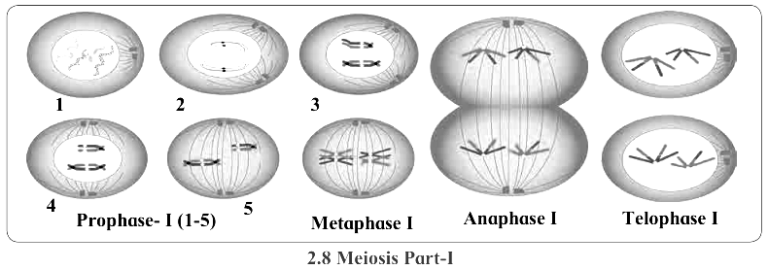
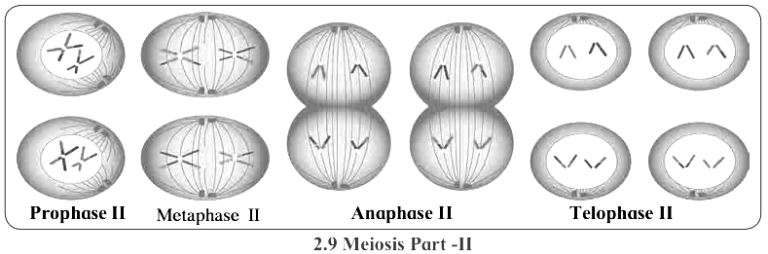
Observe the diagrams and answer the following questions.
Image
Image

(a) Which peculiarity do you observe in the figure of Metaphase-I of meiosis ?
(b) What is the important difference between Telophase-I and Telophase-II of meiosis?
(c) Which figure shows phenomena of crossing over?
An object placed 4cm in front of a converging lens produces a real image 12cm from the lens.
  1. What is the magnification of the image?
  2. What is the focal length of the lens?
  3. Draw a ray diagram to show the formation of image. Mark clearly F and 2F in the diagram.
Which device is used to produce electricity? Describe with a neat diagram.
(a) Electric motor
(b) Galvanometer
(c) Electric generator (DC)
(d) Voltmeter
One can sense colour only in bright light.
Observe the figure and answer the following questions.
Image
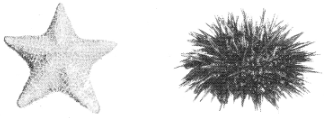
(a) To which phylum these organisms belong?
(b) Name the substance with which their body is covered.
(c) Name their organs of locomotion.
Write short notes: Darwin’s theory of natural selection.
Which type/types of power generation involve maximum number of steps of energy conversion? In which power generation is the number minimum?
Describe the merits of Mendeleev’s periodic table?
The liquid connective tissue A circulates in our body continuously without stopping. This tissue contains a pigment B which imparts it a colour C. The tissue A consists of four components D, E, F and G. The component D fights infection and protects us from diseases. The component E helps in the clotting of tissue A if a person gets a cut. The component F is a liquid which consists mainly of water with many substances dissolved in it and component G carries oxygen from the lungs to all the parts of the body.
  1. What is (i) tissue A, (ii) pigment B and (iii) colour C?
  2. Name (i) D, (ii) E, (iii) F and (iv) G.
  3. Name one substance (other than oxygen) which is transported by tissue A in the human body.
  4. Which two components of tissue A are the cells without nucleus?
  5. Name any two organisms (animals) which do not have liquid like A in their body.
Explain the following terms with example: Alkane.