Question
What is optically denser and optically rarer medium?

Answer

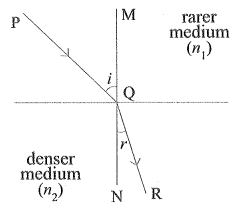
$\bullet$ Optical denser medium:
Image
$\rightarrow$ If $n_{21}>1$, then from $\frac{\sin i}{\sin r}=n_{21}$
$ \frac{\sin i}{\sin r}>1$
$\therefore i>r$
$\rightarrow$ Hence, refracted ray bends towards the normal.
$\rightarrow$ Here, medium $2$ is said to be denser as compared to medium $1$ .
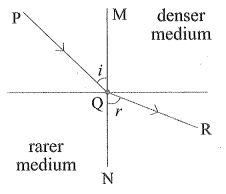
$\bullet$ Optically rarer medium :
Image
$\rightarrow$ If $n_{21}<1$, then
$ \frac{\sin i}{\sin r}<1$
$\therefore i < r $
$\rightarrow$ Hence, refracted ray goes away from normal.
$\rightarrow$ Here, medium $2$ is said to be rarer as compared to medium $1$ .

Need a full question paper?

Generate a complete, print-ready paper with questions like this in minutes — across 16+ boards, with answer keys.
Start Generating Free

Similar questions

The circuit arrangement given below shows that when an a.c. passes through the coil A, the current starts flowing in the coil B.
  1. State the underlying principle involved.
  2. Mention two factors on which the current produced in the coil B depends.
A charge Q is placed at the centre of a cube. Find the flux of the electric field through the six surfaces of the cube.
In Exercises 7.3 and 7.4, what is the net power absorbed by each circuit over a complete cycle. Explain your answer.
On a hot summer day we want to cool our room by opening the refrigerator door and closing all the windows and doors. Will the process work ?
Two transparent slabs having equal thickness but different refractive indices $\mu_1$ and $\mu_2$ are pasted side by side to form a composite slab. This slab is placed just after the double slit in a Young's experiment so that the light from one slit goes through one material and the light from the other slit goes through the other material. What should be the minimum thickness of the slab so that there is a minimum at the point $P_0$ which is equidistant from the slits?
Provide the classification of semi-conductors with example.
Can work be done by a system without changing its volume?
Answer the following question:
Ray optics is based on the assumption that light travels in a straight line. Diffraction effects (observed when light propagates through small apertures/slits or around small obstacles) disprove this assumption. Yet the ray optics assumption is so commonly used in understanding location and several other properties of images in optical instruments. What is the justification?
A person drops a coin. Describe the path of the coin as seen by the person if he is in:
  1. A car moving at constant velocity.
  2. In a freely falling elevator.