Question
What is the change in frequency when a source goes past a stationary observer with velocity $V_s$? (Given: velocity of sound is c and the frequency is v).

Answer

When a source approaches a stationary observer,
$\text{v}'=\text{v}\Big(\frac{\text{c}}{\text{c}-\text{v}_\text{s}}\Big)$
When the source goes away,
$\text{v}"=\text{v}\Big(\frac{\text{c}}{\text{c}+\text{v}_\text{s}}\Big)$
$\therefore$ Change when the source goes past stationary observer is,
$\text{v}'-\text{v}"=\text{vc}\Big[\frac{\text{c}}{\text{c}-\text{v}_\text{s}}-\frac{\text{c}}{\text{c}+\text{v}_\text{s}}\Big]$
$=\frac{2\text{vcv}_\text{s}}{(\text{c}^2-\text{v}^2_\text{s})}$

Need a full question paper?

Generate a complete, print-ready paper with questions like this in minutes — across 16+ boards, with answer keys.
Start Generating Free

Similar questions

If two quantities have same dimensions, do they represent same physical content?
A positive charge q is placed in front of a conducting solid cube at a distance d from its centre. Find the electric field at the centre of the cube due to the charges appearing on its surface.
What are conditions for the projectile path to be annular?
Three particles having equal masses are placed at the three corners of an equilateral triangle of side a. Find the moment of inertia of the system relative to the axis passing through any one particle and perpendicular to the plane of the triangle.
A force F = a + bx acts on a particle in the x-direction, where a and b are constants. Find the work done by this force during a displacement from x = 0 to x = d.
A monkey is ascending a branch with constant acceleration. If the breaking strength is 160% of the monkey's weight, what is the maximum acceleration permitted for the monkey?
Obtain $\omega=\omega_0+\alpha t$ from first principles.
What is the significance of:
  1. Wetting agents used by dyers.
  2. Water proofing agents?
A mass of $6 \times 10^{24}kg$ (equal to the mass of the earth) is to be compressed in a sphere in such a way that the escape velocity from its surface is $3 \times 10^8m/s$. What should be the radius of the sphere?
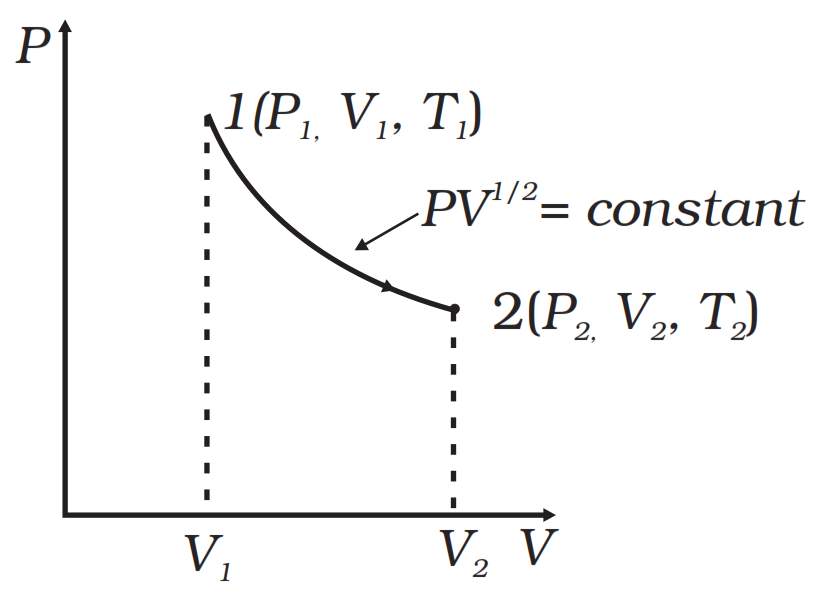
Consider a P-V diagram in which the path followed by one mole of perfect gas in a cylindrical container is shown in Fig. What is the ratio of temperature $\frac{\text{T}_1}{\text{T}_2},\text{if}\text{V}_2=2\text{V}_1?$