Question

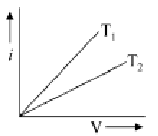
What physical quantities may X  and Y  represent ? (Y represents the first mentioned quantity)

(a) Pressure  v/s temperature of a given gas (constant volume)

(b) Kinetic energy v/s velocity of a particle

(c) Capacitance v/s charge to give a constant potential

(d) Potential v/s capacitance to give a constant charge

Answer

(d) Potential v/s capacitance to give a constant charge

Need a full question paper?

Generate a complete, print-ready paper with questions like this in minutes — across 16+ boards, with answer keys.

Start Generating Free

Similar questions

When no current is passed through a conductor:
  1. The free electrons do not move.
  2. The average speed of a free electron over a large period of time is zero.
  3. The average velocity of a free electron over a large period of time is zero.
  4. The average of the velocities of all the free electrons at an instant is zero.
In the given figure, V-i graph of a conductor at two different temperatures is shown. If resistances corresponding to these temperatures are $R_1$ and $R _2$ respectively, then which of the following statement is correct ?
Image

A bar magnet is oscillating in the Earth’s magnetic field with a period T. What happens to its period and motion if its mass is quadrupled

(a) Motion remains S.H.M. with time period = 2T

(b) Motion remains S.H.M. with time period = 4T

(c) Motion remains S.H.M. and period remains nearly constant

(d) Motion remains S.H.M. with time period =  

The 21 cm radio wave emitted by hydrogen in interstellar space is due to the interaction called the hyperfine interaction is atomic hydrogen. the energy of the emitted wave is nearly

(a)  Joule

(b) 1 Joule

(c) 7  Joule

(d)  Joule

Mean life of a radioactive sample is 100 seconds. Then its half life (in minutes) is

(a) 0.693 

(b) 1

(c) 10-4

(d) 1.155

A long, straight wire of radius R carries a current distributed uniformly over its cross section. T he magnitude of the magnetic field is:
A paramagnetic material is kept in a magnetic field. The field is increased till the magnetization becomes constant. If the temperature is now decreased, the magnetization

The mechanism of the heat produced in a conductor when an electric current flows through it, can be explained on the basis of

(a) Viscosity

(b) Friction

(c) Free electron theory

(d) Gauss's theorem

When a p-n diode is reverse biased, then
Equipotential surfaces: