Question
When a bar magnet is broken into two pieces:

Answer

  1. Each piece will have two unlike poles.
Explanation:
When we break a magnet into two, both act as magnets, that is both have a north and south pole each. In both these pieces the corresponding north and south poles remain on the sides as in the original magnet. This means that the 2 broken sides must get oppositely polarized.

Need a full question paper?

Generate a complete, print-ready paper with questions like this in minutes — across 16+ boards, with answer keys.
Start Generating Free

Similar questions

If the distance between a point source and screen is doubled, then intensity of light on the screen will become(a) Four times(b) Double(c) Half    (d) One-fourth
       
The radius of a circular loop is $r$ and $a$ current $i$  is flowing in it. The equivalent magnetic moment will be
The distance of two points on the axis of a magnet from its centre is 10 cm and 20 cm respectively. The ratio of magnetic intensity at these points is 12.5 : 1. The length of the magnet will be(a) 5 cm(b) 25 cm(c) 10 cm(d) 20 cm
       
An $\alpha$-particle is bombarded on $^{14}N.$ As a result, $a ^{17}O$ nucleus is formed and a particle is emitted. This particle is a:
Two streams of electrons are moving parallel to each other in the same direction. They_____.
Inductance plays the role of
If two streams of protons move parallel to each other in the same direction, then they(a) Do not exert any force on each other(b) Repel each other(c) Attract each other(d) Get rotated to be perpendicular to each other


A parallel plate capacitor having a plate separation of $2\ mm$ is charged by connecting it to a $300\ V$ supply. The energy density is
The ionization potential for second He electron is (a) 13.6 eV(b) 27.2 eV(c) 54.4 eV(d) 100 eV
       
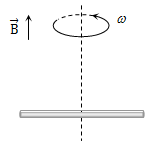
A conducting rod of length $2l$ is rotating with constant angular speed $w$ about its perpendicular bisector. A uniform magnetic field $\vec{B}$  exists parallel to the axis of rotation. The $e.m.f.$ induced between two ends of the rod is