Question
When a p-n junction is reverse-biased, the current becomes almost constant at $25\mu\text{A}.$ When it is forwardbiased at 200mV, a current of $75\mu\text{A}$ is obtained. Find the magnitude of diffusion current when the diode is,
  1. Unbiased.
  2. Reverse-biased at 200mV.
  3. Forward-biased at 200mV.

Answer

  1. $\text{i}_1=25\mu\text{A},\text{V}=200\text{mV},\text{i}_2=75\mu\text{A}$

When in unbiased condition drift current = diffusion current

$\therefore$ Diffusion current $=25\mu\text{A}.$

  1. On reverse biasing the diffusion current becomes ‘O’.
  2. On forward biasing the actual current be x.

x - Drift current = Forward biasing current

$\Rightarrow\text{x}-25\mu\text{A}=75\mu\text{A}$

$\Rightarrow\text{x}=(75+25)\mu\text{A}=100\mu\text{A}.$

Need a full question paper?

Generate a complete, print-ready paper with questions like this in minutes — across 16+ boards, with answer keys.

Start Generating Free

Similar questions

Calculate potential on the axis of a ring due to charge Q uniformly distributed along the ring of radius R.
Consider a non-conducting plate of radius r and mass m that has a charge q distributed uniformly over it. The plate is rotated about its axis with an angular speed $\omega.$ Show that the magnetic moment $\mu$ and the angular momentum of the plate are related as $\mu=\frac{\text{q}}{2\text{m}}\text{l}.$
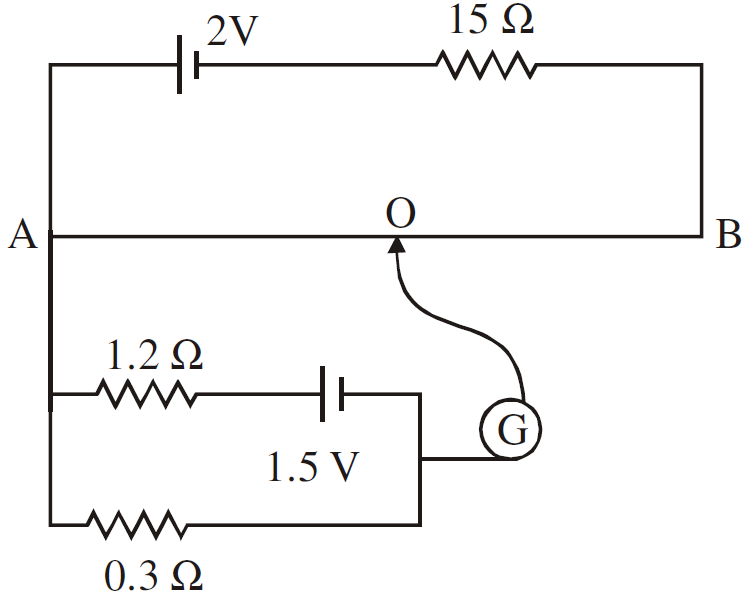
  1. State the principle of working of a potentiometer.
  2. In the following potentiometer circuit, AB is a uniform wire of length 1 m and resistance 10Ω. Calculate the potential gradient along the wire and balance length AO ( = l).

Light is incident from glass $(\mu=1.50)$ to water $(\mu=1.33).$ Find the range of the angle of deviation for which there are two angles of incidence.
When a metal plate is exposed to a monochromatic beam of light of wavelength 400nm, a negative potential of 1.1V is needed to stop the photocurrent. Find the threshold wavelength for the metal.
Under certain circumstances, a nucleus can decay by emitting a particle more massive than an $\alpha$particle. Consider the following decay processes:
$^{223}_{88}\text{Ra}\rightarrow^{209}_{82}\text{Pb}+^{14}_{6}\text{C}$
$^{223}_{88}\text{Ra}\rightarrow^{219}_{86}\text{Rn}+^{4}_{2}\text{He}$
Calculate the Q-values for these decays and determine that both are energetically allowed.
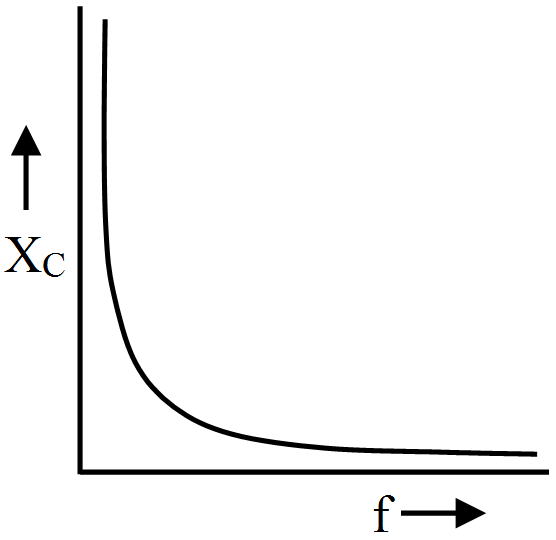
Define the term capacitive reactance. Show graphically the variation of capacitive reactance with frequency of applied alternating voltage.

An ac voltage $\text{V = V}_0\sin\omega\text{t}$ is applied across a pure capacitor of capacitance C. Find an expression for current flowing through it. Show mathematically the current flowing through it leads the applied voltage by angle $\frac{\pi}{2}.$

Explain with the help of a circuit diagram how the value of unknown resistance can be determined using a Wheatstone Bridge. Give the formula used.
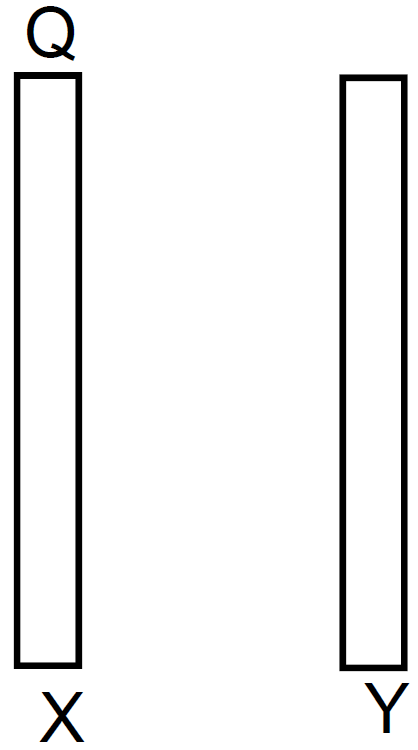
Two conducting plates X and Y, each having large surface area A (on one side), are placed parallel to each other as shown in figure. The plate X is given a charge Q whereas the other is neutral. Find:

  1. The surface charge density at the inner surface of the plate X.
  2. The electric field at a point to the left of the plates.
  3. The electric field at a point in between the plates.
  4. The electric field at a point to the right of the plates.
What are the dimensions of $\chi$, the magnetic susceptibility? Consider an H-atom. Guess an expression for $\chi$, upto a constant by constructing a quantity of dimensions of $\chi$, out of parameters of the atom: e, m, v, R and μ0 . Here, m is the electronic mass, v is electronic velocity, R is Bohr radius. Estimate the number so obtained and compare with the value of $|\chi|\sim10^{-5}$ for many solid materials.