MCQ
When a potential difference is applied across, the current passing through
  • A
    An insulator at $0K$ is zero
  • B
    A semiconductor at $0K$ is zero
  • C
    A P-N diode at $300K$ is finite, if it is reverse biased
  • All of the above

Answer

Correct option: D.
All of the above
d
(d) At $0 K$, a semiconductor becomes a perfect insulator. Therefore at $0 K$, if some potential difference is applied across an insulator or a semiconductor, current is zero. But a conductor will become a superconductor at $0 K$. Therefore, current will be infinite. In reverse biasing at $300\, K$ through a $P-N$ junction diode, a small finite current flows due to minority charge carriers.

Need a full question paper?

Generate a complete, print-ready paper with questions like this in minutes — across 16+ boards, with answer keys.
Start Generating Free

Similar questions

A magnet is dropped down an infinitely long vertical copper tube
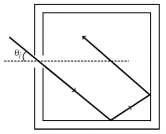
A monochromatic beam of light enters a square enclosure with mirrored interior surfaces at an angle of incidence $\theta_i(\neq 0)$ (see figure). For some value(s) of $\theta_i$, the beam is reflected by every mirrored wall (other than the one with the opening) exactly once and exits the enclosure through the same hole. Which of the following statements about this beam is correct?
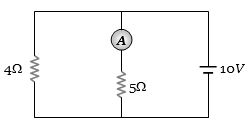
In the circuit, the reading of the ammeter is ................. $A$ (assume internal resistance of the battery be zero)
Two identical thin plano-convex glass lenses (refractive index $1.5$) each having radius of curvature of $20\,\, cm$ are placed with their convex surfaces in contact at the centre. The intervening space is filled with oil of refractive index $1. 7$ .  The focal length of the combination is.......$cm$
Two charged thin infinite plane sheets of uniform surface charge density $\sigma_{+}$ and $\sigma_{-}$ where $\left|\sigma_{+}\right|>\left|\sigma_{-}\right|$ intersect at right angle. Which of the following best represents the electric field lines for this system
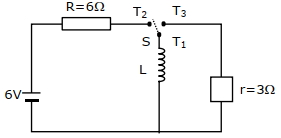
Consider an electrical circuit containing a two way switch $^{\prime}{S}^{\prime}$. Initially ${S}$ is open and then ${T}_{1}$ is connected to ${T}_{2} .$ As the current in ${R}=6 \,\Omega$ attains a maximum value of steady state level, ${T}_{1}$ is disconnected from ${T}_{2}$ and immediately connected to ${T}_{3} .$ Potential drop across ${r}=3\, \Omega$ resistor immediately after $T_{1}$ is connected to $T_{3}$ is $....\,V.$ (Round off to the Nearest Integer)
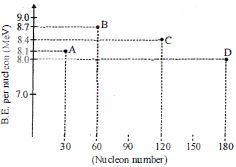
The positions of four different nuclei in the binding energy curve are shown in figure. The process that might not proceed spontaneously is
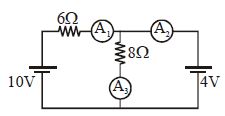
Reading of ammeter $A_1, A_2$ and $A_3$ will be respectively
A potentiometer wire of length $L$ and a resistance $r$ are connected in series with a battery of e.m.f. $E_0$ and a resistance $r_1$. An unknown e.m.f. $E$ is balanced at a length $l$ of the potentiometer wire. The e.m.f. $E$ will be given by
The capacity of parallel plate condenser depends on