Question
When subatomic particles undergo reactions, energy is conserved, but mass is not necessarily conserved. However, a particle's mass “contributes” to its total energy, in accordance with Einstein's famous equation, $E = mc^2$ In this equation, E denotes the energy carried by a particle because of its mass. The particle can also have additional energy due to its motion and its interactions with other particles. Consider a neutron at rest and well separated from other particles. It decays into a proton, an electron and an undetected third particle as given here: Neutron → proton + electron + ???
The given table summarizes some data from a single neutron decay. Electron volt is a unit of energy. Column 2 shows the rest mass of the particle times the speed of light squared.
Particle
$Mass\times c^2$ (MeV)
Kinetic energy (MeV)
Neutron
940.97
0.00
Proton
939.67
0.01
Electron
0.51
0.39
  1. From the given table, which properties of the undetected third particle can be calculate?
  1. Total energy, but not kinetic energy.
  2. Kinetic energy, but not total energy.
  3. Both total energy and kinetic energy.
  4. Neither total energy nor kinetic energy.
  1. Assuming the table contains no major errors, what can we conclude about the $(mass \times c^2)$ of the undetected third particle?
  1. It is 0. 79 MeV
  2. It is 0.39 MeV
  3. It is less than or equal to 0.79 MeV; but we cannot be more precise.
  4. It is less than or equal to 0.40 MeV; but we cannot be more precise.
  1. Could this reaction occur?
Proton → neutron + other particles
  1. Yes, if the other particles have much more kinetic energy than mass energy.
  2. Yes, but only if the proton has potential energy (due to interactions with other particles).
  3. No, because a neutron is more massive than a proton.
  4. No, because a proton is positively charged while a neutron is electrically neutral.
  1. How much mass has to be converted into energy to produce electric power of 500MW for one hour?
  1. $2 \times 10^{-5}kg$
  2. $1 \times 10^{-5}kg$
  3. $3 \times 10^{-5}kg$
  4. $4 \times 10^{-5}kg$
  1. The equivalent energy of 1g of substance is.
  1. $9 \times 10^{13}J$
  2. $6 \times 10^{12}J$
  3. $3 \times 10^{13}J$
  4. $6 \times 10^{13}J$

Answer

  1. (a) Total energy, but not kinetic energy.
Explanation:
As just shown, energy conservation allows us to calculate the third particle's total energy. But we do not know what percentage of that total is mass energy.
  1. (d) It is less than or equal to 0.40 MeV, but we cannot be more precise.
Explanation:
According to the passage, subatomic reactions do not conserve mass. So, we cannot find the third particle's mass by setting $\text{m}_\text{neutron}$equal to $\text{m}_\text{proton}+\text{m}_\text{electron}+\text{E}_\text{thrid particle}$
The neutron has energy 940.97 MeV. The proton has energy 939.67 MeV + 0.01 MeV = 939.69 MeV. The electron has energy 0.51 MeV + 0.39 MeV = 0.90 MeV. Therefore, the third particle has energy.
$\text{E}_\text{third particle}=\text{E}_\text{neutron}-\text{E}_\text{proton}-\text{E}_\text{electron}$
$= 940.97 - 939.67 - 0.90 = 0.40$ MeV
We just found the third particle's total energy, the sum of its mass energy and kinetic energy. Without more information, we cannot figure out how much of that energy is mass energy.
  1. (b) Yes, but only if the proton has potential energy (due to interactions with other particles).
  2. (a) $2 \times 10^{-5}kg$
Explanation:
Here, $P = 500MW = 5 \times 10^8W,$
$t = 1h = 3600s$
Energy produced, $E = P \times t = 5 \times 10^8 \times 3600 = 18 \times 10^{11}J$
$\text{As}\ \text{E}=\Delta\text{mc}^2$
$\therefore\Delta\text{m}=\frac{\text{E}}{\text{c}^2}=\frac{18\times10^{11}}{(3\times10^8)^2}$
$=\frac{18\times10^{11}}{(3\times10^8)^{16}}=2\times10^{-5}\text{kg}$
  1. (a) $9 \times 10^{13}J$
Explanation:
Using, $E = mc^2$
Here, $m = 1g = 1 \times 10^{-3}kg, c = 3 \times 10^8m s^{-1}$
$\therefore E = 10^{-3} \times 9 \times 10^{16} = 9 \times 10^{13}J$

Need a full question paper?

Generate a complete, print-ready paper with questions like this in minutes — across 16+ boards, with answer keys.

Start Generating Free

Similar questions

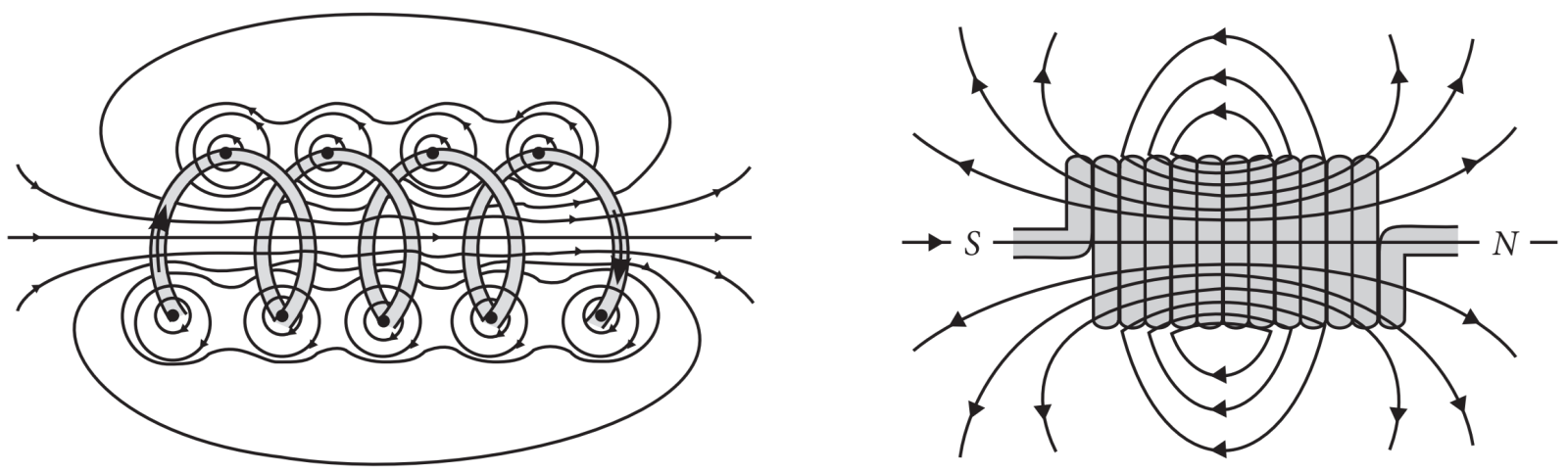
A solenoid is a long coil of wire tightly wound in the helical form. Solenoid consists of closely stacked rings electrically insulated from each other wrapped around a non-conducting cylinder.
Figure below shows the magnetic field lines of a solenoid carrying a steady current I. We see that if the turns are closely spaced, the resulting magnetic field inside the solenoid becomes fairly uniform, provided that the length of the solenoid is much greater than its diameter. for an "ideal" solenoid, which is infinitely long with turns tightly packed, the magnetic field inside the solenoid is uniform and parallel to the axis, and vanishes outside the solenoid.
  1. A long solenoid has 800 turns per metre length of solenoid. A current of 1.6A flows through it. The magnetic induction at the end of the solenoid on its axis is
  1. $10 \times 10^{-4}T$
  2. $8 \times 10^{-4}T$
  3. $32 \times 10^{-4}T$
  4. $4 \times 10^{-4}T$
  1. Choose the correct statement in the following.
  1. The magnetic field inside the solenoid is less than that of outside.
  2. The magnetic field inside an ideal solenoid is not at all uniform.
  3. The magnetic field at the centre, inside an ideal solenoid is almost twice that at the ends.
  4. The magnetic field at the centre, inside an ideal solenoid is almost half of that at the ends.
  1. The magnetic field (B) inside a long solenoid having n turns per unit length and carrying current I when iron core is kept in it is ($\mu_0$ = permeability of vacuum, = magnetic susceptibility)
  1. $\mu_0\text{ nI}(\text{l}-\chi)$
  2. $\mu_0\text{ nI }\chi$
  3. $\mu_0\text{ nI}^2(\text{1}+\chi)$
  4. $\mu_0\text{ nI}(\text{1}+\chi)$
  1. A solenoid oflength land having l turns carries a current I is in anticlockwise direction. The magnetic field is:
  1. $\mu_0\text{ nI}$
  2. $\mu_0\frac{\text{ nI}}{\text{l}^2}$
  3. A​​​​​​along the axis of solenoid.
  4. Perpendicular to the axis of coil.
  1. The magnitude of the magnetic field inside a long solenoid is increased by:
  1. Decreasing its radius.
  2. Decreasing the current through it.
  3. Increasing its area of cross-section.
  4. Introducing a medium of higher permeability.
A silver ball of radius 4.8cm is suspended by a thread in a vacuum chamber. Ultraviolet light of wavelength 200 run is incident on the ball for some time during which a total light energy of $1.0 \times 10^{-7}J$ falls on the surface. Assuming that on the average one photon out of every ten thousand is able to eject a photoelectron, find the electric potential et the surface of the bell assuming zero potential at infinity. What is the potential at the centre of the bell?
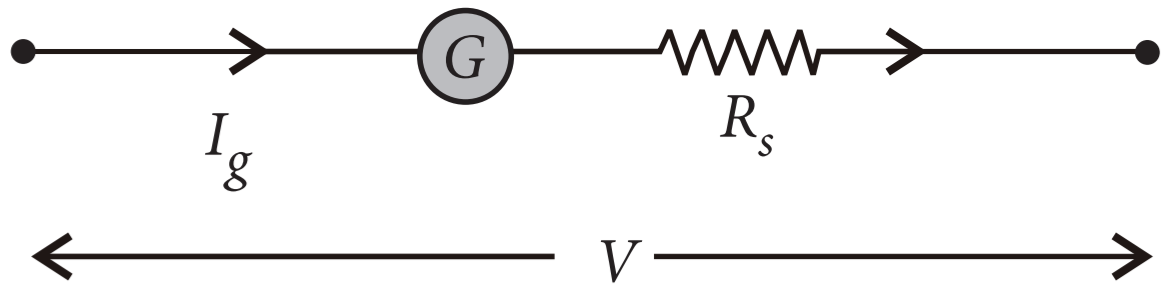
A galvanometer can be converted into voltmeter of given range by connecting a suitable resistance R, in series with the galvanometer, whose value is given by,
$\text{R}_\text{s}=\frac{\text{V}}{\text{I}_\text{g}}-\text{G}$
where Vis the voltage to be measured, lg is the current for full scale deflection of galvanometer and G is the resistance of galvanometer.

Series resistor(R,) increases range of voltmeter and the effective resistance of galvanometer. It also protects the galvanometer from damage due to large current. Voltmeter is a high resistance instrument and it is always connected in parallel with the circuit element across which potential difference is to be measured. An ideal voltmeter has infinite resistance. In order to increase the range of voltmeter n times the value of resistance to be connected in series with galvanometer is $R_s = (n - 1)G.$
  1. 10mA current can pass through a galvanometer of resistance $25\Omega$ What resistance in series should be connected through it, so that it is converted into a voltmeter of 100V?
  1. $0.975\Omega$
  2. $99.75\Omega$
  3. $975\Omega$
  4. $9975\Omega$
  1. There are 3 voltmeter A, B, C having the same range but their resistance are $15000\Omega,10000\Omega$, and $5000\Omega$ respectively. 'Tile best voltmeter amongst them is the one whose resistance is
  1. $5000\Omega$
  2. $10000\Omega$
  3. $15000\Omega$
  4. all are equally good.
  1. A milliammeter of range 0 to 25mA and resistance of $10\Omega$ is to be converted into a voltmeter with a range of 0 to 25V. 'Tile resistance that should be connected in series will be:
  1. $930\Omega$
  2. $960\Omega$
  3. $990\Omega$
  4. $1010\Omega$
  1. To convert a moving coil galvanometer (MCG) into a voltmeter:
  1. A high resistance R is connected in parallel with MCG.
  2. A low resistance R is connected in parallel with MCG.
  3. A low resistance R is connected in series with MCG.
  4. A high resistance R is connected in series with MCG.
  1. To increase the current sensitivity of a moving coil galvanometer, we should decrease:
  1. Zero.
  2. Low.
  3. High.
  4. Infinity.
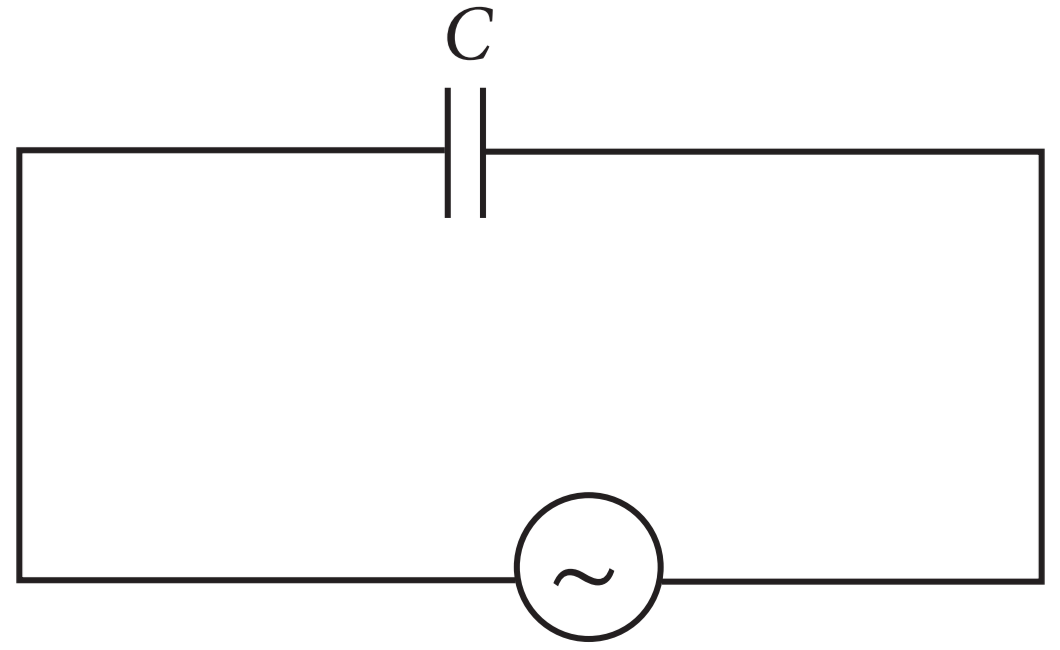
Let a source of alternating e.m.f. $\text{E} = \text{E}_\circ\sin\omega\text{t}$ be connected to a capacitor of capacitance C. If 'I' is the instantaneous value of current in the circuit at instant t, then $\text{I}=\frac{\text{E}_0}{\frac{1}{\omega\text{C}}}\sin\Big(\omega\text{t}+\frac{\pi}{2}\Big).$ The capacitive reactance limits the amplitude of current in a purely capacitive circuit and it is given by $\text{X}_\text{C}=\frac{1}{\omega\text{C}}.$
  1. What is the unit of capacitive reactance?
  1. Farad
  2. Ampere
  3. Ohm
  4. $Ohm^{-1}$
  1. The capacitive reactance of a $5\mu\text{F}$ capacitor for a frequency of $10^6Hz$ is:
  1. $0.032\Omega$
  2. $2.52\Omega$
  3. $1.25\Omega$
  4. $4.51\Omega$
  1. In a capacitive circuit, resistance to the flow of current is offered by:
  1. Resistor
  2. Capacitor
  3. Inducto
  4. Frequency
  1. In a capacitive circuit, by what value of phase angle does alternating current leads the e.m.f?
  1. $45^\circ$
  2. $90^\circ$
  3. $75^\circ$
  4. $60^\circ$
  1. One microfarad capacitor is joined to a 200V, 50Hz alternator. The rrns current through capacitor is:
  1. $6.28 \times 10^{-2}A$
  2. $7.5 \times 10^{-4}A$
  3. $10.52 \times 10^{-2}A$
  4. $15.25 \times 10^{-2}A$
A thick wire of $15 \Omega$ is stretched to three times its original length. Assuming that the density of the wire remains unchanged, calculate the resistance of the new wire.
An elevator is descending with uniform acceleration. To measure the acceleration, a person in the elevator drops a coin at the moment the elevator starts. The coin is 6ft above the floor of the elevator at the time it is dropped. The person observes that the coin strikes the floor in 1 second. Calculate from these data the acceleration of the elevator.
Suppose you are running fast in a field when you suddendly find a snake in front of you. You stop quickly. Which force is responsible for your deceleration?

The field of a hollow wire with constant current is homageneous.
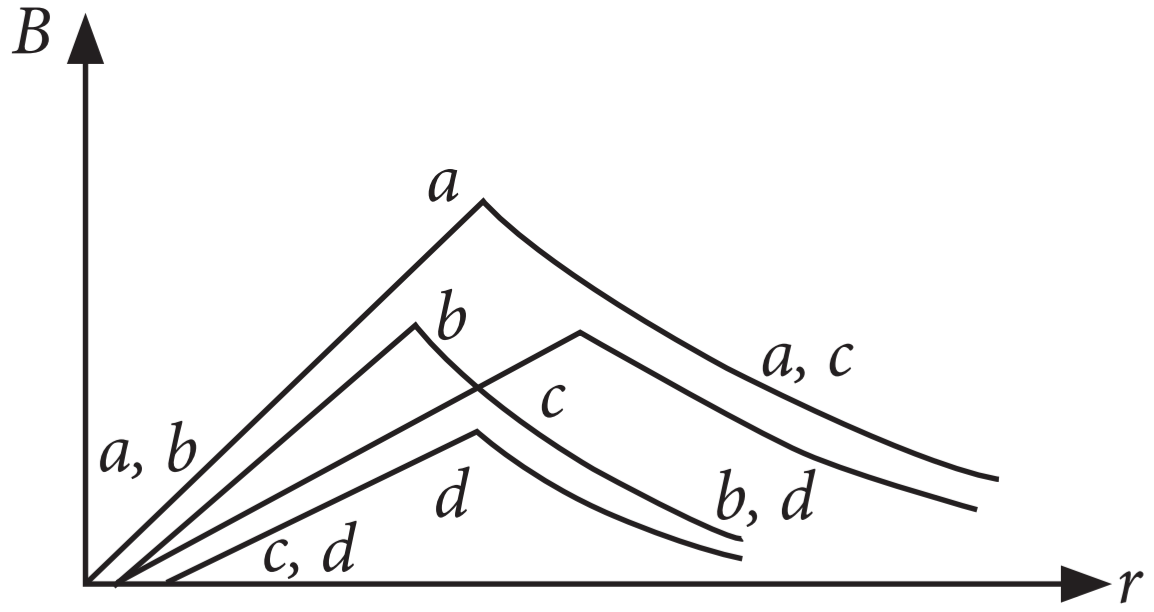
Curves in the graph shown give, as functions of radius distance r, the magnitude B of the magnetic field inside and outside four long wires a, b, c and d, carrying currents that are uniformly distributed across the cross sections of the wires. Overlapping portions of the plots are indicated by double labels.
  1. Which wire has the greatest magnitude of the magnetic field on the surface?
  1. a
  2. b
  3. c
  4. d
  1. The current density in a wire a is:
  1. Greater than in wire c.
  2. Less than in wire c.
  3. Equal to that in wire c.
  4. Not comparable to that of in wire c due to lack of information.
  1. Which wire has the greatest radius?
  1. a
  2. b
  3. c
  4. d
  1. A direct current I flows along the length of an infinitely long straight thin walled pipe, then the magnetic field is:
  1. Uniform throughout the pipe but not zero.
  2. Zero only along the axis of the pipe.
  3. Zero at any point inside the pipe.
  4. Maximum at the centre and minimum at the edges.
  1. In a coaxial, straight cable, the central conductor and the outer conductor carry equal currents in opposite direction. The magnetic field is zero.
  1. Outside the cable.
  2. Inside the inner conductor.
  3. Inside the outer conductor.
  4. In between the two conductor.
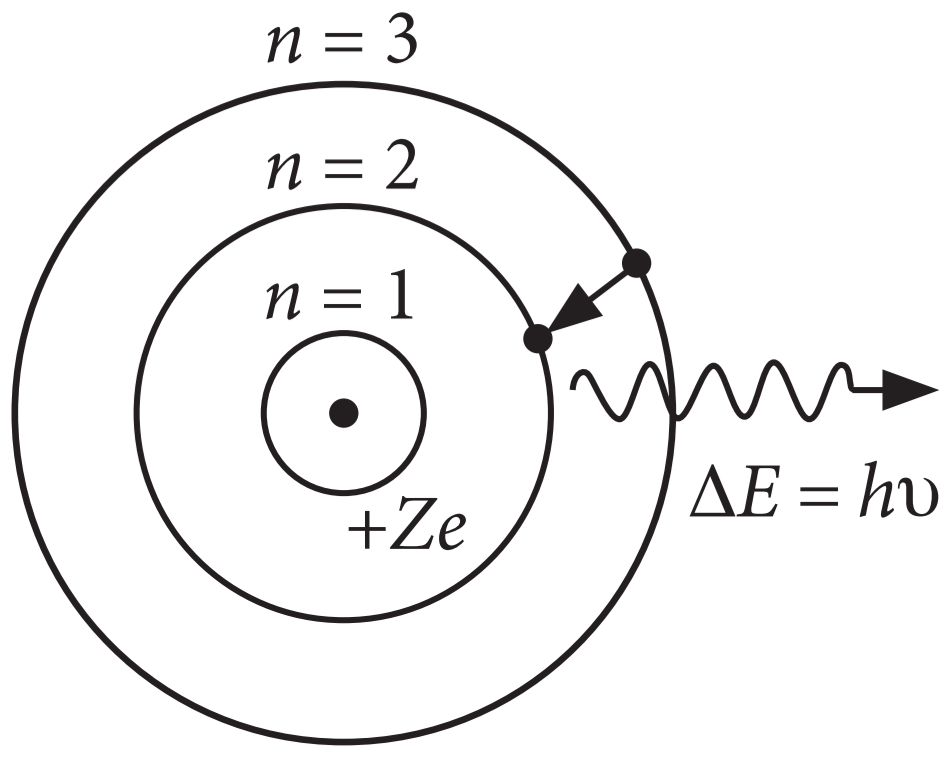
Niels Bohr introduced the atomic Hydrogen model in 1913. He described it as a positively charged nucleus, comprised of protons and neutrons, surrounded by a negatively charged electron cloud. In the model, electrons orbit the nucleus in atomic shells. The atom is held together by electrostatic forces between the positive nucleus and negative surroundings.

Bohr correctly proposed that the energy and radii of the orbits of electrons in atoms are quantized, with energy for transitions between orbits given by
$\triangle\text{E}=\text{h}\upsilon=\text{E}_\text{i}-\text{E}_\text{f}$ where $\triangle\text{E}$ is the change in energy between the initial and final orbits and $\text{h}\upsilon$ is the energy of an absorbed or emitted photon.
  1. In the Bohr model of the hydrogen atom, discrete radii and energy states result when an electron circles the atom in an integer number of
  1. De Broglie wavelengths
  2. Wave frequencies
  3. Quantum numbers
  4. Diffraction patterns.
  1. The angular speed of the electron in the $n^{th}$ orbit of Bohr's hydrogen atom is.
  1. Directly proportional to n
  2. Inversely proportional to $\sqrt{\text{n}}$
  3. Inversely proportional to $n^2$
  4. Inversely proportional to $n^3$
  1. When electron jumps from n = 4 level to n = 1 level, the angular momentum of electron changes by.
  1. $\frac{\text{h}}{2\pi}$
  2. $\frac{\text{h}}{\pi}$
  3. $\frac{\text{3h}}{2\pi}$
  4. $\frac{\text{2h}}{\pi}$
  1. The lowest Bohr orbit in hydrogen atom has.
  1. The maximum energy
  2. The least energy
  3. Infinite energy
  4. Zero energy
  1. Which of the following postulates of the Bohr model led to the quantization of energy of the hydrogen atom?
  1. The electron goes around the nucleus in circular orbits.
  2. The angular momentum of the electron can only be an integral multiple of $\frac{\text{h}}{2\pi}$.
  3. The magnitude of the linear momentum of the electron is quantized.
  4. Quantization of energy is itself a postulate of the Bohr model.
A wire is stretched to reduce its diameter to half. What will be the magnitude of its new resistance?