Which device can convert all electrical energy into heat
Easy
Download our app for free and get started

Download our appand get started for free
Experience the future of education. Simply download our apps or reach out to us for more information. Let's shape the future of learning together!No signup needed.*
Similar Questions
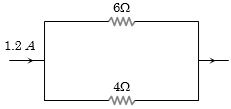
- 1In the figure given below, the current passing through $6\,\Omega $ resistor is ........... $ampere$View Solution
- 2Two wires of same metal have the same length but their cross-sections are in the ratio $3:1$. They are joined in series. The resistance of the thicker wire is $10\,\Omega $. The total resistance of the combination will be ............. $\Omega$View Solution
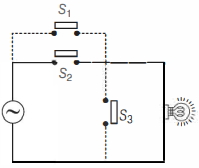
- 3View SolutionConsider the following circuit given below. The bulb will light up, if
- 4View SolutionConductivity increases in the order of
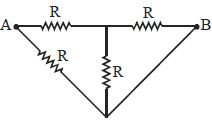
- 5Find equivalent resistance $A$ and $B$View Solution
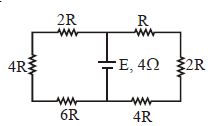
- 6A battery of internal resistance $4\,\Omega $ is connected to the network of the resistance as shown in Fig. If the maximum power can be delivered to the network, the magnitude of $R$ in $\Omega $ should beView Solution
- 7In a meter bridge, the balancing length from the left end (standard resistance of $1 \,ohm$ is in the right gap) is found to be $20\, cm$. The value of the unknown resistance is ............... $\Omega$View Solution
- 8View SolutionWhich of the following quantities do not change when a resistor connected to a battery is heated due to the current?
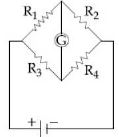
- 9The Wheatstone bridge shown in Fig. here, gets balanced when the carbon resistor used as $R_1$ has the colour code (Orange, Red, Brown). The resistors $R_2$ and $R_4$ are $80\, \Omega $ and $40\,\Omega $, respectively. Assuming that the colour code for the carbon resistors gives their accurate values, the colour code for the carbon resistor, used as $R_3$ would beView Solution
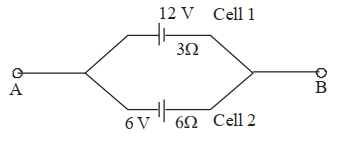
- 10Two cells are connected between points $A$ and $B$ as shown. Cell $1$ has emf of $12\,V$ and internal resistance of $3\,\Omega$. Cell $2$ has emf of $6\,V$ and internal resistance of $6\,\Omega$. An external resistor $R$ of $4\,\Omega$ is connected across $A$ and $B$. The current flowing through $R$ will be $.............A$.View Solution