Conductivity increases in the order of
Easy
Download our app for free and get started
(b) Siver is found in it's pure form from earth it is the best conductor among these elements followed by Copper and Aluminium, which are also good conductors. So, Aluminium comes first, then Copper and then Silver.

Download our appand get started for free
Experience the future of education. Simply download our apps or reach out to us for more information. Let's shape the future of learning together!No signup needed.*
Similar Questions
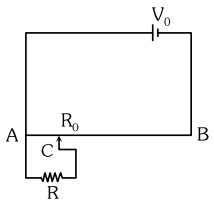
- 1The sliding contact $C$ is at one fourth of the length of the potentiometer wire $( AB )$ from $A$ as shown in the circuit diagram. If the resistance of the wire $AB$ is $R _0$, then the potential drop $( V )$ across the resistor $R$ isView Solution
- 2A cell of e.m.f. $E$ is connected with an external resistance $R$, then p.d. across cell is $V$. The internal resistance of cell will beView Solution
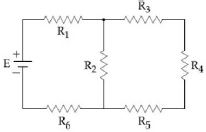
- 3In the figure shown, what is the current (in Ampere) drawn from the battery ? You are given $R_1 = 15\,\Omega $$,R _2 = 10\,\Omega ,$$ R_3 = 20\,\Omega ,$$ R_4 = 5\,\Omega ,$$R_5 = 25\,\Omega ,$$R_6 = 30\,\Omega , $$E = 15\,V$View Solution
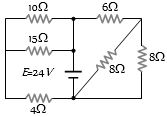
- 4Find the equivalent resistance across the terminals of source of $e.m.f$. $24\, V$ for the circuit shown in figure .............. $\Omega$View Solution
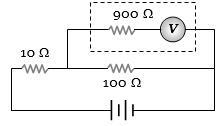
- 5The potential difference across the $100\,\Omega$ resistance in the following circuit is measured by a voltmeter of $900 \,\Omega$ resistance. The percentage error made in reading the potential difference isView Solution
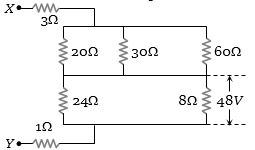
- 6The potential difference across $8\, ohm$ resistance is $48\, volt$ as shown in the figure. The value of potential difference across $X$ and $Y$ points will be ............. $volt$View Solution
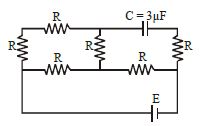
- 7In steady state the potential difference across the capacitor is $10\,\, V.$ Each resistance is of $3\,\Omega $. The cell is ideal. The $emf$ of the cell is .............. $\mathrm{V}$View Solution
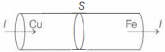
- 8Two rods of copper and iron with the same cross-sectional area are joined at $S$ and a steady current $I$ flows through the rods as shown in the figure. Choose the most appropriate representation of charges accumulated near the junction $S$.View Solution
- 9The current density in a cylindrical wire of radius $r=4.0 \,mm$ is $1.0 \times 10^{6} \,A / m ^{2}$. The current through the outer portion of the wire between radial distances $r / 2$ and $r$ is $x \pi A$; where $x$ is ..........View Solution
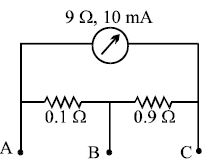
- 10A milliammeter of range $10\, mA$ and resistance $9\, \Omega$ is joined in a circuit as shown. The meter gives full-scale deflection for current $I$ when $A$ and $B$ are used as its terminals, i.e., current enters at $A$ and leaves at $B$ ($C$ is left isolated). The value of $I$ isView Solution