MCQ
Which is metalloid
  • A
    $Pb$
  • $Sb$
  • C
    $Bi$
  • D
    $Zn$

Answer

Correct option: B.
$Sb$
b
It’s Obvious

Need a full question paper?

Generate a complete, print-ready paper with questions like this in minutes — across 16+ boards, with answer keys.

Start Generating Free

Similar questions

In hydrogen atom, the de Broglie wavelength of an electron in the second Bohr orbit is $[$ Given that Bohr radius, $a_0 = 52.9 \;pm]$
$2 NOCl ( g ) \rightleftharpoons 2 NO ( g )+ Cl _{2}( g )$

In an experiment, $2.0$ $moles$ of $NOCl$ was placed in a one-litre flask and the concentration of NO after equilibrium established, was found to be $0.4$ $mol / L$. The equilibrium constant at $30^{\circ} C$ is $.......\times 10^{-4}$

The equivalent weight of ${K_2}C{r_2}{O_7}$ in acidic medium
Boric acid in solid, whereas $BF _3$ is gas at room temperature because of
The $IUPAC$ name of $\begin{matrix}
   HO-CH-COOH  \\
   |\,\,\,\,\,\,\,\,\,\,\,\,  \\
   HO-CH-COOH  \\
\end{matrix}$ is
The equilibrium constant for reaction $P _{4(s)}+5 O _{2(g)}$ $\rightleftharpoons P _4 O _{10(s)}$ is :
Consider the following statements

$(I)$ The radius of an anion is larger than that of the parent atom. 

$(II)$ The ionization energy generally increases with increasing atomic number  in a period.

$(III)$ The electronegativity of an element is the tendency of an isolated atom  to attract an electron.

Which of the above statements is/are correct?
A quantity of $PC{l_5}$ was heated in a $10$ litre vessel at ${250\,^o}C$; $PC{l_5}_{(g)}$ $\rightleftharpoons$ $PC{l_3}_{(g)} + C{l_2}_{(g)}$. At equilibrium the vessel contains $0.1$ $mole$ of $PC{l_5}\,0.20$ $mole$ of $PC{l_3}$ and $0.2$ $mole$ of $C{l_2}$. The equilibrium constant of the reaction is
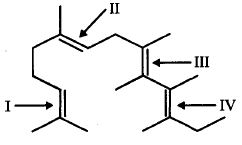
In the following structure, the double bonds are marked as $I, II, III$ and $IV$ Geometrical isomerism is not possible at site $(s)$
The addition of small amounts of either acid or base to a buffer solution causes only small  changes in $pH$ because the buffer solution