MCQ
Which of following can induce the maximum induced voltage?
- A1 amp dc.
- B1 amp 1 Hz.
- C1 amp 100 Hz.
- D20 amp dc.
Explanation:
If we apply a high-frequency supply of the same peak voltage to the coil, the current still is being delayed by 90o but the time it requires to reach its maximum value has been reduced due to the increase in frequency. Because the frequency is inversely proportional to time (T). Hence, the rate of change of the flux within the coil has also increased due to the increase in frequency. Hence, the induced EMF is maximum in case of 1 amp 100 Hz supply source in the coil.
Generate a complete, print-ready paper with questions like this in minutes — across 16+ boards, with answer keys.
In semiconductors at a room temperature
|
(a) The valence band is partially empty and the conduction band is partially filled |
|
(b) The valence band is completely filled and the conduction band is partially filled |
|
(c) The valence band is completely filled |
|
(d) The conduction band is completely empty |
Assertion : X-ray travel with the speed of light.
Reason : X-rays are electromagnetic rays.
|
(a) If both assertion and reason are true and the reason is the correct explanation of the assertion. |
|
(b) If both assertion and reason are true but reason is not the correct explanation of the assertion. |
|
(c) If assertion is true but reason is false. |
|
(d) If the assertion and reason both are false. |
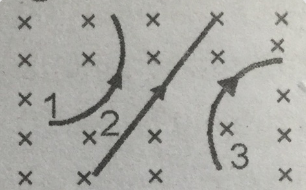
Consider the following two statements A and B, and identify the correct choice out of given answers
A. Thermo e.m.f. is minimum at neutral temperature of a thermocouple
B. When two junctions made of two different metallic wires are maintained at different temperatures, an electric current is generated in the circuit.
|
(a) A is false and B is true |
(b) A is true and B is false |
|
(c) Both A and B are false |
(d) Both A and B are true |
Consider the circuits shown in the figure. Both the circuits are taking same current from battery but current through R in the second circuit is  th of current through R in the first circuit. If R is 11 W, the value of R1

|
(a) 9.9 W |
(b) 11 W |
(c) 8.8 W |
(d) 7.7 W |
Assertion : The air bubble shines in water.
Reason : Air bubble in water shines due to refraction of light
|
(a) If both assertion and reason are true and the reason is the correct explanation of the assertion. |
|
(b) If both assertion and reason are true but reason is not the correct explanation of the assertion. |
|
(c) If assertion is true but reason is false. |
|
(d) If the assertion and reason both are false. |
$\omega\propto\frac{1}{\text{r}}$
$\omega\propto\text{r}$
$\omega=0$
$\omega$ is independent of r.