MCQ
Which of the following cannot be polarized?
- AUltraviolet rays
- BUltrasonic waves
- CX-rays
- DRadiowaves
Explanation:
All the longitudinal waves like sound etc cannot be polarized because the motion of the particles is already in one dimension that is the direction of propagation of wave.
Thus all the transverse waves like electromagnetic waves can be polarized.
Thus, (B) Ultrasonic waves being sound waves having frequency greater than 20kHz but being longitudinal in nature cannot be polarized
Generate a complete, print-ready paper with questions like this in minutes — across 16+ boards, with answer keys.
In the circuit shown in figure, the heat produced in 5 ohm resistance is 10 calories per second. The heat produced in 4 resistance is
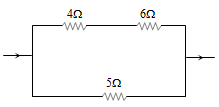
|
(a) 1 cal / sec |
(b) 2 cal/sec |
(c) 3 cal / sec |
(d) 4 cal/sec |
Three long, straight parallel wires carrying current, are arranged as shown in figure. The force experienced by a 25 cm length of wire C is

|
(a) 10-3 N |
(b) 2.5 ×10⁻³ N |
(c) Zero |
(d) 1.5 × 10⁻³ N |
A galvanometer can be converted into an ammeter by connecting
|
(a) Low resistance in series |
(b) High resistance in parallel |
|
(c) Low resistance in parallel |
(d) High resistance in series |
An infinite number of charges, each of charge 1 mC, are placed on the x-axis with co-ordinates x = 1, 2, 4, 8, ....¥. If a charge of 1 C is kept at the origin, then what is the net force acting on 1 C charge
|
(a) 9000 N |
(b) 12000 N |
(c) 24000 N |
(d) 36000 N |
The energy released in a typical nuclear fusion reaction is approximately
|
(a) 25 MeV |
(b) 200 MeV |
(c) 800 MeV |
(d) 1050 MeV |