MCQ
Which of the following effects could not be explained by Maxwell's electromagnetic wave theory?
  • A
    Photoelectric effect
  • B
    Compton effect
  • C
    Raman effect
  • D
    All of these

Answer

  1. All of these

Explanation:

  1. Photoelectric effect was discovered by heinrich Rudoy Hertz.
  2. Compton effect was discovered by Aethur Holl Compton.
  3. Raman effect was discovered by Sir Chandrasekhar Venbata Ram. 

So, none of these effect was discovered by Maxwell.

Need a full question paper?

Generate a complete, print-ready paper with questions like this in minutes — across 16+ boards, with answer keys.

Start Generating Free

Similar questions

If the distance between a point source and screen is doubled, then intensity of light on the screen will become

(a) Four times

(b) Double

(c) Half    

(d) One-fourth

The power of a person's spectacle lenses is +2 D . He is suffering from which of the following defects?
Identify the quantity which changes when a charged particle moves through a magnetic field?
Why are alkali metals most suited as photo-sensitive metals?
Charge $+Q$ is placed at the centre of a circular path of radius $r$. The work done to bring charge $+q$ from one end of the diameter to other end of the circular path in the electric field produced by charge + Q is ___________ .
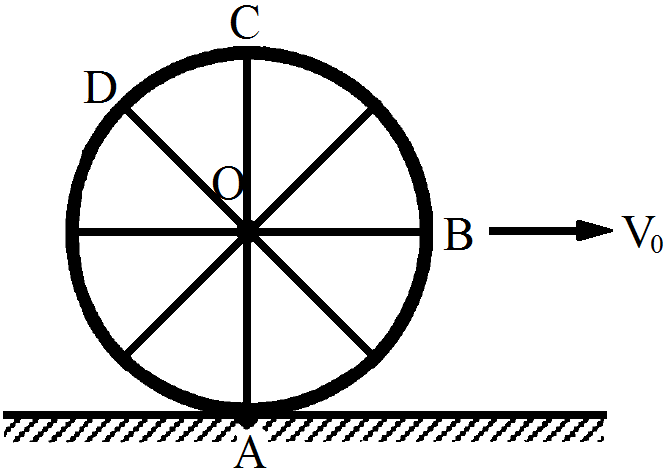
Consider a wheel of a bicycle rolling on a level road at a linear speed v0:

  1. The speed of the particle A is zero.
  2. The speed of B, C and D are all equal to v0.
  3. The speed of C is 2v0.
  4. The speed of B is greater than the speed of O.

When a current passes through a wire whose different parts are maintained at different temperatures, evolution or absorption of heat all along the length of wire is known as

(a) Joule effect

(b) Seebeck effect

(c) Peltier effect

(d) Thomson effect

An electron with kinetic energy 5eV is incident on a hydrogen atom in its ground state. The collision:
  1. Must be elastic.
  2. May be partially elastic.
  3. Must be completely inelastic.
  4. May be completely inelastic.

Given a point source of light, which of the following can produce a parallel beam of light

(a) Convex mirror

(b) Concave mirror

(c) Concave lens

(d) Two plane mirrors inclined at an angle of 90°

A charge q  is placed at the centre of the open end of cylindrical vessel. The flux of the electric field through the surface of the vessel is

(a) Zero

(b)  

(c)  

(d)