MCQ
Which of the following is paramagnetic
  • $N{i^{ + 2 }}$
  • B
    $C{u^ + }$
  • C
    $Z{n^{ + 2 }}$
  • D
    $S{c^{ + 3 }}$

Answer

Correct option: A.
$N{i^{ + 2 }}$
a
(a) Elements or ions containing unpaired electrons are paramagnetic.

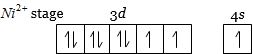
$_{28}Ni = [Ar]\;3{d^8}4s_2^{}$ ; $N{i^{2 + }} = [Ar]\;3{d^8}4{s^0}$

Because $N{i^{2 + }}$ have $2$  unpaired electrons in $3d$  subshell therefore it is paramagnetic.
Need a full question paper?

Generate a complete, print-ready paper with questions like this in minutes — across 16+ boards, with answer keys.
Start Generating Free

Similar questions

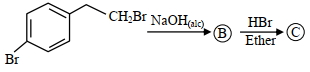
Identify ($B$) and ($C$) and how are ($A$) and ($C$) related ?
The limiting molar conductivity $\mathop \Lambda \limits^o $ for $NaCl, KBr$ and $KCl$ are $126, 152$ and $150 \,S\,cm^2  \,mol^{-1}$ respectively. The $\mathop \Lambda \limits^o $ for $NaBr$ is (in $S\, cm^2\, mol^{-1}$).
Formula of ferric sulphate is
Which of the following is not a correct statement for primary aliphatic amines?
For the reaction between $A$ and $B$ , the initial rate of reaction $(r_0)$ was measured for different initial concentration of $A$ and $B$ as given below Order of the reaction with respect to $A$ and $B$ respectively, is $\sqrt 2  = 1.4 ,\,\sqrt 3  \times 10^{-4}$ 
$A/mol\,L^{-1}$ $0.2$ $0.2$ $0.4$
$B/mol\,L^{-1}$ $0.3$ $0.1$ $0.05$
$r_0/mol^{-1}s^{-1}$ $5.0\times 10^{-5}$ $5.0\times 10^{-5}$ $1.4\times 10^{-4}$
Which of the following is the correct order of increasing field strength of ligands to form coordination compounds?
Consider the cell $Pt|H_2(P_1\ atm) | H^+(X_1M) || H^+ (X_2M) | H_2(P_2\ atm) |Pt.$ The cell reaction will be spontaneous if 
Correct order of electrophilic substitution reaction is :
The highest oxidation state of $Cr$ will be
Consider the following reactant sample

$(I)$ $1\,mol$ of $A$ and $2\,mol$ of $B$ in a $1\,L$ vessel

$(II)$  $2\,mol$ of $A$ and $2\,mol$ of $B$ in a $2\,L$ vessel

$(III)$ $0.2\,mol\, A$ and $0.2\,mol\,B$ in $0.1\,L$ vessel

Which reactant sample reacts by highest rate if reactant is in gaseous state and do not follow zero order reaction ?