MCQ
Which of the following is true for electrolytic refining?
  • A
    Pure metal is used at anode and impure metal at cathode.
  • B
    Pure metal is used at cathode and impure metal at anode.
  • C
    Both can be possible A and B.
  • D
    None of these.

Answer

  1. Pure metal is used at cathode and impure metal at anode.

Explanation:

Impure metal will release electron hence form anode electrode and pure metal will absorb electron hence it will be posses as cathode electrode. Pure metal is used as the cathode and impure metal as anode.

Need a full question paper?

Generate a complete, print-ready paper with questions like this in minutes — across 16+ boards, with answer keys.
Start Generating Free

Similar questions

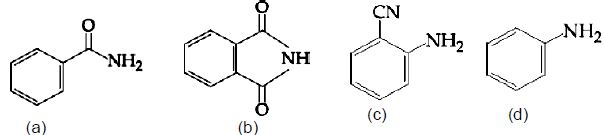
The increasing order of reactivity of the following compounds towards reaction with alkyl halide directly is
A compound $X$  with molecular formula ${C_3}{H_8}O$ can be oxidised to a compound $Y$  with the molecular formula ${C_3}{H_6}{O_2}$  $X$  is most likely to be
Which of the following gives correct arrangement of compounds involved based on their bond strength
Match the following aspects with the respective metal.

Aspects Metal
$(a)$ The metal which reveals a maximum number of oxidation states $(i)$ Scandium
$(b)$ The metal although placed in $3 d$ block is considered not as a transition element $(ii)$ Copper
$(c)$ The metal which does not exhibit variable oxidation states $(iii)$ Manganese
$(d)$ The metal which in $+1$ oxidation state in aqueous solution undergoes disproportionation $(iv)$ Zinc

Select the correct option

If the conductivity of mercury at $0^{\circ} \,\mathrm{C}$ is $1.07 \times 10^{6}$ $\mathrm{S} \,\mathrm{m}^{-1}$ and the resistance of a cell containing mercury is $0.243\, \Omega$, then the cell constant of the cell is $\mathrm{x} \times 10^{4} \,\mathrm{~m}^{-1}$. The value of $\mathrm{x}$ is ...... .(Nearest integer)
Which is the correct sequence in the following, poperties? For the correct order mark $(T)$ and for the incorrect order mark $(F)$

$(a)$ Lewis acidity order : $SiF_4 < SiC_{4} < SiBr_4 < Sil_4$

$(b)$ Melting point : $NH_3 > SbH_3 > AsH_3 > PH_3$

$(c)$ Boiling point : $NH_3 > SbH_3 > AsH_3 > PH_3$

$(d)$ Dipole moment order : $NH_3 > SbH_3 > AsH_3 > PH_3$

In the presence of a catalyst, the heat evolved or absorbed during the reaction _______________
Which of the following has the maximum value of pkb​?
The charcoal maintained at ${100^o}\,C$ absorbs
The equivalent conductance of benzoic acid is $12.8\, ohm^{-1}\,cm^2\,eq^{-1}$. If conductance of benzoate ion and $H^+$ ion at infinite dilution is $42$ and $288.42\, ohm^{-1}\, cm^2$ respectively. Its degree of dissociation is ............. $\%$