MCQ
Which of the following processes is reversible
  • A
    Transfer of heat by radiation
  • B
    Electrical heating of a nichrome wire
  • C
    Transfer of heat by conduction
  • Isothermal compression

Answer

Correct option: D.
Isothermal compression
d
(d) Slow isothermal expansion or compression of an ideal gas is reversible process, while the other given process are irreversible in nature.
 

Need a full question paper?

Generate a complete, print-ready paper with questions like this in minutes — across 16+ boards, with answer keys.
Start Generating Free

Similar questions

For which combination of working temperatures the efficiency of Carnot’s engine is highest
Doppler's effect holds good for:
A solid cube of side $l$ is made to oscillate about a horizontal axis passing through one of its edges. Its time period will be
Which one of the following substances possesses the highest elasticity
A ball is thrown vertically upwards. Which of the following plots represents the speed-time graph of the ball during its height if the air resistance is not ignored
$A$ small object is attached to a light string which passes through a hollow tube. The tube is held by one hand and the string by the other. The object is stet into rotation in a circle of radius $r_1$. The string is then pulled down, shortening the radius of the circle to $r_2$. The ratio of the new kinetic energy to original kinetic energy is
A car is moving at a speed of $40\,m/s$ on a circular track of radius $400\,m.$ This speed is increasing at the rate of $3\,m/s^2.$ The acceleration of car is  ........ $m/s^2$
An ideal gas filled in a cylinder occupies volume $V$. The gas is compressed isothermally to the volume $V/3$. Now, the cylinder valve is opened and the gas is allowed to leak keeping temperature same. What percentage of the number of molecules should escape to bring the pressure in the cylinder back to its original value?
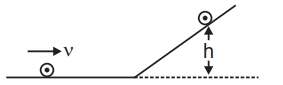
A disc of radius $R$ and mass $M$ is rolling horizontally without slipping with speed $v$. It then moves up an inclined smooth surface as shown in figure. The maximum height that the disc can go up the incline is:
A particle undergoes uniform circular motion. About which point in the plane of the circle, will the angular momentum of the particle remain conserved?