MCQ
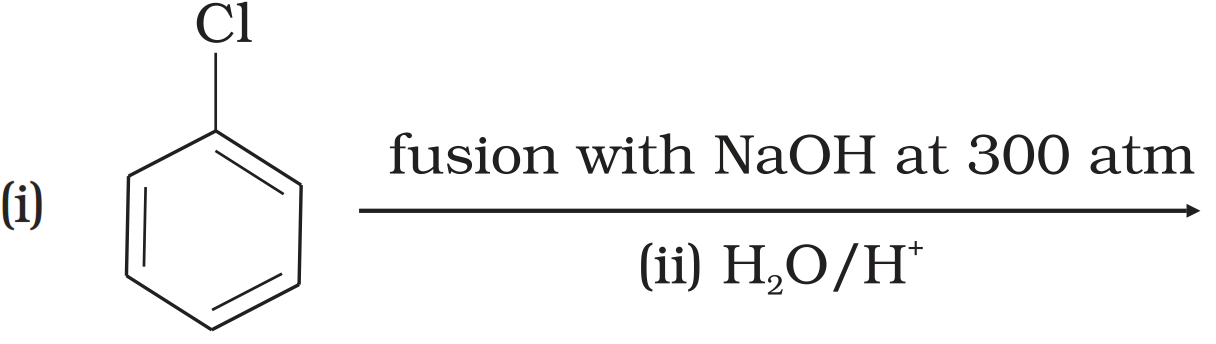
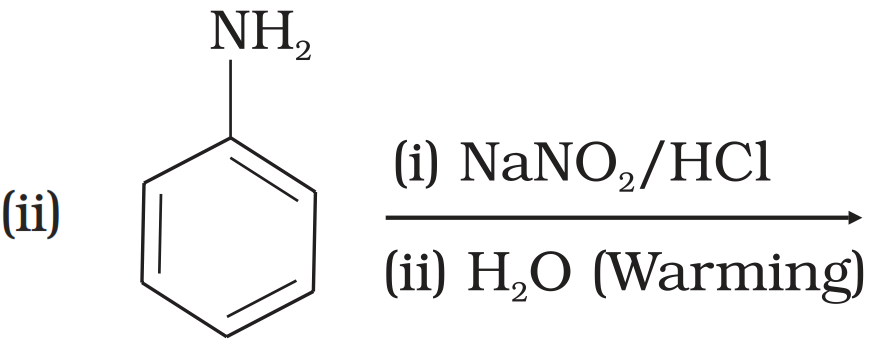
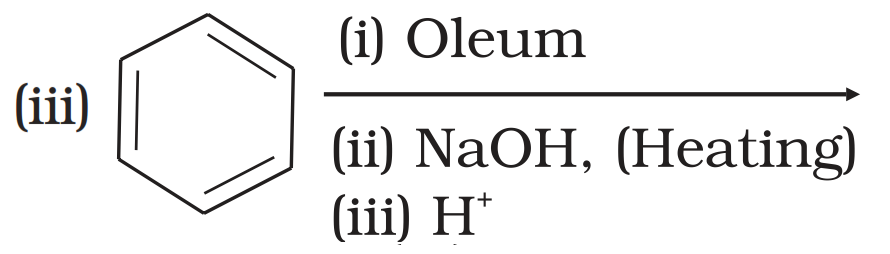
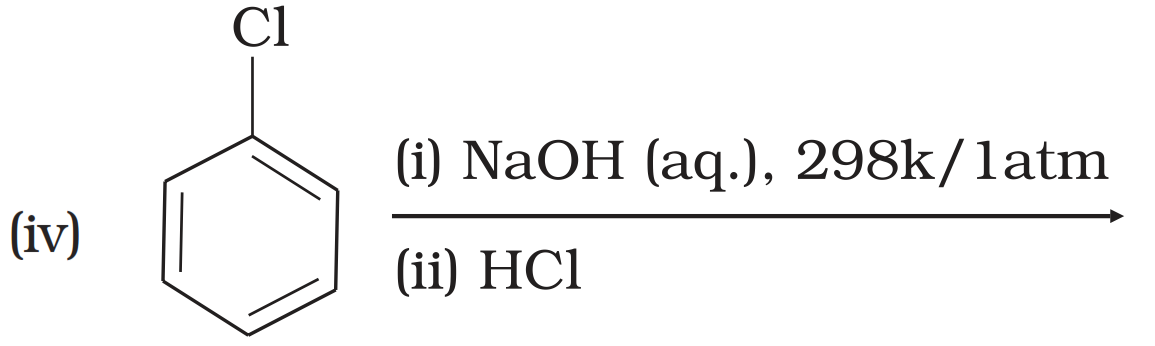
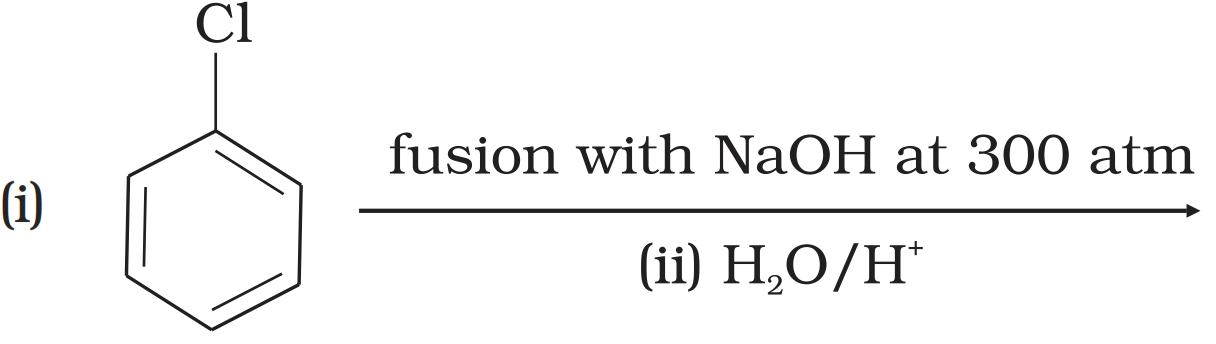
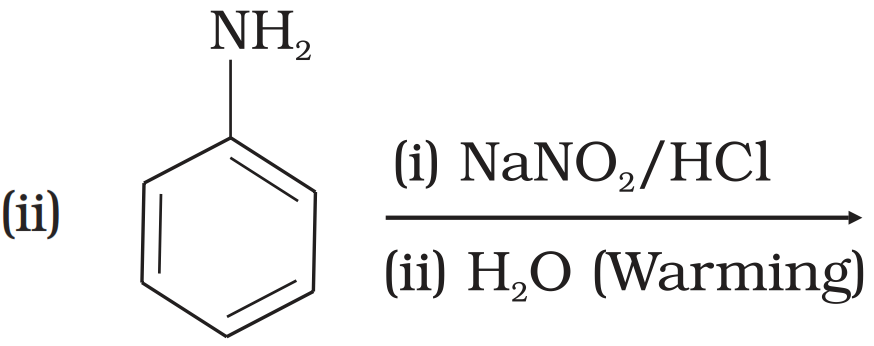
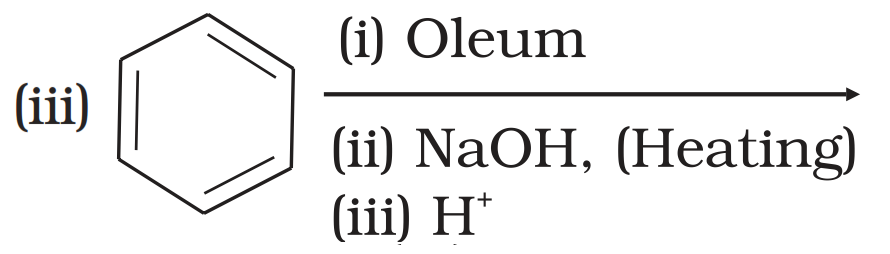
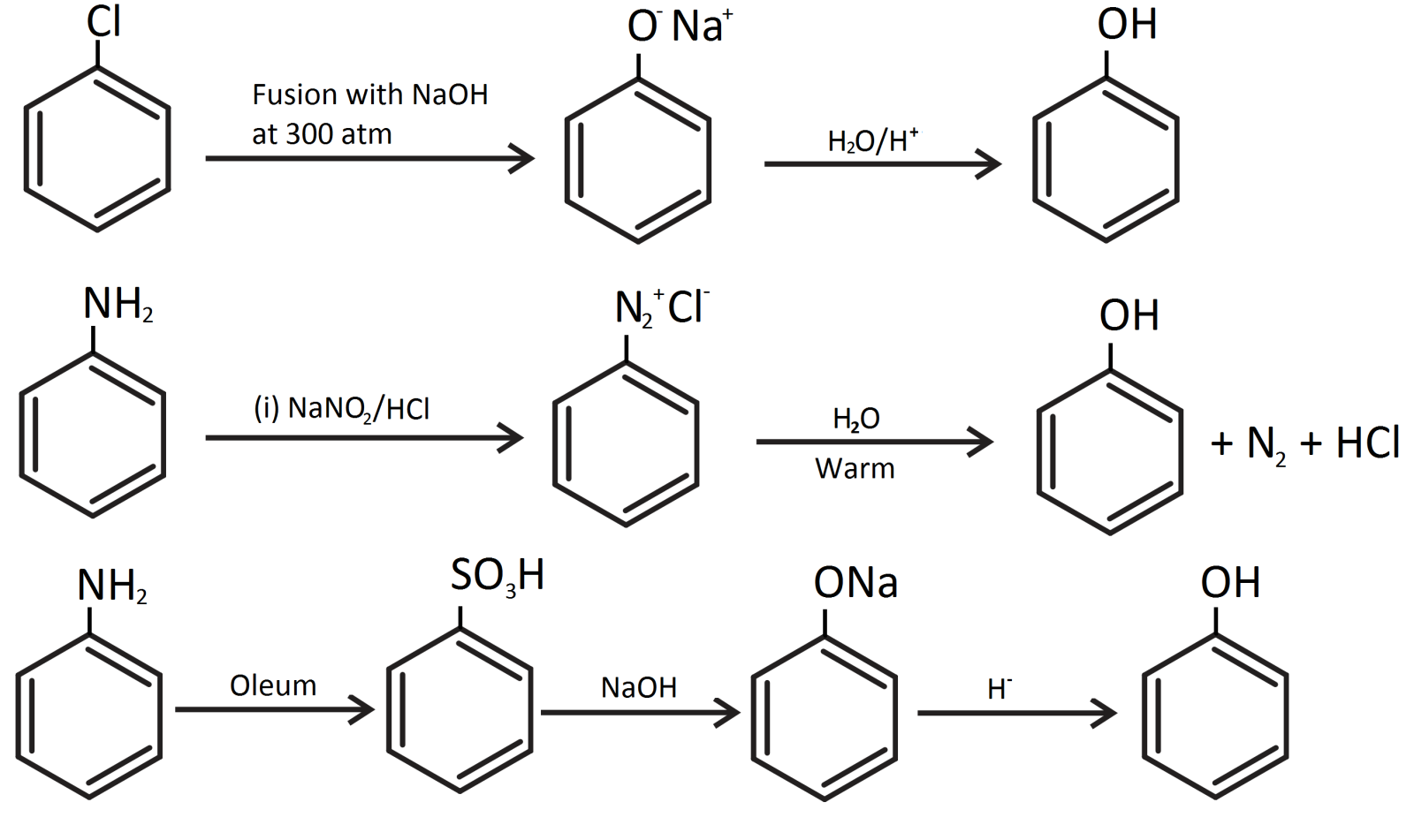
Which of the following reactions will yield phenol?
  • A
  • B
  • C
  • D

Answer


Explanation:

Need a full question paper?

Generate a complete, print-ready paper with questions like this in minutes — across 16+ boards, with answer keys.

Start Generating Free

Similar questions

Which of the following are secondary bromides?
Which of the following aqueous solution will result maximum number of moles of metal deposited on passing same charge ?
Primary amines can be distinguished from secondary and tertiary amines by reacting with
$p$-Amino- $N, N$-dimethylaniline is added to a strongly acidic solution of ${X}$. The resulting solution is treated with a few drops of aqueous solution of ${Y}$ to yield blue coloration due to the formation of methylene blue. Treatment of the aqueous solution of ${Y}$ with the reagent potassium hexacyanoferrate$(II)$ leads to the formation of an intense blue precipitate. The precipitate dissolves on excess addition of the reagent. Similarly, treatment of the solution of ${Y}$ with the solution of potassium hexacyanoferrate$(III)$ leads to a brown coloration due to the formation of ${Z}$.

$1.$ The compound ${X}$ is

$(A)$ $\mathrm{NaNO}_3$ $(B)$ $\mathrm{NaCl}$ $(C)$ $\mathrm{Na}_2 \mathrm{SO}_4$ $(D)$ $\mathrm{Na}_2 \mathrm{~S}$

$2.$ The compound ${Y}$ is

$(A)$ $\mathrm{MgCl}_2$ $(B)$ $\mathrm{FeCl}_2$ $(C)$ $\mathrm{FeCl}_3$ $(D)$ $\mathrm{ZnCl}_2$

$3.$ The compound ${Z}$ is

$(A)$ $\left.\mathrm{Mg}_2 \mid \mathrm{Fe}(\mathrm{CN})_6\right]$ $(B)$ $\operatorname{Fe}\left[\mathrm{Fe}(\mathrm{CN})_6\right]$

$(C)$ $\mathrm{Fe}_4\left[\mathrm{Fe}(\mathrm{CN})_6\right]_3$ $(D)$ $\mathrm{K}_2 \mathrm{Zn}_3\left[\mathrm{Fe}(\mathrm{CN})_6\right]_2$

Give the answer question $1,2$ and $3.$

${\lambda _{ClC{H_2}COONa}} = 224\;oh{m^{ - 1}}\,c{m^2}\,gme{q^{ - 1}}$,

${\lambda _{NaCl}} = 38.2\;oh{m^{ - 1}}\,c{m^2}\,gme{q^{ - 1}}$,

${\lambda _{HCl}} = 203\;oh{m^{ - 1}}\,c{m^2}\,gme{q^{ - 1}}$,

What is the value of ${\lambda _{ClC{H_2}COOH}}$ .............. ${\rm{Oh}}{{\rm{m}}^{ - 1}}{\mkern 1mu} {\rm{c}}{{\rm{m}}^2}{\rm{gm}}\,{\rm{e}}{{\rm{q}}^{ - 1}}$

Which of the following types of metals forms the most efficient catalysts:
Which of the following statements is correct regarding case of dehydration in alcohols
In the reactions given below,

$R-Cl\xrightarrow{(i)\,\,KCN,(ii)\,LiAl{{H}_{4}}} $   Product  $A$

$R-Cl\xrightarrow{(i)\,\,AgCN,(ii)\,LiAl{{H}_{4}}} $  Product  $B $

the compounds $A$ and $B$ are

The standard electrode potential for the following reaction is $+1.33\,V.$  What is the potential at $pH = 2.0$ ............ $\mathrm{V}$

$Cr_2O_7^{2-}$ ( $aq$  $1\,M$ ) $+ 14H^+(aq) + 6e^-$ $\rightarrow 2Cr^{+3} (aq,\,1\,M) + 7H_2O (l)$

In a solution of $7.8\,gm$ benzene ${C_6}{H_6}$ and $46.0\,gm$ toluene $({C_6}{H_5}C{H_3})$, the mole fraction of benzene in this solution is