MCQ
Which of the following statements is incorrect?
  • A
    Most of the collisions on the macroscopic scale are inelastic collisions.
  • In a perfectly inelastic collision, there is complete loss of $KE$
  • C
    Forces involved in an elastic collision are conservative in nature
  • D
    Oblique collision is that collision in which the colliding bodies do not move along the same straight line path
Answer

Correct option: B.
In a perfectly inelastic collision, there is complete loss of $KE$
b
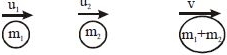
In perfectly inelastic collision both bodies will

more with same velocity

$\mathrm{m}_{1} \mathrm{u}_{1}+\mathrm{m}_{2} \mathrm{u}_{2}=\left(\mathrm{m}_{1}+\mathrm{m}_{2}\right) \mathrm{v}$

final $KE$ has some value because of velocity

Option $(2)$ is wrong

Need a full question paper?

Generate a complete, print-ready paper with questions like this in minutes — across 16+ boards, with answer keys.

Start Generating Free

Similar questions

According to kinetic theory of gases,

$A$. The motion of the gas molecules freezes at $0^{\circ} C$

$B$. The mean free path of gas molecules decreases if the density of molecules is increased.

$C$. The mean free path of gas molecules increases if temperature is increased keeping pressure constant.

$D$. Average kinetic energy per molecule per degree of freedom is $\frac{3}{2} k_{B} T$ (for monoatomic gases)

Choose the most appropriate answer from the options given below

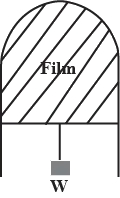
A thin liquid film formed between a U-shaped wire and a light slider supports a weight of $1.5 \times 10^{-2} \;N$ (see figure). The length of the slider is $30 \;cm$ and its weight negligible. The surface tension of the liquid film is
What is the maximum number of rectangular components into which a vector can be split in space?
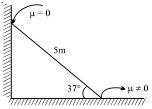
$A\, 5\, m$ long pole of $3\, kg$ mass is placed against a smooth vertical well as shown in the figure. Under equilibrium condition, if the pole makes an angle of $37^o$ with the horizontal, the frictional force between the pole and horizontal surface is
The specific heat of a gas in a polytropic process is given by
Can the resultant of $2$ vectors be zero
The acceleration of moon with respect to earth is 0⋅0027ms-2 and the acceleration of an apple falling on earth's surface is about 10ms-2. Assume that the radius of the moon is one fourth of the earth's radius. If the moon is stopped for an instant and then released, it will fall towards the earth. The initial acceleration of the moon towards the earth will be:
  1. 10ms-2
  2. 0.0027ms-2
  3. 6.4ms-2
  4. 5.0ms-2
The ends of a stretched wire of length $L$ are fixed at $x = 0$ and $x = L.$ In one experiment, the displacement of the wire is ${y_1} = A\sin (\pi x/L)\sin \omega t$ and energy is ${E_1}$, and in another experiment its displacement is ${y_2} = A\sin (2\pi x/L)\sin 2\omega t$ and energy is ${E_2}$. Then
An engineer claims to have made an engine delivering $10 kW$ power with fuel consumption of $1\,g\,{s^{ - 1}}$. The calorific value of fuel is $2k cal/g$. His claim
Consider one mole of helium gas enclosed in a container at initial pressure $P_1$ and volume $V_1$. It expands isothermally to volume $4 V_1$. After this, the gas expands adiabatically and its volume becomes $32 V_1$. The work done by the gas during isothermal and adiabatic expansion processes are $W_{\text {iso }}$ and $W_{\text {adia, }}$ respectively. If the ratio $\frac{W_{\text {iso }}}{W_{\text {adia }}}=f \ln 2$, then $f$ is. . . . . . . .