MCQ
Which relation is correct for isometric process
  • $\Delta Q = \Delta U$
  • B
    $\Delta W = \Delta U$
  • C
    $\Delta Q = \Delta W$
  • D
    None of these

Answer

Correct option: A.
$\Delta Q = \Delta U$
a
(a)For isochoric process $\Delta V = 0==>\Delta W = 0$
From FLOT $\Delta Q = \Delta U + \Delta W$ ==>$\Delta Q = \Delta U$

Need a full question paper?

Generate a complete, print-ready paper with questions like this in minutes — across 16+ boards, with answer keys.
Start Generating Free

Similar questions

A gas mixture consists of $8$ moles of argon and $6$ moles of oxygen at temperature $T$. Neglecting all vibrational modes, the total internal energy of the system is
When a train stops suddenly, passengers in the running train feel an instant jerk in the forward direction because
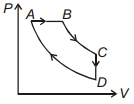
For $P-V$ diagram of a thermodynamic cycle as shown in figure, process $B C$ and $D A$ are isothermal. Which of the corresponding graphs is correct?
A satellite S is moving in an elliptical orbit around the earth. The mass of the satellite is very small compared to the mass of the earth.
A body is at rest under the action of three forces, two of which are ${\vec F_1} = 4\hat i,\,{\vec F_2} = 6\hat j,$ the third force is
The work per unit volume to stretch the length by $1\%$ of a wire with cross sectional area of $1\,m{m^2}$ will be. $[Y = 9 \times {10^{11}}\,N/{m^2}]$
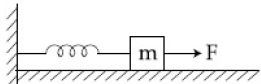
A block of mass $m$, lying on a smooth horizontal surface, is attached to a spring (of negligible mass) of spring constant $k$. The other end of the spring is fixed, as shown in the figure. The block is initially at rest in a equilibrium position. If now the block is pulled with a constant force $F$, the maximum speed of the block is
Two masses of 1gm and of 4gm are moving with equal linear momenta. The ratio of their kinetic energies is:
A lead bullet at $27°C$ just melts when stopped by an obstacle. Assuming that $25\%$ of heat is absorbed by the obstacle, then the velocity of the bullet at the time of striking........ $m/sec$  ($M.P.$ of lead $= 327°C,$ specific heat of lead $= 0.03\, cal/gm°C,$ latent heat of fusion of lead $= 6\, cal/gm$ and $J = 4.2\, joule/cal)$
Two bodies are thrown simultaneously from a tower with same initial velocity ${v_0}:$ one vertically upwards, the other vertically downwards. The distance between the two bodies after time $t$ is