MCQ
Which resistor is difficult to make of having a value less than about $2 \ Ohms?$
  • A
    Iron Resistor
  • Carbon Resistor
  • C
    Wire wound Resistor
  • D
    Both $b$ and $c$

Answer

Correct option: B.
Carbon Resistor

Carbon resistor is difficult to make of having a value less than about $20 \ Ohms$ because they have ability to withstand high energy pulses, when current flow through the carbon composition body conducts the energy. So carbon resistor can be made with a higher resistance.

Need a full question paper?

Generate a complete, print-ready paper with questions like this in minutes — across 16+ boards, with answer keys.
Start Generating Free

Similar questions

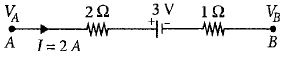
The potential difference $(V_A - V_B)$ between the points $A$ and $B$ in the given figure is ............ $V$
The binding energy of the innermost electron in tungsten is $40 keV$. the energy of the characteristic $X-$ rays given out is
The electric potential V at any point O (x, y, z all in metres) in space is given by $\mathrm{V}=4 \mathrm{x}^2$ volt. The electric field at the point (1m,0, 2m) in volt/metre is
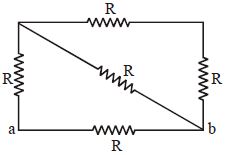
Find out the equivalent resistance between the points $a$ and $b$
An electron passing through a potential difference of 4.9 V collides with a mercury atom and transfers it to the first excited state. What is the wavelength of a photon corresponding to the transition of the mercury atom to its normal state
When the separation between two charges is increased the electric potential energy of the charges.
The coefficient of mutual inductance between two coils depends on.
The voltage V and current I graph for a conductor at two different temperatures $\mathrm T_1$ and $\mathrm T_2$ are shown in the figure. The relation between $\mathrm T_1$ and $\mathrm T_2$ is
Two thin lenses, when in contact, produce a combination of power $+ 10\, D$. When they are $0.25\, m$ apart, the power reduces to $+ 6D$. The focal lengths of the lenses (in $m$) are
A heavy ring of mass $m$ is clamped on the periphery of al light circular disc. A small particle having equal mass is clamped at the centre of the disc. The system is rotated in such a way that the centre moves in a circle of radius $r$ with a uniform speed $v$. We conclude that an external force: