Question
Why is the interference pattern not detected, when two coherent sources are far apart?

Answer

Fringe width of interference fringes, is given by $\beta=\frac{\text{D}\lambda}{\text{d}}\alpha\frac{1}{\text{d}},$.If the sources are far apart; d is large; so fringe width $(\beta)$ will be so small that the fringes are not resolved and they do not appear separate. That is why the interference pattern is not detected for large separation of coherent sources.

Need a full question paper?

Generate a complete, print-ready paper with questions like this in minutes — across 16+ boards, with answer keys.
Start Generating Free

Similar questions

What is electromagnetic wave? How is its speed is related with permittivity and permeability of the medium?
Several capacitors of capacitance $C$ are connected in infinite number as shown in the figure. Find the value of total capacitance between points $A$ and $B$.
Find the intensity at a point on a screen in Young’s double slit experiment where the interfering waves of equal intensity have a path difference of (i) $\lambda/4$, and (ii) $\lambda/3$.
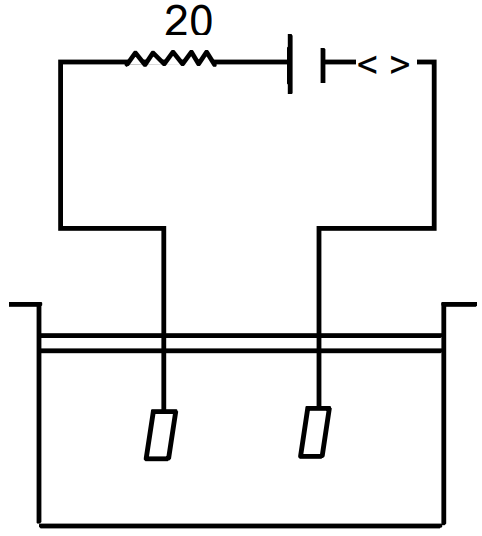
Figure shows an electrolyte of AgCl through which a current is passed. It is observed that 2.68g of silver is deposited in 10 minutes on the cathode. Find the heat developed in the $20\Omega$ resistor during this period. Atomic weight of silver is 107.9g/mole.

What is self induction ? Obtain expression for self induced emf.
State four properties of electro magnetic waves.
Consider two different hydrogen atoms. The electron in each atom is in an excited state. Is it possible for the electrons to have different energies but the same orbital angular momentum according to the Bohr model?
Draw the series L-C-R AC circuit and obtain the relationship between voltage and current for this circuit. (Derive the necessary equations.)
Explaination of experimental results of photoelectric effect with Einstein's equation.
A plate of thickness t made of a material of refractive index $\mu$ is placed in front of one of the slits in a double slit experiment.
  1. Find the change in the optical path due to introduction of the plate.
  2. What should be the minimum thickness t which will make the intensity at the centre of the fringe pattern zero? Wavelength of the light used is $\lambda$. Neglect any absorption of light in the plate.