MCQ
Work done by a body against friction always results in:
  • A
    Loss in kinetic energy.
  • B
    Loss in potential energy.
  • C
    Gain in kinetic energy.
  • D
    Gain in potential energy.

Answer

  1. Loss in kinetic energy.

Need a full question paper?

Generate a complete, print-ready paper with questions like this in minutes — across 16+ boards, with answer keys.
Start Generating Free

Similar questions

A body is projected vertically upwards with a velocity of $10\,ms^{-1}.$ It reaches the maximum vertical height $h$ in time $t.$ In $\frac {t}{2}$, the height covered is
You measure two quantities as $\text{A} = 1.0 \text{m}\pm 0.2 \text{m},\ \text{B} = 2.0 \text{m}\pm 0.2 \text{m}.$ We should report correct value for $\sqrt{\text{AB}}$ as:
A fluid is flowing through a horizontal pipe of varying cross-section, with speed $v\;ms^{-1}$ at a point where the pressure is $P$ Pascal. At another point where pressure is $\frac{ P }{2}$ Pascal its speed is $V\;ms^{-1}$. If the density of the fluid is $\rho\, kg\, m ^{-3}$ and the flow is streamline, then $V$ is equal to
Two sound waves of slightly different frequencies have amplitude ratio $\frac{11}{9} .$ What is the difference of sound levels in decibels of maximum and minimum intensities heard at a point :- ............. $\mathrm{dB}$
Stress to strain ratio is equivalent to
According to Newtonl's law of cooling, the rate of cooling is :
The quantity having the same unit in all system of unit is:
Two sound waves (expressed in $CGS$ units) given by ${y_1} = 0.3\sin \frac{{2\pi }}{\lambda }(vt - x)$ and ${y_2} = 0.4\sin \frac{{2\pi }}{\lambda }(vt - x + \theta )$ interfere. The resultant amplitude at a place where phase difference is $\pi /2$ will be .... $ cm$
A solid cylinder $P$ rolls without slipping from rest down an inclined plane attaining a speed $v_p$ at the bottom. Another smooth solid cylinder $Q$ of same mass and dimensions slides without friction from rest down the inclined plane attaining a speed $v_q$ at the bottom. The ratio of the speeds $\frac{v_q}{v_p}$ is
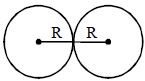
Two masses (spheres) as in fig are placed. If mass density of each sphere is $'\rho '$. Find force between than