Question
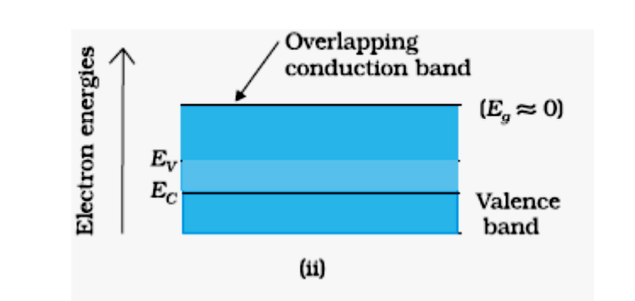
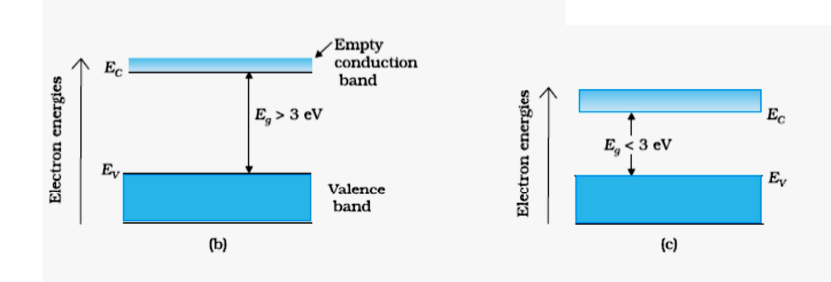
Write any two distinguishing features between conductors, semiconductors and insulators on the basis of energy band diagrams.

Answer


Two distinguishing features:
  1. In conductors, the valency band and conduction band tend to overlap (or nearly overlap) while in insulators they are seperated by a large energy gap and in semiconductors are separated by a small energy gap.
  2. The conduction band, of a conductor, has a large number of electrons available for electrical conduction. However the conduction band of insulators is almost empty while that of the semi- conductor has only a (very) small number of such electrons available lectrical conduction.

Need a full question paper?

Generate a complete, print-ready paper with questions like this in minutes — across 16+ boards, with answer keys.
Start Generating Free

Similar questions

Name the following constituent radiations of electromagnetic spectrum which
  1. produce intense heating effect.
  2. is absorbed by the ozone layer in the atmosphere.
  3. is used for studying crystal structure.
Write one more application forr each of these radiations.
Is it possible for two bodies to be in thermal equilibrium if they are not in contact?
The first excited energy of a $He^+$ ion is the same as the ground state energy of hydrogen. Is it always true that one of the energies of any hydrogen$-$like ion will be the same as the ground state energy of a hydrogen atom?
Using lens maker's formula obtain the equation of lens.
Show that the ratio of the magnetic dipole moment to the angular momentum (l = mvr) is a universal constant for hydrogen-like atoms and ions. Find its value.

Locate the image of the point P as seen by the eye in the figure.
The potential barrier existing across an unbiased $p-n$. junction is $0·2$ volt. What minimum kinetic energy a hole should have to diffuse from the $p-$side to the $n-$side if,
  1. The junction is unbiased.
  2. The junction is forwardbiased at $0.1$ volt.
  3. The junction is reverse-biased at $0.1$ volt?
Explain with example, whether the neutron-proton ratio in a nucleus increases or decreases due to $\beta-$decay.
$i$. Using Bohr's second postulate of quantisation of orbital angular momentum show that the circumference of the electron in the nth orbital state in hydrogen atom is $n-$ times the de $-$ Broglie wavelength associated with it.
$ii.$ The electron in hydrogen atom is initially in the third excited state. What is the maximum number of spectral lines which can be emitted when it finally moves to the ground state?
Explain Electric Flux.