Question
Write Huygen's principle and explain how a new spherical wave front is formed after a very small time interval.

Answer

• Huygen's principle :
"Every point or particle of a wavefront behaves as an independent secondary source, emits by itself secondary spherical waves. After a very small time interval the surface tangential to all such secondary spherical wavelets gives the position and shape of the new wavefront."
[Alternatively, "Each point of the wavefront is the source of a secondary disturbance and the wavelets emanating from these points spread out in all directions with the speed of the wave. These wavelets emanating from the wavefront are usually referred to as secondary wavelets and if we draw a common tangent to all these spheres, we obtain the new position of the wave front at a later time."]
Image
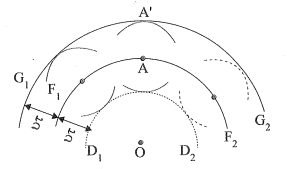
As shown in the Fig, $F _1 F_2$ represents the spherical wave front (with O as Centre) at $t=0$.
As per Huygen's principle each point on the wavefront behaves as a secondary source and the waves emanating from these point spread equally in all directions at the speed of wave. If we wish to determine the shape of the wave front at $t=\tau$, we draw spheres of radius $v \tau$ from each point on the spherical wave front where $v$ represents the speed of the waves in the medium.
If we now draw a common tangent to all these spheres, we obtain the new position of the wave front at $t =\tau$.
The new wavefront is shown in the Fig. as $G _1 G _2$, which is again a spherical with point ' O ' as centre.

Need a full question paper?

Generate a complete, print-ready paper with questions like this in minutes — across 16+ boards, with answer keys.
Start Generating Free

Similar questions

One end of a rod of length 20cm is inserted in a furnace at 800K The sides of the rod are covered with an insulating material and the other end emits radiation like a blackbody. The temperature of this end is 750K in the steady state. The temperature of the surrounding air is 300K. Assuming radiation to be the only important mode of energy transfer between the surrounding and the open end of the rod, find the thermal conductivity of the rod. Stefan constant $\sigma=6.0\times10^{-8}\text{Wm}^{-2}\text{K}^{-4}.$
Why is the diffraction of sound waves more evident in daily experience than that of light wave?
You are given three lenses L1, L2 and L3 each of focal length 20 cm. An object is kept at 40 cm in front of L1, as shown. The final real image is formed at the focus I of L3. Find the separations between L1, L2 and L3.

A radio can tune over the frequency range of a portion of MW broadcast band: (800kHz to 1200kHz). If its LC circuit has an effective inductance of 200μH, what must be the range of its variable capacitor?
[Hint: For tuning, the natural frequency i.e., the frequency of free oscillations of the LC circuit should be equal to the frequency of the radiowave.]
Compare and explain three distinguishing features observed in Young’s double slit interference pattern with those seen for a coherently illuminated single slit producing diffraction pattern.
In a series LCR circuit, $\text{R = 1k}\Omega,\text{C}=2\mu\text{F}$ and voltage across R is 100V. The resonant frequency of the circuit $\omega$ is 200 rad s-1. Calculate the value of voltage across L at resonance.
The given graph shows the variation of photo-electric currently) with the applied voltage(V) for two different materials and for two different intensities of the incident radiations. Identify and explain using Einstein's photo electric equation the pair of curves that correspond to (i) different materials but same intensity of incident radiation (ii) different intensities but same materials.

The rest distance between Patna and Delhi is 1000km. A nonstop train travels at 360km/h:
  1. What is the distance between Patna and Delhi in the train frame?
  2. How much time elapses in the train frame between Patna and Delhi?
(a) The radii of curvatures of the faces of a double convex lens are 10 cm . and 15 cm . Its focal length is 12 cm . What is the refractive index of the material of lens?
(b) A convex lens of glass has 20 cm focal length in air. What is focal length in water? (Refractive index of air water is 1.33 . Refractive index of air-glass $=1.5$ )
State Kirchhoff’s rules. Use these rules to write the expressions for the currents I1, I2 and I3 in the circuit diagram shown.