Question
Write the differences between mass and weight of an object.

Answer

 
Mass
Weight
1.
The mass of an object is the quantity of matter contained in it.
The weight of an object is the force with which it is attracted towards the centre of the earth.
2.
SI unit of mass is kilogram (kg).
SI unit of mass is newton (N).
3.
The mass of an object is constant.
The weight of an object is not constant. It changes with the change in acceleration due to gravity.
4.
The mass of an object can never be zero.
The weight of an object can be zero.

Need a full question paper?

Generate a complete, print-ready paper with questions like this in minutes — across 16+ boards, with answer keys.
Start Generating Free

Similar questions

An automobile engine propels a $1000\ kg$ car
$(A)$ along a levelled road at a speed of $36\ km\ h^{-1}.$ Find the power if the opposing frictional force is $100N$.
Now, suppose after travelling a distance of $200m,$ this car collides with another stationary car
$(B)$ of same mass and comes to rest. Let its engine also stop at the same time. Now car $(B)$ starts moving on the same level road without getting its engine started. Find the speed of the car $(B)$ just after the collision.
A ball of mass $200g$ falls from a height of $5$ metres. What is its kinetic energy when it just reaches the ground? $(g = 9.8\ m/s).$
What is osmosis?
How can reverberations in a big hall or auditotium be reduced?`
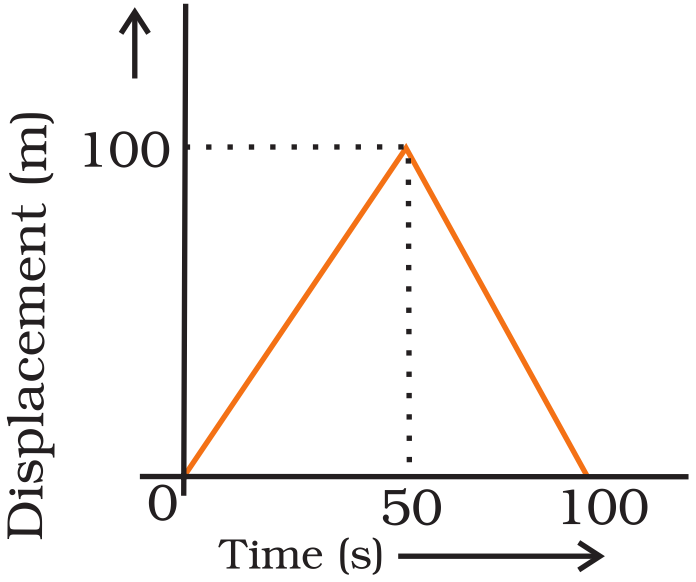
A girl walks along a straight path to drop a letter in the letterbox and comes back to her initial position. Her displacement–time graph is shown in Plot a velocity–time graph for the same.
Carry out the following osmosis experiment:
Take four peeled potato halves and scoop each one out to make potato cups, one of these potato cups should be made from a boiled potato. Put each potato cup in a trough containing water. Now,
  1. Keep cup A empty.
  2. Put one teaspoon sugar in cup B.
  3. Put one teaspoon salt in cup C.
  4. Put one teaspoon sugar in the boiled potato cup D.
Keep these for two hours. Then observe the four potato cups and answer the following:
  1. Explain why water gathers in the hollowed portion of B and C.
  2. Why is potato A necessary for this experiment?
  3. Explain why water does not gather in the hollowed out portions of A and D.
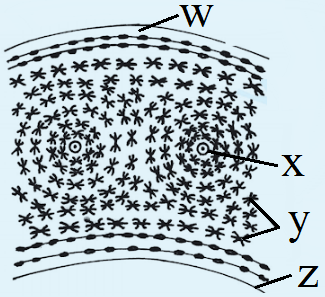
  1. Identify the figure.
  2. Label W, X, Y and Z
  3. What is chemical composition of material of the figure
  4. What of the function of X?
An object is dropped from rest at a height of $150m$ and simultaneously another object is dropped from rest at a height $100m.$ What is the difference in their heights after $2s$ if both the objects drop with same accelerations? How does the difference in heights vary with time?
On a level road, a scooterist applies brakes to slow down from a speed of $10\ m/s$ to $5\ m/s.$ If the mass of the scooterist and the scooter be $150\ kg,$ calculate the work done by the brakes. $($Neglect air resistance and friction$)$
A boy walks from his classroom to the bookshop along a straight corridor towards North. He covers a distance of 20m in 25 seconds to reach the bookshop. After buying a book, he travels the same distance in the same time to reach back in the classroom. Find (a) average speed, and (b) average velocity, of the boy.