Question
Write the function of a (i) Transducer and (ii) Repeater in a communication system.

Answer

  1. Transducer: The device which converts one form of energy into another.
  2. Repeater: A repeater picks up signal, amplifies and retransmits them to receiver.

Need a full question paper?

Generate a complete, print-ready paper with questions like this in minutes — across 16+ boards, with answer keys.
Start Generating Free

Similar questions

In order to have a current in a long wire, it should be connected to a battery or some such device. Can we obtain the magnetic due to a straight, long wire by using Ampere's law without mentioning this other part of the circuit?
The pressures of the gas in a constant volume gas thermometer are 80cm, 90cm and 100cm of mercury at the ice point, the steam point and in a heated wax bath, respectively. Find the temperature of the wax bath.
The distance between the cathode (filament) and the target in an X-ray tube is 1.5m. If the cutoff wavelength is 30pm, find the electric field between the cathode and the target.
A single lens is mounted in a tube. A parallel beam enters the tube and emerges out of the tube as a divergent beam. Can you say with certainty that there is a diverging lens in the tube?
A photographic film is coated with a silver bromide layer. When light fells on this film, silver bromide molecules dissociate end the film records the light there. A minimum of $0.6eV$ is needed to dissociate a silver bromide molecule. Find the maximum wavelength of light that can be recorded by the film.
Write Snell's law and derive its general equation.
A semicircular wire of radius 5.0cm carries a current of 5.0A. A magnetic field B of magnitude 0.50T exists along the perpendicular to the plane of the wire. Find the magnitude of the magnetic force acting on the wire.
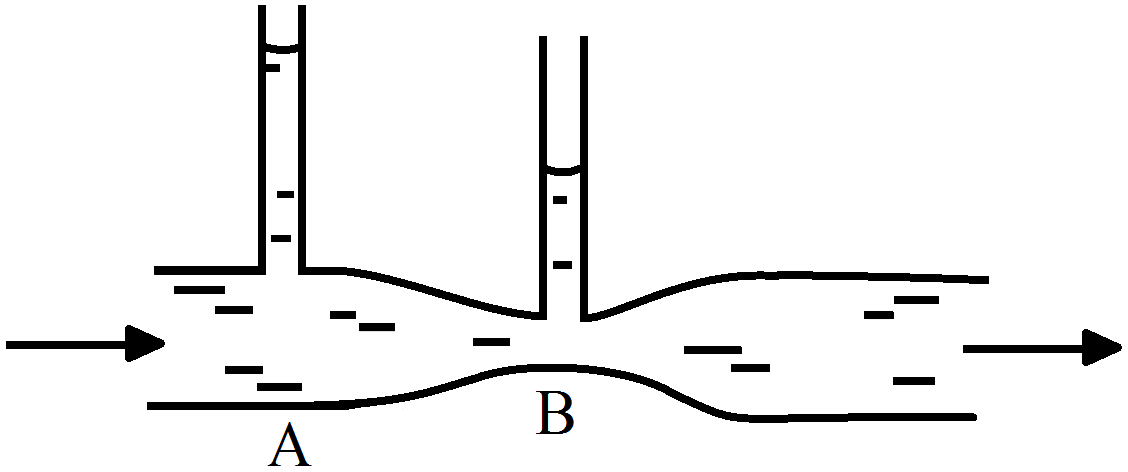
Water flows through a horizontal tube as shown in If the difference of heights of water column in the vertical tubes is $2\ cm,$ and the areas of cross-section at $A$ and $B$ are $4\ cm^2$ and $2\ cm^2$ respectively, find the rate of flow of water across any section.
If we put a cardboard (say 20cm × 20cm) between a light source and our eyes, we can't see the light. But when we put the same cardboard between a sound source and our ear, we hear the sound almost clearly. Explain.
Explain the method of charging by friction briefly.