MCQ
$X-$ rays cannot be deflected by means of an ordinary grating due to
  • A
    Large wavelength
  • B
    High speed
  • Short wavelength
  • D
    None of these

Answer

Correct option: C.
Short wavelength
c
(c)

Need a full question paper?

Generate a complete, print-ready paper with questions like this in minutes — across 16+ boards, with answer keys.
Start Generating Free

Similar questions

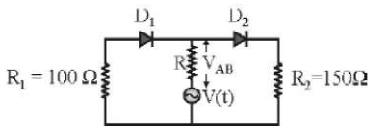
In the circuit given below, $V ( t )$ is the sinusoidal voltage source, voltage drop $V_{A B}(t)$ across the resistance $R$ is
Two identical $p-ri$ junctions may be connected in series with a battery in three ways $($figure$)$. The potential difference across the two $p-n$. junctions are equal in:
The parallel rays of white light are made an incident normally on an air film of uniform thickness. $250$ fringes are seen in the transmitted light between $4000 \mathring{\text{A}}$ and $6500 \mathring{\text{A}}$. Thickness of air film is:
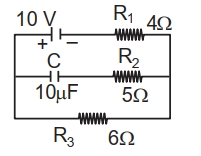
In an electrical circuit drawn below the amount of charge stored in the capacitor is___ $\mu \mathrm{C}$.
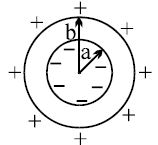
An empty thick conducting shell of inner radius $a$ and outer radius $b$ is shown in figure.If it is observed that the inner face of the shell carries a uniform charge density $-\sigma$ and the surface carries a uniform charge density $ '\sigma '$

If the charge $q_A$ is slowly moved inside the shell, then choose the statement$(s)$
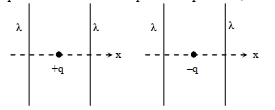
The figures below depict two situations in which two infinitely long static line charges of constant positive line charge density $\lambda$ are kept parallel to each other. In their resulting electric field, point charges $q$ and $- q$ are kept in equilibrium between them. The point charges are confined to move in the $x$ direction only. If they are given a small displacement about their equilibrium positions, then the correct statement$(s)$ is(are)
The ratio of gravitational force and electrostatic repulsive force between two electrons is approximately (gravitational constant $=6.7 \times 10^{-11} \,Nm ^2 / kg ^2$, mass of an electron $=9.1 \times 10^{-31} \,kg$, charge on an electron $=1.6 \times 10^{-19} C$ )
The binding energy of a H-atom, considering an electron moving around a fixed nuclei $($proton$)$, is $\text{B}=-\frac{\text{me}^4}{8\text{n}^2\in_0^2\text{h}^2}. (m =$ electron mass$).$
If one decides to work in a frame of reference where the electron is at rest, the proton would be moving arround it. By similar arguments, the binding energy would be,
$\text{B}=-\frac{\text{me}^4}{8\text{n}^2\in_0^2\text{h}^2} (M =$ proton mass$)$
This last expression is not correct because:
Two long parallel wires P and Q are both perpendicular to the plane of the paper with distance 5 m between them. If P and Q carry current of 2.5 amp and 5 amp respectively in the same direction, then the magnetic field at a point half way between the wires is
A current carring coil is placed in a uniform magnetic field. If the coil turns through an angle $\theta,$ then the torque is directly proportional to: