MCQ
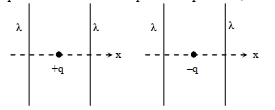
The figures below depict two situations in which two infinitely long static line charges of constant positive line charge density $\lambda$ are kept parallel to each other. In their resulting electric field, point charges $q$ and $- q$ are kept in equilibrium between them. The point charges are confined to move in the $x$ direction only. If they are given a small displacement about their equilibrium positions, then the correct statement$(s)$ is(are)
  • A
    Both charges execute simple harmonic motion.
  • B
    Both charges will continue moving in the direction of their displacement.
  • Charge $+ q$ executes simple harmonic motion while charge $- q$ continues moving in the direction of its displacement.
  • D
    Charge $- q$ executes simple harmonic motion while charge $+ q$ continues moving in the direction of its displacement.
Answer

Correct option: C.
Charge $+ q$ executes simple harmonic motion while charge $- q$ continues moving in the direction of its displacement.
c
In Case $I$ :

$\overrightarrow{ F }=\frac{\lambda q }{2 \pi \varepsilon_0( r + x )} \hat{ i }+\frac{\lambda q }{2 \pi \varepsilon_0( r - x )}(-\hat{ i })$

$=\frac{\lambda q }{\pi \varepsilon_0 I ^2} x (-\hat{ i })$

Hence $+ q$, charge will performs $S H M$ with time period $T =2 \pi \sqrt{\frac{ \pi r ^2 \varepsilon_0 m }{\lambda q }}$

In case II: Resultant force will act along the direction of displacement.

Need a full question paper?

Generate a complete, print-ready paper with questions like this in minutes — across 16+ boards, with answer keys.

Start Generating Free

Similar questions

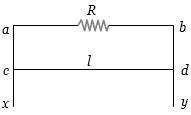
A wire $cd$ of length $l$ and mass $m$ is sliding without friction on conducting rails $ax$ and $by$ as shown. The vertical rails are connected to each other with a resistance $R$ between $a$ and $b$. $A$ uniform magnetic field $B$ is applied perpendicular to the plane $abcd$ such that $cd$ moves with a constant velocity of
A concave and convex lens have the same focal length of $20 cm$ and are put into contact to form a lens combination. The combination is used to view an object of $5 cm$ length kept at $20 cm $ from the lens combination. As compared to the object, the image will be
Two slits, $4 \,mm$ apart, are illuminated by light of wavelength $6000 Å$. What will be the fringe width on a screen placed $2\,m$ from the slits.....$mm$
What describe the Einsteins equation for the relativity of mass and energy?
Lines which represent places of constant angle of dip are called
Resolving power of a microscope depends upon
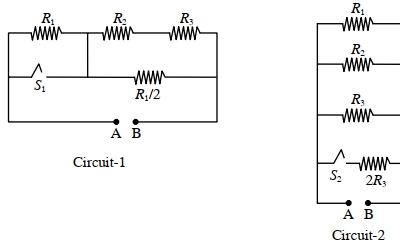
In Circuit-$1$ and Circuit- $2$ shown in the figures, $R_1=1 \Omega, R_2=2 \Omega$ and $R_3=3 \Omega$. $P_1$ and $P_2$ are the power dissipations in Circuit-$1$ and Circuit-$2$ when the switches $S_1$ and $S_2$ are in open conditions, respectively. $Q_1$ and $Q_2$ are the power dissipations in Circuit-$1$ and Circuit-$2$ when the switches $S_1$ and $S_2$ are in closed conditions, respectively.

Which of the following statement($s$) is(are) correct?

$(A)$ When a voltage source of $6 V$ is connected across $A$ and $B$ in both circuits, $P_1$

$(B)$ When a constant current source of $2 Amp$ is connected across $A$ and $B$ in both circuits, $P_1>P_2$.

$(C)$ When a voltage source of $6 V$ is connected across $A$ and $B$ in Circuit-$1$, $Q_1>P_1$.

$(D)$ When a constant current source of $2 Amp$ is connected across $A$ and $B$ in both circuits, $Q_2$

In a P-type semi-conductor, germanium is dopped with
$n$ identical cells are joined in series with two cells $A$ and $B$ with reversed polarities. $emf$ of each cell is $E$ and internal resistance is $r$. Potential difference across cell $A$ and $B$ is : $(n > 4)$
In an ac circuit, the instantaneous current is zero, when the instantaneous voltage is maximum. In this case, the source may be connected to:

$A$. pure inductor.

$B$. pure capacitor.

$C$. pure resistor.

$D$. combination of an inductor and capacitor.

Choose the correct answer from the options given below: