MCQ
X-rays of $\lambda=1 \mathrm{~A}^0$ have frequency
  • A
    $3 \times 10^{8} \mathrm{~Hz}$
  • $3 \times 10^{18} \mathrm{~Hz}$
  • C
    $3 \times 10^{10} \mathrm{~Hz}$
  • D
    $3 \times 10^{15} \mathrm{~Hz}$

Answer

Correct option: B.
$3 \times 10^{18} \mathrm{~Hz}$
(b) $3 \times 10^{18} \mathrm{~Hz}$

Need a full question paper?

Generate a complete, print-ready paper with questions like this in minutes — across 16+ boards, with answer keys.

Start Generating Free

Similar questions

A magnet oscillating in a horizontal plane has a time period of $2$ $second$ at a place where the angle of dip is $30^o$ and $3 $ $seconds$ at another place where the angle of dip is $60^o$. The ratio of resultant magnetic fields at the two places is
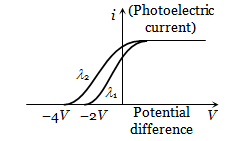
The maximum value of stopping potential in the following diagram is
An initially uncharged capacitor $C$ is being charged by a battery of emf $E$ through a resistance $R$ upto the instant, when the capacitor is charged to the potential $E / 2$, then the ratio of the work done by the battery to the heat dissipated by the resistor is given by
Assertion : An electron and proton enters a magnetic field with equal velocities, then, the force experienced by the proton will be more than electron.
Reason : The mass of proton is 1837 times more than electron.
A plano-convex lens is made of refractive index of $1.6.$ The radius of curvature of the curved surface is $60 cm.$ The focal length of the lens is.....$cm$
If refractive index of red, violet and yellow lights are 1.42, 1.62 and 1.50 respectively for a medium. Its dispersive power will be
If the central portion of a convex lens is wrapped in black paper as shown in the figure
An ideal coil of $10\, H$ is connected in series with a resistance of $5 \,\Omega$ and a battery of $5\, V$. After $2 \,s$, after the connection is made, the current flowing (in ampere) in the circuit is.
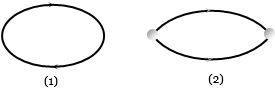
Below figures $(1)$ and $(2)$ represent lines of force. Which is correct statement
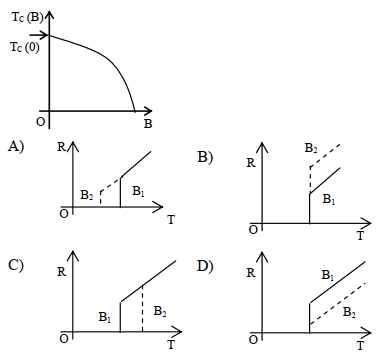
Electrical resistance of certain materials, known as superconductors, changes abruptly from a nonzero value to zero as their temperature is lowered below a critical temperature $T_c(0)$. An interesting property of superconductors is that their critical temperature becomes smaller than $T_c(0)$ if they are placed in a magnetic field, i.e., the critical temperature $T_c(B)$ is a function of the magnetic field strength $B$. The dependence of $T_c(B)$ on $B$ is shown in the figure. $Image$

$1.$ In the graphs below, the resistance $\mathrm{R}$ of a superconductor is shown as a function of its temperature $\mathrm{T}$ for two different magnetic fields $\mathrm{B}_1$ (solid line) and $\mathrm{B}_2$ (dashed line). If $\mathrm{B}_2$ is larger than $\mathrm{B}_1$ which of the following graphs shows the correct variation of $\mathrm{R}$ with $\mathrm{T}$ in these fields?

MCQ $Image$

$2.$ A superconductor has $T_C(0)=100 \mathrm{~K}$. When a magnetic field of 7.5 Tesla is applied, its $\mathrm{T}_{\mathrm{c}}$ decreases to $75 \mathrm{~K}$. For this material one can definitely say that when

$(A)$ $\mathrm{B}=5$ Tesla, $\mathrm{T}_{\mathrm{c}}(\mathrm{B})=80 \mathrm{~K}$

$(B)$ $\mathrm{B}=5$ Tesla, $75 \mathrm{~K}<\mathrm{T}_{\mathrm{c}}(\mathrm{B})<100 \mathrm{~K}$

$(C)$ $\mathrm{B}=10 \mathrm{Tesla}, 75 \mathrm{~K}<\mathrm{T}_{\mathrm{c}}<100 \mathrm{~K}$

$(D)$ $\mathrm{B}=10$ Tesla, $\mathrm{T}_{\mathrm{c}}=70 \mathrm{~K}$

Give the answer question $1, 2$