Questions · Page 2 of 4

M.C.Q [1M]

MCQ 511 Mark
For watt-less power in an AC circuit the phase angle between the current and voltage is.
  • A
  • B
    90°
  • C
    45°
  • D
    Not possible
Answer
  1. 90°

Explanation:

Watt-less power in an AC circuit is basically power supposed to be generated by inductive and capacitive reactance and since they are not resistor they generate any heat, and these power wasted is called watt-less power and its phase angle is always 90o as it has only capacitor and inductor.

View full question & answer
MCQ 521 Mark
Which of the following combinations should be selected for better tuning of an LCR circuit used for communication?
  • A
    R = 20Ω, L = 1.5H, C = 35μF.
  • B
    R = 25Ω, L = 2.5H, C = 45μF.
  • C
    R = 15Ω, L = 3.5H, C = 30μF.
  • D
    R = 25Ω, L = 1.5H, C = 45μF.
Answer
  1. R = 15Ω, L = 3.5 H, C = 30μF.

Solution:

Quality factor (Q) of an L-C-R circuit is given by, $\text{Q}=\frac{1}{\text{R}}\sqrt{\frac{\text{L}}{\text{C}}}$

Tuning of an L-C-R circuit depends on quality factor of the circuit. Tuning will be better when quality factor of the circuit is high.

As, quality factor (Q) of an L-C-R circuit is given by, $\text{Q}=\frac{1}{\text{R}}\sqrt{\frac{\text{L}}{\text{C}}}$

For Q to be high, R should be low, L should be high and C should be low, Therefore option (c) is most apporopriate.

View full question & answer
MCQ 531 Mark
A series AC circuit has a resistance of $4\Omega$ and a reactance of $3\Omega$. The impedance of the circuit is.
  • A
    $5\Omega$
  • B
    $7\Omega$
  • C
    $\frac{12}{7\Omega}$
  • D
    $\frac{7}{12\Omega}$
Answer
  1. $5\Omega$

Explanation:

Impedance(Z) $=\sqrt{\text{R}^2+\text{X}^2}$

where, R = resistance

X = reactance

Given $\text{R}=4\Omega\text{ and }\text{X}=3\Omega$

Substitute values back in equation

$\text{Z}=\sqrt{4^2+3^2}$

$\text{Z}=5\Omega$

View full question & answer
MCQ 541 Mark
In a series LCR circuit, resonance occurring at 105Hz. At that time, the potential difference across the 100 resistance is 40V while the potential difference across the pure inductor is 30v. The inductance L of the inductor is equal to.
  • A
    2.0 × 10⁻⁴
  • B
    3.0 × 10⁻⁴
  • C
    1.2 × 10⁻⁴
  • D
    2.4 × 10⁻⁴
Answer
  1. 1.2 × 10⁻⁴

Explanation:

In a series LCR circuit, resonance occurring at 105Hz. At that time, the potential difference across the 100 resistance is 40V while the potential difference

across the pure inductor is 30V. The inductance L of the inductor is equal to

Current(i) $=\frac{\text{V}_\text{r}}{\text{R}}=\frac{100}{40}=2.5\text{A}$

the inductor value is VL ​= i × (wL)

$\text{L}=\frac{30}{2.5\times2\times\pi1\times105}=1.2\times10^{-4}\text{H}$

View full question & answer
MCQ 551 Mark
Electrical energy is transmitted over large distances at high alternating voltages. Which of the following statements is (are) correct?
  • A
    For a given power level, there is a lower current.
  • B
    Lower current implies less power loss.
  • C
    Transmission lines can be made thinner.
  • D
    It is easy to reduce the voltage at the receiving end using step-down transformers.
Answer
  1. For a given power level, there is a lower current.
  2. Lower current implies less power loss.
  1. It is easy to reduce the voltage at the receiving end using step-down transformers.

Solution:

Key Concept: Power loss due to transmisssion lines having resistance (R) and Irms current flowing in the circuit is I2rms R.

The power is to be transmitted over the large distances ar high alternating voltages, so current flowing through the wires will be low because of given power (P).

For a given power level, we find that

P = ErmsIrms (Irms is low when Erms is high)

Powor loss = I2rms R = low ($\because$ Irms is low)

Now at the receiving end high voltage is reduced by using step-down transformers.

View full question & answer
MCQ 561 Mark
If the frequency of an alternating e.m.f. is f in L-C-R circuit, then the value of impedance Z as log(frequency) increases:
  • A
    increases
  • B
    increases and then becomes equal to resistance, then it will start decreasing
  • C
    decreases and when it becomes minimum, equal to the resistance then it will start increasing
  • D
    go on decreasing
Answer
  1. decreases and when it becomes minimum, equal to the resistance then it will start increasing

Explanation:

Image result for impedance vs log frequency

If the frequency of an alternating e.m.f. is f in L-C-R circuit, then the value of impedance Z decreases and when it becomes minimum, equal to the resistance then it will start increasing as log(frequency) increases:

View full question & answer
MCQ 571 Mark
The unit of susceptance is.
  • A
    $\text{ohm}$
  • B
    $\text{ohm}^{-1}$
  • C
    $\frac{\text{ohm}}{\text{cm}}$
  • D
    $\frac{\text{ohm}}{\text{m}}$
Answer
  1. $\text{ohm}^{-1}$

Explanation:

Susceptance is the imaginary part of admittance. 

The admittance is the inverse of impedance. 

Unit of admittance is ohm. Unit of admittance is ohm-1 or siemens. 

Unit of susceptance is same as of admittance.

View full question & answer
MCQ 581 Mark
If the values of L, C and R in a series L - C - R circuit are $100\text{mH},100\mu\text{F}$ and $100\Omega$ respectively then the value of resonant frequency will be.
  • A
    $\frac{10}{2\pi}\text{Hz}$
  • B
    $2\times10^3\text{Hz}$
  • C
    $2\times\frac{10^3}{\text{pi}}\text{Hz}$
  • D
    ${10^3}\text{Hz}$
Answer
  1. $\frac{10}{2\pi}\text{Hz}$

Explanation:

Resonant frequency $=\frac{1}{2\pi\sqrt{\text{LC}}}$

$=\frac{1}{2\pi\sqrt{10^{-6}}}$

$=\frac{10}{2\pi}\text{Hz}$

View full question & answer
MCQ 591 Mark
If in a series L - C - R ac circuit, the voltages across L, C and R are V1​, V2​ and V3​ respectively, then the voltage of the source is always.
  • A
    equal to V1 ​+ V2 ​+ V3​
  • B
    equal to V1 ​- V2​ + V3
  • C
    more than V1 ​+ V2​ + V​3
  • D
    none of the above is true
Answer
  1. none of the above is true

Explanation:

The voltages across different elements in AC circuit add vectorially.

The voltages across inductor and capacitor are out of phase and at 90 to that across resistor.

Hence net voltage across source $=\sqrt{(\text{V}_1-\text{V}_2)+\text{V}^2_3}.$

View full question & answer
MCQ 601 Mark
A coil of self-inductance L is connected in series with a bulb B and an AC source. Brightness of the bulb decreases when.
  • A
    Frequency of the AC source is decreased
  • B
    Number of turns in the coil is reduced
  • C
    A capacitance of reactance XC ​= XL​ is included in the same circuit
  • D
    An iron rod is inserted in the coil
Answer
  1. An iron rod is inserted in the coil

Explanation:

As the iron rod is inserted, the magnetic field inside the coil magnetizes the iron increasing the magnetic field inside it. Hence. the inductance of the coil increases. Consequently, the inductive reactance of the coil increases. As a result, a larger fraction of the applied AC voltage appears across the lnductor, leaving less voltage across the bulb.Therefore' the brightness of the light bulb decreases.

View full question & answer
MCQ 611 Mark
In a circuit, the current lags behind the voltage by a phase difference of $\frac{\pi}{2}$ the circuit will contain which of the following: 
  • A
    Only R
  • B
    Only C
  • C
    R and C
  • D
    Only L
Answer
  1. Only L

Explanation:

In an inductor, current lags behind the input voltage by a phase difference of $\frac{\pi}{2}$.

Current and voltage are in same phase in resistor whereas current leads the voltage by $\frac{\pi}{2}$in a capacitor.

So, the circuit must contain an inductor only.

View full question & answer
MCQ 621 Mark
An AC source rated 100V (rms) supplies a current of 10A (rms) to a circuit. The average power delivered by the source:
  • A
    Must be 1000W.
  • B
    May be 1000W.
  • C
    May be greater than 1000W.
  • D
    May be less than 1000W.
Answer
  1. May be 1000W.
  1. May be less than 1000W.

Explanation:

Average power $\text{P}_\text{av}=\text{V}_\text{rms}\text{I}_\text{rms}\cos\phi$

$=100\times10\cos\phi$

$\text{P}_\text{av}=1000\cos\phi$

$\therefore\ \cos\phi$ lies "0 to 1".

$\Rightarrow\ 0\leq\text{P}_\text{av}\leq1000.$

View full question & answer
MCQ 631 Mark
The reactance of a circuit is zero. It is possible that the circuit contains:
  • A
    An inductor and a capacitor.
  • B
    An inductor but no capacitor.
  • C
    A capacitor but no inductor.
  • D
    Neither an inductor nor a capacitor.
Answer
  1. An inductor and a capacitor.

Explanation:

$\text{X}=0$ (Given)

$\text{X}=\text{X}_\text{L}+\text{X}_\text{C}$

$=\omega\text{L}-\frac{1}{\omega\text{C}}=0$

It is possible that the circuit contains an inductor and a capacitor.

View full question & answer
MCQ 641 Mark
An inductor, a resistance and a capacitor are joined in series with an AC source. As the frequency of the source is slightly increased from a very low value, the reactance:
  • A
    Of the inductor increases.
  • B
    Of the resistor increases.
  • C
    Of the capacitor increases.
  • D
    Of the circuit increases.
Answer
  1. Of the inductor increases.

Explanation:

$\text{X}_\text{L}=\omega\text{L}$

$\text{X}_\text{C}=\frac{1}{\omega\text{C}}$

If frequency increases that causes 'XL' raction of inductor increases and 'XC' reactance of capacitor decreses.

View full question & answer
MCQ 651 Mark
An alternating current having peak value 14A is used to heat a metal wire. To produce the same heating effect, a constant current i can be used where i is:
  • A
    14A
  • B
    About 20A.
  • C
    7A.
  • D
    About 10A.
Answer
  1. About 10A.

Explanation:

$\text{I}_\text{p}=14\text{Amp}$

$\text{I}_\text{rms}=\frac{\text{IP}}{\sqrt{2}}=\frac{14}{\sqrt{2}}$

$=9.9=10\text{Amp}.$

View full question & answer
MCQ 661 Mark
An alternating voltage$\text{V}=200\sqrt{2}\sin100\text{t},$ Where V is in volt and t is in seconds, is connected to a series combination of $1\mu\text{F}$ capacitor and $10\text{k}\Omega$ resistor through an AC ammeter. The reading of the ammeter will be_____.
  • A
    $\sqrt{\text{2}}\text{mA}$
  • B
    $10\sqrt{\text{2}}\text{mA}$
  • C
    $\text{2}\text{mA}$
  • D
    $\text{20}\text{mA}$
Answer
  1. $10\sqrt{\text{2}}\text{mA}$

Explanation:

$\text{i}=\frac{\text{V}_\text{rms}}{\sqrt{\text{R}^2+\Big(\frac{1}{\omega\text{C}}-\omega\text{L}\Big)^2}}$

$\Rightarrow\text{i}=\frac{200\sqrt{2}\frac{1}{\sqrt{2}}}{\sqrt{10000^2+\Big(\frac{1}{100\times10^{-6}}-100\times0\Big)^2}}=\frac{200}{\sqrt{2\times10000^2}}$

$10\sqrt{\text{2}}\text{mA}$

View full question & answer
MCQ 671 Mark
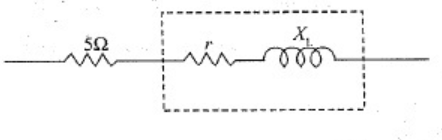
An inductor $\frac{10\Omega}{60^\circ}$ is connected to a $5\Omega$ resistance in series. Find net impedance.
Image
  • A
    $15\Omega$
  • B
    $12\Omega$
  • C
    $13.2\Omega$
  • D
    $18\Omega$
Answer
  1. $13.2\Omega$
View full question & answer
MCQ 681 Mark
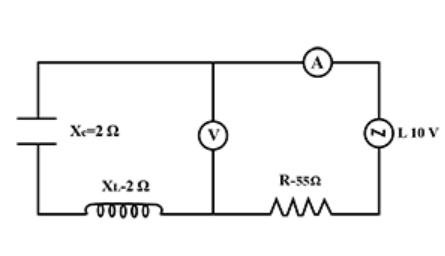
In the given figure as shown, the reading of the ammeter in ampere is.
Image
  • A
    2
  • B
    3
  • C
    1
  • D
    0
Answer
  1. 2

Explanation:

$\text{I}=\frac{\text{E}}{\sqrt{\text{R}^2+(\text{X}_\text{L}-\text{X}_\text{C})^2}}$

$=\frac{110}{\sqrt{55^2+(2-2)^2}}$

$=\frac{110}{55}=2\text{A}$

View full question & answer
MCQ 691 Mark
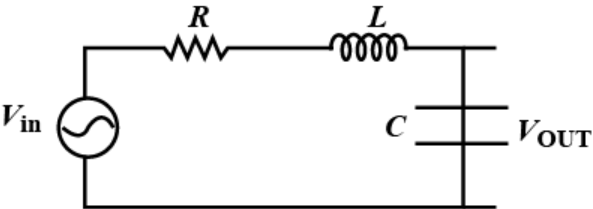
If the output is taken across a capacitor in a series RLC circuit then it acts as.
Image
  • A
    band-pass filter
  • B
    high-pass filter
  • C
    low-pass filter
  • D
    band reject filter
Answer
  1. low-pass filter

Explanation:

Given circuit is one simple low-pass filter circuit consists of a resistor in series with a load, and a capacitor in parallel with the load. The capacitor exhibits reactance, and blocks low-frequency signals, forcing them through the load instead. At higher frequencies the reactance drops, and the capacitor effectively functions as a short circuit.

View full question & answer
MCQ 701 Mark
An alternating current generator has an internal resistance Rg and an internal reactance Xg. It is used to supply power to a passive load consisting of a resistance Rg and a reactance XL. For maximum power to be delivered from the generator to the load, the value of XL is equal to:
  • A
    Zero.
  • B
    Xg.
  • C
    -Xg.
  • D
    Rg.
Answer
  1. -Xg.

Solution:

For maximum power to be delivered from the generator (or internal reactance Xg) to the load (of reactance, XL),

⇒ XL + Xg = 0 (the total reactance must vanish)

⇒ XL= -Xg.

View full question & answer
MCQ 711 Mark
An inductance of 0.2 H and a resistance of $100\Omega$ are connected in series to an A.C. 180 V, 50 Hz supply. The apparent current flowing in the circuit will be.
  • A
    0.525 A
  • B
    5.25 A
  • C
    1.525 A
  • D
    15.25 A
Answer
  1. 1.525 A
View full question & answer
MCQ 721 Mark
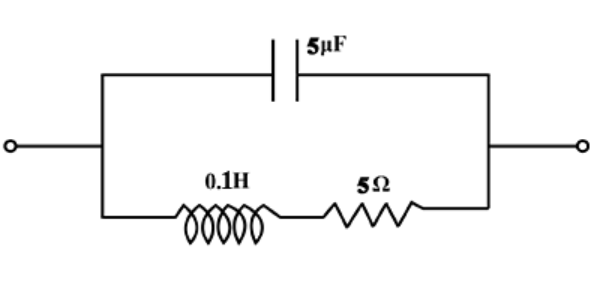
In the circuit shown in fig., the resonant frequency is.
Image
  • A
    200Hz
  • B
    220Hz
  • C
    225.08Hz
  • D
    230Hz
Answer
  1. 225.08Hz

Explanation:

The resonant frequecy of a circuit is given by $\text{f}=\frac{1}{2\pi\sqrt{\text{LC}}}$

Given $\text{L}=0.1\text{H }\text{C}=5\mu\text{F }\text{R}=5\Omega$

Substituting them in formula for f gives

f = 225.08 Hz.

View full question & answer
MCQ 731 Mark
An inductor, a resistor and a capacitor are joined in series with an AC source. As the frequency of the source is slightly increased from a very low value, the reactance of the.
  • A
    inductor increases
  • B
    resistor increases
  • C
    capacitor increases
  • D
    circuit increases
Answer
  1. inductor increases
View full question & answer
MCQ 741 Mark
The inductance of a resistanceless coil is 0.5 henry. In the coil, the value of alternating current is 0.2 A, whose frequency is 50 Hz. The reactance of circuit is.
  • A
    $15.7\Omega$
  • B
    $157\Omega$
  • C
    $1.57\Omega$
  • D
    $757\Omega$
Answer
  1. $157\Omega$

Explanation:

$\text{Reactance }=\omega\text{L}$

$=2\pi\text{fL}$

$=2\pi\times50\times0.5$

$157\Omega$

View full question & answer
MCQ 751 Mark
Reciprocal of Impedance is:
  • A
    Susceptance
  • B
    Conductance
  • C
    Admittance
  • D
    Transconductance
Answer
  1. Admittance

Explanation:

Impedance is the opposition a circuit presents to a current when a voltage is applied.

Admittance is a measure of how easily a circuit or device will allow a current to flow.

Admittance is defined as $\text{Y}=\frac{1}{\text{Z}}$

where Z is the impedance of the circuit.

View full question & answer
MCQ 761 Mark
In a purely inductive circuit, the current:
  • A
    is in phase with the voltage
  • B
    is out of phase with the voltage
  • C
    leads the voltage by $\frac{\pi}{2}$
  • D
    lags behind the voltage by $\frac{\pi}{2}$
Answer
  1. lags behind the voltage by $\frac{\pi}{2}$

Explanation:

In a purely inductive circuit (an AC circuit containing inductance only) the current lags behind the voltage by $\frac{\pi}{2}$

View full question & answer
MCQ 771 Mark
Alternating current is flowing in inductance L and resistance R. The frequency of source is $\frac{\omega}{2\pi}$ Which of the following statement in correct:
  • A
    For low frequency the limiting value of impedance is L.
  • B
    For high frequency the limiting value of impedance is $\omega\text{L}.$.
  • C
    For high frequency the limiting value of impedance is R.
  • D
    For low frequency the limiting value of impedance is $\omega\text{L}.$
Answer
  1. For low frequency the limiting value of impedance is L.
View full question & answer
MCQ 781 Mark
Alternating current is one which changes in its:
  • A
    direction
  • B
    magnitude
  • C
    magnitude and direction both
  • D
    none
Answer
  1. magnitude and direction both

Explanation:

An alternating current (AC) is an electric current whose magnitude and direction vary, unlike direct current, whose direction remains constant.

The usual waveform of an AC power circuit is a sine wave, because this leads to the most efficient transmission of energy. The sine wave oscillates periodically between positive and negative direction.

View full question & answer
MCQ 791 Mark
The capacitor of an oscillatory circuit of negligible resistance is enclosed in a evacuated container. The frequency of the circuit is 150 kHZ and when the container is filled with a gas, the frequency changes by 100 HZ. The dielectric constant of the gas.
  • A
    2
  • B
    1.53
  • C
    1.0012
  • D
    3
Answer
  1. 1.0012

Explantion:

We know frequency is given by:

$\text{n}_1=\frac{1}{2\pi\sqrt{\text{LC}_1}}$

And

$\text{n}_2=\frac{1}{2\pi\sqrt{\text{LKC}_1}}$

Thus we get the ratio of frequencies as

$\frac{\text{n}_1}{\text{n}_2}=\frac{150000}{149900}=\sqrt{\text{k}}$

Solving the above equation we get, $\text{K}\approx1.0012$

View full question & answer
MCQ 801 Mark
A resistor and an inductor are connected to an ac supply of 120V and 50 Hz. The current in the circuit is 3A. If the power consumed in the circuit is 108W, then the resistance in the circuit is.
  • A
    $12\Omega$
  • B
    $40\Omega$
  • C
    $\sqrt{(52\times28)}\Omega$
  • D
    $360\Omega$
Answer
  1. $12\Omega$

Explanation:

Irms​ = currentincircuit = 3A

$\text{p}=108\text{W}=\text{I}_\text{ems}^2\text{R}=3^2\text{R}$

$\text{R}=\frac{108}{9}=12\Omega$

View full question & answer
MCQ 811 Mark
An inductor has a resistance R and inductance L. It is connected to an AC source of emf Ev​ and angular frequency ω; then the current Iv​ in the circuit is:
  • A
    $\frac{\text{E}_\text{v}}{\omega\text{L}}$
  • B
    $\frac{\text{E}_\text{v}}{\text{R}}$
  • C
    $\frac{\text{E}_\text{v}}{\sqrt{\text{R}^2+\omega^2\text{L}^2}}$
  • D
    $\sqrt{\Big(\frac{\text{E}_\text{v}}{\text{R}}\Big)^2+\Big(\frac{\text{E}_\text{v}}{\omega\text{L}}\Big)^2}$
Answer
  1. $\frac{\text{E}_\text{v}}{\sqrt{\text{R}^2+\omega^2\text{L}^2}}$

Explanation:

The impedance in R-L circuit is 

$\text{Z}=\sqrt{\text{R}^2+{\text{X}^2_\text{L}}}=\sqrt{\text{R}^2+{(\omega\text{L})^2}}$

The current $\text{I}_\text{V}=\frac{\text{E}_\text{V}}{\text{Z}}$

$\frac{\text{E}_\text{v}}{\sqrt{\text{R}^2+\omega^2\text{L}^2}}$

View full question & answer
MCQ 821 Mark
In an AC series circuit, the instantaneous current is zero when the instantaneous voltage is maximum. Connected to the source may be a:
  • A
    Pure inductor.
  • B
    Pure capacitor.
  • C
    Pure resistor.
  • D
    Combination of an inductor and a capacitor.
Answer
  1. Pure inductor.

  2. Pure capacitor.

  1. Combination of an inductor and a capacitor.

Explanation:

Instantaneous current is zero when the intantaneous voltage is maximum.

Mean resistance = 0.

View full question & answer
MCQ 831 Mark
An LCR series circuit with $100\Omega$ resistance is connected to an ac source of 200V and of frequency of $\frac{300 \text{rad}}{\text{s}}$. When only the capacitance is removed, the current lags behind the voltage by 600. When only the inductance is removed, the current leads the voltage by 60° the current through the circuit is:
  • A
    1 A
  • B
    2 A
  • C
    3 A
  • D
    4 A
Answer
  1. 2 A

Explanation:

Since current lead and lag are same So, circuit is in resonance, so, circuit is purely resistive circuit.

So, $\text{i}=\frac{\text{V}}{\text{R}}$

$=\frac{200}{100}$

$=2\text{A}$

View full question & answer
MCQ 841 Mark
In a series L - C - R circuit, current in the circuit is 11A when the applied voltage is 220V. Voltage across the capacitor is 200V. If value of resistor $20\Omega$ then the voltage across the unknown inductor is.
  • A
    Zero
  • B
    200V
  • C
    20V
  • D
    None of these
Answer
  1. 200V

Explanation:

The given LCR circuit is in resonance. Inductive reactance magnitude XL​ increases as frequency increases while capacitive reactance magnitude XC​ decreases with the increase in frequency.

At one particular frequency, these two reactances are equal in magnitude but opposite in sign; that frequency is called the resonant frequency fO​ for the given circuit. Hence, at resonance:

XL ​= XC​

So the voltage across rthe unknown inductor is 200V as same as the voltage across the capacitor.

View full question & answer
MCQ 851 Mark
An LCR circuit has L = 10 mH, $\text{R}=3\Omega$ and $\text{C}=1\mu\text{ F}$ connected in series to a source of $15\cos\omega\text{t}$ volt. The current amplitude at a frequency that is 10% lower than the resonant frequency is:
  • A
    0.5A
  • B
    0.7A
  • C
    0.9A
  • D
    1.1A
Answer
  1. 0.7A

Explanation:

Resonant frequency, $\text{w}_\text{o}=\frac{1}{\sqrt{\text{LC}}}=\frac{1}{\sqrt{(10\times10^{-3})(10^{-6})}}=\frac{10^4\text{rad}}{\text{s}}$

New frequency $\omega=(0.9)\omega_\text{o}=9\times\frac{10^3\text{rad}}{\text{s}}$

We have new $\text{X}_\text{L}=\omega\text{L}=9\times10^3\times10\times10^{-3}=90\Omega\text{ and}\text{ X}_\text{C}=\frac{1}{\omega\text{C}}=111.11\text{ohm.}$

Thus we calculate new Z as

$\sqrt{3^2+[90-111.11]^2}$

$=21.32\Omega$

Current amplitude $=\frac{\text{V}_\text{o}}{\text{Z}}=\frac{15}{21.32}=0.7\text{A}$

View full question & answer
MCQ 861 Mark
At low frequency a condenser offers:
  • A
    high impedance
  • B
    low impedance
  • C
    zero impedance
  • D
    impedance of condenser is independent of frequency
Answer
  1. high impedance

Explanation

$\text{Z}=\frac{1}{\text{WC}}$

$\text{W}\downarrow\text{Z}\uparrow$

View full question & answer
MCQ 871 Mark
An A.C. circuit containing only capacitance, the current:
  • A
    Lags the voltage by 90°
  • B
    Leads the voltage by 90°
  • C
    Remains in phase with voltage
  • D
    Lags the voltage by 180°
Answer
  1. Leads the voltage by 90°

Explanation:

In an a.c. circuit containing resistance onIy voltage & current remain in the same phase. If circuit contains inductance only, voltage remains ahead of current by phase difference of 90°. If circuit contains capacitance only, current remains ahead of voltage by a phase difference of 90°.

View full question & answer
MCQ 881 Mark
If we increase the driving frequency in a circuit with a purely resistive load, then amplitude VR​.
  • A
    remain in the same
  • B
    increase
  • C
    decrease
  • D
    none
Answer
  1. remain in the same

Explanation:

We know that VR​ does not depend on driving frequency in a purely resistive circuit. So, If we increase the driving frequency in a circuit with a purely resistive load, then amplitude remain in the same.

View full question & answer
MCQ 891 Mark
The square root of the product of inductance and capacitance has dimensions of.
  • A
    length
  • B
    mass
  • C
    time
  • D
    dimensionless
Answer
  1. time

Explanation:

$\text{f}=\frac{1}{\sqrt{\text{LC}}}$

$\text{or}{\sqrt{\text{LC}}}=\text{T}$

View full question & answer
MCQ 901 Mark
An AC source producing emf $\in=\in_{0}\Big[\cos\big(100\pi\text{s}^{-1}\big)\text{t}+\cos\big(500\pi\text{s}^{-1}\big)\text{t}\Big]$ is connected in series with a capacitor and a resistor. The steady-state current in the circuit is found to be $\text{i}=\text{i}_1\cos\Big[\big(100\pi\text{s}^{-1}\big)\text{t}+\phi_1\Big]+\text{i}_2\cos\Big[\big(500\pi\text{s}^{-1}\big)\text{t}+\phi_2\Big].$
  • A
    i1 > i2
  • B
    i1 = i2
  • C
    i1 < i2
  • D
    The information is insufficient to find the relation between i1 and i2
Answer
  1. i1 < i2

Explanation:

$\text{Q}=\text{C}\in=\in_{0}\text{C}\Big[\cos\big(100\pi\text{s}^{-1}\big)\text{t}+\cos\big(500\pi\text{s}^{-1}\big)\text{t}\Big]$

$\text{i}=\frac{\text{dQ}}{\text{dt}}$

$\text{Q}=\text{C}\in=\in_{0}\text{C}\Big[\cos\big(100\pi\text{s}^{-1}\big)\text{t}+\cos\big(500\pi\text{s}^{-1}\big)\text{t}\Big]$

$\in_0\text{C}\times100\pi\Big[\sin\big(100\pi\text{s}^{-1}\big)\text{t}\Big]\\+\in_0\text{C}\times500\pi\Big[\sin\big(500\pi\text{s}^{-1}\big)\text{t}\Big]$

$=100\text{C}\pi\in_0\cos\Big[\big(100\pi\text{s}^{-1}\big)\text{t}+\phi_1\Big]\\+500\text{C}\pi\in_0\cos\Big[\big(500\pi\text{s}^{-1}\big)\text{t}+\phi_2\Big]$

$\text{i}_1=100\pi\in_0\text{C}$ and $\text{i}_2=500\pi\in_0\text{C}$

$\text{i}_2>\text{i}_1$

View full question & answer
MCQ 911 Mark
An inductor, a resistor and a capacitor are joined in series with an AC source. As the frequency of the source is slightly increased from a very low value, the reactance.
  • A
    of the inductor increases
  • B
    of the resistor increases
  • C
    of the capacitor increases
  • D
    of the circuit increases
Answer
  1. of the inductor increases
View full question & answer
MCQ 921 Mark
For an LCR circuit, the power transferred from the driving source to the driven oscillator is $\text{P}=\text{FZ}\cos\phi$.
  • A
    Here, the power factor $\cos\phi\geq0,\text{P}\geq0$.
  • B
    The driving force can give no energy to the oscillator (P = 0) in some cases.
  • C
    The driving force cannot syphon out (P < 0) the energy out of oscillator.
  • D
    The driving force can take away energy out of the oscillator.
Answer
  1. Here, the power factor $\cos\phi\geq0,\text{P}\geq0$.
  2. The driving force can give no energy to the oscillator (P = 0) in some cases.
  3. The driving force cannot syphon out (P < 0) the energy out of oscillator.

Solution:

Key Concept: Power Factor.

  1. It may be defined as cosine of the angle of lag of lead (i.e., $\cos\phi$).
  2. It is also defined as the radio of resistance and impedange $\Big(\text{i.e.,} \frac{\text{R}}{\text{Z}}\Big)$.
  3. $\text{The radio}=\frac{\text{True power}}{\text{Apparent power}}=\frac{\text{W}}{\text{VA}}=\frac{\text{kW}}{\text{kVA}}=\cos\phi$

In the given problem power transferred,

$\text{P}=\text{I}^2\text{Z}\cos\phi$

where I is the current, Z = Impedance and $\cos\phi$ is power factor

  1. As power factor, $\cos\phi=\frac{\text{R}}{\text{Z}}$

where R > 0 and Z > 0

$\Rightarrow\ \cos\phi>0\Rightarrow\ \text{P}>0$

  1. When $\phi=\frac{\pi}{2}$ (in case of L of C), P = 0.
  2. From (a), it is clear that P < 0 is not possible.
View full question & answer
MCQ 931 Mark
Choose the wrong statement of the following:
  • A
    The peak voltage across the inductor can be less than the peak voltage of the source in an LCR circuit
  • B
    In a circuit containing and a capacitor and an ac source the current is zero at the instant source voltage is maximum
  • C
    When an AC source is connected to a capacitor, then the rms current in the circuit gets increased if a dielectric slab is inserted into the capacitor
  • D
    In a pure inductive circuit emf will be in phase with the current
Answer
  1. In a pure inductive circuit emf will be in phase with the current

Explanation:

In pure inductive circuit, 

voltage leads by $\frac{\pi}{2}$ 

View full question & answer
MCQ 941 Mark
In a RLC circuit capacitance is changed from C to 2C. For the resonant frequency to remain unchanged, the inductance should be changed from L to.
  • A
    $4\text{L}$
  • B
    $2\text{L}$
  • C
    $\frac{\text{L}}{2}$
  • D
    $\frac{\text{L}}{4}$
Answer
  1. $\frac{\text{L}}{2}$

Explanation:

$\text{f}=\frac{1}{2\pi\sqrt{(\text{LC})}}$

when C is doubled, L should be halved so that resonant frequency remains unchanged.

View full question & answer
MCQ 951 Mark
In series L - C - R resonant circuit, to increase the resonant frequency:
  • A
    L will have to be increased
  • B
    C will have to be increased
  • C
    LC will have to be decreased
  • D
    LC will have to be increased
Answer
  1. LC will have to be decreased

Explanation:

$\text{Resonant frequency}=\frac{1}{\sqrt{\text{LC}}}$

$\text{LC}\downarrow\text{if }\omega_\text{r}\uparrow$

View full question & answer
MCQ 961 Mark
If the value of C in a series RLC circuit is decreased, the resonant frequency.
  • A
    is not affected
  • B
    increases
  • C
    is reduced to zero
  • D
    decreases
Answer
  1. increases

Explanation:

Resonant frequency in the series RLC circuit $\text{v}_\text{r}=\frac{1}{2\pi\sqrt{\text{LC}}}$

$\Rightarrow\text{v}_\text{r}\propto\frac{1}{\sqrt{\text{C}}}$

Thus resonant frequency of the circuit increases if the value of C decreases.

View full question & answer
MCQ 971 Mark
The capacitive reactance of $50\mu\text{F}$ capacitance at a frequency of 2 × 10³Hz will be ____ $\Omega$
  • A
    $\frac{2}{\pi}$
  • B
    $\frac{3}{\pi}$
  • C
    $\frac{4}{\pi}$
  • D
    $\frac{5}{\pi}$
Answer
  1. $\frac{5}{\pi}$

Explanation:

Capacitive reactance $=\frac{1}{\omega\text{c}}$

$=\frac{1}{2\pi\text{fc}}$

$=\frac{1}{2\pi2\times10^3\times50\times10^{-6}}$

$=\frac{5}{\pi}\Omega$

View full question & answer
MCQ 981 Mark
In an ac circuit, the potential differences across an inductance and resistance joined in series are, respectively, 16V and 20V. The total potential difference across the circuit is.
  • A
    20V
  • B
    25.6V
  • C
    31.9V
  • D
    53.5V
Answer
  1. 25.6V

Explanation:

In phasor, $\text{V}_\text{R}=20\angle0;\text{V}_\text{L}=16\angle(-90)$

Total potential difference is $=\text{V}_\text{R}+\text{V}_\text{L}=25.6\angle(-38.66)$

Magnitude of total potential difference = 25.6V

View full question & answer
MCQ 991 Mark
A 5cm long solenoid having 10 ohm resistance and 5mH inductance is joined to a 10V battery. At steady state, the current through the solenoid (in ampere) will be.
  • A
    5
  • B
    2
  • C
    1
  • D
    zero
Answer
  1. 1

Explanation:

At steady state inductor behave like short circuit.

$\text{i}=\frac{\text{v}}{\text{r}}=\frac{10}{10}=1\text{A}$

View full question & answer
MCQ 1001 Mark
The magnetic field energy in an inductor changes from maximum value to minimum value in 5.0ms when connected to an AC source. The frequency of the source:
  • A
    20Hz.
  • B
    50Hz.
  • C
    200Hz.
  • D
    500Hz.
Answer
  1. 50Hz.

Explanation:

Frequency of the source is remain constant = 50Hz.

View full question & answer