Questions · Page 2 of 3

6 Marks Question

Question 516 Marks
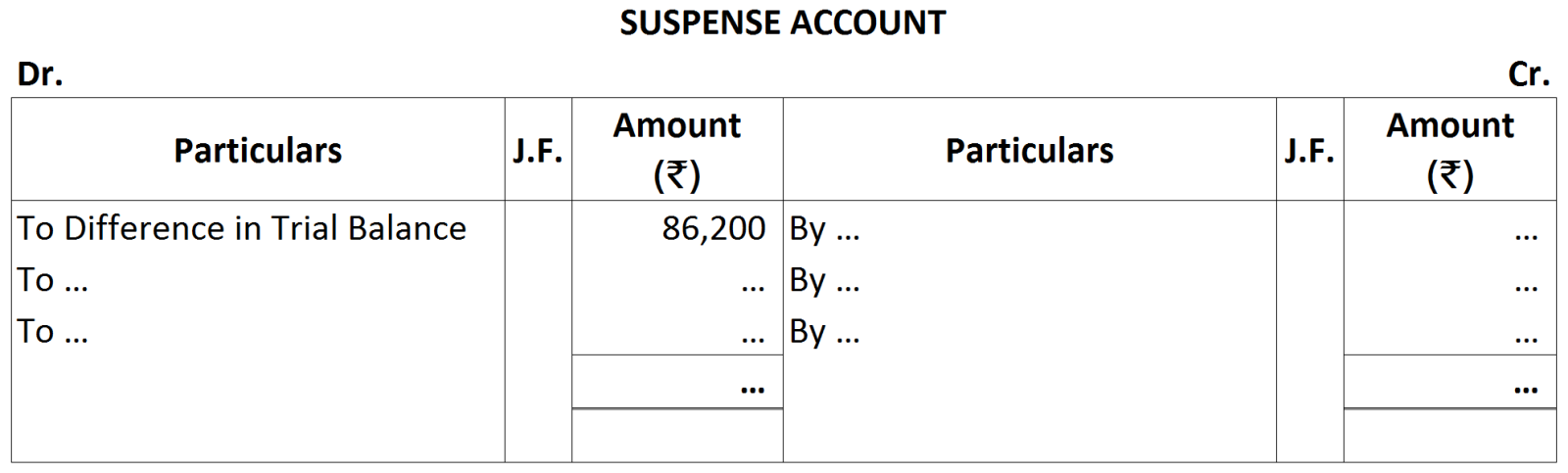
A Book-keeper finds that the totals of his trial balance disagree by ₹ 2,800. He temporarily debits a Suspense Account with this amount and closes the books. On an examination of the books, the following errors are discovered:-
  1. The total of Purchase Return Book ₹ 710 was posted Twice.
  2. Goods costing ₹ 800 were distributed as free samples but no entry was passed in the books.
  3. Purchase of Machinery for ₹ 5,600 on credit was recorded in Purchase Book as ₹ 6,500.
  4. Cash Sales to Ram Lal for ₹ 1,200 were recorded in Cash Book as well as in Sales Book and were posted from both.
  5. Closing Stock has been overvalued by ₹ 1,500.
  6. Sales Return Book was untotalled, though personal accounts were posted ₹ 1,580.
  7. No entries have been made in the Cash Book for the Insurance Premium directly paid by bank ₹ 700 and interest charged on overdraft ₹ 320.
  8. A sum of ₹ 200 for Drawings on the Credit Side of Cash Book was not posted to the Drawings account.
Pass entries to rectify the above errors. Close the Suspense Account already opened.
View full question & answer
Question 536 Marks
The accountant of a firm finds that the Trial Balance as on 31st March, 2019 is out by an excess debit of ₹ 283. He placed the amount in the Suspense Account. In the first week of April, 2019, he discovered the following errors. Pass the Journal entries necessary to rectify these errors and show the Suspense Account as it would appear at the end of the week. Have you any comment to make?
  1. Cash paid to Amar Nath, ₹ 75, was posted to the credit of Amar Singh's Account as ₹ 57.
  2. Discount allowed by Brijesh of ₹ 5 was not entered in the Cash Book but Brijesh stands debited correctly.
  3. No entry was made for goods worth ₹ 40 taken away by proprietor for personal use.
  4. ₹ 500 received from Jhaveri Bros. for interest on loan advanced to them were recorded in the Cash Book. But the entry was not posted in the Ledger.
  5. The total of Returns Outward Book was short by ₹ 100.
View full question & answer
Question 546 Marks
Rectify the following errors which were detected before preparing the Trial Balance:
  1. The total of Sales Book carried forward ₹ 5,000 less.
  2. A credit sale to Sita ₹ 6,300 posted as ₹ 3,600.
  3. A credit sale to Radha ₹ 2,400 posted as ₹ 4,200.
  4. A credit sale to Parbati ₹ 3,000 credited to her account.
  5. A credit sale to Laxmi ₹ 5,600 credited as ₹ 6,500.
View full question & answer
Question 556 Marks
Pass Journal entries to rectify the errors in the following cases:
  1. A purchase of goods from David amounting to ₹ 150 has been wrongly passed through the Sales Book.
  2. A credit sale of goods of ₹ 120 to Peter has been wrongly passed through the Purchases Book.
  3. ₹ 200, salary paid to Cashier, Bimal, stands wrongly debited to his Personal Account.
  4. A credit sale of ₹ 4,230 to Krishan entered as purchase from Kishan ₹ 4,320.
  5. Ramesh's Account was credited with ₹ 840 twice instead of once.
View full question & answer
Question 566 Marks
Rectify the following errors assuming:-
That such a suspense account has been opened.
  1. Goods costing ₹ 800 purchased from Sachin on credit were omitted to be credited to his account.
  2. Goods costing ₹ 800 purchased from Sachin on credit were credited to his account as ₹ 80.
  3. Goods costing ₹ 800 purchased from Sachin on credit were credited to his account as ₹ 880.
  4. Goods costing ₹ 800 purchased from Sachin on credit were posted to the debit of his account.
  5. Goods costing ₹ 800 purchased from Sachin on credit were posted to the debit of his account as ₹ 80.
View full question & answer
Question 576 Marks
Rectify the following errors assuming that suspension account was opened. Ascertain the difference in trial balance.
  1. Furniture purchased for ₹ 10,000 wrongly debited to purchase account as ₹ 4,000.
  2. Machinery purchased on credit from Raman for ₹ 20,000 recorded through Purchases Book as ₹ 6,000.
  3. Repairs on machinery ₹ 1,400 debited to Machinery account as ₹ 2,400.
  4. Repairs on overhauling of second hand machinery purchased Rs. 2,000 was debited to Repairs account as ₹ 200.
  5. Sale of old machinery at book value ₹ 3,000 was credited to sales account as ₹ 5,000.
View full question & answer
Question 586 Marks
Rectify the following errors:
  1. Purchases Book is overcast by ₹ 500.
  2. Salary paid to an employee, Mr. Ajay, is debited to his Personal account ₹ 3,000.
  3. Goods sold to Shashi on credit ₹ 300 have been wrongly passed through the Purchases Book.
  4. Total of Returns Inward Book has been added ₹ 9 short.
  5. Purchase of chair from Happy Traders for ₹ 35 has been entered in the Purchases Book as ₹ 53.
View full question & answer
Question 596 Marks
During the course of an accounting year, the accountant prepared a trial balance which did not tally. He put the difference in a suspense account. Subsequently, he located the following errors in his books of account:
  1. The total of the returns outwards book, ₹ 21,500 has not been posted.
  2. A sale of ₹ 4,300 to Ramesh has been credited to him as ₹ 3,400.
  3. A sale of ₹ 2,960 to Shyam has been recorded in sales book as ₹ 2,690.
  4. Old furniture sold for cash worth ₹ 5,400 has been posted in sales account as ₹ 4,500. There was no profit or loss on sale.
  5. Goods taken by proprietor worth ₹ 1,000 have not been recorded in the books of account at all.
Pass journal entries of rectify the above mentioned errors and prepare suspense account assuming no error has remained undetected.
View full question & answer
Question 606 Marks
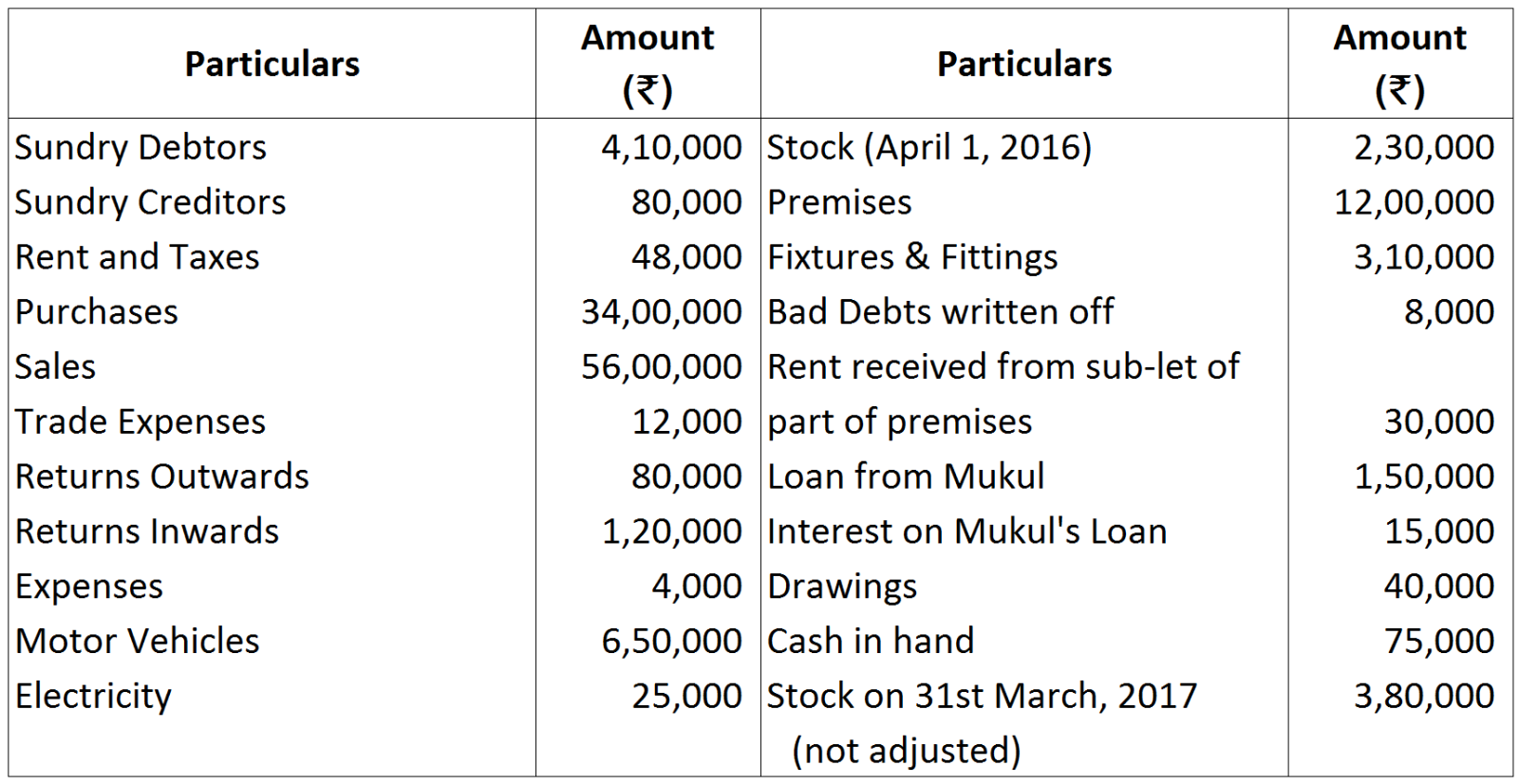
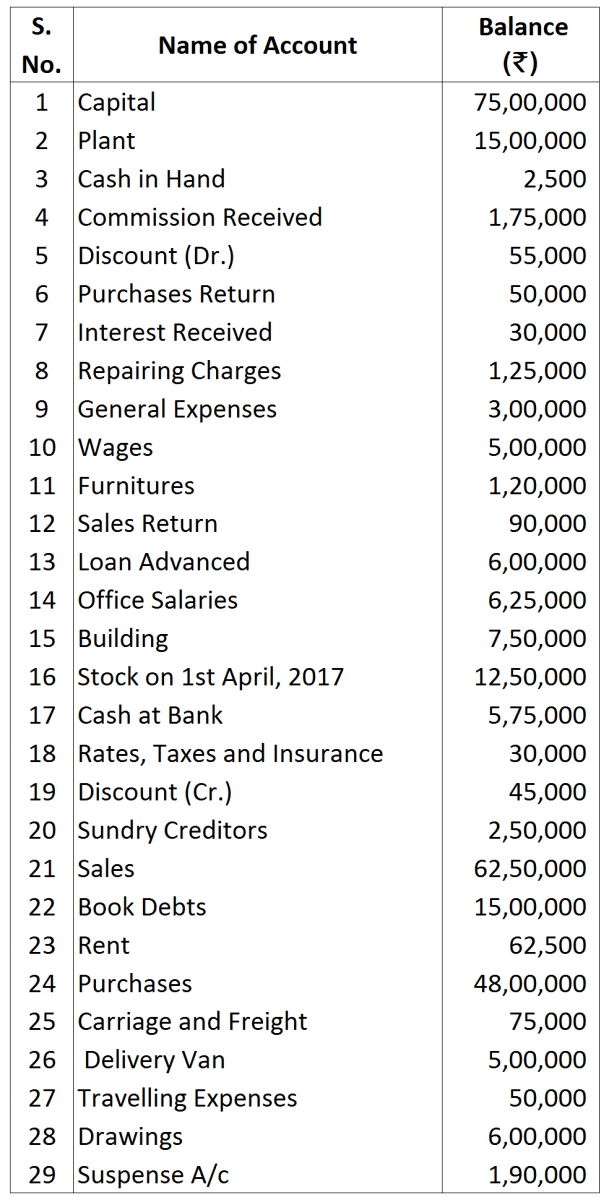
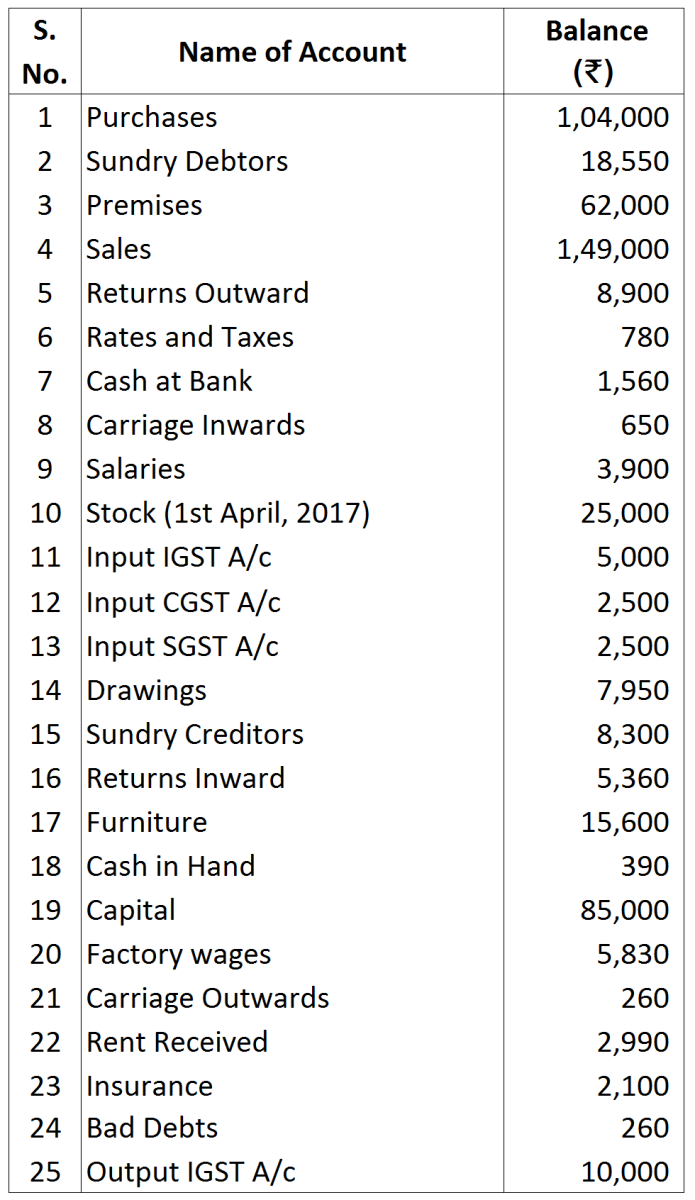
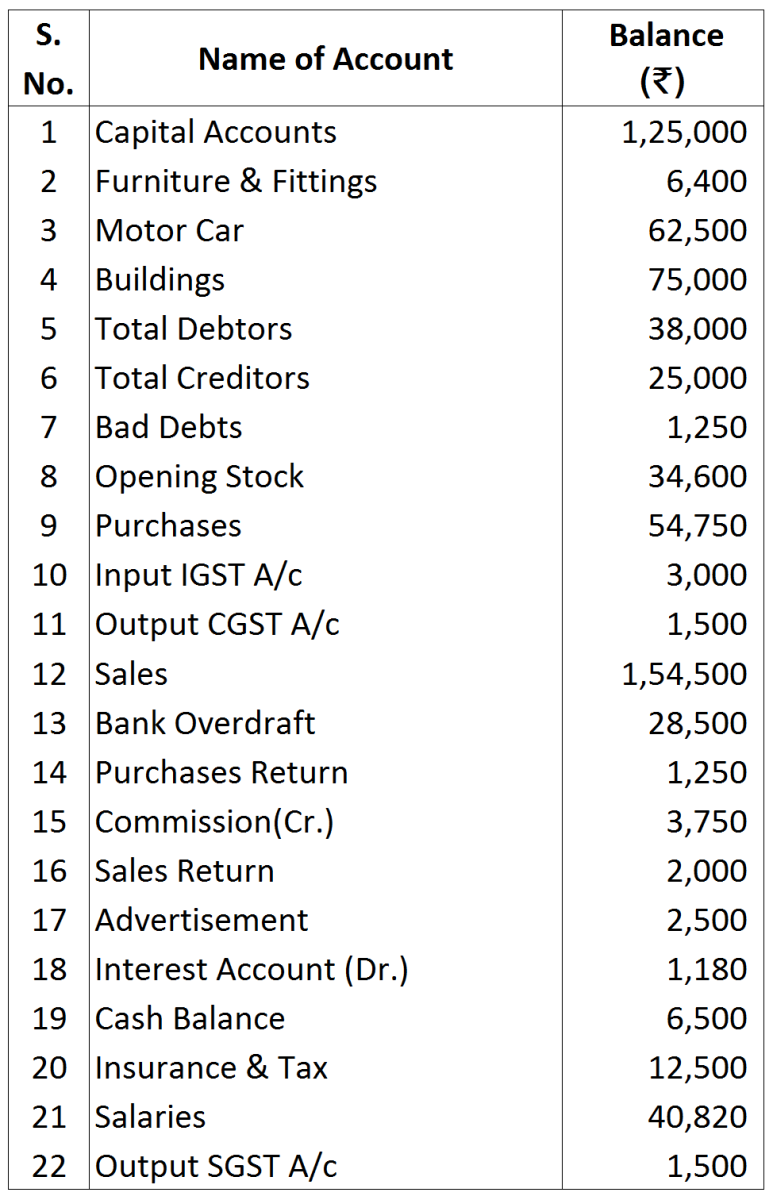
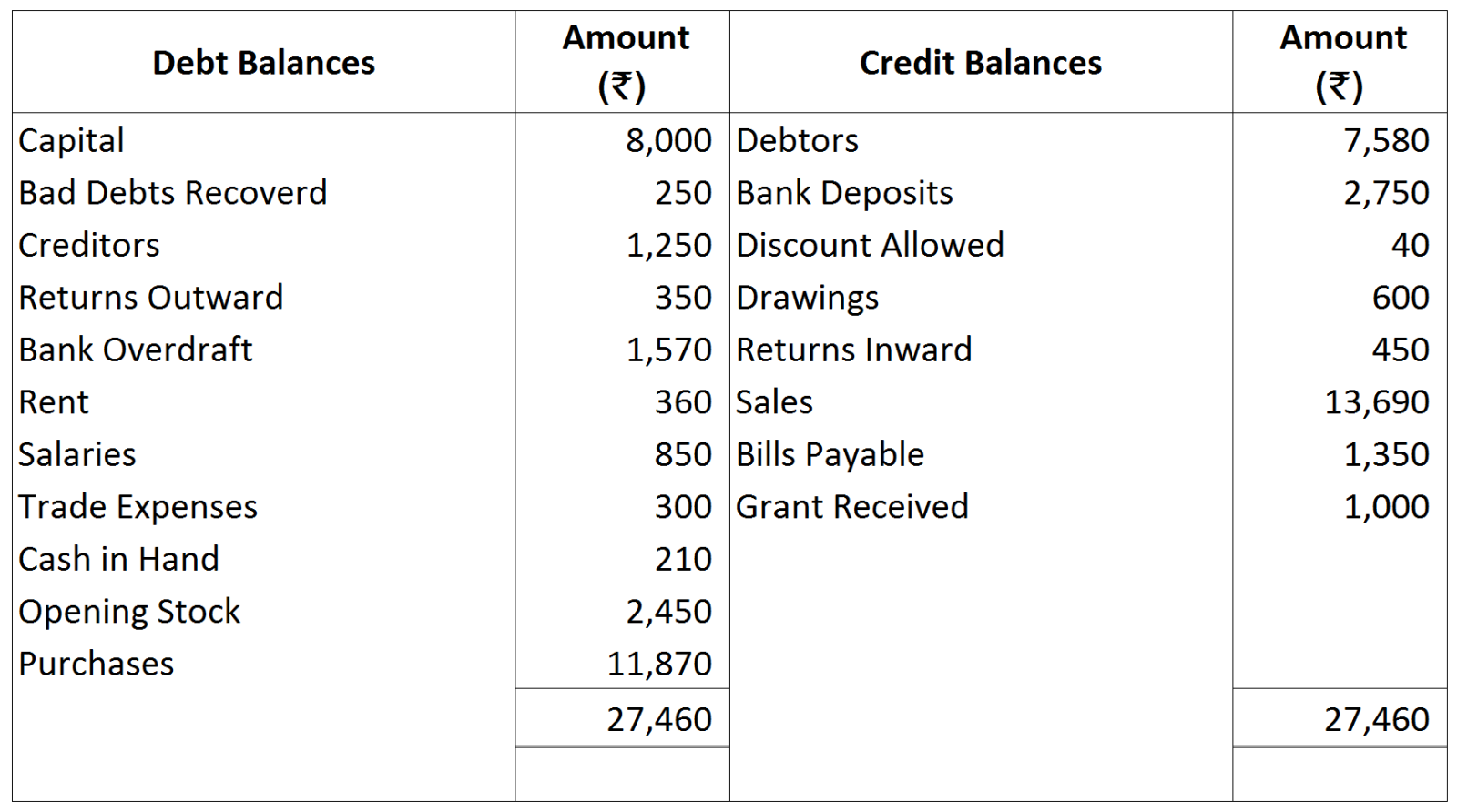
Following balances were extracted from the books of Ravinder Associates as at 31st March, 2017: You are required to prepare the trial balance treating the difference as his capital.
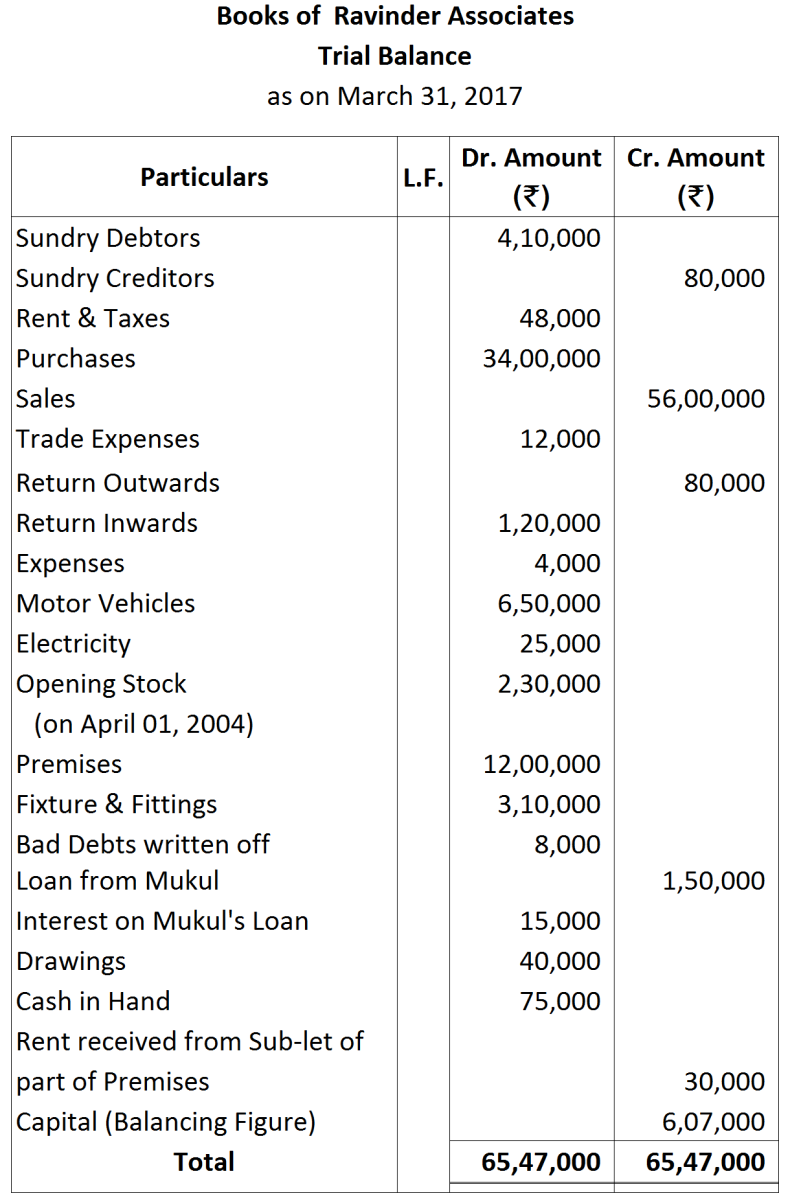
Answer

Note: Closing Stock of ₹ 3,80,000 will not appear in Trial Balance, because it has not been accounted yet.
View full question & answer
Question 616 Marks
The accountant of X prepared the Trial Balance at the end of the year on 31st March, 2015. But there was a difference and the accountant put the difference in a Suspense Account. Rectify the following errors found and prepare the Suspense Account:
  1. The total of the returns outward book ₹ 420 has not been posted in the ledger.
  2. A purchase of ₹ 350 from Y has been entered in the sales book. However Y's Account has been correctly entered.
  3. A sale of ₹ 390 to Z has been credited to his account ₹ 290.
  4. Old furniture sold for ₹ 5,400 had been posted as ₹ 4,500 in Sales Account.
  5. Goods taken by the proprietor ₹ 500 have not been entered in the books at all.
View full question & answer
Question 626 Marks
Rectify the following errors:
  1. Furniture purchased for ₹ 10,000 wrongly debited to Purchases Account.
  2. Machinery purchased on credit from Raman for ₹ 20,000 was recorded through Purchases Book.
  3. Repairs on machinery ₹ 1,400 debited to Machinery Account.
  4. Repairs on overhauling of second hand machinery purchased ₹ 2,000 was debited to Repairs Account.
  5. Sale of old machinery at book value of ₹ 3,000 was credited to Sales Account.
View full question & answer
Question 636 Marks
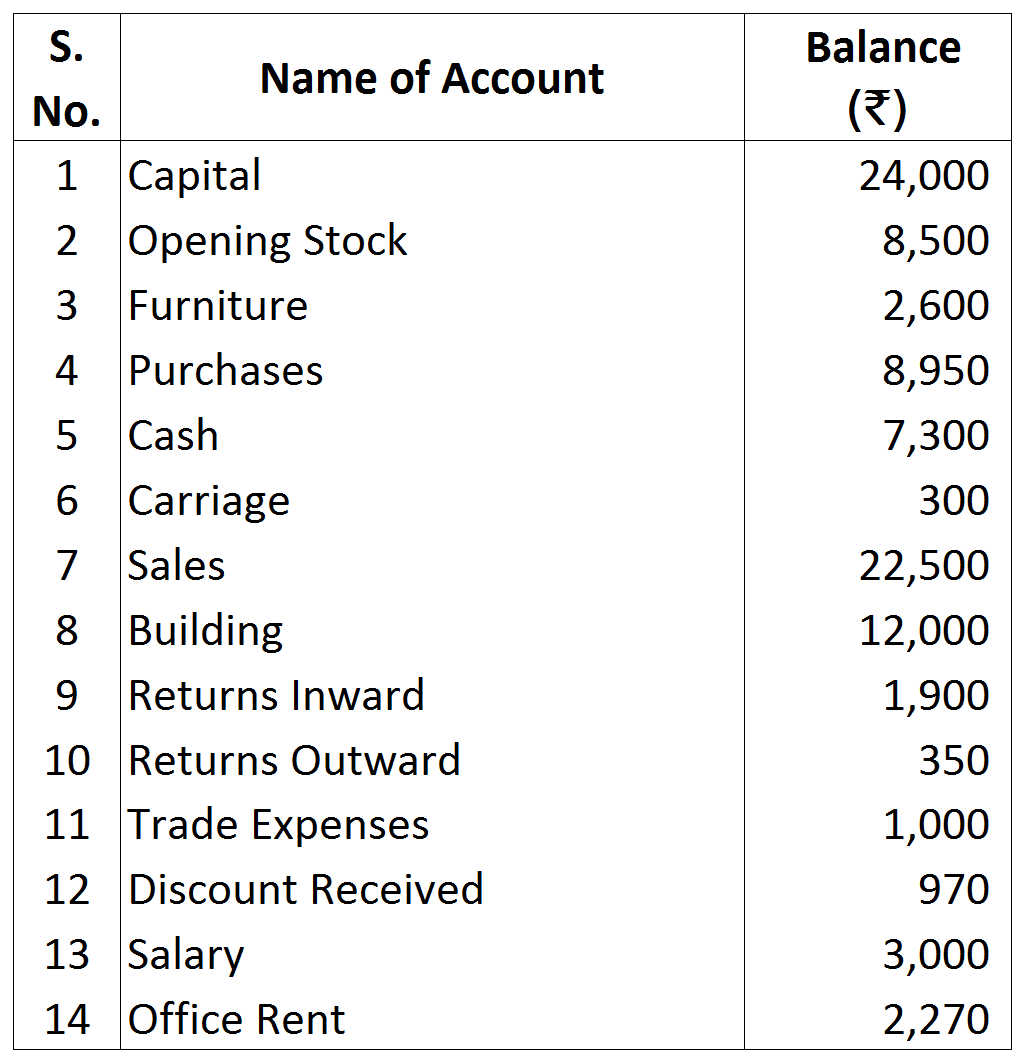
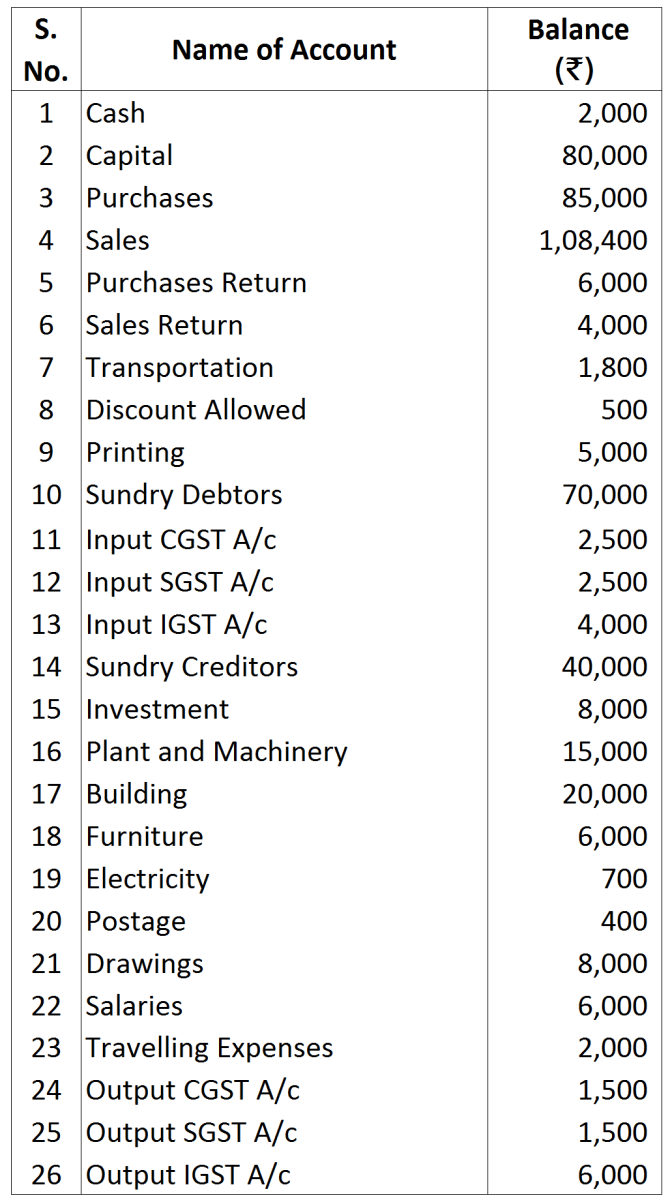
The following are the balances extracted from the books of Mr. A. Mukhopadhyay. Prepare a Trial Balance as on 31st March, 2019:
View full question & answer
Question 646 Marks
What are the methods of preparing trial balance?
Answer
A trial balance can be prepared in the following three ways:
  • Totals Method: In this method, the total of the debit and the credit side of the ledger is determined and presented separately in the trial balance. The total of both the sides should match as the accounts are based on double entry system.
  • Balances Method: In this method, the balances of all ledger accounts are presented in their respective debit and credit columns of the trial balance. The total of both the sides should match as the accounts are based on double entry system and this method of preparing a trial balance is widely used because it helps in the preparation of financial statements.
  • Totals-cum-balances Method: This method is a blend of the totals and balances method. This method has four columns. The first two columns are to write the totals of the debits and credits of the various accounts and the other two columns are to write the debit or the credit balances of these accounts. This method is time consuming, and hence are not used widely.
View full question & answer
Question 656 Marks
From the following information, prepare a Trial Balance of M/s. Prayag for the year ended $31^{st}$​​​​​​​ March,$ 2019:$​​​​​​​
View full question & answer
Question 666 Marks
Rectify the following errors assuming:-
That no suspense account has been opened with difference in the trial balance.
Answer
  1. Purchases of ₹ 800 from Sachin have been omitted to be posted to his account. It is a mistake at the time of posting in the ledger. Since the entry in the Purchases Book is correct, total of Purchases Book will also be correct. The mistake is only in Sachin’s account where ₹ 800 has not been posted to the credit side of his account. So it would be rectified by crediting Sachin’s account with ₹ 800.
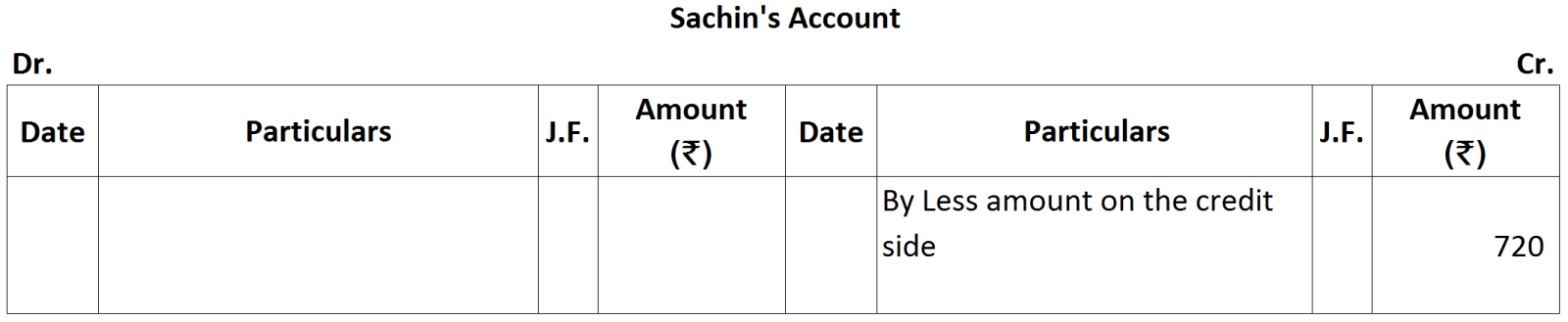
  1. Purchases of ₹ 800 from Sachin have been posted to his account as ₹ 80. It is a mistake at the time of posting in the ledger. Because the entry in the Purchase Book is correct, so there is no mistake in Purchases account, the mistake will affect only Sachin’s Account where lesser amount has been credited to his account. So, ₹ 720 more will be credited to his account for rectification of this error.
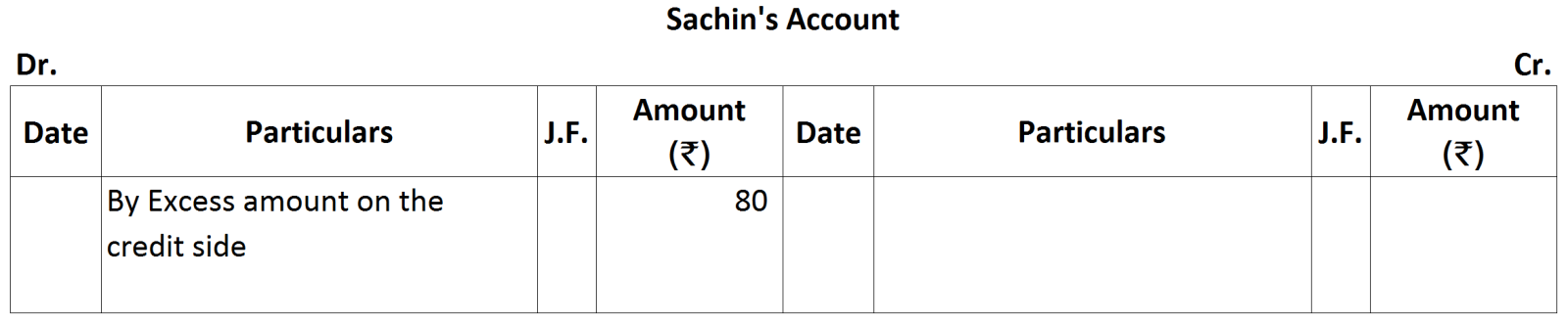
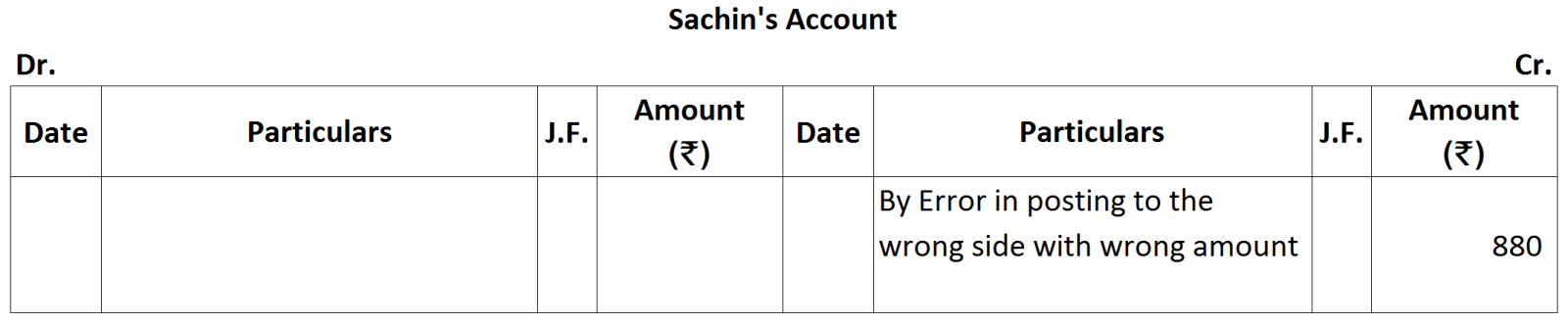
  1. Purchases of ₹ 800 from Sachin have been posted to his account as ₹ 880. It is a mistake at the time of posting in the ledger. Because the entry in the Purchase Book is correct, so there is no mistake in Purchases account, the mistake will affect only Sachin’s account where an excess amount of ₹ 80 is credited to his account. So ₹ 80 will be debited to his account for rectification of this error.
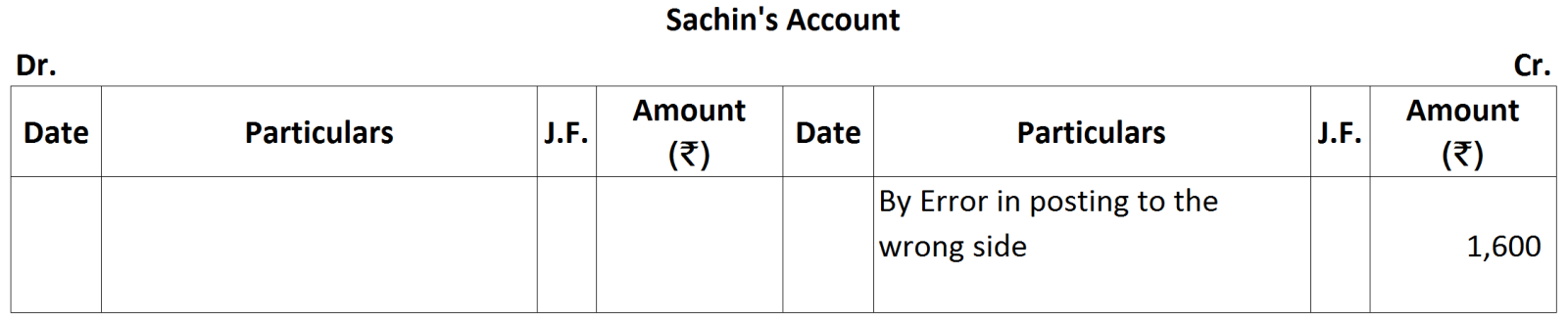
  1. Purchase of ₹ 800 from Sachin have been posted to the debit side of his account. It is a mistake at the time of posting in the ledger. There is no mistake in Purchases account the mistake will affect only Sachin’s account. Sachin’s account has been wrongly debited with ₹ 800 instead of crediting his account. Hence rectification would be made by double the amount of entry.
​​​​​​​
  1. Purchase of ₹ 800 from Sachin have been posted to the debit side of his account as ₹ 80. It is a mistake at the time of posting in the ledger. There is no mistake in Purchases account the mistake will affect only Sachin’s account. Sachin’s account has been wrongly debited with ₹ 80 instead of crediting his account as ₹ 800. Hence rectification would be made by adding these two amounts and ₹ 880 will be credited to his account.
​​​​​​​​​​​​​​
View full question & answer
Question 676 Marks
A Trial Balance showed excess credit of ₹ 2,728, which were placed in a suspense account. Later on the following errors were located. Pass rectifying entries and prepare Suspense A/c.
  1. ₹ 825, the total of purchase return book has been posted to the debit of sales return account.
  2. Goods purchased from Suresh ₹ 1,800 recorded in Sales Book as ₹ 180.
  3. An item of ₹ 328 written off as a bad debt from Ajay Sharma has not been debited to Bad Debts Account.
  4. Goods purchased from X ₹ 3,500 and from Y ₹ 4,000, but were recorded in the purchase book as X ₹ 4,000 and Y ₹ 3,500.
  5. Goods returned to Ramesh for ₹ 2,600 was correctly recorded in the return outward book but was wrongly posted to his account as ₹ 260.
  6. A sum of ₹ 2,210 stolen by an ex-employee stand debited to Suspense A/c.
  7. A sum of ₹ 500 written off as depreciation on Machinery, were not posted to Machinery account.
View full question & answer
Question 686 Marks
Rectify the following errors assuming that Suspense Account was opened. Ascertain the difference in Trial Balance.
  1. Credit sales to Mohan ₹ 7,000 were recorded in Purchase Book. However, Mohan's Account was correctly debited.
  2. Credit purchases from Rohan ₹ 9,000 were recorded in Sales Book. However, Rohan's Account was correctly credited.
  3. Goods returned to Rakesh ₹ 4,000 were recorded in Sale Returns Book. However, Rakesh's Account was correctly debited.
  4. Goods returned from Mahesh ₹ 1,000 were recorded through Purchase Returns Book. However, Mahesh's Account was correctly credited.
  5. Goods returned to Naresh ₹ 2,000 were recorded through Purchases Book. However, Naresh's Account was correctly debited.
View full question & answer
Question 696 Marks
Rectify the following errors found in the books of Bheem. Trial Balance had ₹ 930 excess credit. The difference has been posted to a Suspense Account:
  1. The total of Returns Inward Book has been cast ₹ 1,000 short.
  2. The purchase of an office table costing ₹ 3,000 has been passed through the Purchases Book.
  3. ₹ 3,750 paid for wages to workmen for making showcases had been charged to the Wages Account.
  4. A purchase of ₹ 670 had been posted to the Creditors' Account as ₹ 600.
  5. A cheque for ₹ 2,000 received from Nakul had been dishonoured and was passed to the debit of the Allowances Account.
  6. An amount of ₹ 15,720 due from Prasad written off as had in a previous year, was recovered and credited to the Personal Account of Prasad.
After rectification reflect the transactions in the Suspense Account.
View full question & answer
Question 706 Marks
Rectify the following errors:-
  1. ₹ 4,500 spent on the extension of Buildings were debited to Repairs A/c.
  2. Wages paid to the firm's own workmen ₹ 3,600 for the installation of a new machinery were posted to Wages Account.
  3. Contractor's bill for the construction of a godown at a cost of ₹ 10,000 has been charged to 'Repairs' A/c.
  4. ₹ 1,500 paid as Wages to a worker 'Bahadur Singh', has been debited to his personal account.
  5. Old furniture sold for ₹ 500 has been credited to Sales Account.
  6. A cheque of ₹ 620 received from Ram, has been wrongly credited to Shyam.
View full question & answer
Question 716 Marks
Trial Balance of a bookkeeper shows an excess of debits over credits by ₹ 261. This difference is placed in a Suspense Account to facilitate books closure. Later on the following errors were discovered:
  1. A credit item of ₹ 349 has been debited to a Personal Account as ₹ 439.
  2. A sum of ₹ 625 written off from fixtures as depreciation has not been posted to the Depreciation Account.
  3. ₹ 9,000 paid for furniture bought have been charged to the Purchases Account.
  4. A discount allowed to a customer has been credited to him as ₹ 145 in place of ₹ 154.
  5. A sale of ₹ 594 was posted as ₹ 495 in the Sales Account.
  6. The total of Returns Inward Book has been added ₹ 10 short.
Pass the Journal entries to correct these errors and prepare the Suspense Account.
View full question & answer
Question 726 Marks
Rectify the following errors assuming that suspense account was opened. Ascertain the difference in trial balance.
  1. Credit sales to Mohan ₹ 7,000 were recorded in Purchase Book. However, Mohan’s account was correctly debited.
  2. Credit purchases from Rohan ₹ 9,000 were recorded in sales book. However, Rohan’s account was correctly credited.
  3. Goods returned to Rakesh ₹ 4,000 were recorded in sales return book. However, Rakesh’s account was correctly debited.
  4. Goods returned from Mahesh ₹ 1,000 were recorded through purchases return book. However, Mahesh’s account was correctly credited.
  5. Goods returned to Naresh ₹ 2,000 were recorded through purchases book. However, Naresh’s account was correctly debited.
View full question & answer
Question 736 Marks
From the following balances extracted from the Ledger of Sri Narugopal, prepare Trial Balance as on 31st March, 2019:
View full question & answer
Question 746 Marks
What is a Trial Balance? Name the errors that are disclosed by a Trial Balance.
Answer
Trial Balance: Trial Balance is a statement of accounts which appears in the Ledger and Cash Book showing either the balances or the total amounts of debit and credit items.
Errors Disclosed by a Trail Balance.
  1. Posting of wrong amount: Sometimes, wrong amount is posted in one of the two accounts. For example goods sold of $ 500 are correctly entered in credit side of sales account but it was debited in cash account as $ 550. There is a difference in amount of $ 50. As a result trial balance shows the disagreement.
  2. Posting on the wrong side: When an item is by mistake posted on the wrong side of an account in the ledger, it would cause disagreement in the trial balance. Suppose, wages paid of $1500. In this case, wages account must be debited by $ 1500. But wages account was debited accurately however cash account was also debited instead of crediting it. It created the excess amount in debit side.
  3. Wrong totaling of subsidiary books: When there is error in totaling of subsidiary books, that will cause disagreement of trial balance. Suppose sales book has been totaled $ 1000 instead of $ 1050.
  4. Wrong totaling or balancing of ledger account: Sometimes, errors may be committed in writing totaling or balancing of ledger account the trial balance will disagree.
  5. Ommission to post an amount into ledger: When an aspect of transaction is omitted to post in ledger account, the trial balance shows disagreement. For example, cash paid for interest $ 200. Interest account was debited by the same amount but it was omitted to credit in cash account.
  6. Ommission to enter an amount in trial balance: If an amount is omitted to enter in trial balance while transferring from ledger balances, then the trial balance shows disagreement.
View full question & answer
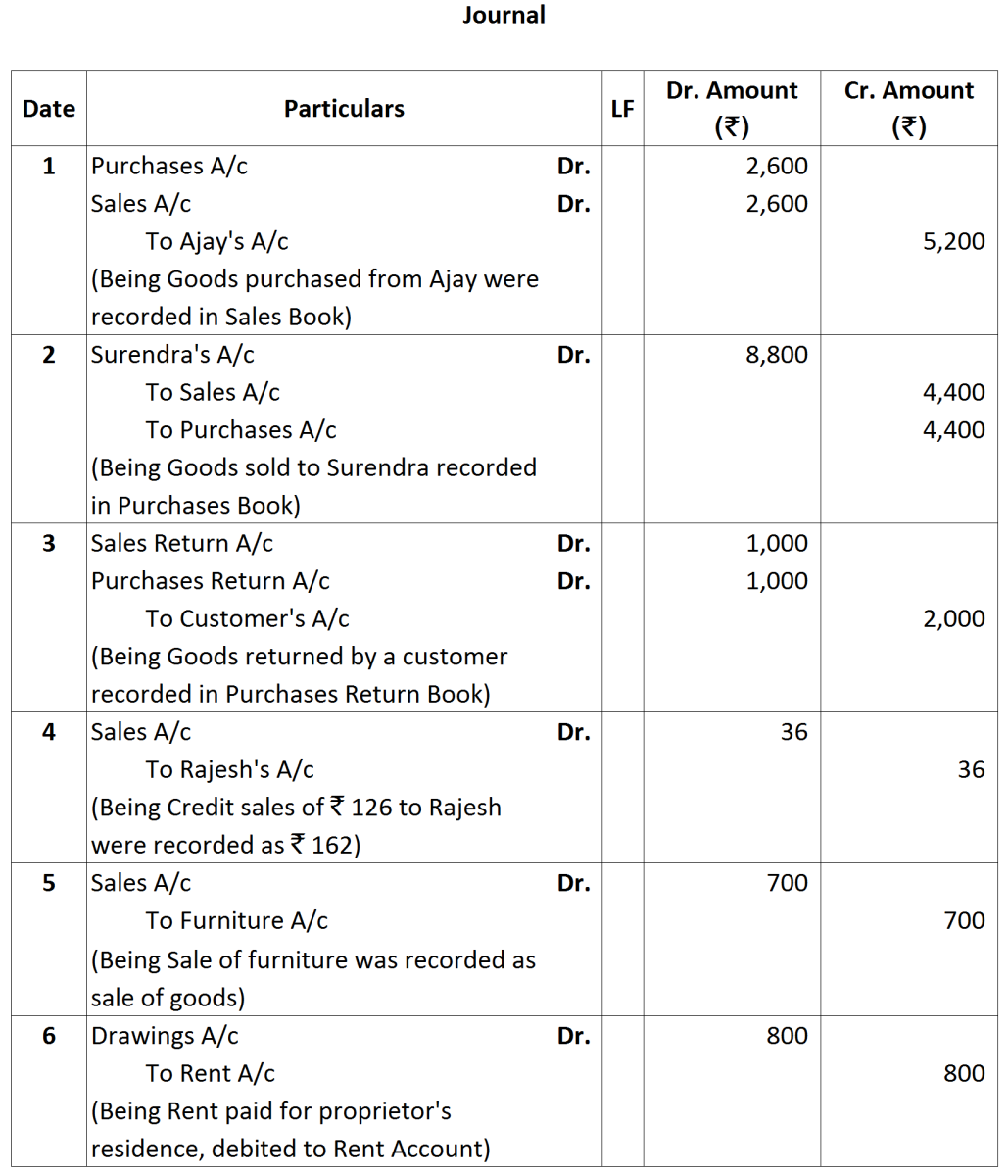
Question 756 Marks
Give Journal Entries to rectify the following errors:-
  1. Goods purchased from Ajay for ₹ 2,600 were recorded in Sales Book by mistake.
  2. Goods for ₹ 4,400 sold to Surendra was passed through Purchase Book.
  3. A customer returned goods worth ₹ 1,000. It was recorded in 'Purchase Return Book'.
  4. A credit sale of ₹ 126 to Rajesh was entered in the books as ₹ 162.
  5. Sale of old chairs and Table for ₹ 700 was treated as sale of goods.
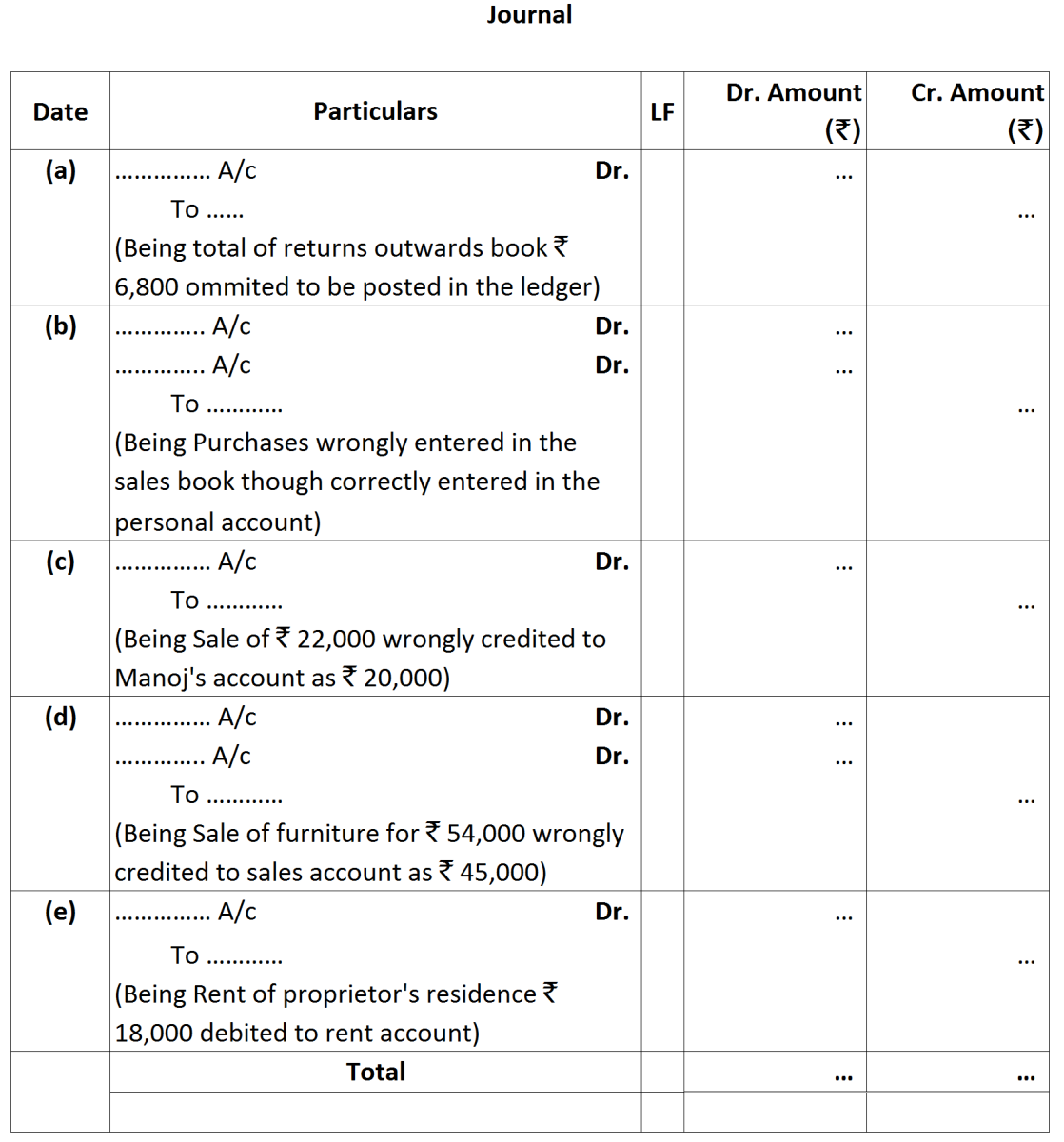
  6. Rent of proprietor's residence, ₹ 800, debited to Rent A/c.
Answer
Solution is as follows.
View full question & answer
Question 766 Marks
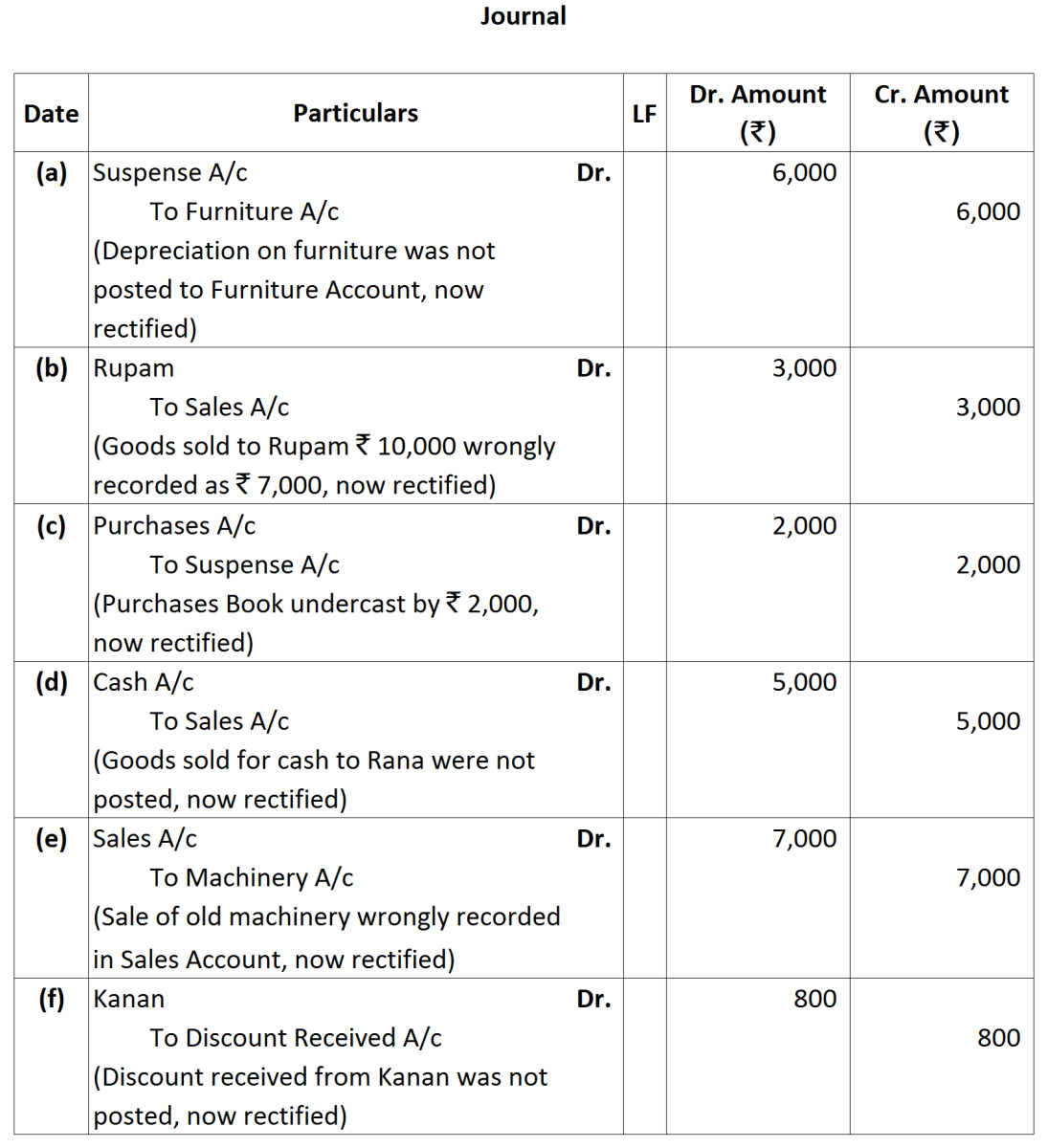
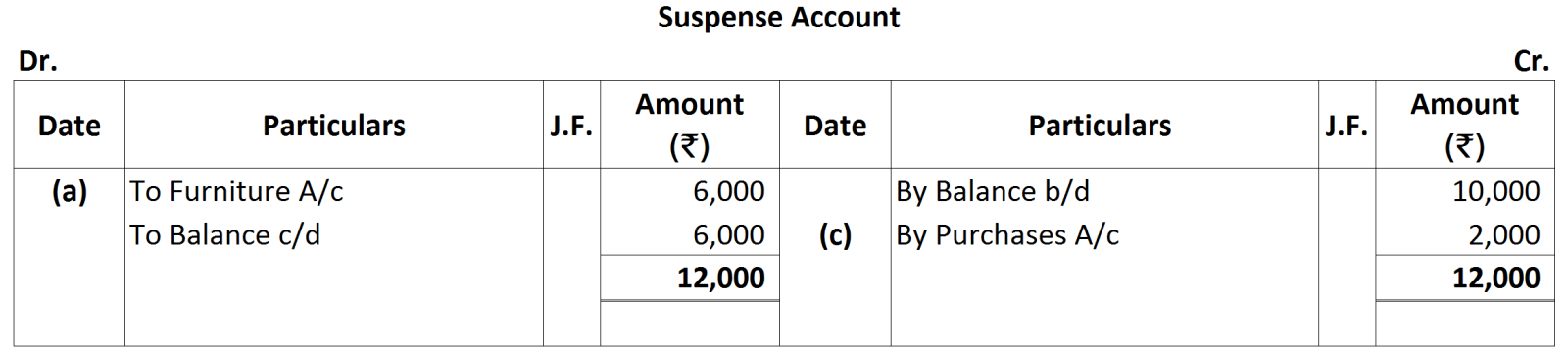
Trial balance of Raju showed an excess debit of ₹ 10,000. He put the difference to suspense account and discovered the following errors:
  1. Depreciation written-off the furniture ₹ 6,000 was not posted to Furniture account.
  2. Credit sales to Rupam ₹ 10,000 were recorded as ₹ 7,000.
  3. Purchases book undercast by ₹ 2,000.
  4. Cash sales to Rana ₹ 5,000 were not posted.
  5. Old Machinery sold for ₹ 7,000 was credited to sales account.
  6. Discount received ₹ 800 from kanan on playing cash to him was not posted.
Rectify the errors and prepare suspense account.
Answer


Note: As per the solution, suspense account shows the credit balance of ₹ 6,000. However, in the book the answer is credit balance of ₹ 1,000. So, in order to match the answer with the book item (d) is taken as, ‘Cash Sales to Rana ₹ 5,000 were not posted to the sales account.’ Thus, the rectifying entry of this error will be:
Suspense A/c
Dr.
5,000
 
To Sales A/c
 
 
5,000
View full question & answer
Question 776 Marks
Classify the under-mentioned errors into:
  1. Error of Omission
  2. Error of Commission
  3. Compensating Error
  4. Error of Principle
  1. Purchased goods from Bhardwaj on credit for ₹ 600, but were recorded in the purchase book as ₹ 6,000.
  2. Amount paid for the proprietor’s life insurance premium was debited to 'General Expenses Account'.
  3. Goods amounting to ₹ 2,000 have been returned to Chakravarti, but no entry has been made in the books.
  4. An excess debit of ₹ 4,500 has been made in the account of X, whereas Y's account has been credited by ₹ 5,000 instead of ₹ 500.
  5. Goods sold to Suresh for ₹ 650 were recorded as ₹ 560 in the Sales Book.
  6. Typewriter purchased for office use has been debited to Purchases Account.
  7. Wages paid for the construction of Building ₹ 15,000 were recorded in "Wages Account'.
  8. Goods for ₹ 500 have been taken by the proprietor for his personal use, for which no entry has been passed in the books.
Answer
Error of Omission:
  1. Goods amounting to ₹ 2,000 have been returned to Chakravarti, but no entry has been made in the books.
  1. Goods for ₹ 500 have been taken by the proprietor for his personal use, for which no entry has been passed in the books.
Error of Commission:
  1. Purchased goods from Bhardwaj on credit for ₹ 600, but were recorded in the purchase book as ₹ 6,000.
  1. Goods sold to Suresh for ₹ 650 were recorded as ₹ 560 in the Sales Book.
Compensating Error:
  1. An excess debit of ₹ 4,500 has been made in the account of X, whereas Y's account has been credited by ₹ 5,000 instead of ₹ 500.
Error of Principle:
  1. Amount paid for the proprietor’s life insurance premium was debited to 'General Expenses Account'.
  1. Typewriter purchased for office use has been debited to Purchases Account.
  1. Wages paid for the construction of Building ₹ 15,000 were recorded in "Wages Account'.
View full question & answer
Question 786 Marks
A Book-keeper failed to balance his trial balance, the credit side exceeding the debit side by ₹ 175. This amount was entered in a Suspense Account. Later on the under mentioned errors were discovered:
  1. Goods amounting to ₹ 620 sold to D & Co. were correctly entered in the Sales book, but posted to the Company's A/c as ₹ 260.
  2. A credit balance of ₹ 755 of Rent Received account was shown as ₹ 570.
  3. The total of Returns Outwards Book amounting to ₹ 200 was not posted to the Ledger.
  4. Goods worth ₹ 100 were purchased from Prakash but the amount was entered in the Sales Book. The account of Prakash was correctly credited.
  5. Sales Book was undercast by ₹ 100.
  6. The total of the credit side of Sohan's account was overcast by ₹ 100.
Give journal entries to rectify these errors and prepare the Suspense Account.
View full question & answer
Question 806 Marks
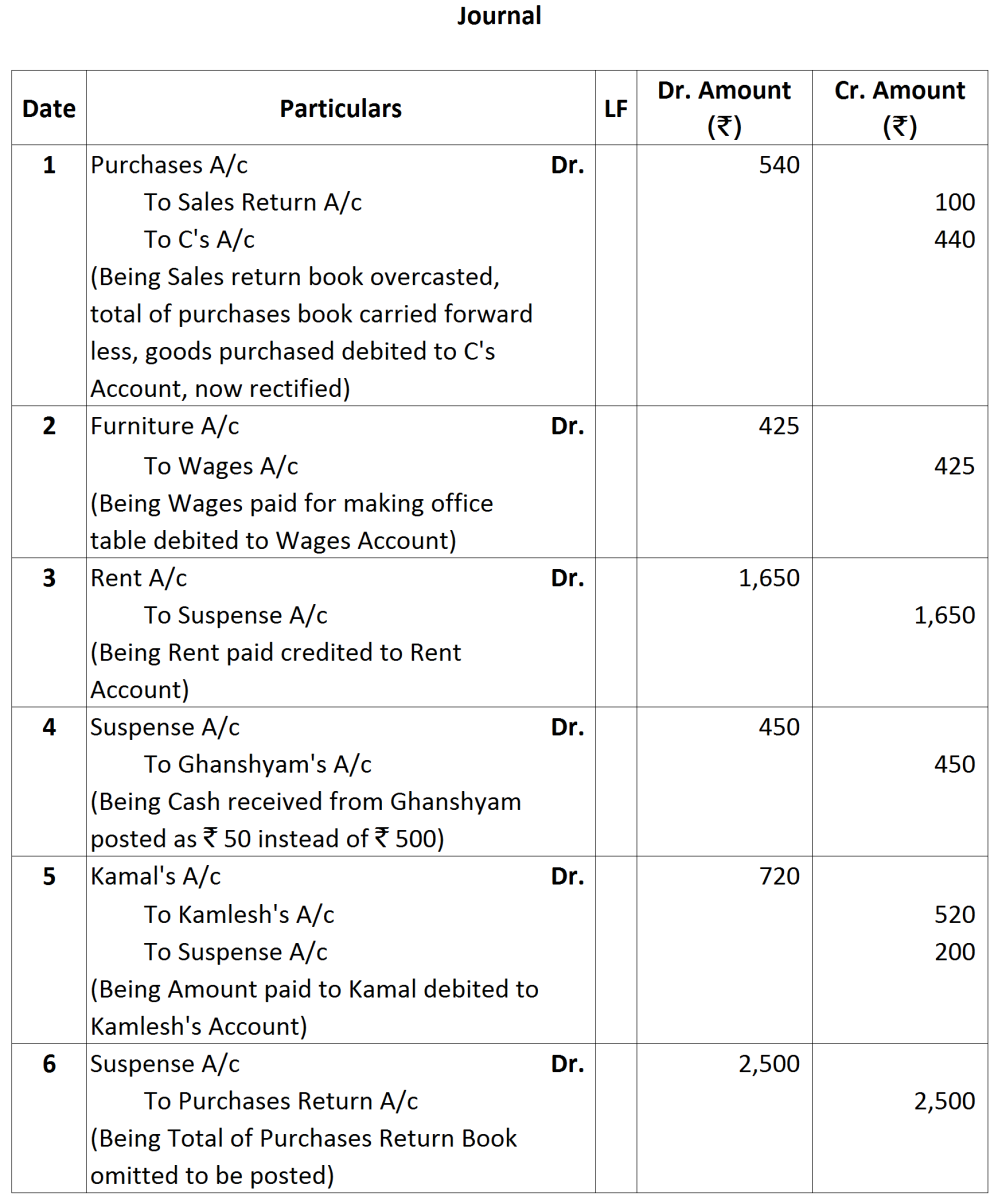
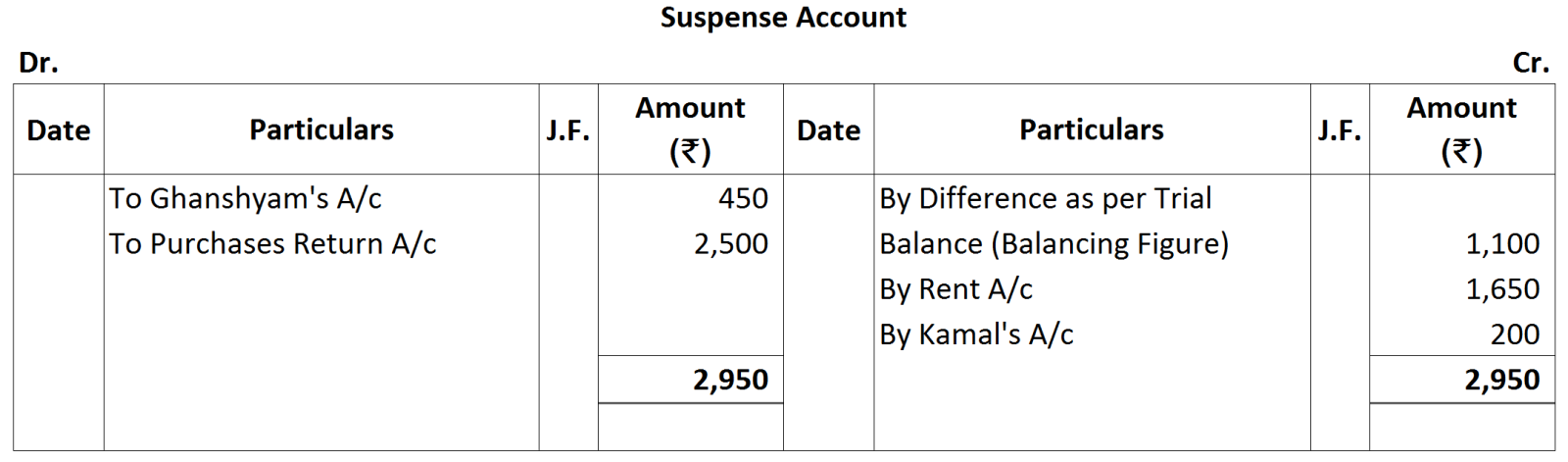
Rajesh Kumar was unable to reconcile his Trial Balance as on 31st March 2014 and has opened a suspense account from the difference. Later on the following errors were discovered:-
  1. There were three compensating errors:-
  1. The total of Sales Return Book was overcast by ₹ 100.
  2. The total of one page of the Purchase Book was carried forward as ₹ 1,286 instead of ₹ 1,826.
  3. Goods purchased from C for ₹ 400 was debited to his account as ₹ 40.
  1. ₹ 425 paid for wages to workmen for making office table were debited to wages account.
  2. Rent paid ₹ 1,500 were posted to the credit of Rent account as ₹ 150.
  3. Cash received from Ghanshyam ₹ 500 were correctly recorded in cash book but were posted to his account as ₹ 50.
  4. ₹ 720 paid to Kamal has been debited to Kamlesh A/c as ₹ 520.
  5. The total of Purchase Return Book ₹ 2,500 was left unposted.
Pass rectifying entries and prepare Suspense A/c.
Answer
Solution is as follows.

View full question & answer
Question 816 Marks
Rectify the following errors and ascertain the amount of difference in trial balance by preparing suspense account:
  1. Credit sales to Mohan ₹ 7,000 were not posted.
  2. Credit purchases from Rohan ₹ 9,000 were not posted.
  3. Goods returned to Rakesh ₹ 4,000 were not posted.
  4. Goods returned from Mahesh ₹ 1,000 were not posted.
  5. Cash paid to Ganesh ₹ 3,000 was not posted.
  6. Cash sales ₹ 2,000 were not posted.
View full question & answer
Question 826 Marks
Trial balance of Khatau did not agree. He put the difference to suspense account and discovered the following errors:
  1. Credit sales to Manas ₹ 16,000 were recorded in the purchases book as ₹ 10,000 and posted to the debit of Manas as ₹ 1,000.
  2. Furniture purchased from Noor ₹ 6,000 was recorded through purchases book as ₹ 5,000 and posted to the debit of Noor ₹ 2,000.
  3. Goods returned to Rai ₹ 3,000 recorded through the Sales book as ₹ 1,000.
  4. Old machinery sold for ₹ 2,000 to Maneesh recorded through sales book as ₹ 1,800 and posted to the credit of Manish as ₹ 1,200.
  5. Total of Returns inwards book ₹ 2,800 posted to Purchase account. Rectify the above errors and prepare suspense account to ascertain the difference in trial balance.
View full question & answer
Question 836 Marks
From the following Ledger account balances extracted from the books of R.J. Gupta, prepare a Trial Balance as on 31st March, 2019:
​​​​​​​
View full question & answer
Question 846 Marks
What are the steps taken by an accountant to locate the errors in the trial balance?
Answer
The following are various steps that an accountant takes to locate the errors in the Trial Balance.
  1. Re-totalling of the debit and the credit columns of the Trial Balance to locate the difference in the total of both the columns.
  2. Checking whether any account is omitted to be recorded with the exact difference amount.
  3. Half the difference, then check whether any amount is posted in the wrong column of the Trial Balance.
  4. Divide the difference by 9, if it is completely divisible, it is an error of transposition of figure, i.e. 546 is written as 645.
  5. If there exist differences especially of ₹ 1, ₹ 10, ₹ 100, ₹ 1000, etc., it suggests that the casting of Subsidiary Books should be checked once again.
  6. If difference still exists and it is not possible to detect the reason for the difference, then for the time being, the difference is transferred in the suspense account in order to proceed further. Otherwise, a complete checking is suggested.
View full question & answer
Question 856 Marks
Pass the rectification entries for the following transactions:
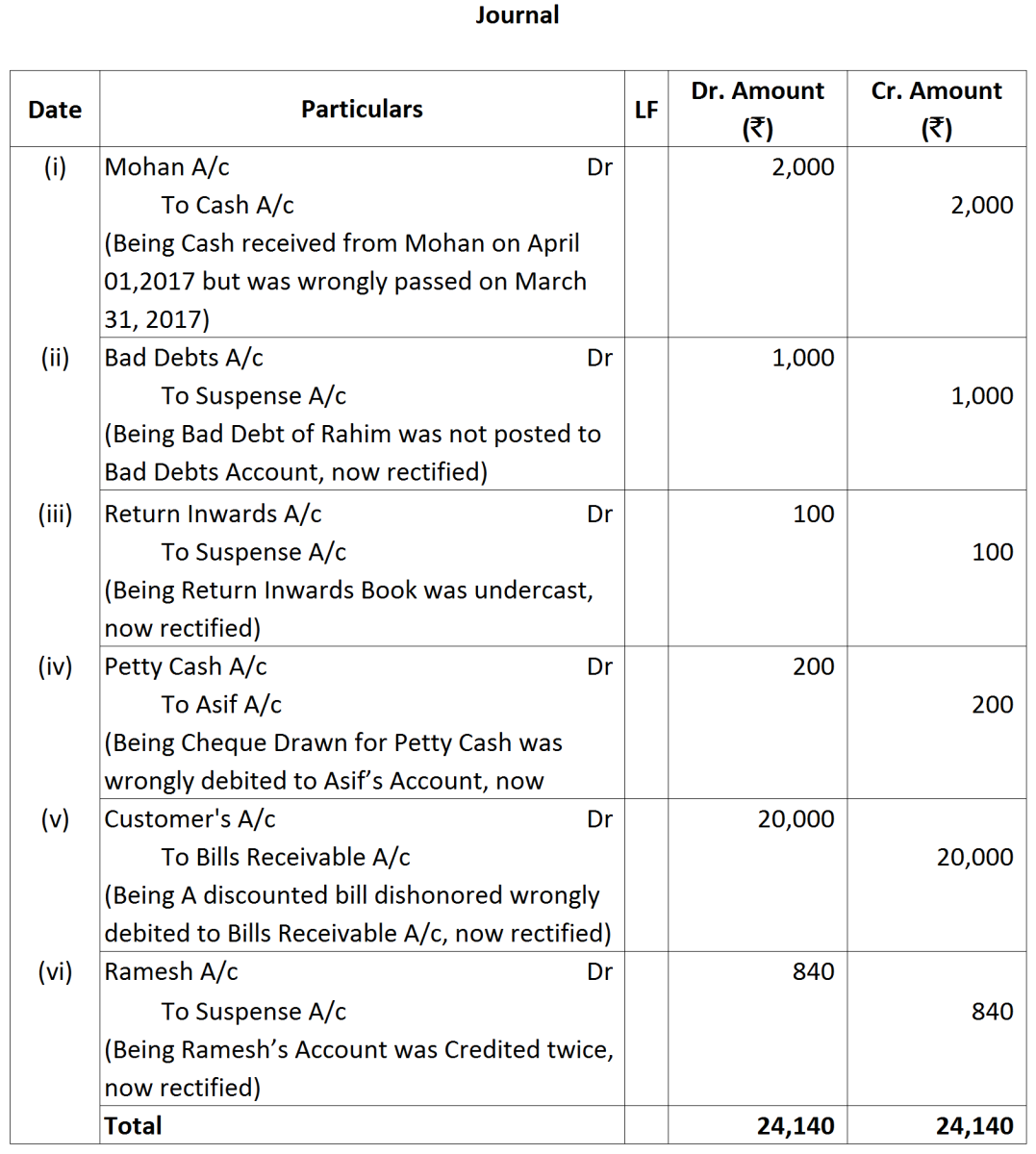
  1. An amount of ₹ 2,000 received from Mohan on 1st April, 2019 had been entered in the Cash Book as having been received on 31st March, 2019.
  2. The balance in the account of Rahim ₹ 1,000 had been written off as bad but no other account has been debited.
  3. An addition in the Returns Inward Book had been cast ₹ 100 short.
  4. A cheque for ₹ 200 drawn for the Petty Cash Account has been posted in the account of Asif.
  5. A discounted Bill of Exchange for ₹ 20,000 returned by the firm's bank had been credited to the Bank Account and debited to Bills Receivable Account. A cheque was received later from the customer for ₹ 20,000 and duly paid.
  6. Ramesh's Account was credited with ₹ 840 twice instead of once.
Answer
Solution is as follows.
View full question & answer
Question 866 Marks
The bookkeeper of a firm found that his Trial Balance was out (excess credit) by ₹ 742. He placed the amount in a Suspense Account and subsequently found the following errors:
  1. A discount of ₹ 178 was allowed to Ramesh but in his account only ₹ 100 is recorded.
  2. The total of the Purchases Book was ₹ 1,000 short.
  3. A sale of ₹ 375 to Kohli was entered in the Sales Book as ₹ 735.
  4. From the Purchases Book, Bose’s Account was debited with ₹ 175.
  5. Cash ₹ 250 received from Maitra against debt previously written off was credited to his account.
  6. Purchase of office furniture worth ₹ 750 on credit from Delhi Furnitures was entered in the Purchases Book.
  7. While carrying forward the total of the Sales Book from one page to another the amount of ₹ 11,358 was written as ₹ 11,538.
  8. The proprietor took goods of the value of ₹ 150 for his domestic consumption. No record of it has been made in the books.
  9. Repairs bill of ₹ 410 for the proprietor’s personal car, has been paid by the firm and debited to the Repairs Account.
  10. A sale to Kassim of ₹ 700 has been entered in the Purchases Book.
  11. Rectify the errors by means of suitable Journal entries and show the Suspense Account.
View full question & answer
Question 876 Marks
Pass the necessary Journal entries to rectify the following errors:
  1. Credit sale of ₹ 850 to Kishan was posted to Krishan's Account.
  2. Cash sale of ₹ 850 to Meenu was posted to the credit of Meena.
  3. Amount of ₹ 1,500 withdrawn from bank by the proprietor for his personal use was debited to Purchases Account.
  4. Credit sale of old furniture to Mohan for ₹ 1,700 was posted as ₹ 7,100.
  5. Credit sale of old furniture to Babu Ram for ₹ 3,000 was credited to Sales Account.
  6. Cheque of ₹ 1,280 received from Farid was dishonoured and has been posted to the debit of Sales Return Account.
View full question & answer
Question 886 Marks
“Is Trial Balance merely a proof of Arithmetical accuracy”? Explain the errors which are not disclosed by a Trial Balance.
Answer
Trial Balance is not a conclusive proof of the absolute accuracy of the books of account. If the Trial Balance agrees, it does not mean that there are no errors in the books of account. A tallied Trial Balance means that equal debits and credits have been recorded in the books of account. Even when Trial Balance agrees, some errors may remain undetected and may not be disclosed by the Trial Balance. Thus, the limitations of a Trial Balance are:
  1. Errors of principle, i.e., errors which arise due to incorrect application of the principle of accounting are not disclosed by the Trial Balance.
  2. Compensating errors, i.e., group of errors which are committed in such a way that one mistake is compensated by the other and the Trial Balance still agrees.
  3. Transactions completely omitted from recording in the books of account cannot be detected.
  4. Recording both aspects of a transaction twice in the books of account.
  5. Posting correct amount on the correct side but in the wrong account is not reflected by the Trial Balance.
  6. Wrong amount recorded in the books of original entry and same amount is debited and credited, is not brought out by the Trial Balance.
View full question & answer
Question 896 Marks
Pass the necessary Journal entries to rectify the following errors:
  1. Credit sale of ₹ 570 to Mohan was recorded as ₹ 750.
  2. Credit sale of ₹ 850 to Sohan was recorded as sale to Mohan.
  3. Credit sale of ₹ 850 to Meenu was recorded as sale to Meena as ₹ 580.
  4. Credit sale of ₹ 850 to Ram was recorded in the Purchases Book.
  5. Credit sale of old machinery to Sohan for ₹ 1,700 was entered in the Sales Book as ₹ 7,100.
  6. Bill Receivable for ₹ 5,000 accepted by Mahinder recorded as acceptance given to Mahinder for ₹ 6,000.
View full question & answer
Question 926 Marks
State whether the following accounts will indicate a debit or credit balance:
  1. Drawings
  2. Advance Rent Received
  3. Bad Debts
  4. Sales Return
  5. Furniture
  6. Bank Overdraft
Answer
Drawings
Dr. Balances
Advance Rent Received
Cr. Balances
Bad Debts
Dr. Balances
Sales Return
Dr. Balances
Furniture
Dr. Balances
Bank Overdraft
Cr. Balances
View full question & answer
Question 936 Marks
There was a difference of ₹ 430 in a Trial Balance. It was placed on the Debit side of a Suspense A/c. Later on the following errors were discovered. Pass rectifying entries and prepare Suspense A/c.
  1. Purchases book was overcast by ₹ 100.
  2. Sales book was overcast by ₹ 1,000.
  3. Goods for ₹ 800 purchased from Umakant, though entered in the purchase book, has not been posted to his account.
  4. An amount of ₹ 500 has been posted to the credit side of commission account instead of ₹ 570.
  5. Goods sold to Bharti for ₹ 4,400 has been posted to her account as ₹ 4,000.
  6. Goods sold to X for ₹ 750 were recorded in purchase book.
View full question & answer
Question 946 Marks
Rectify the following errors:
  1. Sold old furniture to A for ₹ 11,500 was passed through the Sales Book.
  2. Credit purchases of ₹ 12,000 from Ojas omitted to be recorded in the books.
  3. Repairs made were debited to Building Account ₹ 7,000.
  4. Credit sale of ₹ 1,800 to Avikan was recorded as ₹ 8,100.
  5. ₹ 6,000 paid for office furniture was debited to office expenses account.
  6. A credit sale of goods of ₹ 15,000 to Ramesh has been wrongly passed through the purchases Book.
View full question & answer
Question 956 Marks
What do you mean by Suspense Account? When is it opened?
Answer
Suspense Account: Suspense Account is the account to which the amount being the difference in trial balance is temporarily placed. If the total of debit side is short, Suspense Account will show debit balance. And if, the total of credit side is short, Suspense Account will show credit balance. The difference is placed in the Suspense Account so that final accounts are prepared without delay. As a result of this, Trial Balance will appear to agree.. However, the errors still remain in the Trial Balance which are identified and rectified.
Suspense Account is used for rectifying all One-Sided Errors: It is opened Due to errors any error in journal entries especially one-sided errors, There may be cases when Trial balance does not match i.e when the total of the debit column does not match that of the credit column, then the difference of the Trial Balance is transferred to a temporary account in order to avoid delay in preparation of the financial statements. This temporary account is termed as Suspense Account and it is prepared only in case of one-sided errors in the books of accounts.
View full question & answer
Question 966 Marks
In taking out the Trial Balance, book-keeper finds that he is out ₹ 3,809 excess debit. Being desirous of closing his books he places the difference to a newly opened Suspense A/c which is carried forward. In the next period he discovered that :-
  1. ₹ 17,715 received from X has not been posted to his account.
  2. A sum of ₹ 9,500 written off as depreciation on fixtures has not been posted to the Depreciation A/c.
  3. ₹ 1,50,000 paid for furniture purchased has been charged to Ordinary Purchases A/c.
  4. A discount of ₹ 3,742 allowed to a customer has been credited to him as ₹ 3,648.
  5. The total of the Inwards return has been added ₹ 900 short.
  6. An item of Sale for ₹ 5,900 was posted as ₹ 9,500 in the Sales Account.
Give the rectifying entries and prepare the Suspense Account.
View full question & answer
Question 976 Marks
The Trial Balance of S. Sen did not agree and the difference in books was carried to a Suspense Account. Pass the entries required to rectify the following errors which accounted for the difference. Also, prepare the Suspense Account:
  1. A Sales Invoice for ₹ 1,000 for goods sold on credit to B. Basu was entered in the Purchases Book but in the Ledger, the amount was correctly debited to the account of B. Basu.
  2. Goods bought on credit from Ram Lal for ₹ 1,500 were wrongly debited to his account as ₹ 5,100
  3. An amount of ₹ 275 was posted as ₹ 325 to the debit side of the Commission Account.
  4. The Sales Book for the month of April was undercasted by ₹ 100.
  5. ₹ 460 paid for building repairs was debited to the Building Account as ₹ 640.
View full question & answer
Question 986 Marks
Rectify the following errors:-
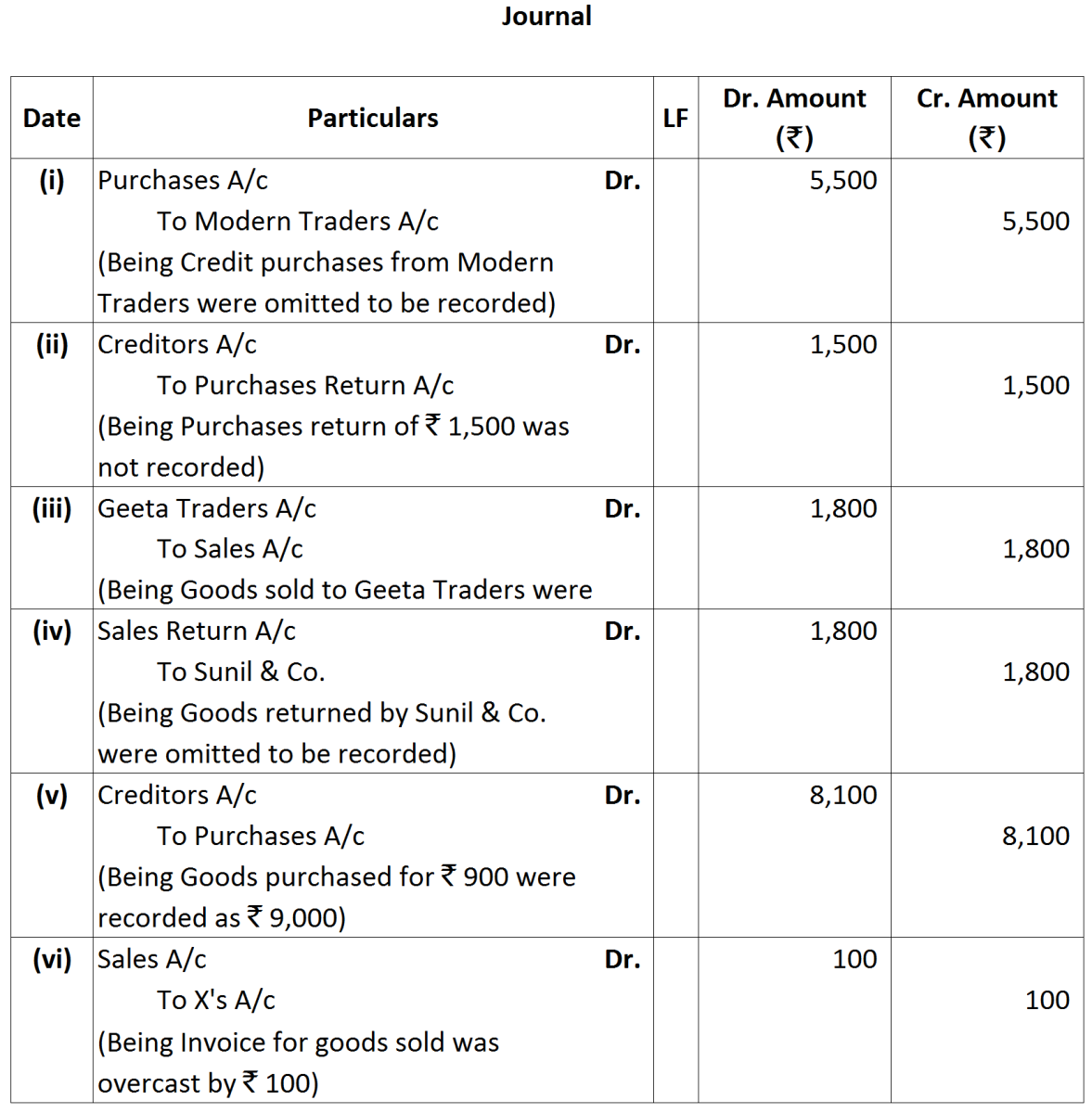
  1. Goods for ₹ 5,500 were purchased from Modern Traders on credit, but no entry has yet been passed.
  2. Purchase Return for ₹ 1,500 not recorded in the books.
  3. Goods for ₹ 2,000 sold to 'Geeta Traders' on Credit were entered in the sales book as ₹ 200 only.
  4. Goods of the value of ₹ 1,800 returned by Sunil & Co. were included in stock, but no entry was passed in the books.
  5. Goods purchased for ₹ 900, entered in the purchases book as ₹ 9,000.
  6. An invoice for goods sold to X was overcast by ₹ 100.
Answer
Solution is as follows:
View full question & answer
Question 996 Marks
Pass Journal Entries to rectify the following errors:-
  1. Machinery purchased for ₹ 5,000 has been debited to Purchases A/c.
  2. ₹ 700 paid to Sh. Mohan Kapoor as Legal Charges were debited to his personal account.
  3. ₹ 10,000 paid to Escorts Company for Machinery purchased stand debited to Escorts Company account.
  4. Typewriter purchased for ₹ 6,000 was wrongly passed through purchase book.
  5. ₹ 20,000 paid for the purchase of a Motor Cycle for proprietor has been charged to 'General Expenses' A/c.
  6. ₹ 15,000 paid for the purchase of 'Gas Engine' were debited to 'Purchases' A/c.
  7. Cash paid to Ram ₹ 400 was debited to the account of Shyam.
View full question & answer
Question 1006 Marks
Pass the rectification entries for the following transactions:
  1. Repairs to plant amounting to ₹ 2,000 had been charged to Plant and Machinery Account.
  2. Wages paid to the firm's workmen for making certain additions to machinery amounting to ₹ 1,340 were debited to Wages Account.
  3. A cheque for ₹ 7,500 received from Sandesh was credited to the account of Ramesh.
  4. Goods to the value of ₹ 7,000 returned by Prateek were included in closing stock, but no entry was made in the books.
  5. (v) Goods costing ₹ 5,000 were purchased for various members of the staff and the cost was included in 'Purchases'. A similar amount was deducted from the salaries of the staff members concerned and the net payments to them debited to Salaries Account.
  6. Credit purchase of old machinery from Sohan for ₹ 1,70,000 was entered in the Purchase Book as purchase from Mohan for ₹ 7,10,000. ₹ 30,000 paid as repairing charges on the reconditioning of a newly purchased second hand machinery were debited to General Expenses Account.
  7. Debit and Credit totals of discount columns in the Cash Book which come to ₹ 400 and ₹ 370 respectively have not been posted to Discount Accounts.
View full question & answer