MCQ 11 Mark
Select the correct statements for a particle going on a straight line:
- A
If the position and velocity are in opposite directions, the particle is moving towards the origin.
- B
It the acceleration and velocity are in opposite directions, the particle is slowing down.
- C
If the velocity is zero for a time interval, the acceleration is zero at any moment within that time interval.
- ✓
If the velocity is zero at any instant, then the acceleration must also be zero at that instant.
AnswerCorrect option: D. If the velocity is zero at any instant, then the acceleration must also be zero at that instant.
a. If the position and velocity are in opposite directions, the particle is moving towards the origin.
b. It the acceleration and velocity are in opposite directions, the particle is slowing down.
c. If the velocity is zero for a time interval, the acceleration is zero at any moment within that time interval.
View full question & answer→MCQ 21 Mark
What will be the velocity v/s time graph of a ball falling from a height before hitting the ground look like?
- ✓
A straight line with positive slope
- B
A straight line with negative slope
- C
A straight line with zero slope
- D
AnswerCorrect option: A. A straight line with positive slope
a. A straight line with positive slope
Explanation:
As the ball falls down, its velocity increases. This is because of the acceleration due to gravity. Hence the graph looks like a straight line with positive slope. The first equation of motion verifies this.
View full question & answer→MCQ 31 Mark
Which of the following is not a vector quantity?
MCQ 41 Mark
An object may have:
$i.$ varying speed without having varying velocity.
$ii.$ varying velocity without having varying speed.
$iii.$ non-zero acceleration without having varying velocity.
$iv.$ non-zero acceleration without having varying speed.
- A
$i$ and $ii$ are correct.
- B
$ii$ and $iii$ are correct.
- ✓
$ii$ and $iv$ are correct.
- D
AnswerCorrect option: C. $ii$ and $iv$ are correct.
$II$ and $IV$ are correct.
Explanation:
Speed is a scalar quantity while velocity is a vector quantity.
An object can have constant speed but velocity will change since velocity is a vector quantity.
Without having a varying speed non - zero acceleration.
Uniform circular motion is an example of options $B$ and $D$
View full question & answer→MCQ 51 Mark
Two particles $A$ and $B$ are moving in a straight line with the same speed. Which of the following statement (s) is/ are correct for the relative motion of the two particles?
- A
The relative velocity $V_{AB}$ Or $V_{BA}$ is zero. Only if they are moving in the same direction.
- B
If the particles are moving in opposite direction, the magnitude of $V_{AB}$ Or $V_{BA}$ is twice, then the magnitude of velocity of $A$ or that of $B.$
- C
The relative velocity $V_{AB}$ Or $V_{BA}$ is always zero.
- ✓
Both $(a)$ and $(b).$
AnswerCorrect option: D. Both $(a)$ and $(b).$
$d.$ Both $(a)$ and $(b).$
View full question & answer→MCQ 61 Mark
The relative velocity $V_{BA}$ Or $V_{AB}$ is zero for two particles moving along $x-$axis uniformly. The position$-$time graph for this situation will be:
- ✓
Straight lines parallel but inclined to time axis.
- B
Straight lines parallel and also parallel to time axis.
- C
Straight lines intersecting each other at some point.
- D
Curves and not straight lines.
AnswerCorrect option: A. Straight lines parallel but inclined to time axis.
View full question & answer→MCQ 71 Mark
The variation of quantity $A$ with quantity $B$, plotted in Fig. describes the motion of a particle in a straight line. 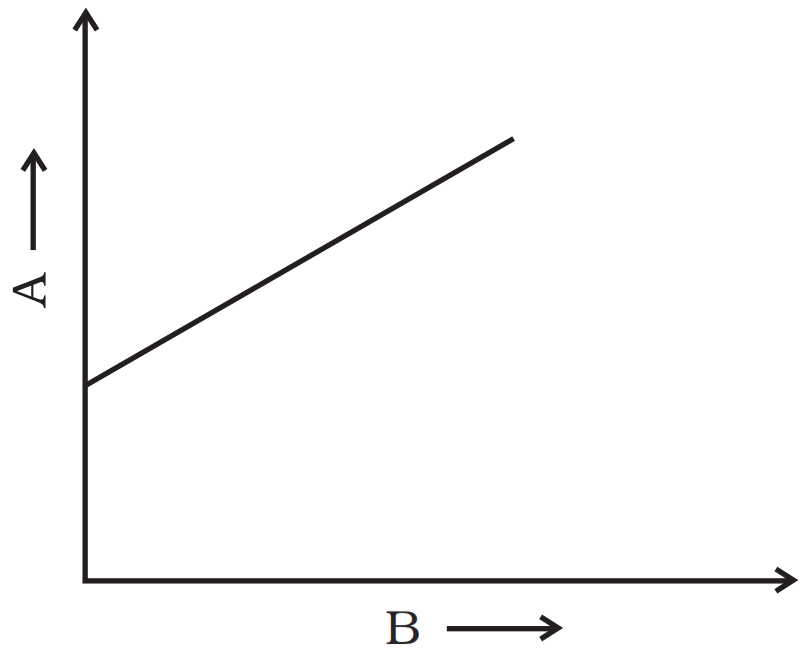
- A
Quantity $B$ may represent time.
- ✓
Quantity $A$ is velocity if motion is uniform.
- C
Quantity $A $ is displacement if motion is uniform.
- D
Quantity $A$ is velocity if motion is uniformly accelerated.
AnswerCorrect option: B. Quantity $A$ is velocity if motion is uniform.
$a.$ Quantity $B$ may represent time.
$b.$ Quantity $A$ is displacement if motion is uniform.
$c.$ Quantity $A$ is velocity if motion is uniformly accelerated.
Explanation:
If $B$ represents velocity then graph become (the $v-t$ graph is a straight line so it is uniformly accelerated motion, so motion is not uniform. Verifies option $(a), (d).$ If $B$ represents time and $A$ represents displacement, then graph become $(s - t)$ graph. Here $s - t $ graph is a straight line which represents uniform motion, so verifies the option $(c).$
View full question & answer→MCQ 81 Mark
The displacement of an object at any instant is given by $ x = 30 + 20t^2$ , where $x$ is in metres and $ t$ in seconds. The acceleration of the object will be:
- ✓
$40\ ms^{-2}$
- B
$50\ ms^{-2}$
- C
$30 \ ms ^{-2}$
- D
$0$
AnswerCorrect option: A. $40\ ms^{-2}$
$a. \ 40\ ms^{-2}$
View full question & answer→MCQ 91 Mark
If the velocity of a body does not change, its acceleration is:
Answera. Zero
Explanation:
Acceleration of a body is defined as the rate of change of the velocity of the body.
Now since the velocity doesn't change at all, the rate of change will be zero.
So, acceleration $= 0$
View full question & answer→MCQ 101 Mark
A car starts from rest from origin $O$ and continues to move till point $C$ as shown in the graph. Select the correct statement about the motion of car as shown in the graph. 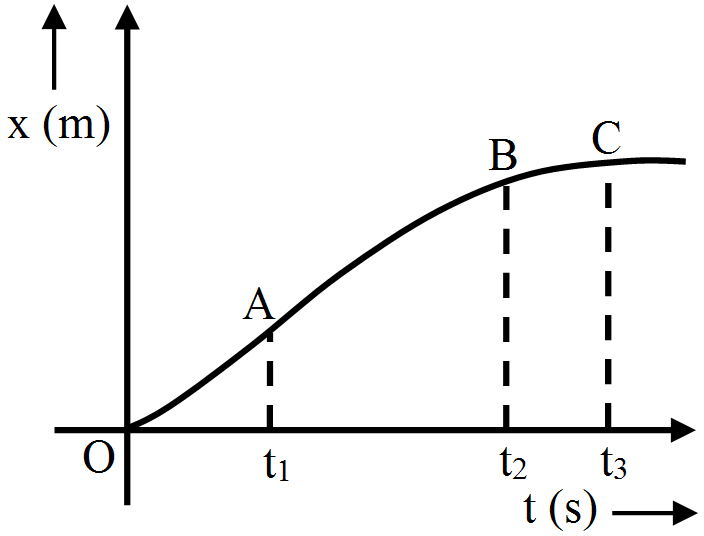
- A
Part $AB$ represents non-uniform motion.
- ✓
At instant time $t = t_2$, brakes must have been applied.
- C
At $t= t_3$, the car must have accelerated.
- D
AnswerCorrect option: B. At instant time $t = t_2$, brakes must have been applied.
$b.$ At instant time $t = t_2$, brakes must have been applied.
View full question & answer→MCQ 111 Mark
Distance$-$time graph of a body at rest is:
AnswerCorrect option: A. Parallel to time$-$axis.
View full question & answer→MCQ 121 Mark
Which of the following statement must always be true?
$I.$ If an objects acceleration is zero, then its speed must remain constant.
$II.$ If an objects acceleration is constant, then it must move in a straight line.
$III.$ If an objects speed remains constant, then its acceleration must be zero.
- A
$I$ and $III$ only
- ✓
$I$ only
- C
$III$ only
- D
$II$ and $II$ only
AnswerCorrect option: B. $I$ only
Explanation: $(B)$ $I$ only
Acceleration is the rate of change of speed of the object. Thus when acceleration is zero, the speed of object remains constant.
Acceleration of an object moving in a circular path is $\frac{{v}^2}{{R}}.$ Thus an object with constant acceleration may not move in a straight line.
Again in case of circular path, the speed remains same, but acceleration is finite.
View full question & answer→MCQ 131 Mark
An observer finds the magnitudes of the acceleration of two bodies to be the same. This necessary implies that the two bodies.
- A
Are at rest with respect to each other.
- B
Are at rest or move with constant velocities with respect to each other.
- C
Are accelerated with respect to each other.
- ✓
May be at rest, moving with constant velocities or accelerated with respect to each other.
AnswerCorrect option: D. May be at rest, moving with constant velocities or accelerated with respect to each other.
Case $1:$
Both the bodies are moving with same velocity. Thus they are rest w.r.t each other but they have same acceleration.
Case $2:$
Both the bodies are moving with different constant velocities. Hence both are moving with constant w.r.t to each other and yet they can have the same acceleration.
Case $3:$
Both are moving with different velocities but in opposite direction with same acceleration.
Acceleration of $1$ w.r.t $2,$ $a_{12} = a−(−a) = 2a$
Hence both are accelerating w.r.t each other, although having same acceleration.

View full question & answer→MCQ 141 Mark
The displacement of a particle is represented by the following equation $s = 2t^3 + 7t^2 + 5t + 8$ where $s$ is in metres and $t$ in seconds. The acceleration of the particle at $t = 1\ s$ is:
- A
$18 \ m/s^2$
- ✓
$32 \ m/s^2$
- C
- D
$14 \ m/s^2$
AnswerCorrect option: B. $32 \ m/s^2$
$b. 32\ m/s ^2$
Explanation:
$\text{s}=3\text{t}^3+7\text{t}^2+5\text{t}+8;$
$\text{v}=\frac{\text{ds}}{\text{dt}}=9\text{t}^2+14\text{t}+5$
Acceleration, $\text{a}=\frac{\text{dv}}{\text{dt}}=18\text{t}+14$
$\therefore (\text{a})_{\text{t}=1}=18\times1+14$
$=32\text{m/s}^2$
View full question & answer→MCQ 151 Mark
The velocity of a body can change:
- A
If its acceleration is zero.
- ✓
If its acceleration is non-zero.
- C
Both $A \ and\ B$
- D
AnswerCorrect option: B. If its acceleration is non-zero.
$b.$ If its acceleration is non - zero.
Explanation:
Acceleration is defined as change of velocity in unit time. So if acceleration is zero, there is no change of velocity, the body is moving with a constant velocity.
View full question & answer→MCQ 161 Mark
A body is started from rest with acceleration $2\ m/ s^2$ till it attains the maximum velocity then retards to rest with $3\ m/ s^2$. If total time taken is $10$ second then maximum speed attained is:
- ✓
$12\ m/ s$
- B
$8\ m/ s$
- C
$6\ $m/ s$
- D
$4\ m/ s$
AnswerCorrect option: A. $12\ m/ s$
$a. \ 12\ m/ s$
View full question & answer→MCQ 171 Mark
Among the four graphs Fig. there is only one graph for which average velocity over the time intervel $(0, T )$ can vanish for a suitably chosen $T.$ Which one is it?
AnswerWe need to identify the graph in which there is one displacement for different timings. it means that these displacements would be in opposite directions and when we add these opposite displacements, net displacement would be zero or average velocity would be zero. This thing is only possible in the graph $(b).$
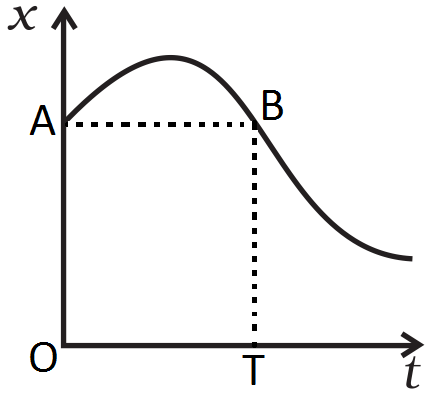
If we draw a line parallel to time axis from the point $(A)$ on the graph at $t = 0$ sec. This line can intersect graph again at $B.$ At this point, the change in displacement $(O - T)$ time is zero i.e., displacement at $A$ and $B$ are equal so as the change in displacement is zero so the average velocity of body vanishes to zero. View full question & answer→MCQ 181 Mark
A person travelling on a straight line moves with a uniform velocity $v_1$ for some time and with uniform velocity $v_2$ for the next equal time. The average velocity is given by:
- ✓
$\text{v}=\frac{\text{v}_1+\text{v}_2}{2}$
- B
$\text{v}=\sqrt{\text{v}_1\text{v}_2}$
- C
$\frac{2}{\text{v}}=\frac{1}{\text{v}_1}+\frac{1}{\text{v}_2}$
- D
$\frac{1}{\text{v}}=\frac{1}{\text{v}_1}+\frac{1}{\text{v}_2}$
AnswerCorrect option: A. $\text{v}=\frac{\text{v}_1+\text{v}_2}{2}$
$a.\ \text{v}=\frac{\text{v}_1+\text{v}_2}{2}$
Explanation:
Velocity is uniform in both cases; that is, acceleration is zero.
We have:
$\text{d}_1=\text{v}_1\text{t}$ and $\text{d}_2=\text{v}_2\text{t}$
Total displacement, $\text{d = d}_1+\text{d}_2$
Total time, $\text{t = t + t = 2t}$
$\therefore$ Average velocity, $\text{v}=\frac{\text{d}_1+\text{d}_2}{2\text{t}}=\frac{\text{v}_1+\text{v}_2}{2}$
View full question & answer→MCQ 191 Mark
A cyclist moving on a circular track of radius $40\ m $ completes half a revolution in $40\ s.$ Its average velocity is:
- A
- ✓
$2\ \text{ms}^{-1}$
- C
$4\pi\ \text{ms}^{-1}$
- D
$8\pi\ \text{ms}^{-1}$
AnswerCorrect option: B. $2\ \text{ms}^{-1}$
$b. \ 2\text{ms}^{-1}$
Explanation:
Average velocity $=\frac{\text{Displacement}}{\text{Time taken}}=\frac{2\text{R}}{\text{t}}$
$=\frac{2\times40}{40}=2\text{ms}^{-1}$
View full question & answer→MCQ 201 Mark
Pick the correct statements:
AnswerCorrect option: A. Average speed of a particle in a given time is never less than the magnitude of the average velocity.
$a.$ Average speed of a particle in a given time is never less than the magnitude of the average velocity.
$b.$ It is possible to have a situation in which $\Big|\frac{\text{d}\vec{\text{v}}}{\text{dt}}\Big|\neq0$ but $\frac{\text{d}}{\text{dt}}|\vec{\text{v}}|=0.$
$c.$ The average velocity of a particle is zero in a time interval. It is possible that the instantaneous velocity is never zero in the interval.
Explanation:
$a.$ Average speed of a particle in a given time is never less than the magnitude of the average velocity.
$b.$It is possible to have a situation in which $\Big|\frac{\text{d}\vec{\text{v}}}{\text{dt}}\Big|\neq0$ but $\frac{\text{d}}{\text{dt}}|\vec{\text{v}}|=0.$
$c.$ The average velocity of a particle is zero in a time interval. It is possible that the instantaneous velocity is never zero in the interval.
Example, the motion of a particle on a circular track with a constant speed.
Average velocity $=\frac{\text{Displacement}}{\text{Total time}}$
$\text{Displacement}\leq\text{Distance}$
$\therefore\text{Average velocrty}\leq\text{Average speed}$
In uniform circular motion, speed is constant but velocity is not.
$\text{i.e.},\Big|\frac{\text{d}\vec{\text{v}}}{\text{dt}}\Big|\neq0$ but $\frac{\text{d}}{\text{dt}}=|\vec{\text{v}}|=0$ which proves case $(b)$
$d.$In one complete circle of uniform motion, average velocity is zero. Instantaneous velocity is never zero in the interval.
View full question & answer→MCQ 211 Mark
A spring with one end attached to a mass and the other to a rigid support is stretched and released.
- ✓
Magnitude of acceleration, when just released is maximum.
- B
Magnitude of acceleration, when at equilibrium position, is maximum.
- C
Speed is maximum when mass is at equilibrium position.
- D
Magnitude of displacement is always maximum whenever speed is minimum.
AnswerCorrect option: A. Magnitude of acceleration, when just released is maximum.
$a. $ Magnitude of acceleration, when just released is maximum.
$b.$ Speed is maximum when mass is at equilibrium position.
Explanation:
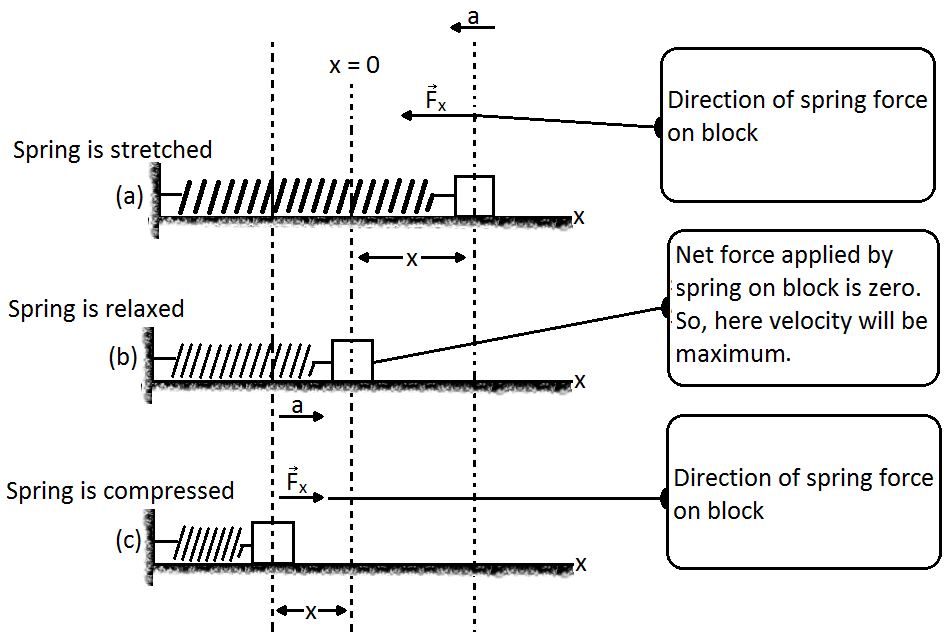
As shown in the figure above when spring is stretched by length x, restoring force will be $F = -kx$ $(-ve$ sigh shows that the force is always is the direction opposite to displacement $x).$ Then the potential energy of the stretched spring.
$=\text{PE}=\frac{1}{2}\text{kx}^2$
The restoring force is central, hence when particle is released it will execute Simple Harmonic Motion about equilibrium position.
Acceleration will be $\text{a}=\frac{\text{F}}{\text{m}}=\frac{\text{-kx}}{\text{m}}$
At equilibrium position, $\text{x}=0\Rightarrow\text{a}=0$
Hence, when just released $\text{x}=\text{x}_\text{max}$
Hence, acceleration is maximum. Thus option $(a)$ is correct.
At equilibrium whole $PE$ will be converted to $KE$, so $KE$ will be maximum and hence, speed will be maximum. Thus option $(c)$ is correct. View full question & answer→MCQ 221 Mark
The changes in displacement in three consecutive instances are $5m, 4m, 11m,$ the total time taken is $5s.$ What is the average velocity in $m/ s?$
Answer$b.\ 4$
Explanation:
The total change in displacement $= 20m.$
Total time taken $= 5s.$ Average velocity $=$ total change in displacement/total time taken $=\frac{20}{5}=4\text{m}/\ \text{s}.$
View full question & answer→MCQ 231 Mark
A car is moving with a velocity of $30\ ms^{-1}$. On applying the brakes, the velocity decreases to $15\ ms^{-1}$ in $2s.$ The acceleration of the car is:
- A
$+7.5\ ms^{-2}$
- B
$-7.7\ ms^{-2}$
- ✓
$-75\ ms^{-2}$
- D
$+15ms^{-2}$
AnswerCorrect option: C. $-75\ ms^{-2}$
$c. \ -75ms^{-2}$
View full question & answer→MCQ 241 Mark
An object thrown vertically upwards with a velocity of $25\ m/ s$ takes $4\ sec$ to reach the thrower. What is displacement of the object?
- A
$100\ m$
- B
$180\ m$
- ✓
$0\ m$
- D
$120\ m$
AnswerCorrect option: C. $0\ m$
$c. \ 0m$
Explanation:
Displacement is the minimum distance between the initial and final position of an object If a ball thrown from point $A$ reaches point $B$ and then return to point $A,$ then a displacement of the ball becomes zero as it returns to its initial position.
View full question & answer→MCQ 251 Mark
Identify one dimensional motion out of the following:
- A
A honey bee dancing in air.
- B
A teacher writing on a blackboard.
- ✓
A scooterist speeding on a level road.
- D
AnswerCorrect option: C. A scooterist speeding on a level road.
$c. $ A scooterist speeding on a level road.
View full question & answer→MCQ 261 Mark
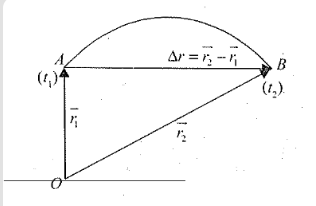
Which of the following statements regarding motion of particle is true ?
- A
The motion between $A$ and $B$ is known.
- B
The motion between $A$ and $B$ is erratic.
- ✓
The motion between $A$ and $B$ may have been steady or erratic.
- D
The motion between $A$ and $B$ is steady.
AnswerCorrect option: C. The motion between $A$ and $B$ may have been steady or erratic.
$c. $ The motion between $A$ and $B$ may have been steady or erratic.
Explanation:
The motion between $A$ and $B$ is steady if the velocity of the particle is constant and erratic if it is variable. From the question it is not clear what happens with the particle during the motion so we cannot say whether the particle is in erratic or steady motion.
View full question & answer→MCQ 271 Mark
Which of the following terms does not go well with the motion of a bus on a crowded road.
Answer$a.$ Uniform velociity
Explanation:
On a crowded road, depending on traffic conditions, the bus driver has to change its speed and direction of motion many times.
The driver will have to frequently apply brakes as well. He might also have to accelerate the bus with different rates.
So, the velocity changes both by magnitude and direction. Thus, uniform velocity is not attained in this case.
View full question & answer→MCQ 281 Mark
Which of the following types of motion cannot describe the motion of a clock’s hands?
AnswerThe hands of a clock move in a circular manner. Hence, the motion exhibited is circular motion. Moreover, it happens periodically, so it is also periodic motion. But its is not rectilinear motion.
View full question & answer→MCQ 291 Mark
In the arrangement shown in figure, the ends $P$ and $Q$ of an inextensible string move downwards with uniform speed $u$. Pulleys $A$ and $B$ are fixed. The mass $M$ moves upwards with a speed: 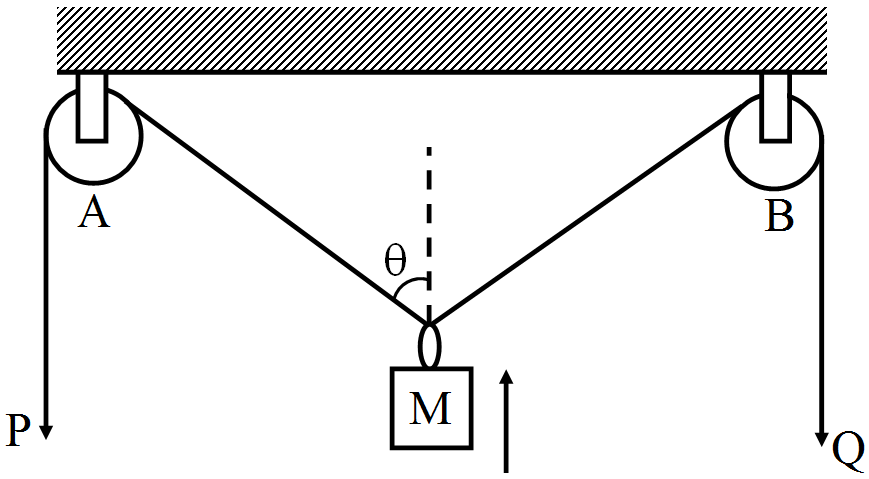
AnswerCorrect option: B. $\frac{\text{u}}{\cos\theta}$
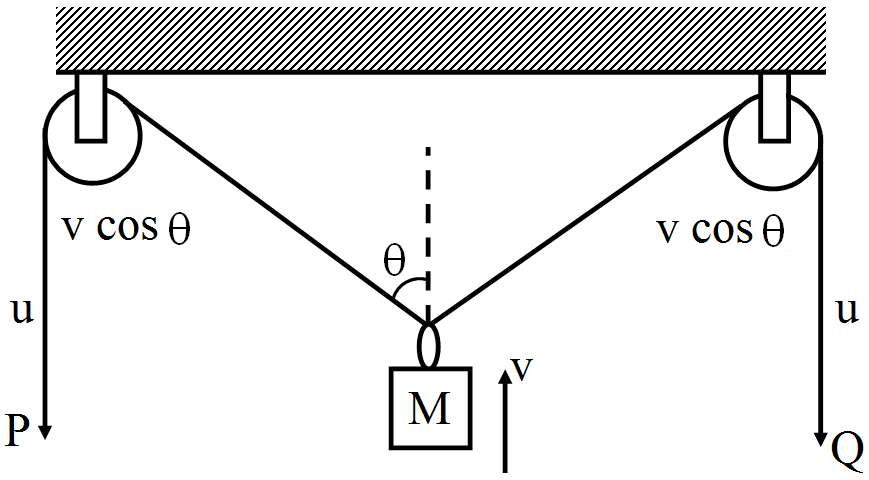
Along the string, the velocity of each object is the same.
$2\text{v}\cos(\theta)=2\text{u}$
$\text{v}=\frac{\text{u}}{\cos(\theta)}$ View full question & answer→MCQ 301 Mark
A stone is dropped from a certain height and at the same time another stone is thrown horizontally from the same height which one will reach the ground earlier:
AnswerSince the initial vertical velocity of both the stones is zero and both are accelerated vertically downwards by equal acceleration, hence they reach earth simultaneously.
View full question & answer→MCQ 311 Mark
Newtons law are not valid in:
AnswerCorrect option: A. Both inertial as well as non $-$ inertial frame of reference.
Newton's Law is only valid in inertial frame of reference. If there is a non $-$ inertial frame of reference then it won't be valid.
View full question & answer→MCQ 321 Mark
The displacement x of a particle varies with time according to the relation $\text{x}=\frac{\text{a}}{\text{b}}(1-\text{e}^{-\text{bt}}).$ The:
- A
At $t=\frac{1}{\text{b}},$ the displacement of the particle is nearly $\Big(\frac{2}{3}\Big)\Big(\frac{\text{a}}{\text{b}}\Big).$
- B
The particle cannot reach a point at a distance $x$ from its starting position if $\text{x}>\frac{\text{a}}{\text{b}}.$
- C
The velocity and acceleration of the particle at $ t = 0$ are $a$ and $-ab$ respectively.
- ✓
The particle will come back to its starting point as $\text{t}\rightarrow\infty.$
AnswerCorrect option: D. The particle will come back to its starting point as $\text{t}\rightarrow\infty.$
$a. $ $\text{At t}=\frac{1}{\text{b}},$ the displacement of the particle is nearly $\Big(\frac{2}{3}\Big)\Big(\frac{\text{a}}{\text{b}}\Big).$
$b. $ The particle cannot reach a point at a distance x from its starting position if $\text{x}>\frac{\text{a}}{\text{b}}.$
$c. $ The velocity and acceleration of the particle at $t = 0$ are $a$ and $-ab$ respectively.
View full question & answer→MCQ 331 Mark
Displacement between two points is $. . . . . .$
Answer$a.$ The shortest path
Explanation:
Displacement between two points is the shortest path between them. It is always less than or equal to the distance between them. Displacement can never be greater than distance.
View full question & answer→MCQ 341 Mark
When person moves in the coordinate system from $A (0, 0)$ to $B (5, 10),$ to $C (8, 6),$ what is the displacement covered?
- ✓
$10$ units
- B
$5$ units
- C
$7$ units
- D
$15$ units
AnswerCorrect option: A. $10$ units
$a.$ $10$ units
Explanation:
The displacement is the distance between the final and the initial location. Here the final location is $C$ and the initial is $A.$ We can solve this by using distance between two points method.
$AC = \sqrt {(8 – 0)^2) + (6 – 0)^2 }= \sqrt {100} = 10 \ units.$
View full question & answer→MCQ 351 Mark
A bomb is released from a horizontal flying aeroplane. The trajectory of bomb as observed from ground is:
Answer$a. $ A parabola
Explanation:
When thrown from aeroplane, it will have velocity in horizontal direction.
Thus angle between velocity and acceleration (i.e. gravity) is neither $0$ nor $180$ so, it wil be pprojectile motion (i.e. parabola in shape).
View full question & answer→MCQ 361 Mark
What can you say about the motion of an object if its speed-time graph is a straight line parallel to the time axis?
- A
Object is moving with uniform acceleration
- ✓
Object is moving with uniform speed
- C
- D
AnswerCorrect option: B. Object is moving with uniform speed
$b.$ Object is moving with uniform speed
Explanation:
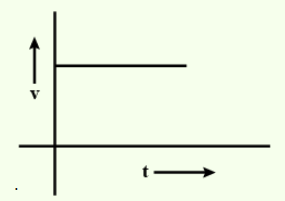
If the speed-time graph is a straight line parallel to the time axis it means that on changing time speed remains constant. View full question & answer→MCQ 371 Mark
Find the odd one out and give the reason: speed, distance, mass, velocity:
MCQ 381 Mark
In which of the following states does a body possess kinetic energy?
- A
- ✓
- C
When placed on a platform
- D
Answer$b.$ Motion
Explanation:
The body moves in the state of motion. Hence it has a velocity and so kinetic energy. Kinetic energy $\big(\frac{1}{2}\big)\text{mv}^2.$
View full question & answer→MCQ 391 Mark
If you decide to launch a ball vertically to a friend located $45\ m$ above you who can catch it. What is the minimum launch speed you can use?
- A
$4.5\ m/ s$
- B
$1.50\ m/ s$
- C
$45\ m/ s$
- ✓
$29.7\ m/ s$
AnswerCorrect option: D. $29.7\ m/ s$
$d.\ 29.7\ m/ s$
Explanation:
Given that,
Distance $s = 45m$
Initial velocity $u = 0$
We know that,
By using equation of motion
$v^2 = u^2 + 2as$
$v^2 = 0 + 2 \times 9.8 \times 45$
$v^2 = 882\ m/ s$
$v = 29.7\ m/ s$
Hence, the minimum speed is $29.7\ m/ s$
View full question & answer→MCQ 401 Mark
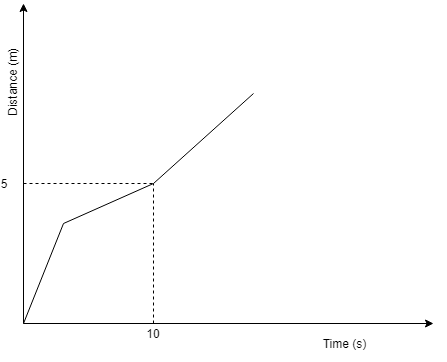
What is the velocity for a body following the graph below at $10s?$
- A
$1m/ s$
- B
$2m/ s$
- ✓
$0.5m/ s$
- D
$0.1m/ s$
AnswerCorrect option: C. $0.5m/ s$
At time $= 10s,$ the distance covered is $5m.$
Velocity $=$ distance/ time.
Hence, velocity $v$ at $10\text{s}=\frac{5}{10}=0.5\text{m}/\text{s}.$
View full question & answer→MCQ 411 Mark
A man of mass $40\ kg$ is standing on a uniform plank of mass $60\ kg$ lying on horizontal frictionless ice. The man walks from one end to the other end of the plank. the distance walked by the man relative to ice is $($given length of plank $= 5m)$
Answer$\text{d}=\frac{\text{mL}}{\text{m}_1+\text{m}_2}$
$\frac{40\times5\text{m}}{100}=2\text{m}$
View full question & answer→MCQ 421 Mark
A man of mass 60kg and a boy of mass 30kg are standing together on frictionless ice surface. If they push each other apart man moves away with a speed of 0.4m/ s relative to ice. After 5sec they will be away from each other at a distance of.
Answer$c. \ 6.0m$
Explanation:
The man and the boy move in opposite directions.
Momentum of man = momentum of boy
$60 \times 0.4 = 30 \times v$
or velocity of the boy $v = 0.8\ ms^{-1}$
$\therefore$ Relative velocity $= 0.4 + 0.8 = 1.2\ ms^{-1}$
$\therefore$ Distance between them in $5\ sec = 1.2 \times 5 = 6.0m.$
View full question & answer→MCQ 431 Mark
A ball is bouncing elastically with a speed $1\ m/s$ between walls of a railway compartment of size $10m$ in a direction perpendicular to walls. The train is moving at a constant velocity of $10\ m/s $ parallel to the direction of motion of the ball. As seen from the ground,
- ✓
The direction of motion of the ball changes every $10$ seconds.
- B
Speed of ball changes every $10$ seconds.
- C
Average speed of ball over any $20$ second interval is fixed.
- D
The acceleration of ball is the same as from the train.
AnswerCorrect option: A. The direction of motion of the ball changes every $10$ seconds.
$b.$ Speed of ball changes every $10$ seconds.
$c.$ Average speed of ball over any $20$ second interval is fixed.
$d.$ The acceleration of ball is the same as from the train.
Explanation:
As the motion is observed from ground, time to strike ball with walls will be after every $10$ seconds. As, the ball is moving with very small speed in the moving train,the direction of ball is same as that of train. Hence direction of motion of ball does not change with respect to observer on Earth.
But, speed of ball changes after collision so option $(a)$ is incorrect and $(b)$is correct.
As speed of ball is uniform so average speed at any time remain same or $1\ m/s$ with respect to train or ground. So option $(c)$ is correct.
Speed of ball changes when it strike to wall initial speed of ball in the direction of moving train with respect to ground $\text{V}_\text{TG}=10+1=11\text{m/s}.$
Speed of ball after collision with side of train $= VBG$ (opposite to the direction of train) $= 10 - 1 = 9\ m/s.$
Change in velocity on collision will be in magnitude $= 11 - 9 = 2\ m/s$. So magnitude of acceleration on both walls of compartment is same but direction will be opposite.
Hence, right option are $(b, c, d).$
View full question & answer→MCQ 441 Mark
A body will have uniform acceleration if its:
- A
Speed changes at uniform rate
- ✓
Velocity changes at uniform rate
- C
Speed changes at non - uniform rate
- D
Velocity remains constant
AnswerCorrect option: B. Velocity changes at uniform rate
$b.$ Velocity changes at uniform rate
Explanation:
If the velocity of an object changes at a uniform rate, then the acceleration that causes the change in velocity is called uniform acceleration or constant acceleration.
For example, the force of gravity imparts an acceleration uniformly which is called acceleration due to gravity.
View full question & answer→MCQ 451 Mark
Figure shows the displacement-time graph of a particle moving on the $X-$axis.
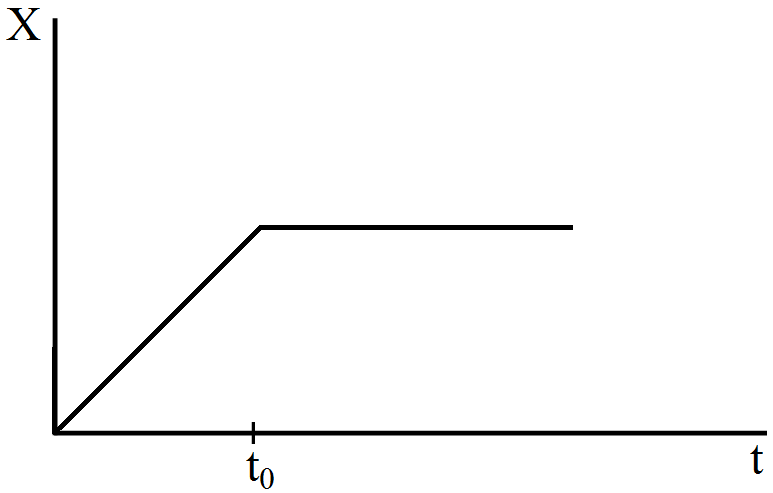
AnswerCorrect option: D. The particle moves at a constant velocity up to a time to, and then stops.
$d.$ The particle moves at a constant velocity up to a time to, and then stops.
Explanation:
The slope of the x-t graph gives the velocity. In the graph, the slope is constant from $t = 0$ to $ t = t_0$, so the velocity is constant. After $t = t_0$, the displacement is zero; i.e., the particle stops.
View full question & answer→MCQ 461 Mark
A car is moving in a spiral starting from the origin with uniform angular velocity. What can be said about the instantaneous velocity?
- ✓
- B
- C
- D
It does not depend on time
Answer$a.$ It increases with time
Explanation:
This type of motion can be called circular motion with increasing radius. As the radius increases, the tangential velocity increases $(v = rw).$ Now, as there is only one velocity present, the speed will be equal to the magnitude of the tangential velocity.
View full question & answer→MCQ 471 Mark
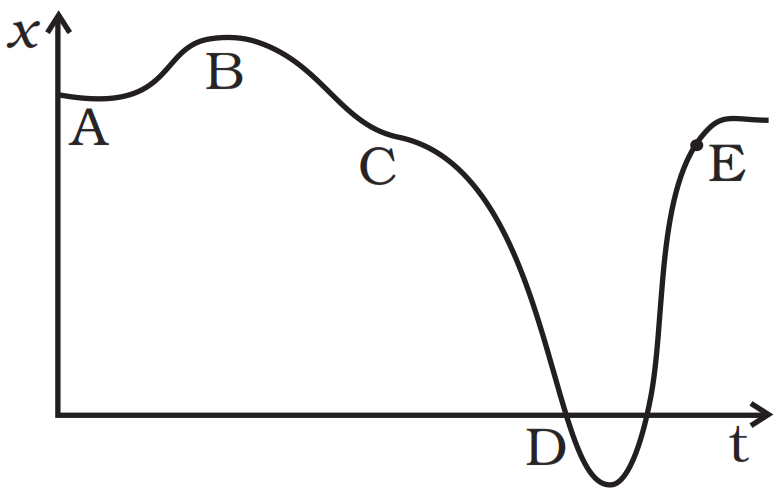
A graph of $x$ versus $t$ is shown in Fig. Choose correct alternatives from below:
- A
The particle was released from rest at $t = 0.$
- B
At $C,$ the velocity and the acceleration vanish.
- C
Average velocity for the motion between $A$ and $D$ is positive.
- ✓
The speed at $D$ exceeds that at $E.$
AnswerCorrect option: D. The speed at $D$ exceeds that at $E.$
$a.$ The particle was released from rest at $t = 0.$
$c.$ At $C,$ the velocity and the acceleration vanish.
$d.$ $D$ The speed at $D$ exceeds that at $E.$
Explanation:
Main concept used: Slope of $x - t$ graph gives $\text{v}=\frac{\text{dx}}{\text{dt}}$
At A graph $(x - t)$ is parallel to the time axis, so $\frac{\text{dx}}{\text{dt}}$ is zero or particle is at rest. After A, slope $\frac{\text{dx}}{\text{dt}}$ increases, so velocity increases. Verifies option $(a).$
Tangent at $B$ and $C$ is a graph $(x - t),$ that is parallel to the time axis, so $\frac{\text{dx}}{\text{dt}}=0$ or $v = 0.$
It implies that acceleration $a = 0$ so it discards option $(b)$ and verifies the option $(c).$
From graph the slope at $D$ is greater than at $E$. So speed at $D$ is greater than at $E.$
Verifies the option $(e).$ Velocity at $A$ is Zero as$ x - t$ parallel to time axis so average velocity at $A$ is zero.
At $D$ displacement or slope is negative. So, the average velocity at $D$ is negative not positive discards option $(d).$
View full question & answer→MCQ 481 Mark
An object is sliding down on an inclined plane. The velocity changes at a constant rate from $10\ cm/s$ to $15\ cm/s$ in $2$ seconds. What is its acceleration?
- A
$5\ cm/ s^2$$
- B
$7.5\ cm/ s^2$
- ✓
$2.5\ cm/ s^2$
- D
$12.5\ cm/ s^2$
AnswerCorrect option: C. $2.5\ cm/ s^2$
$c.\ 2.5\ cm/ s^2$
Explanation:
$\text{a}=\frac{\text{v}-\text{u}}{\text{t}}=\frac{15-10}{2}=2.5\text{cm}/\text{s}^2$
View full question & answer→MCQ 491 Mark
An object while moving may not have:
AnswerCorrect option: A. Variable speed but constant velocity.
View full question & answer→MCQ 501 Mark
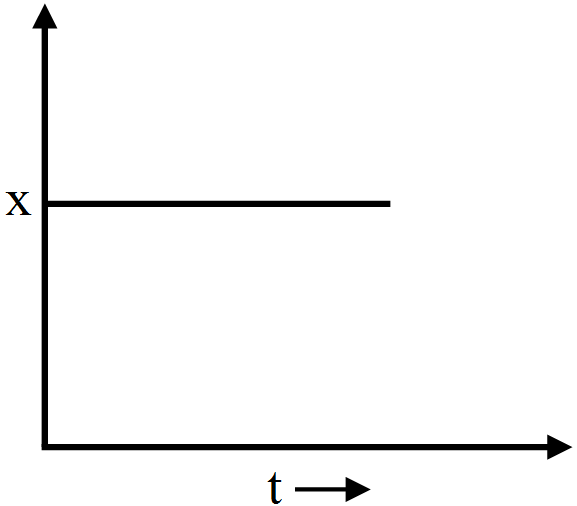
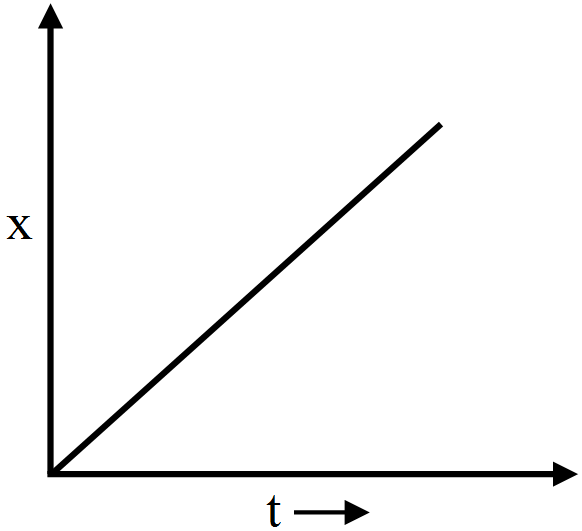
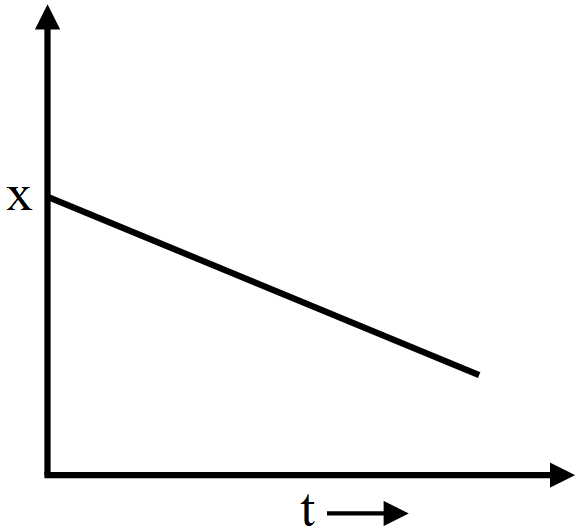
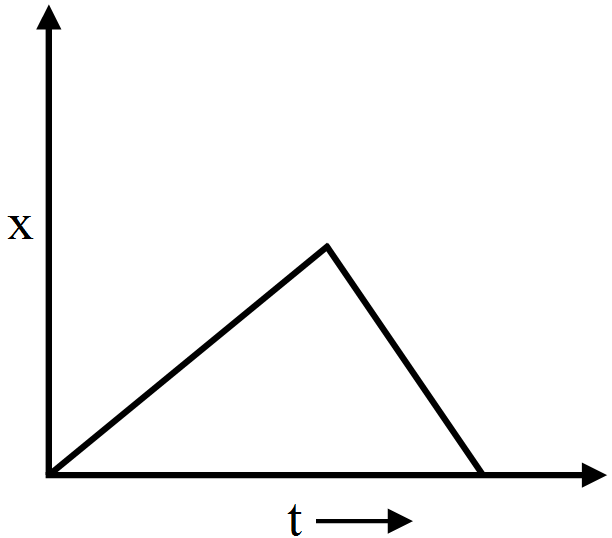
The $x-t$ graph representing an object at rest is:
View full question & answer→