Questions · Page 1 of 2

4 Marks Question

🎯

Test yourself on this topic

50 questions · timed · auto-graded

Question 14 Marks
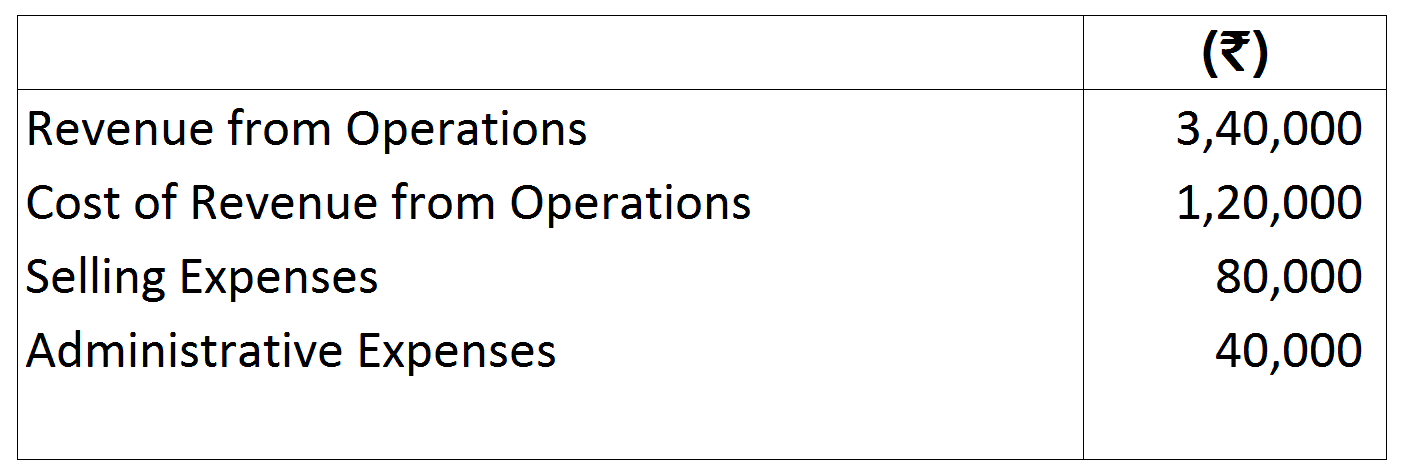
Given the following information:
Answer
Gross Profit = Revenue from Operations - Cost of revenue from operations
= ₹ 3,40,000 - ₹ 1,20,000 = ₹ 2,20,000
Gross Profit Ratio $=\frac{\text{Gross Profit}}{\text{Net Revenue from Operations}}\times100$
$=\frac{₹\ 2,20,000}{₹\ 3,40,000}\times100=64.71\%$
Operating Expenses = Selling Expenses + Administrative Expenses
= 80,000 + 40,000 = 1,20,000
Operating Ratio $=\frac{\text{Cost of Revenue from Operations + Operating Expenses}}{\text{Net Revenue from Operations}}\times100$
$=\frac{₹\ 1,20,000+₹\ 1,20,000}{₹\ 3,40,000}\times100=70.59\%$
View full question & answer
Question 24 Marks
Gross Profit ratio of a Company was 25%. Its cash revenue from operations were ₹ 5,00,000 and its credit revenue from operations were 90% of the total revenue from operations. If the indirect expenses of the company were ₹ 1,50,000, calculate its net profit ratio.
Answer
Credit revenue from operations were 90% of total revenue from operation. It means cash revenue from operations were 10% of total revenue from operations. If cash revenue from operations were 10, total revenue from operations were 100. If cash revenue from operations were ₹ 5,00,000, total revenue from operations were$=\frac{100}{10}\times5,00,000=₹\ 50,00,000$ Gross Profit $=₹\ 50,00,000 \times\frac{ 25}{ 100 }= ₹\ 12,50,000$ Net Profit = Gross Profit - Indirect Expenses= ₹ 12,50,000 - ₹ 1,50,000 = ₹ 11,00,000
Net Profit Ratio $=\frac{\text{Net Profit}}{\text{Net Revenue from Operations}}\times100$
$=\frac{11,00,000}{50,00,000}\times=22\%$
View full question & answer
Question 34 Marks
Current Assets of a Company are ₹ 3,06,000 and its Current ratio is 1.8 Afterwards, it issued new equity shares off ₹ 1,00,000. Calculate the revised current ratio.
Answer
Current Ratio $=\frac{\text{Current Assets}}{\text{Current Liabilities}}$1.8 (Given) $=\frac{₹\ 3,06,000\text{(Given)}}{\text{Current Liabilities}}$
$\therefore$ Current Liabilities $=\frac{₹\ 3,06,000}{1.8}=₹\ 1,70,000$
Issue of new equity shares results in increase in bank and this leads to increase in current assets. Hence, after the issue of new equity shares of ₹ 1,00,000:
Current Assets = ₹ 3,06,000 + ₹ 1,00,000
= ₹ 4,06,000
Revised Current Ratio $=\frac{\text{Current Assets}}{\text{Current Liabilities}}$
$=\frac{₹\ 4,06,000 }{₹\ 7,10,000}=2.388:1$
View full question & answer
Question 44 Marks
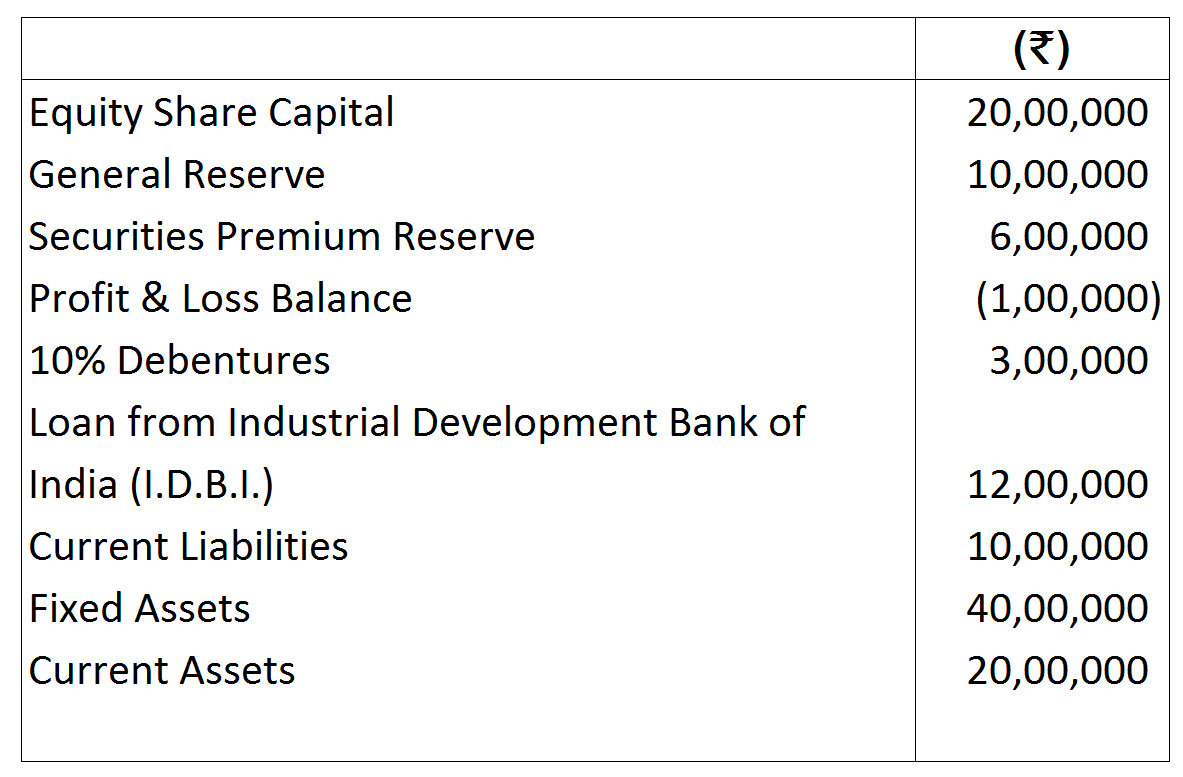
From the following, ascertain Debt-Equity Ratio and Proprietary Ratio:
Answer
  1. Debt-Equity Ratio $= \frac{\text{Long Term Debts}}{\text{Shareholder's Funds}}$
Long Term Debts = 10% Debentures+ Loan from IDBI

= ₹ 3,00,000 + ₹ 12,00,000 = ₹ 15,00,000

Shareholder's Funds = Equity Share Capital + General Reserve + Securities Premium Reserve - Profit & Loss Balance

= ₹ 20,00,000 + ₹ 1,00,000 + ₹ 6,00,000 - ₹ 1,00,000

= ₹ 35, 00,000

Debt Equity Ratio $= \frac{₹\ 15,00,000}{₹\ 35,00,000}= 0.43:1$
  1. Proprietary Ratio $=\frac{\text{Shareholder's Funds}}{\text{Total Assets}}\times100$
Total Assets = Fixed Assets + Current Assets

₹ 40,00,000 + ₹ 20,00,000 = ₹ 60,00,000

Proprietary Ratio $=\frac{₹\ 35,00,000}{₹\ 60,00,000}\times100=58.33\%$
View full question & answer
Question 54 Marks
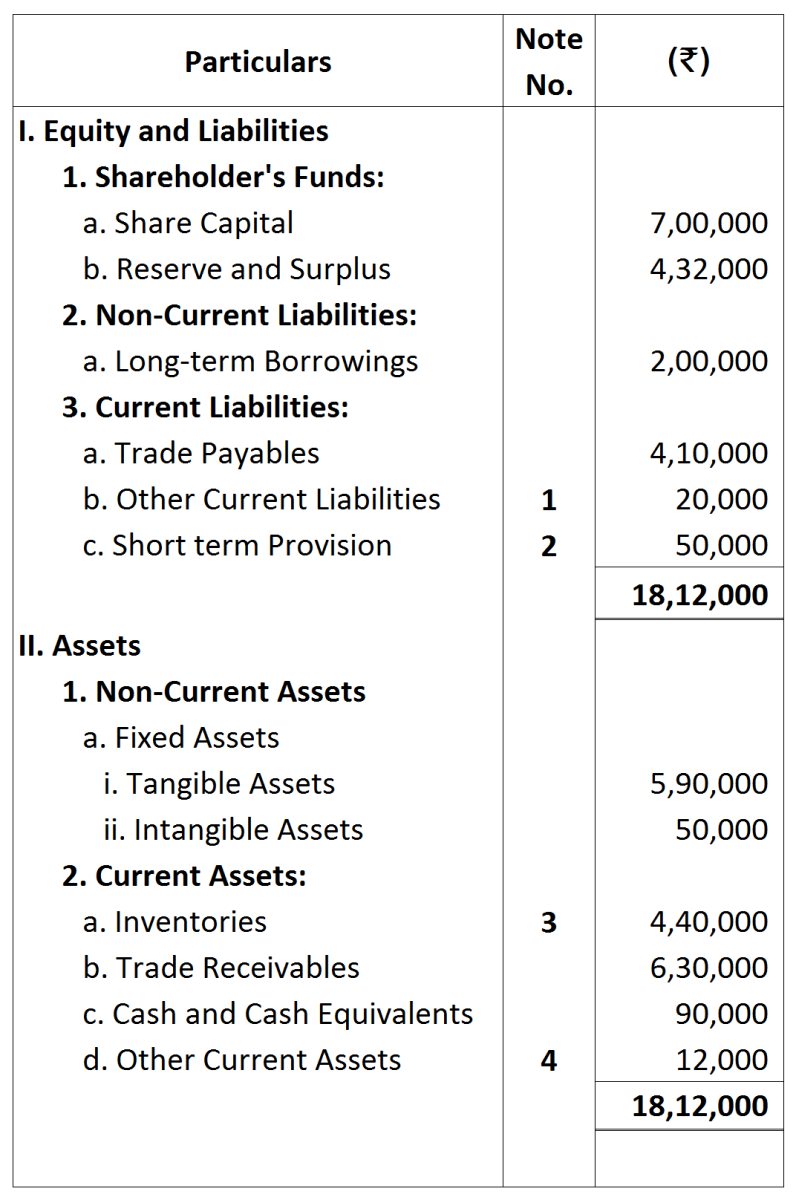
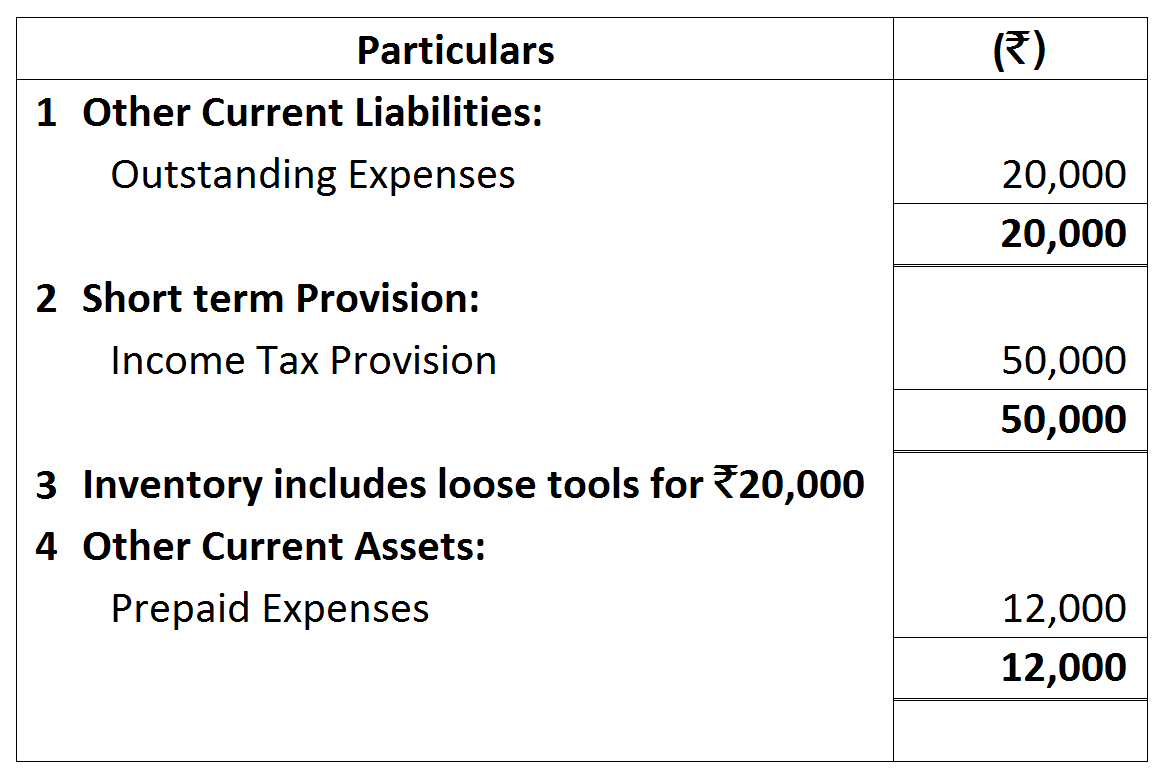
Calculate Current Ratio and Quick Ratio from the following Balance Sheet:

Answer
Current Ratio $=\frac{\text{Current Assets}}{\text{Current Liabilities}}$ Current Assets = Inventory+ Trade Receivables + Cash & Cash Equivalents + Prepaid Exp. = ₹ 4,20,000 + ₹ 6,30,000 + ₹ 90,000 + ₹ 12,000 = ₹ 11,52,000 Current Liabilities = Trade Payables + Outstanding Expenses + Income Tax Provision = ₹ 4,10,000 + ₹ 20,000 + ₹ 50,000 = ₹ 4,80,000 Current Ratio $= \frac{₹\ 11,52,000}{₹\ 4,80,000}= 2.4:1$ Quick Ratio $=\frac{\text{Liquid Assets}}{\text{Current Liabilities}}$ Liquid Assets = Trade Receivables + Cash & Cash Equivalents = ₹ 6,30,000 + ₹ 90,000 = ₹ 7,20,000Quick Ratio $=\frac{₹\ 7,20,000 }{₹\ 4,80,000 }=1.5:1$
Throw light on the short-term financial position of the Company with the help of suitable ratios.
View full question & answer
Question 64 Marks
Rate of Gross profit on cost of a company is 25%. Its Gross profit is ₹ 5,00,000. Its shareholders' Funds are ₹ 12,00,000; Current liabilities are ₹ 3,00,000 and Current Assets are ₹ 10,00,000.
Calculate its Working Capital Turnover Ratio.
Answer
Working Capital Turnover Ratio $=\frac{\text{Revenue from Operations}}{\text{Working Capital}}$
Gross Profit is ₹ 5,00,000 and rate of G.P. on Cost of Revenue from Operations is 25%
Hence, Cost of Revenue from Operations $=5,00,000\times\frac{100}{25}=₹\ 20,00,000$
Revenue from Operations = Cost of Revenue from Operations + Gross Profit
= ₹ 20,00,000 + ₹ 5,00,000 = ₹ 25,00,000
Working Capital = Current Assets - Current Liabilities
= = ₹ 10,00,000 - ₹ 3,00,000 = ₹ 7,00,000
Working Capital Turnover Ratio $=\frac{25,00,000}{7,00,000}=3.57\text{ times}$
View full question & answer
Question 74 Marks
Calculate Total Assets to Debt Ratio from the following:
Answer
Total Assets to Debt Ratio $=\frac{\text{Total Assets}}{\text{Debt}}$
Capital Employed = Shareholder's Funds (i.e., Share Capital + Reserve and Surplus) + Long term Debts.
₹ 60,00,000= ₹ 20,00,000 + ₹ 16,00,000 + Long term Debts.
Long term Debts = ₹ 24,00,000
Total Assets = Shareholder's Funds (i.e., Share Capital + Reserve and Surplus) + Long term Debts + Current Liabilities (i.e., Trade Payables + Outstanding Exp.)
= ₹ 20,00,000 + ₹ 16,00,000 + ₹ 24,00,000 + ₹ 8,00,000 + ₹ 40,000
= ₹ 68,40,000
Total Assets to Debt Ratio $=\frac{68,40,000}{24,00,000}=2.85:1$
View full question & answer
Question 84 Marks
A company earns a gross profit of 20% on cost. Its credit revenue from operations are twice its cash revenue from operations. If the credit revenue from operations are ₹ 4,00,000, calculate the gross profit ratio of the company.
Answer
Credit Revenue from Operations
= ₹ 4,00,000
$\therefore$ Cash Revenue from Operations
= ₹ 2,00,000
Hence, Total Revenue from Operations
= ₹ 6,00,000
Gross Profit is 20% of Cost of Revenue from Operations
Therefore, goods costing ₹ 100 must have been sold for ₹ 120
Hence, If Revenue from Operations are ₹ 120, G.P. = ₹ 20
If Revenue from Operations are ₹ 6,00,000, G.P. $= ₹ \ 6,00,000\times\frac{20}{120}$
$= ₹ \ 1,00,000$
Gross Profit Ratio $=\frac{\text{Gross Profit}}{\text{Net Revenue from Operations}}\times100$
$=\frac{₹ \ 1,00,000}{₹ \ 6,00,000}\times100 = 16.67\% $
View full question & answer
Question 94 Marks
Current Ratio 2.2 : 1; Acid Test Ratio 0.95 : 1; Working Capital ₹ 36,000. Calculate Current Assets, Current Liabilities and Inventory.
Answer
Working Capital = Current Assets - Current Liabilities
Current Ratio = 2.2 : 1, therefore, based on current ratio the working capital is 2.2 - 1 = 1.2
If Working Capital is 1.2,
Current Assets = 2.2
If Working Capital is 1,
Current Assets $=\frac{2.2}{1.2}$
If Working Capital is 36,000
Current Assets $=\frac{2.2}{1.2}\times₹\ 36,000$
= ₹ 66,000
Current Liabilities = Current Assets - Working Capital
= ₹ 66,000 - ₹ 36,000 = ₹ 30,000
Acid Test Ratio $=\frac{\text{Liquid Assets}}{\text{Current Liabilities}} $
0.95 (Given) $=\frac{\text{Liquid Assets}}{ ₹\ 30,000}$
$\therefore$ Liquid Assets = ₹ 30,000 × 0.95 = ₹ 28,500
Inventory = Current Assets - Liquid Assets
= ₹ 66,000 - ₹ 28,500 = ₹ 37,500
View full question & answer
Question 104 Marks
Current Ratio 3.6 : 1; Working Capital ₹ 84,500; Inventory ₹ 50,000 Calculate Current Assets, Current Liabilities, Quick Ratio.
Answer
Working Capital = Current Assets - Current Liabilities
Current Ratio = 3.6 : 1,
therefore, based on current ratio the working capital is 3.6 - 1 = 2.6
If Working Capital is 2,
Current Assets = 3.6
If Working Capital is 1,
Current Assets $=\frac{3.6}{2.6}$
If Working Capital is 4,00,000,
Current Assets $=\frac{3}{2}\times ₹ \ 84,500$
= ₹ 1,17,000
Current Liabilities = Current Assets- Working Capital
₹ 1,17,000 - ₹ 84,500 = ₹ 32,500
Quick Ratio $=\frac{\text{Liquid Assets}}{\text{Current Liabilities}}$
Liquid Assets = Current Assets - Inventory
= ₹ 1,17,000 - ₹ 50,000
= ₹ 67,000
Quick Ratio $=\frac{₹\ 67,000}{₹\ 32,500}=2.06:1$
View full question & answer
Question 114 Marks
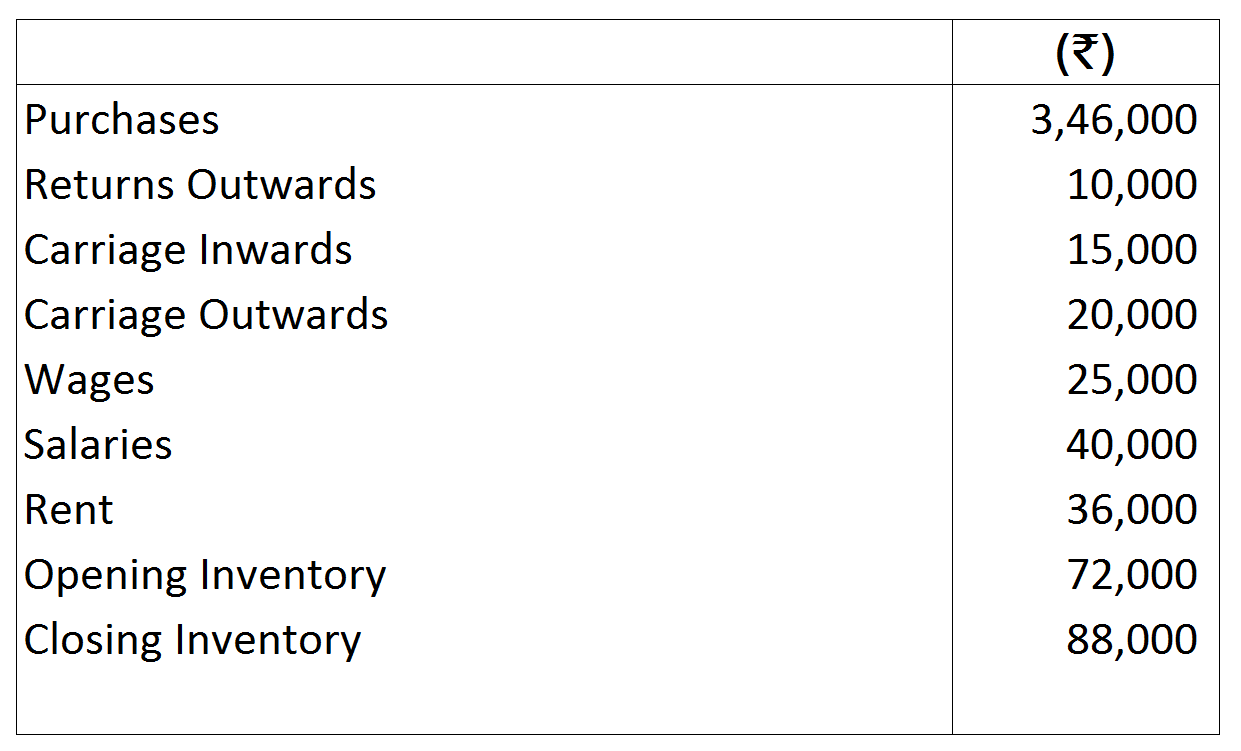
Calculate Inventory Turnover Ratio from the following:
Answer
Inventory Turnover Ratio $=\frac{\text{Cost of Revenue from Operations}}{\text{Average Inventory}}$
Cost of Revenue from Operations = Opening Inventory + Net Purchases (i.e., Purchases - Returns Outwards) + Carriage Inwards + Wages - Closing Inventory
= 72,000 + 3,36,000 + 15,000 + 25,000 - 88,000
= ₹ 3,60,000
Average Inventory $=\frac{\text{Opening Inventory + Closing Inventory}}{2}$
$=\frac{72,000+88,000}{2}=₹\ 80,000$
Inventory Turnover Ratio $=\frac{3,60,000}{80,000}=₹4.5\text{ times}$
Note: Carriage Outwards, Salaries and Rent will be ignored while calculating Inventory Turnover Ratio.
View full question & answer
Question 124 Marks
Calculate the (i) Inventory Turnover Ratio and (ii) Average Age of Inventory from the following:
Opening Inventory ₹ 54,000; Closing Inventory ₹ 66,000; Revenue from Operations (Sales) ₹ 5,00,000; Gross profit Ratio 40% on Revenue from Operations.
Answer
  1. Cost of Revenue from Operations = Revenue from Operations (Sales) - Gross Profit
= ₹ 5,00,000 - 40% of ₹ 5,00,000

= ₹ 5,00,000 - ₹ 2,00,000 = ₹ 3,00,000

Average Inventory $=\frac{₹\ 54,000+₹\ 66,000}{2}=₹\ 60,000$

Inventory Turnover Ratio $=\frac{\text{Cost of Revenue from Operations}}{\text{Average Inventory}}$

$=\frac{₹\ 3,00,000}{₹\ 60,000}=5\ \text{times}.$
  1. Average Age of Inventory (or Inventory Holding Period) $=\frac{\text{Days in a year}}{\text{Inventory Turnover Ratio}}=\frac{365}{5}=73 \text{ days}$
View full question & answer
Question 134 Marks
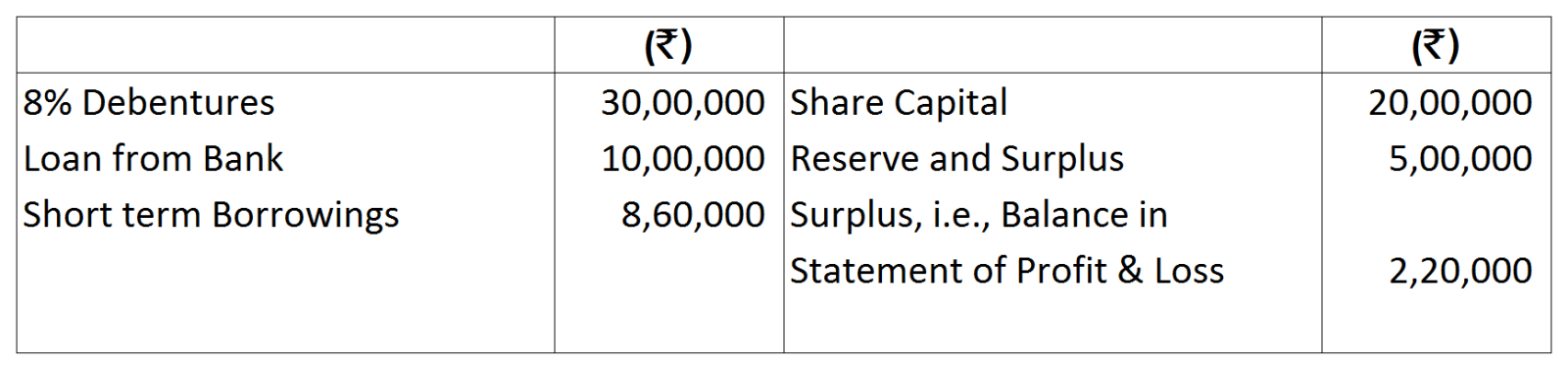
From the following information, calculate Total Assets to Debt Ratio:
Answer
Total Assets to Debt Ratio $=\frac{\text{Total Assets}}{\text{Long term Debts}}$
Long Term Debts = 8% Debentures + Loan from Bank.
= ₹ 30,00,000 + ₹ 10,00,000 = ₹ 40,00,000
Total Assets = Shareholder's Funds (i.e., Share Capital + Reserve and Surplus) + Total Debts (i.e., 8% Debentures + Loan from Bank + Short term Borrowings).
= ₹ 20,00,000 + ₹ 5,00,000 + ₹ 30,00,000 + ₹ 10,00,000 + ₹ 8,60,000 = ₹ 73,60,000
Total Assets to Debt Ratio $=\frac{73,60,000}{40,00,000}=1.84:1$
Note: Surplus i.e., Balance in Statement of Profit & Loss will be ignored since it is already included in Reserve and Surplus.
View full question & answer
Question 144 Marks
The Quick ratio of a company is 0.8 : 1. State with reason whether the following transactions will increase, decrease or not change the quick ratio:
  1. Purchase ofloose tools ₹ 2,000.
  2. Insurance premium paid in advance ₹ 500.
  3. Sale of goods on credit ₹ 3,000.
  4. Honoured a bills payable of ₹ 5,000 on maturity.
Answer
Tr. No.
Quick Ratio will
Reasons
1.
Decrease.
Quick Assets have decreased but Current Liabilities remain unchanged.
2.
Decrease.
Quick Assets have decreased but Current Liabilities remain unchanged.
3.
Increase.
Quick Assets have decreased but Current Liabilities remain unchanged.
4.
Decrease.
Both Quick Assets and Current Liabilities have decreased by the same amount.
View full question & answer
Question 154 Marks
Current Ratio 5 : 2; Quick Ratio 2 : 1; Current Liabilities ₹ 5,60,000. Calculate the value of inventory.
Answer
Current Ratio = 5 : 2, therefore,
If Current Liabilities are 2,
Current Assets = 5
If Current Liabilities are 1,
Current Assets $=\frac{5}{2}$
If Current Liabilities are ₹ 5,60,000.
Current Assets $=\frac{5}{2}\times ₹\ 5,60,000$
= ₹ 14,00,000
Quick Ratio = 2 : 1, therefore
If Current Liabilities are 1,
Liquid Assets = 2
If Current Liabilities are ₹ 5,60,000
Liquid Assets $=\frac{2}{1}\times ₹\ 5,60,000$
= ₹ 11,20,000
Inventory = Current Assets - Liquid Assets
= ₹ 14,00,000 - ₹ 11,20,000
= ₹ 2,80,000
View full question & answer
Question 164 Marks
From the following details, calculate:
  1. Opening Inventory.
  2. Closing Inventory.
Inventory Turnover Ratio 6 times; Gross Profit 20% on Revenue from Operations; Revenue from Operations ₹ 1,80,000; Closing Inventory is ₹ 15,000 in excess of Opening Inventory.
Answer
₹ Inventory Turnover Ratio $=\frac{\text{Cost of Revenue from Operations}}{\text{Average Inventory}}$ $6 \text{(Given)}=\frac{\text{(Revenue from Operations - Gross Profit)}}{\text{Average Inventory}}$ $6=\frac{(₹\ 1,80,000-20\%\ \text{of}\ ₹ \ 1,80,000)}{\text{Average Inventory}}$ $6=\frac{(₹\ 1,80,000-₹\ 36,000)}{\text{Average Inventory}}$ or Average Inventory $=\frac{₹\ 1,44,000}{6}=₹\ 24,000$ Opening Inventory $= ₹ \ 24,000-\frac{1}{2}\text{of}\ ₹\ 15,000$ ₹ 24,000 -₹ 7,500 = ₹ 16,500 Closing Inventory $= ₹ \ 24,000-\frac{1}{2}\text{of}\ ₹\ 15,000$₹ 24,000 ₹ - 7,500 = ₹ 31,500
View full question & answer
Question 174 Marks
From the following data, calculate Inventory Turnover Ratio:
Total Revenue from Operations (Total Sales) ₹ 4,00,000; Revenue from Operations Returns (Sales Returns) ₹ 34,000; Gross Profit ₹ 80,000; Closing Inventory ₹ 52,000; Excess of Closing Inventory over Opening Inventory ₹ 16,000.
Answer
Inventory Turnover Ratio $=\frac{\text{Cost of Revenue from Operations }}{\text{Average Inventory}}$ Cost of Revenue from Operations = Net Revenue from Operations - Gross Profit = ₹ 4,00,000- ₹ 34,000- ₹ 80,000 = ₹ 2,86,000 Average Inventory $=\frac{\text{Opening Inventory}+\text{Closing Inventory}}{2}$Closing Inventory = ₹ 52,000
Since Excess of Closing Inventory over Opening Inventory = ₹ 16,000
Opening Inventory = ₹ 52,000- ₹ 16,000
= ₹ 36,000
Average Inventory $=\frac{₹\ 56,000\ +\ ₹\ 36,000}{2}$ $=\frac{₹\ 88,000}{2}=₹\ 44,000$ Inventory Turnover Ratio $=\frac{₹\ 2,86,000}{₹\ 44,000}=6.5\text{ times}$
View full question & answer
Question 184 Marks
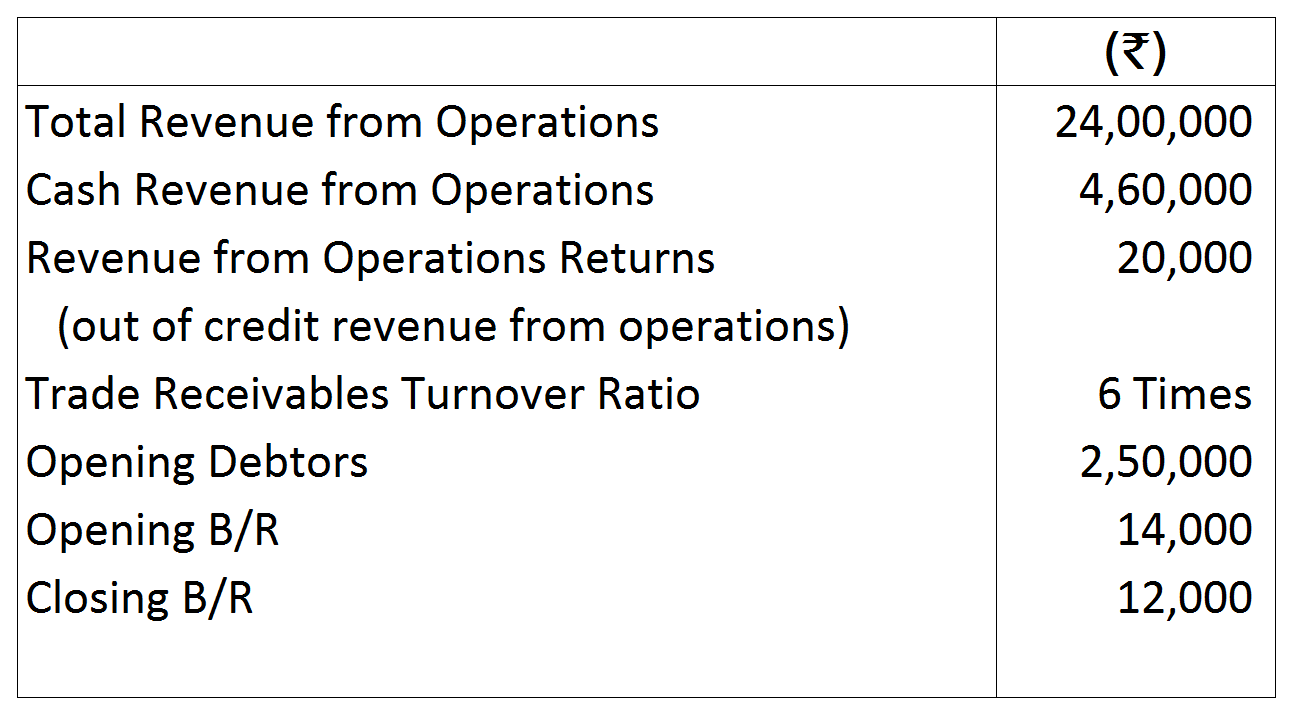
From the following particulars determine the Closing Debtors:
Answer
Trade Receivables Turnover Ratio $=\frac{\text{Net Credit Revenue from Operations}}{\text{Average Debtors &B/R}}$
$6\ \text{(Given)}=\frac{\text{Total Revenue from Operations}\\ {-{\text{}}\text{ Cash Revenue from Operations}}\\{-{\text{}}\text{Credit Revenue from Operations Returns}}}{\text{Average Debtors & B/R}}$
$6=\frac{(₹\ 24,00,000 - ₹\ 4,60,000- ₹\ 20,000 )}{\text{Average Debtors &B/R}}$
Average Debtors & B/R $=\frac{₹\ 19,20,000}{6}= ₹\ 3,20,000 $
Total of Opening Debtors & B/R and Closing Debtors & B/R = ₹ 3,20,000 × 2 = ₹ 6,40,000
or Opening Debtors + Opening B/R + Closing Debtors + Closing B/R = ₹ 6,40,000
= ₹ 2,50,000 + ₹ 14,000 + Closing Debtors + ₹ 12,000 = ₹ 6,40,000
Closing Debtors = ₹ 6,40,000 - ₹ 2,50,000 - ₹ 14,000 - ₹ 12,000
= ₹ 3,64,000
View full question & answer
Question 194 Marks
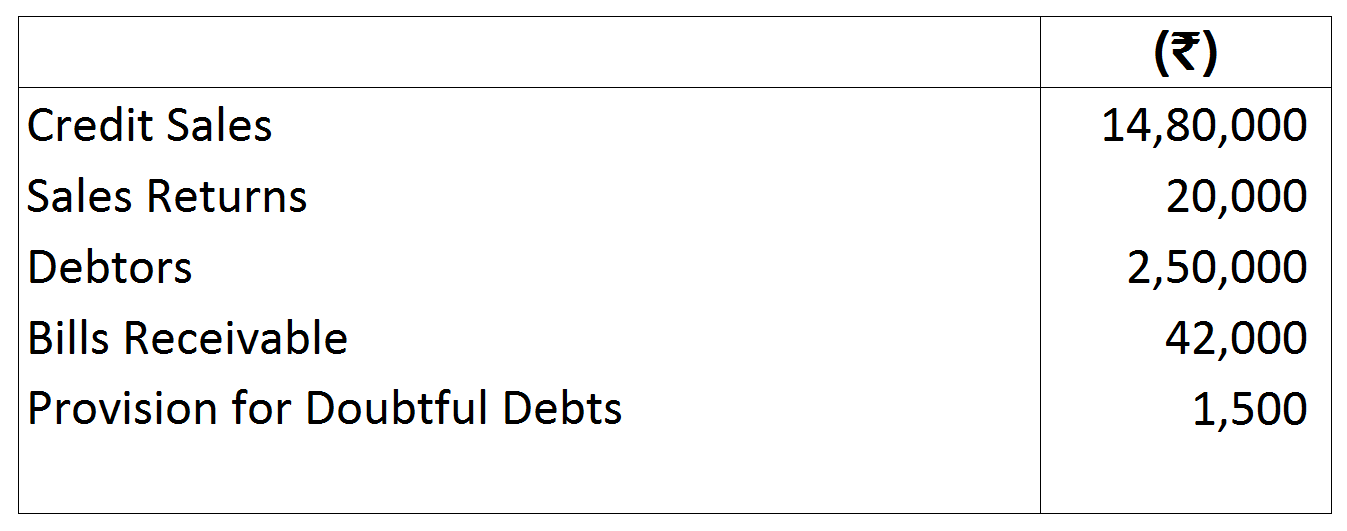
From the following information, calculate trade receivables turnover ratio and average collection period:
Answer
Trade Receivables Turnover Ratio $=\frac{\text{Net Credit Sales}}{\text{Trade Receivables}}$
Net Credit Sales Credit Sales - Sales Returns
= ₹ 14,80,000 - ₹ 20,000 = ₹ 14,60,000
Trade Receivables $= \text{Debtors} + \frac{\text{B}}{\text{R}} = ₹ \ 2,92,000$
Trade Receivables Turnover Ratio $=\frac{₹\ 14,60,000}{₹\ 2,92,000}=5\text{times}$
Average Collection Period $=\frac{\text{Days in a Year}}{\text{Trade Receivables Turnover Ratio}}$
$=\frac{365\text{ days}}{5\text{ times}}=73\text{ days}$
View full question & answer
Question 204 Marks
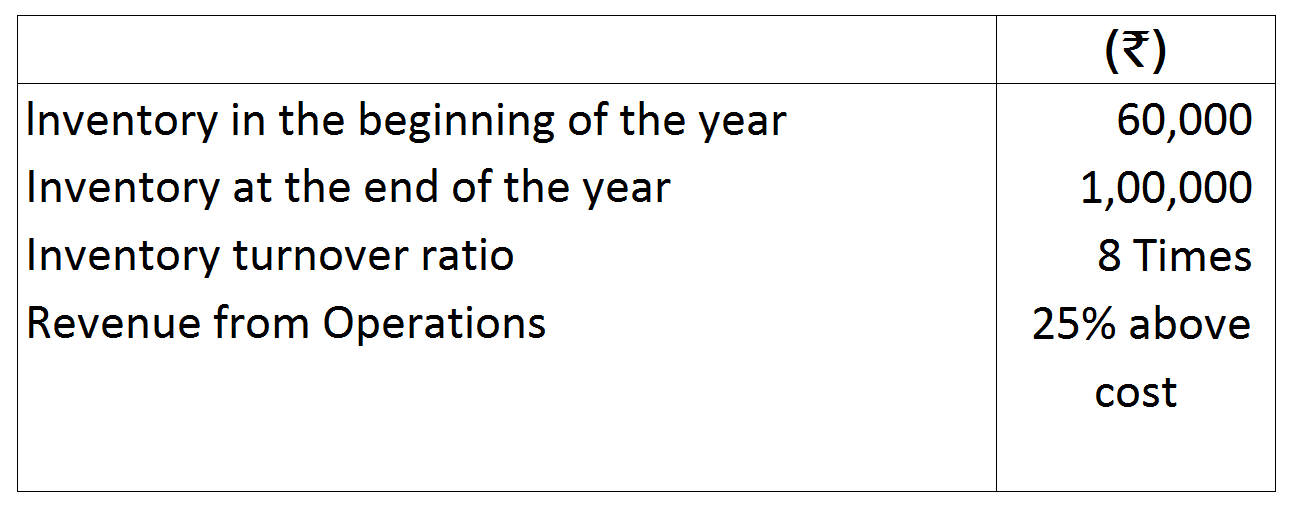
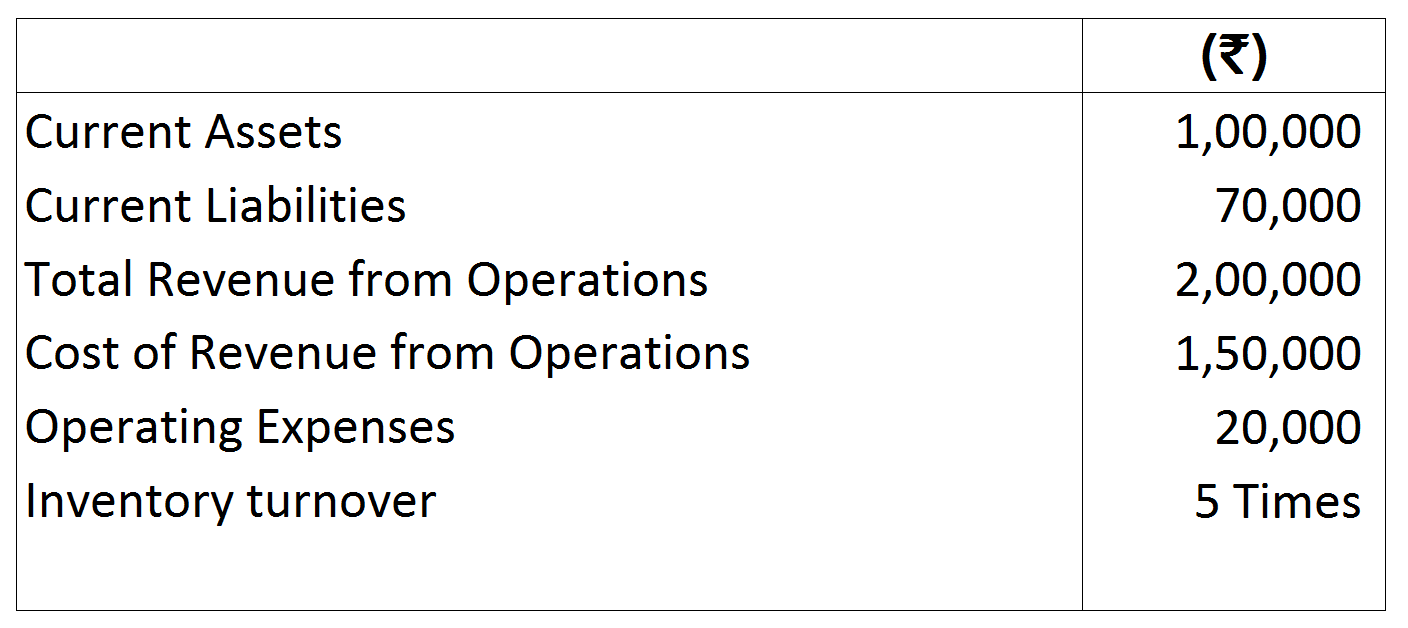
Following figures have been extracted from Shivalika Mills Ltd:
Compute the amount of gross profit and revenue from operations.
Answer
Average Inventory $=\frac{\text{Opening Inventory + Closing Inventory}}{2}$ $= \frac{₹\ 60,000 + ₹\ 1,00,000 }{2}$ $= \frac{₹\ 1,60,000 } {2}=₹\ 80,000$Inventory Turnover Ratio $=\frac{\text{Cost of Revenue from Operations}}{\text{Average Inventory}}$
8 (Given) $=\frac{\text{Cost of Revenue from Operations}}{₹\ 80,000}$ Cost of Revenue from Operations =₹ 80,000 × 8 = ₹ 6,40,000 Gross Profit = 25% of Cost of Revenue from Operations = ₹ 6,40,000 × 25% = ₹ 1,60,000 Revenue from Operations = Cost of Revenue from Operation + Gross Profit ₹ 6,40,000 + ₹ 1,60,000 = ₹ 8,00,000
View full question & answer
Question 214 Marks
Average Inventory ₹ 60,000; Inventory Turnover Ratio 5 Times; Selling price 40% above cost. Calculate Gross Profit Ratio.
Answer
Inventory Turnover Ratio $=\frac{\text{Cost of Revenue from Operations}}{\text{Average Inventory}}$
5 (Given) $=\frac{\text{Cost of Revenue from Operations}}{₹\ \text{60,000 (Given)}}$
Cost of Revenue from Operations = ₹ 60,000 × 5 = ₹ 3,00,000
Selling Price is 40% above cost
$\therefore$ Selling Price $3,00,000\times\frac{140}{100}=₹\ 4,20,000$
Gross Profit = Revenue from Operations - Cost of Revenue from Operations
= ₹ 4,20,000 - ₹ 3,00,000 = ₹ 1,20,000
Gross Profit Ratio $=\frac{\text{Gross Profit}}{\text{Net Revenue from Operations}}\times100$
$=\frac{1,20,000}{4,20,000}\times100=28.57\%$
View full question & answer
Question 224 Marks
Following are the details available:If the closing inventory is more by f4,000 than opening inventory, determine the following:
  1. Opening Inventory.
  2. Liquid Ratio.
Answer
  1. Inventory Turnover Ratio $=\frac{\text{Cost of Revenue from Operations}}{\text{Average Inventory}}$
$5 \text{(Given)} =\frac{₹\ 1,50,000\text{(Given)}}{\text{Average Inventory}}$

Average Inventory $= \frac{₹\ 1,50,000}{5}= ₹\ 30,000$

$\therefore$ Opening Inventory $=₹\ 30,000-\frac{1}{2}\text{of}\ ₹\ 4,000$

= ₹ 28,000

Closing Inventory $=₹\ 30,000-\frac{1}{2}\text{of}\ ₹\ 4,000= ₹\ 32,000$
  1. Liquid Ratio $=\frac{\text{Liquid Assets}}{\text{Current Liabilities}}$
Liquid Assets = Current Assets - Closing Inventory

= ₹ 1,00,000 - ₹ 32,000

= ₹ 68,000

Liquid Ratio $=\frac{₹\ 68,000}{₹\ 70,000}=.97:1$
View full question & answer
Question 234 Marks
Calculate Gross Profit Ratio from the following:
Revenue from Operations ₹ 1, 70,000; Credit Revenue from Operations ₹ 3,50,000; Revenue from Operations Returns (Sales Returns) ₹ 20,000; Cost of Revenue from Operations ₹ 4,00,000.
Answer
Gross Profit Ratio $=\frac{\text{Gross Profit}}{\text{Net Revenue from Operations}}\times100$
Gross Profit = Net Revenue from Operations - Cost of Revenue from Operations
Net Revenue from Operations = Cash Revenue from Operations + Credit Revenue from Operations -Revenue from Operations Returns
= ₹ 1,70,000 + ₹ 3,50,000 - ₹ 20,000
= ₹ 5,00,000
Gross Profit = ₹ 5,00,000- ₹ 4,00,000
= ₹ 1,00,000
Gross Profit Ratio $=\frac{₹\ 1,00,000}{₹\ 5,00,000}\times100=20\%$
View full question & answer
Question 244 Marks
From the following information calculate Operating Profit Ratio:
Opening Stock ₹ 10,000; Purchases ₹ 20,000; Revenue from operations ₹ 4,00,000; Purchase Returns ₹ 5,000; Return from Revenue from operations ₹ 15,000; Selling Expenses ₹ 70,000; Administrative Expenses ₹ 40,000; Closing Stock ₹ 60,000.
Answer
Operating Profit Ratio $=\frac{\text{Operating Profit}}{\text{Net Revence from Operations}}\times100$
Net Revenue from Operations = Opening Stock + Purchases - Purchases Retums - Closing Stock.
= ₹ 10,000 + 1,20,000 - 5,000 - 60,000 = ₹ 65,000.
Gross Profit = Net Revenue from Operations - Cost of revenue from Operations.
= ₹ 3,85,000 - ₹ 65,000 = ₹ 3,20,000.
Operating Expenses = Selling Expenses + Administrative Expenses
= ₹ 70,000 + ₹ 40,000 = ₹ 1,10,000.
Operating Profit = Gross Profit - Operating Expenses.
= ₹ 3,20,000 - ₹ 1,10,000 = ₹ 2,10,000
Operating Profit Ratio = $\frac{₹\ 2,10,000}{₹\ 3,85,000 }\times100=54.55\% $
View full question & answer
Question 254 Marks
Closing Trade Receivables ₹ 4,00,000; Cash Revenue from Operations being 25% of Credit Revenue from Operations. Excess of Closing Trade Receivables over Opening Trade Receivables ₹ 2,00,000. Total Revenue from Operations ₹ 15,00,000. Calculate Trade Receivables Turnover Ratio.
Answer
Trade Receivables Turnover Ratio $=\frac{\text{Credit Revenue from Operations}}{\text{Average Trade Receivables}}$
Total Revenue from Operations = ₹ 15,00,000
Ratio of Cash Revenue from Operations to Credit Revenue from Operations = 1:4
$\therefore$ Credit Revenue from Operations $=₹\ 15,00,000\times \frac{4}{5}= ₹\ 12,00,000$
Closing Trade Receivables = ₹ 4,00,000
Opening Trade Receivables = ₹ 4,00,000 - ₹ 2,00,000
= ₹ 2,00,000
$\therefore$ Average Trade Receivables $= \frac{\text{Opening Trade Receivables + Closing Trade Receivables}}{2}$
$=\frac{ ₹ \ 2,00,000+₹ \ 4,00,000 }{2}$
Trade Receivables Turnover Ratto $=\frac{ ₹ \ 12,00,000}{₹ \ 3,00,000 }= 4\text{ times}$
View full question & answer
Question 264 Marks
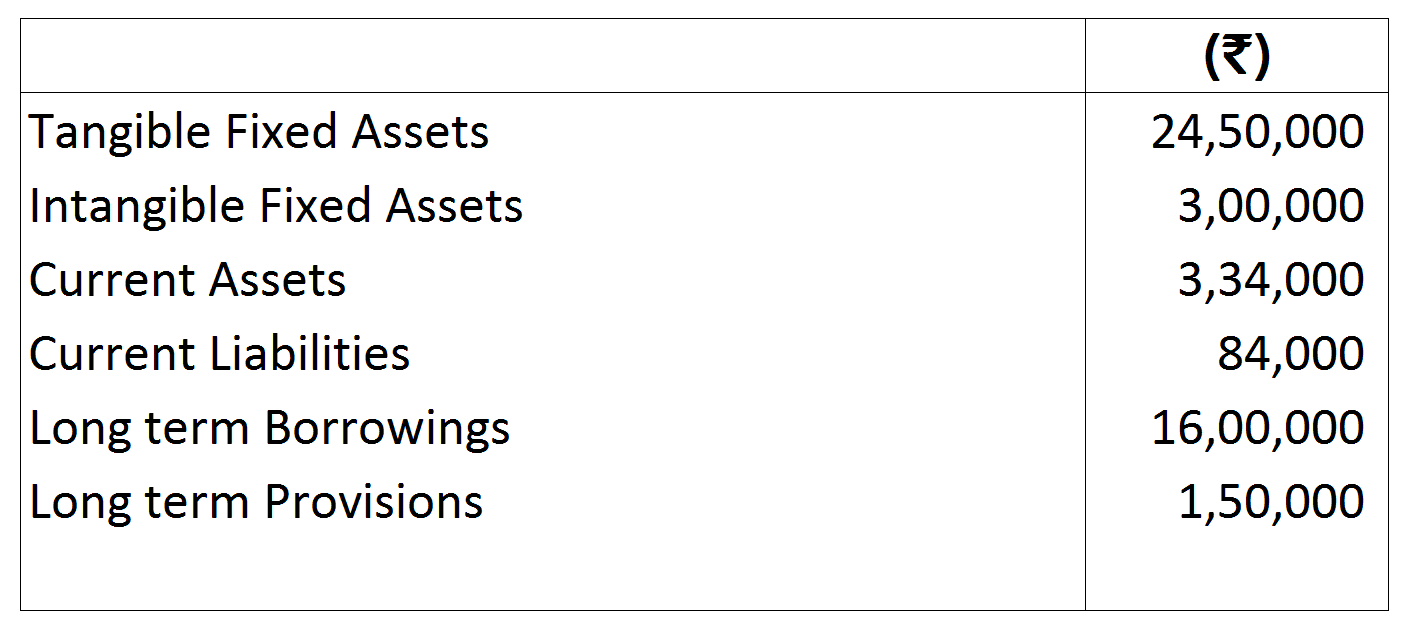
Calculate Debt-Equity Ratio from the following:
Answer
Debt-Equity Ratio $=\frac{\text{Debt}}{\text{Equity}}\text{ or }\frac{\text{Long term Debts}}{\text{Shareholder's Funds}}$
Long term Debts = Long term Borrowings + Long term Provisions.
= ₹ 16,00,000 + ₹ 1,50,000 = ₹ 17,50,000
Shareholder's Funds = Non Current Assets + Working Capital-Non Current Liabilities.
Non Current Assets = Tangible Fixed Assets + Intangible Fixed Assets.
= ₹ 24,50,000 + ₹ 3,00,000
= ₹ 27,50,000
Working Capital = Current Assets - Current Liabilities.
= ₹ 3,34,000 - ₹ 84,000
= ₹ 2,50,000
Non Current Liabilities refer to Long-term Debts
Thus,
Shareholder's Funds = ₹ 27,50,000 + ₹ 2,50,000 - ₹ 17,50,000
= ₹ 12,50,000
Debt Equity Ratio $=\frac{₹\ 17,50,000}{₹\ 12,50,000}=1.4:1$
View full question & answer
Question 274 Marks
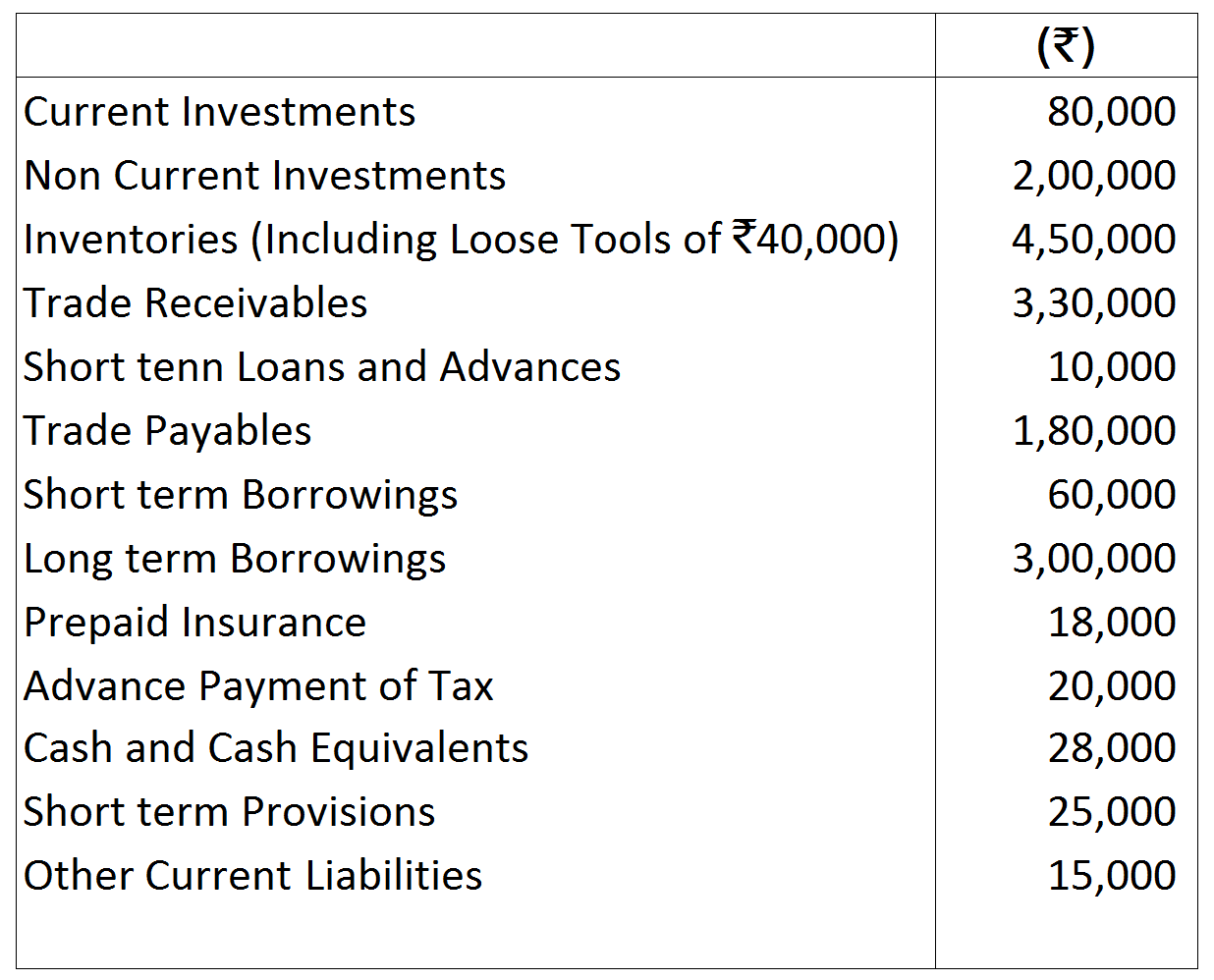
From the following compute:
  1. Current Ratio.
  2. Quick Ratio.
Answer
  1. Current Ratio $=\frac{\text{Current Assets}}{\text{Current Liabilities}}$
Current Assets = Current Investments + Inventories (except Loose Tools) + Trade Receivables + Short term Loans & Advances + Prepaid Insurance+ Advance Payment of Tax + Cash and Cash Equivalents.

= ₹ 80,000 + ₹ 4,10,000 + ₹ 3,30,000 + ₹ 10,000 + ₹ 18,000 = ₹ 20,000 + ₹ 28,000

= ₹ 8,96,000

Current Liabilities = Trade Payables + Short term Borrowings + Short term Provisions + Other Current Liabilities.

= ₹ 1,80,000 + ₹ 60,000 + ₹ 25,000 + ₹ 15,000

= ₹ 2,80,000

Current Ratio $=\frac{₹\ 8,96,000}{₹\ 2,80,000}=3.2:1$
  1. Quick Ratio $=\frac{\text{Liquid Assets}}{\text{Current Liabilities}}$
Liquid Assets = Current Assets - Inventories - Prepaid Insurance - Advance Payment of Tax.

= ₹ 8,96,000 - ₹ 4,10,000 - ₹ 18,000 - ₹ 20,000

= ₹ 4,48,000

Quick Ratio $=\frac{₹\ 4,48,000}{₹\ 2,80,000}=1.6:1$
View full question & answer
Question 284 Marks
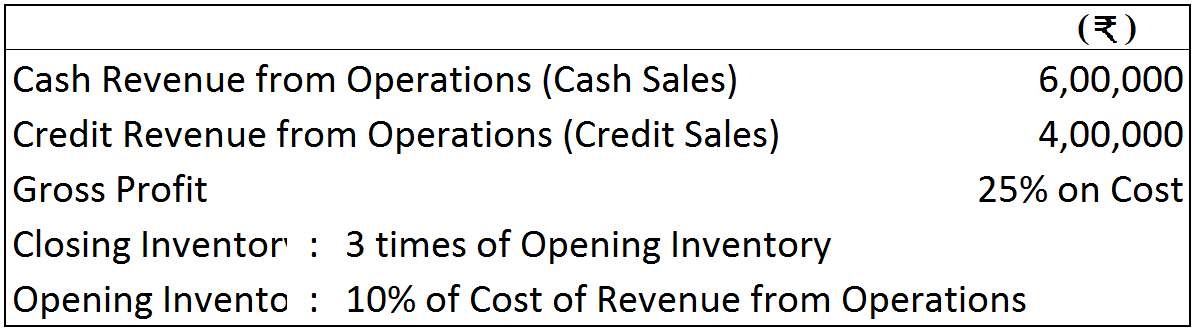
Calculate Inventory Turnover Ratio from the following:
Answer
Gross Profit is 25% on cost. Therefore goods costing ₹ 100 is sold for ₹ 125.
Hence, if Revenue from Operations are ₹ 125.
Cost of Revenue from Operations = ₹ 100
If Revenue from Operations are ₹ 10,00,000
Cost of Revenue from Operations $=\frac{100}{125}\times10,00,000=₹\ 8,00,000$
Opening Inventory is 10% of Cost of Revenue from Operations
$\therefore$ Opening Inventory $=\frac{10}{100}\times8,00,000=₹\ 80,000$
Closing Inventory $=80,000\times3=₹\ 2,40,000$
Average Inventory $=\frac{\text{Opening Inventory + Closing Inventory}}{2}$
$=\frac{80,000 + 2,40,000}{2}=₹\ 1,60,000$
Inventory Turnover Ratio $=\frac{\text{Cost of Revenue from Operations}}{\text{Average Inventory}}$
$=\frac{8,00,000}{1,60,000}=5\text{ times}$
View full question & answer
Question 294 Marks
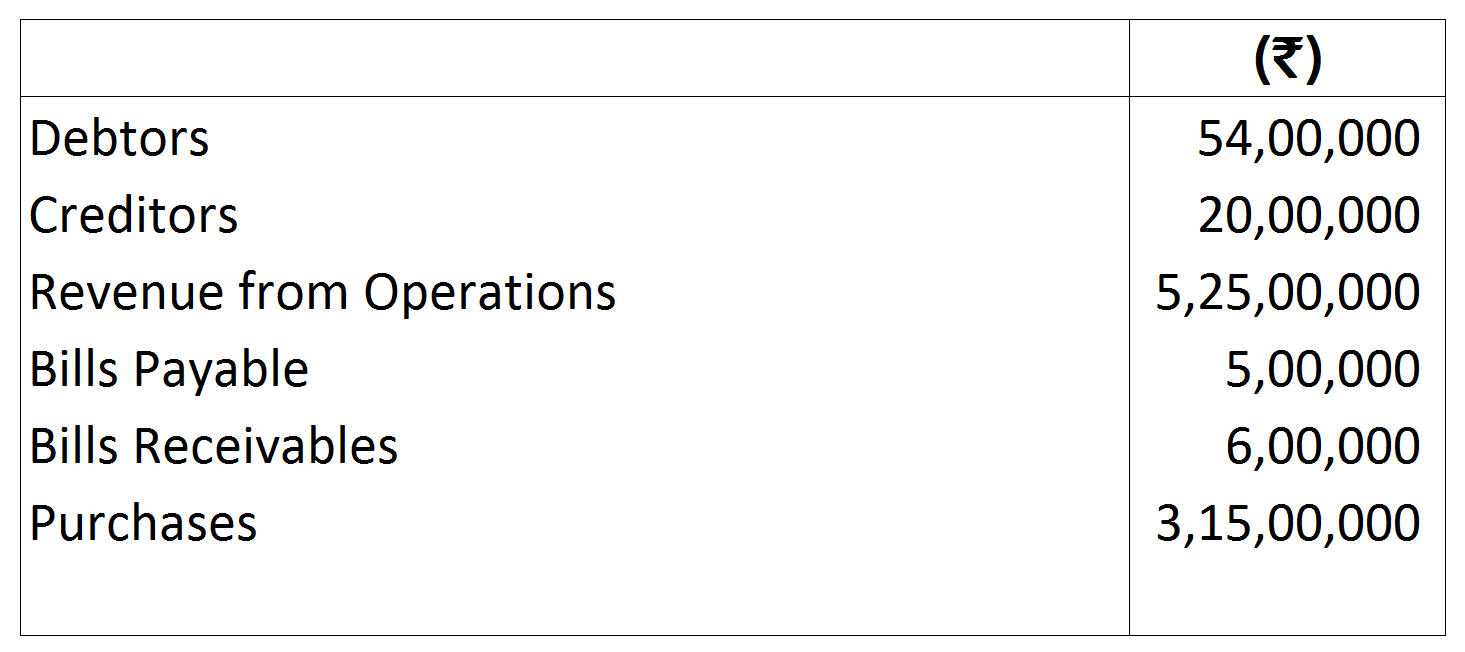
On the basis of the following information calculate (i) Trade Receivables Turnover Ratio; (ii) Average Collection Period; (iii) Trade Payables Turnover Ratio and (iv) Average Payment Period.
Answer
  1. Trade Receivables Turnover Ratio $=\frac{\text{Credit Revenue from Operations}}{\text{Debtors + Bills Receivables}}$
$=\frac{5,25,00,000}{54,00,000 + 6,00,000}=8.75\text{ Times}$
  1. Average Collection Period $=\frac{\text{365 days}}{\text{Trade Receivables Turnover Ratio}}$
$=\frac{365}{8.75}=41.7\text{ or }42\text{ days}$
  1. Trade Payables Turnover Ratio $=\frac{\text{Credit Purchases}}{\text{Creditors + Bills Payable}}$
$=\frac{3,15,00,000}{20,00,000+5,00,000}=12.6\text{ Times}$
  1. Average Payment Period $=\frac{\text{365 days}}{\text{Trade Payables Turnover Ratio}}$
$=\frac{365}{12.6}=28.97\text{ days or 29 days}$
View full question & answer
Question 304 Marks
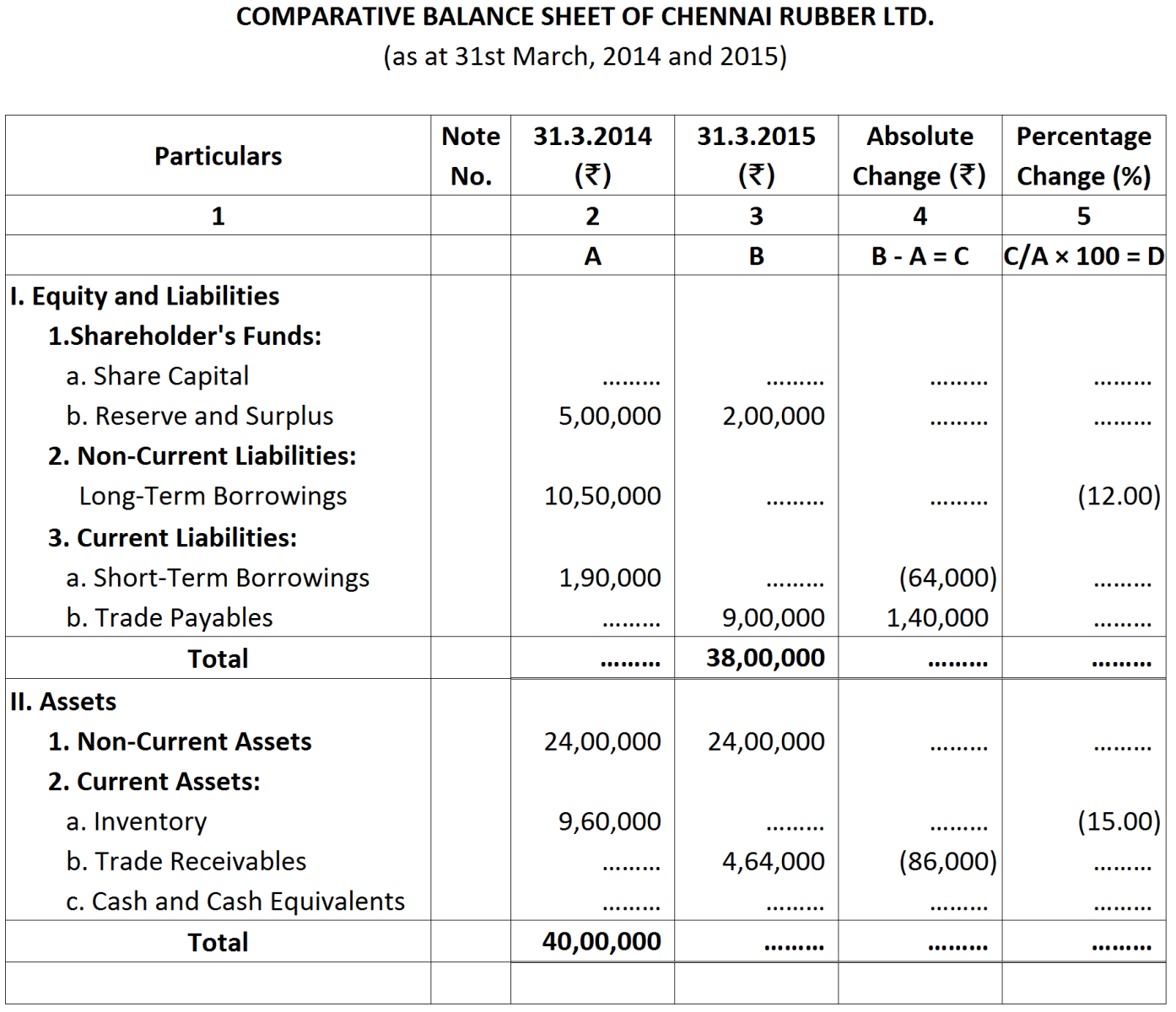
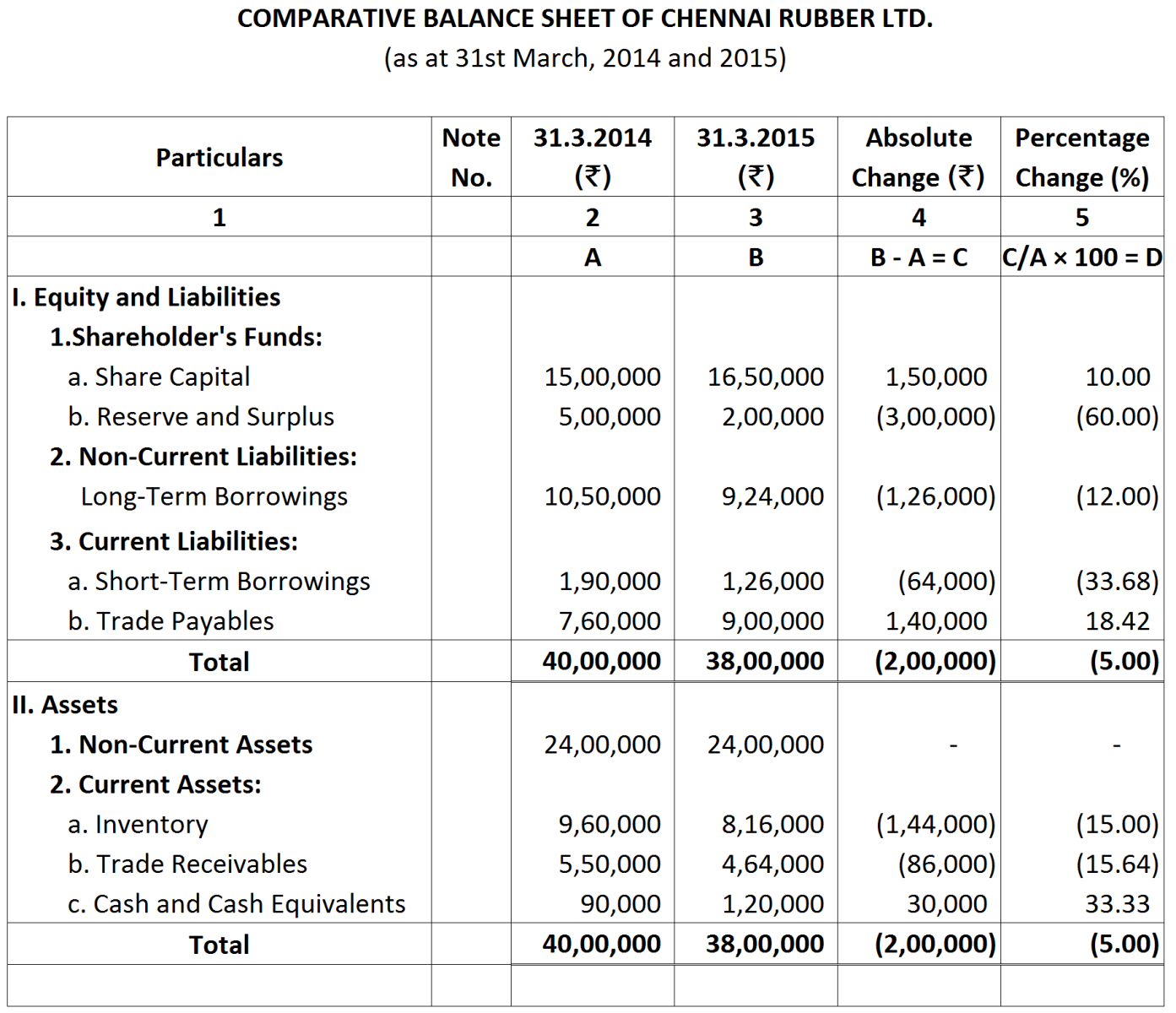
Following is the Comparative Balance Sheet of Chennai Rubber Ltd.
Additional Information: Net Credit Purchases for the year ended 31st March, 2014 and 31st March, 2015 ₹ 72,00,000 and ₹ 66,40,000. Trade Payables as at 31st March, 2013 were ₹ 7,40,000.You are required to:
  1. Fill in the missing figures in the Comparative Balance Sheet.
  2. Compute trade Payables turnover Ratio.
Answer

  1. Percentage Change in Share Capital 10.00; Reserve and Surplus (60.00); Long-term Borrowings (12.00); Short-term Borrowings (33.60); Trade Payables is 42; Non-Current Assets Nil; Inventory (15.00); Trade Receivables (15.64); Cash and Cash Equivalents 33.33.
  2.  
Trade Payables Turnover Ratio: 31.3.2014 = 9.6 Times
  31.3.2015=8 Times
Hint: Average Trade Payables 31.3.2014 ₹ 7,50,000
  31.3.2015 ₹ 8,30,000
View full question & answer
Question 314 Marks
Current Ratio 3 : 1; Quick Ratio 1.2 : 1; Working Capital ₹ 1,50,000. Calculate Current Assets, Current Liabilities and Inventory.
Answer
Working Capital = Current Assets- Current Liabilities
Curret Ratio = 3n : 1, therefore, based on current ratio the working capital is 3 - 1 = 2
If Working Capital is 2,
Current Assets = 3
If Working Capital is 1,
Current Assets $=\frac{3}{2}$
If Working Capital is 1,50,000,Current Assets $=\frac{3}{2}\times₹ \ 1,50,000$
= ₹ 2,25,000
Current Liabilities = Current Assets- Working Capital
= ₹ 2,25,000 - ₹ 1,50,000 = ₹ 75,000
Quick Ratio $=\frac{\text{Liquid Assets}}{\text{Current Liabilities}}$
1.2 (Given) $=\frac{\text{Liquid Assets}}{₹\ 75,000}$
$\therefore$ Liquid Assets = ₹ 75,000 × 1.2 = ₹ 90,000
Inventory = Current Assets - Liquid Assets
= ₹ 1,25,000 - ₹ 90,000 = ₹ 1,35,000
View full question & answer
Question 324 Marks
How does ratio analysis become less effective due to price level changes?
Answer
Ratio Analysis Becomes Less Effective Due to Price Level Changes: Price level over the year goes on changing threfore the ratio of various year cannot be compared. For example, one firm sells 1,000 Machines for ₹ 10 Lakhs during 2017; it again sells 1,000 Machines of the same type in 2018 but owing to rising prices the sale price was ₹ 15 Lakhs. On the basis of ratios it will be concluded that the sales. have increased by 50%, whereas in actual, sales have not increased at all. Hence, the figures of the past years must be adjusted in the light of price level changes before the ratios for these years are compared.
View full question & answer
Question 334 Marks
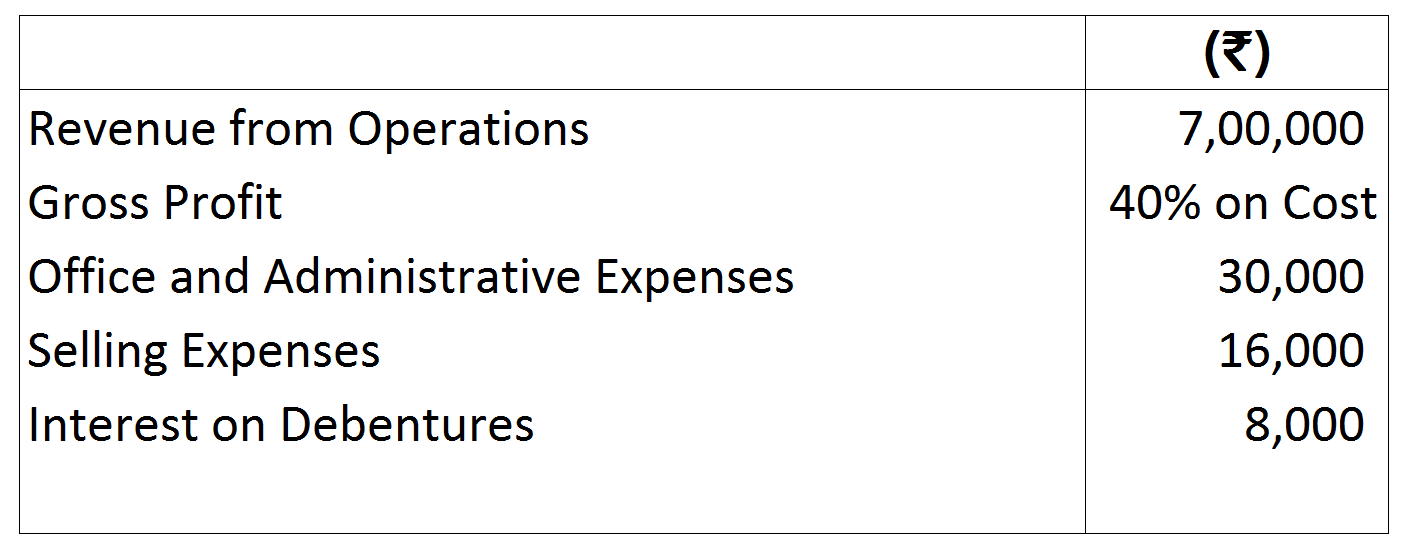
Calculate Operating Profit Ratio from the following:
Answer
Operating Profit Ratio $=\frac{\text{Operating Profit}}{\text{Revenue From Operations (Sales)}\times100}$
If Cost of Revenue from Operations is ₹ 100 = Gross Profit ₹ 40
and Revenue from Operations will be ₹ 100 + ₹ 40 = ₹ 140
When Revenue from Operations is ₹ 140, G.P. = ₹ 40
When Revenue from Operations is ₹ 7,00,000, G.P. $=7,00,000\times\frac{40}{140}=₹\ 2,00,000$
Operating Expenses = Office and Administrative Expenses + Selling Expenses
= ₹ 30,000 + ₹ 16,000 = ₹ 46,000
Operating Profit = Gross Profit- Operating Expenses.
= ₹ 2,00,000 - ₹ 46,000 = ₹ 1,54,000
Operating Profit Ratio $=\frac{₹\ 1,54,000}{₹\ 7,00,000}=22\%$
View full question & answer
Question 344 Marks
₹ 3,00,000 is the cost of Revenue from Operations (Cost of Goods Sold), Inventory turnover 8 times; Inventory at the beginning is 2 times more than the inventory at the end. Calculate the values of Opening & Closing Inventory.
Answer
Inventory Turnover Ratio $=\frac{\text{Cost of Revenue from Operations (Cost of Goods Sold)}}{\text{Average Inventory}}$
8 (Given) $=\frac{₹\ 3,00,000\text{ (Given)}}{\text{Average Inventory}}$
$\therefore$ Average Inventory $=\frac{₹\ 3,00,000}{8}=₹\ 37,500$.
Opening Inventory + Closing Inventory = Average Inventory × 2
= ₹ 37,500 × 2 = ₹ 75,000
Since opening inventory is 2 times more than that at the end, ratio between opening inventory and closing inventory will be 3 : 1.
$\therefore$ Opening Inventory $=₹\ 75,000\times\frac{3}{4}=₹\ 56,250$
Closing Inventory $=₹\ 75,000\times\frac{1}{4}=₹\ 18,750$
View full question & answer
Question 354 Marks
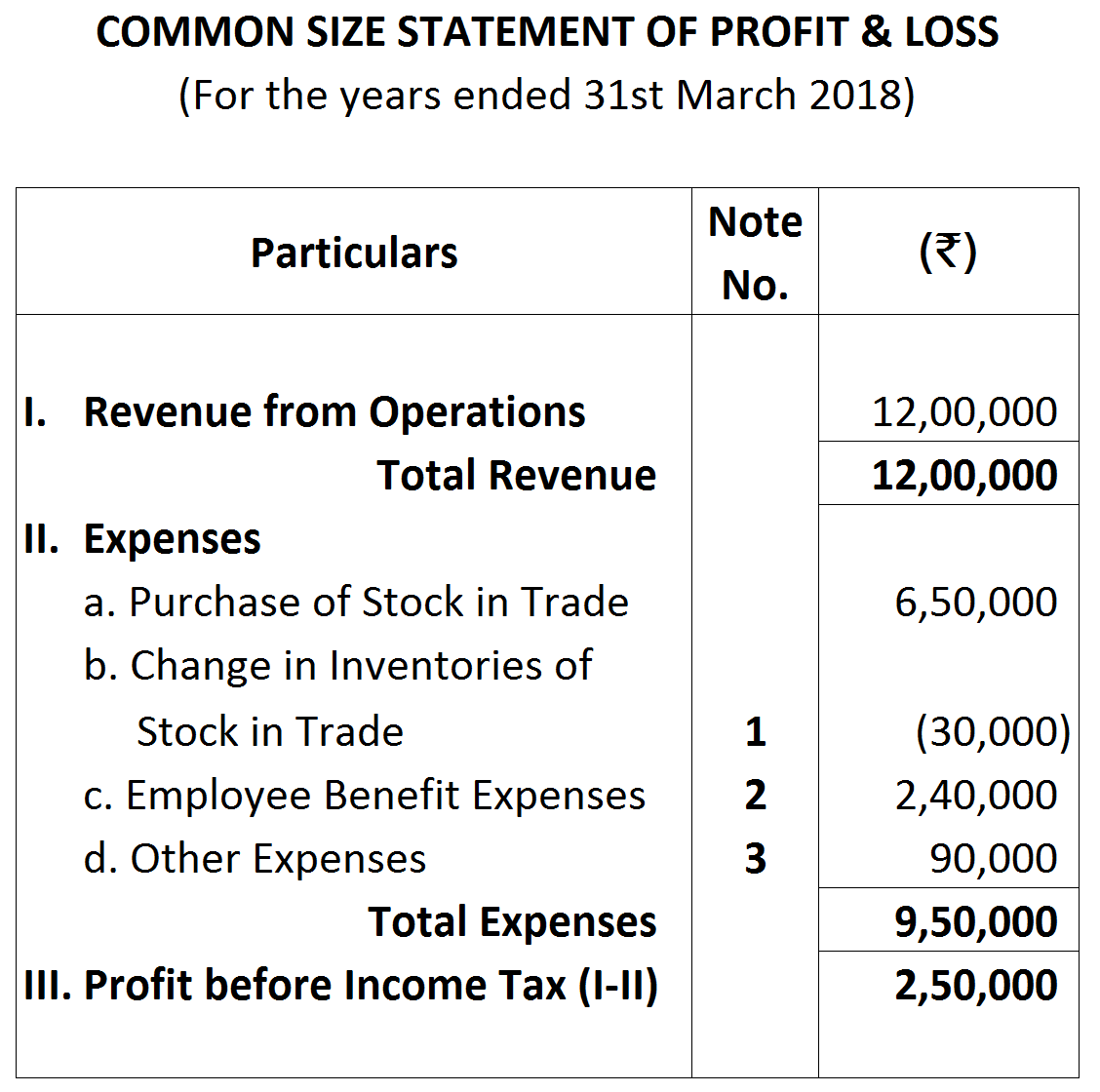
Calculate Inventory Turnover Ratio and Average Age of Inventory from the following:

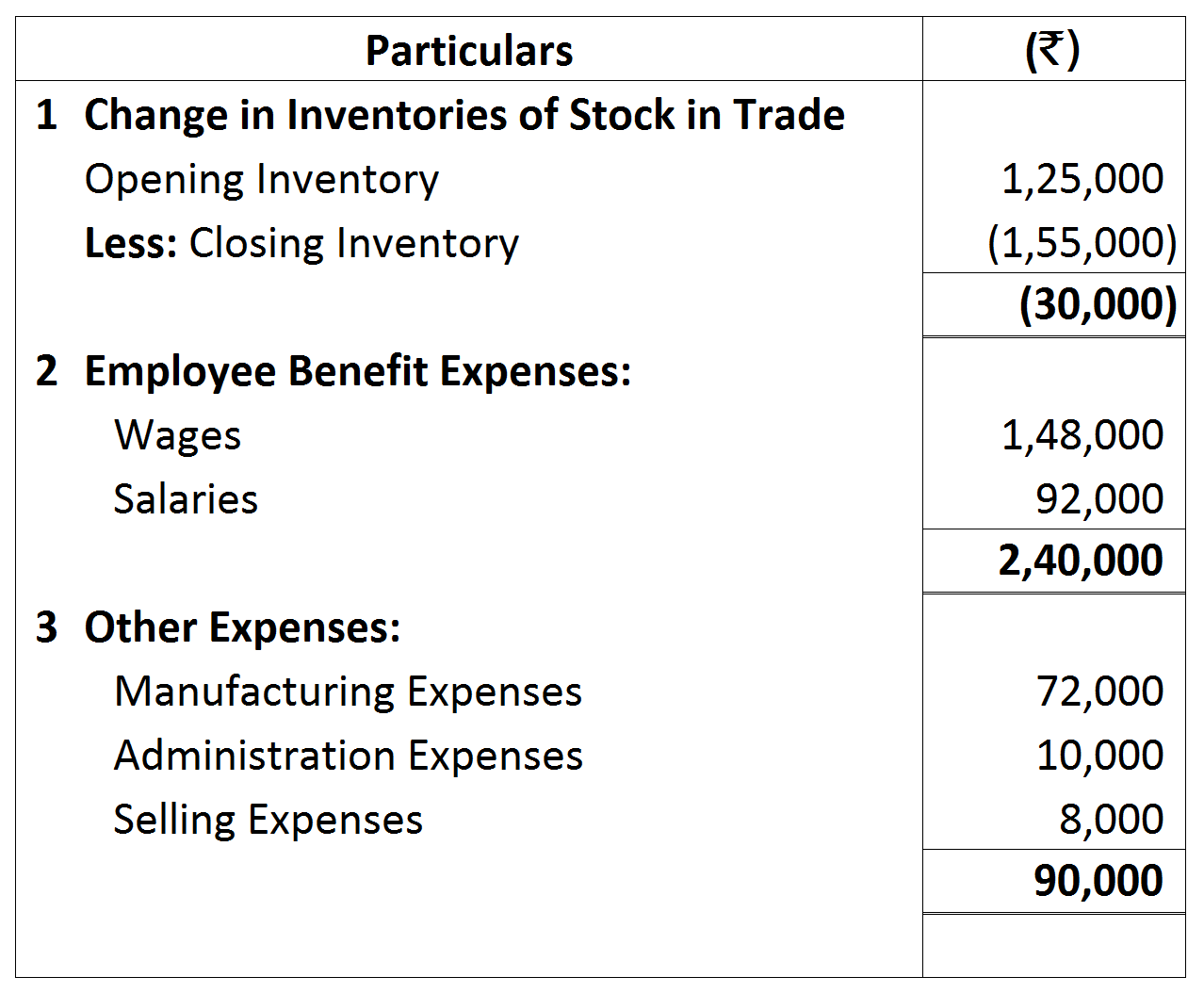
Notes to Accounts:
Answer
  1. Inventory Turnover Ratio $=\frac{\text{Cost of Revenue from Operations (Cost of Goods Sold)}}{\text{Average Inventory}}$
Cost of Revenue from Operations = Purchase of Stock in Trade + Change in Inventory of Stock in Trade + Wages + Manufacturing Exp.

= ₹ 6,50,000 - ₹ 30,000 + ₹ 1,48,000 + ₹ 72,000

= ₹ 8,40,000

Average Inventory $=\frac{1,25,000+1,55,000}{2}=₹\ 1,40,000$

Inventory Turnover Ratio $=\frac{8,40,000}{1,40,000}=6\text{ times}$
  1. Average Age of Inventory $=\frac{\text{Days in a year}}{\text{Inventory Turnover Ratio}}$
$=\frac{365}{6}=61\text{ days}$
View full question & answer
Question 364 Marks
A trader carries an average inventory of ₹ 40,000. His inventory turnover Ratio is 8 times. Ifhe sells goods at a profit of 20% on revenue from operations, find out his profit.
Answer
Inventory Turnover Ratio $=\frac{\text{Cost of Revenue from Operations}}{\text{Inventory}}$
$8 \text{ (Given)}=\frac{\text{Cost of Revenue from Operations}}{ ​​​​ ₹\ 40,000\text{ (Given)}}$
Cost of Revenue from Operations = ₹ 40,000 × 8 = ₹ 3,20,000
Goods are sold at a profit of 20% on Revenue from Operations.
$\therefore$ If Revenue from Operations is ₹ 100, Gross Profit will be ₹ 20 and Cost of Revenue from Operations ₹ 80
Hence, If Cost of Revenue from Operations is ₹ 80
Gross Profit = ₹ 20
If Cost of Revenue from Operations is ₹ 3,20,000
Gross Profit $= ₹\ 3,20,000\times\frac{20}{100}= ₹\ 80,000$
View full question & answer
Question 374 Marks
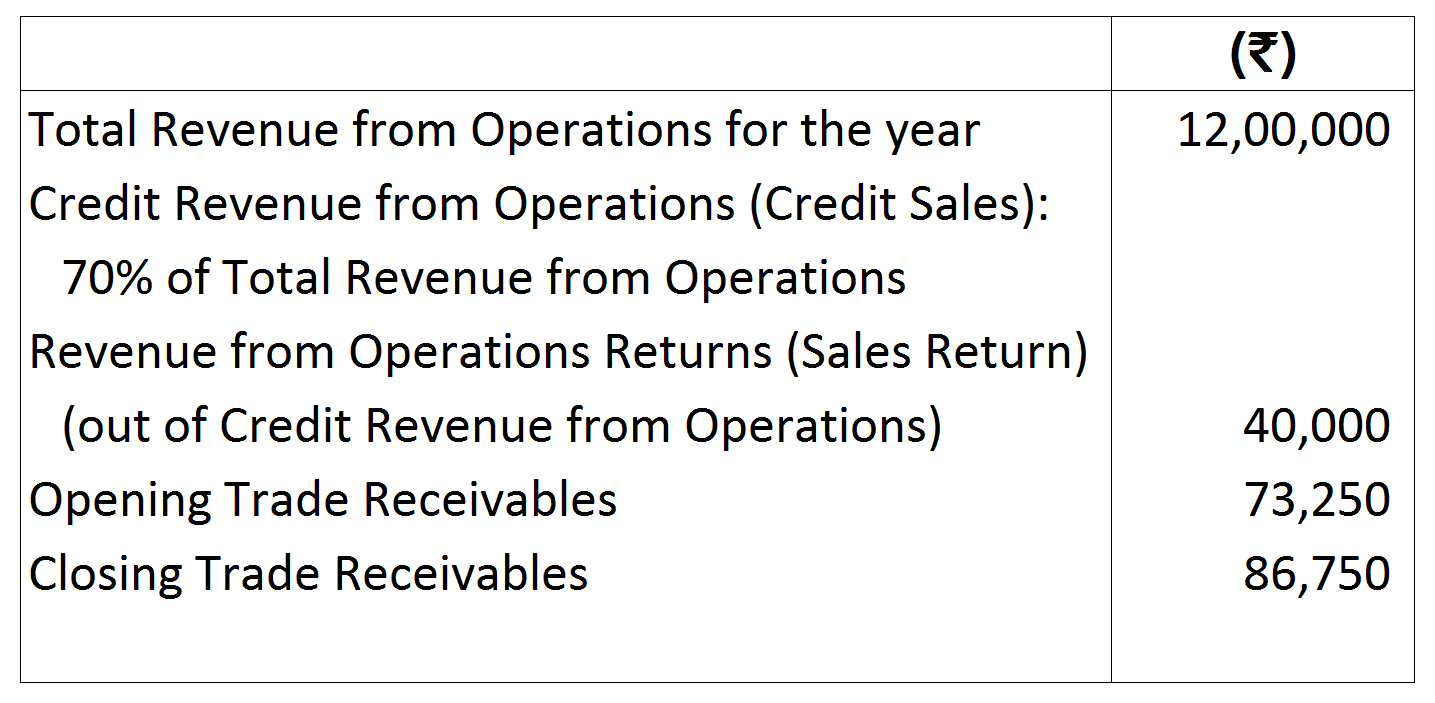
Calculate Trade Receivables Turnover Ratio and Average Collection Period from the following:
Answer
Trade Receivables Turnover Ratio $=\frac{\text{Net Credit Revenue from Operations}}{\text{Average Trade Receivables}}$
Credit Revenue from Operations = 70% of ₹ 12,00,000 = ₹ 8,40,000
Net Credit Revenue from Operations = Credit Revenue from Operations - Revenue from Operations Returns
= ₹ 8,40,000 - ₹ 40,000 = ₹ 8,00,000
Average Trade Receivables $=\frac{\text{Opening Trade Receivables + Closing Trade Receivables}}{2}$
$=\frac{₹\ 73,250 + ₹\ 86,750}{2}= ₹\ 80,000$
Trade Receivables Turnover Ratio $=\frac{\ 8,00,000}{₹\ 80,000}=10\text{ Times}$
Average Collection Period $=\frac{\text{Days in a year}}{\text{Trade Receivables Turnover Ratio}}$
$=\frac{365}{10}=37\text{ day}$
View full question & answer
Question 384 Marks
Calculate Opening Inventory from the following information:
Purchases ₹ 5,70,000; Freight ₹ 20,000; Miscellaneous Expenses ₹ 10,000; Revenue from Operations (Sales) ₹ 5,00,000; Closing Inventory ₹ 70,000; Gross Loss 16% on Revenue from Operations.
Answer
Cost of Revenue from Operations = Revenue from Operations + Gross Loss
= ₹ 5,00,000 + 16% of ₹ 5,00,000
= ₹ 5,80,000
Cost of Revenue from Operations = Opening Inventory + Purchases + Freight - Closing Inventory
₹ 5,80,000 = Opening Inventory + ₹ 5,70,000 + ₹ 20,000 - ₹ 70,000
₹ 5,80,000 = Opening Inventory + ₹ 5,20,000
Opening Inventory = ₹ 60,000
View full question & answer
Question 394 Marks
The ratio of Current Assets (₹ 5,00,000) to Current Liabilities is 2.5 : 1. The accountant of this firm is interested in maintaining a Current Ratio of 2 : 1 by acquiring some Current Assets on Credit. You are required to suggest him the amount of Current Assets which must be acquired for this purpose.
Answer
Current Ratio $=\frac{\text{Current Assets}}{\text{Current Liabilities}}$
2.5 (Given) $=\frac{₹\ 5,00,000 \text{ (Given)}}{\text{Current Liabilities}}$
$\therefore$ Current Liabilities $=\frac{₹\ 5,00,000}{2.5}=₹\ 2,00,000$
In order to reduce the Current Ratio, Current Assets must be acquired on credit. But increase in Current Assets on credit results is an increase in Current Liabilities as well. Let's assume the amount of Current Assets to be acquired as x. After the acquisition of Current Assets of ₹ x on credit,
Current Assets = ₹ 5,00,000 + x
Current Liabilities = ₹ 2,00,000 + x
Current Ratio $=\frac{\text{Current Assets}}{\text{Current Liabilities}}$
2 (Ratio to be maintained) $=\frac{₹\ 5,00,000+\text{x}}{₹\ 2,00,000+\text{x}}$
₹ 4,00,000 + 2x = ₹ 5,00,000 + x
$\therefore$ x = ₹ 1,00,000
Therefore, Current Assets of ₹ 1,00,000 should be acquired on credit to maintain a Current Ratio of 2 : 1.
View full question & answer
Question 404 Marks
Average Inventory ₹ 80,000; Inventory Turnover Ratio 6 Times; Revenue from Operations 25% above cost. Calculate Gross Profit Ratio.
Answer
Inventory Turnover Ratio $=\frac{\text{Cost of Revenue from Operations}}{\text{Average Inventory}}$
6 (Given) $=\frac{\text{Cost of Revenue from Operations}}{₹\ 80,000\text{ (Given)}}$
Cost of Revenue from Operations = ₹ 80,000 × 6 = ₹ 4,80,000
If Cost of Revenue from Operations is ₹ 100,
Gross Profit = ₹ 25
If Cost of Revenue from Operations is f4,80,000
Gross Profit $= ₹\ 4,80,000\times\frac{25}{100}$
$=₹\ 1,20,000$
Revenue from Operations = Cost of Revenue from Operations + Gross Profit
= ₹ 4,80,000 + ₹ 1,20,000 = ₹ 6,00,000
Gross Profit Ratio $=\frac{\text{Gross Profit}}{\text{Net Revenue from Operations}}\times100$
$=\frac{₹\ 1,20,000}{₹\ 6,00,000}\times100=20\%$
View full question & answer
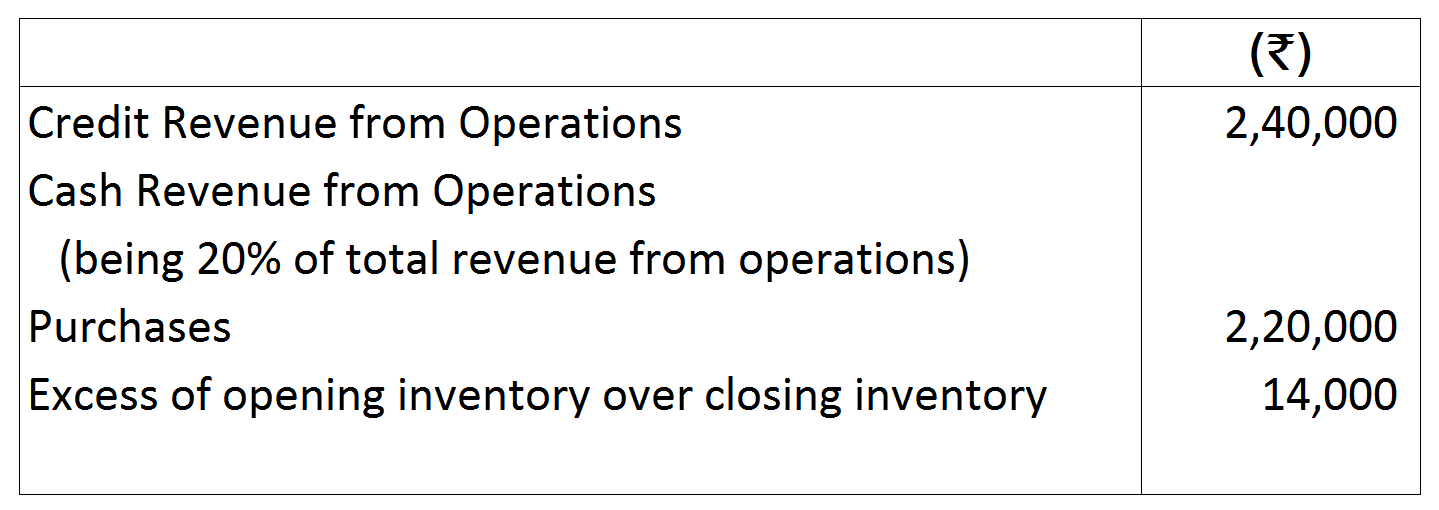
Question 414 Marks
Calculate G.P. ratio from the following:
Answer
If total Revenue from Operations is ₹ 100, Cash revenue from operations will be ₹ 20 and Credit revenue from operations ₹ 80.
Hence, If credit revenue from operations is ₹ 80 total revenue from operations will be = ₹ 100
If credit revenue from operations is ₹ 2,40,000 total revenue from operations will be $=\frac{100}{80}\times2,40,000$
$=₹\ 3,00,000$
Cost of Revenue from Operations = Purchases + Excess of Opening Inventory over Closing Inventory
= ₹ 2,20,000 - ₹ 14,000 = ₹ 2,34,000
Gross Profit = Total Revenue from Operations - Cost of Revenue from Operations
= ₹ 3,00,000 - ₹ 2,34,000 = ₹ 66,000
Gross Profit Ratio $=\frac{\text{Gross Profit}}{\text{Net Revenue from Operations}}\times100$
$=\frac{₹\ 66,000}{₹\ 3,00,000}\times100=22\%$
View full question & answer
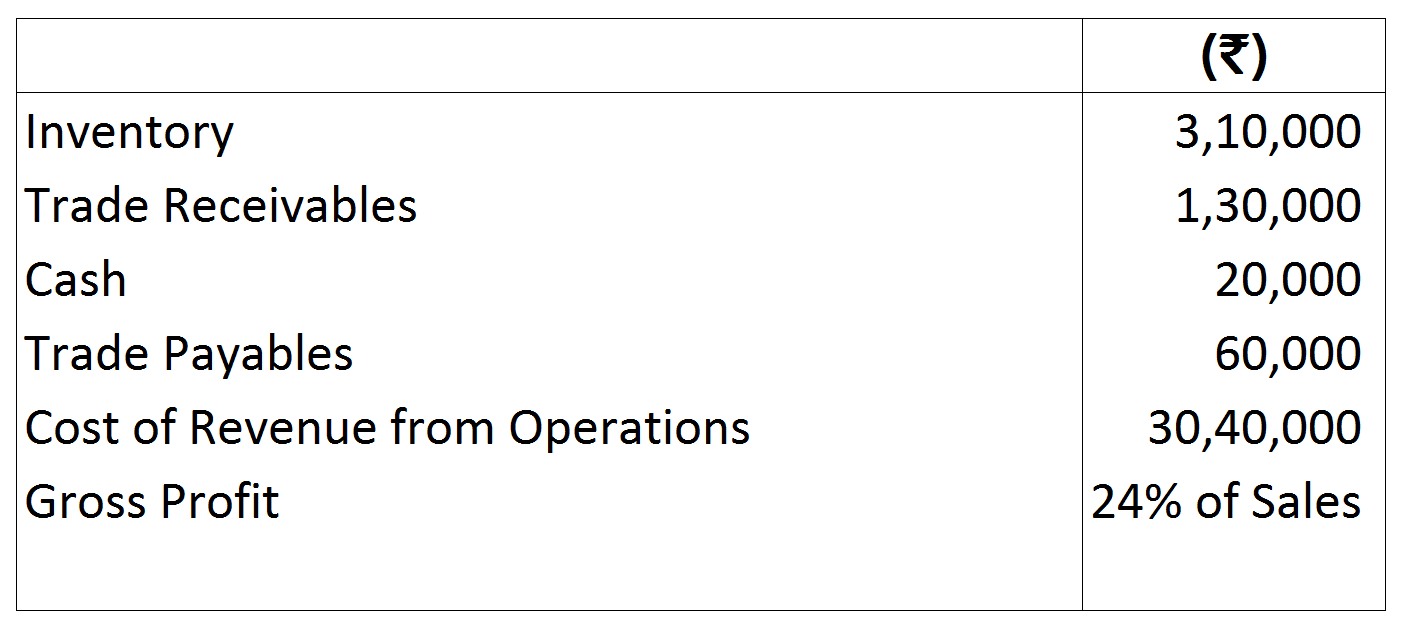
Question 424 Marks
Calculate Working Capital Turnover Ratio from the following information:
Answer
Working Capital Turnover Ratio $=\frac{\text{Net Revenue from Operations}}{\text{Working Capital}}$
Net Revenue from Operations = Cost of Revenue from Operations + Gross Profit
Revenue from Operations include a profit of 24% on revenue from operations, therefore goods costing ₹ 76 must have been sold for ₹ 100. As such,
If Cost of Revenue from Operations is ₹ 76, Revenue from Operations are ₹ 100.
If Cost of Revenue from Operations is ₹ 30,40,000, Revenue from Operations are $\frac{100}{76}\times30,40,000=₹\ 40,00,000$
Working Capital = Current Assets - Current Liabilities
= ₹ 4,60,000- ₹ 60,000 = ₹ 4,00,000
Working Capital Turnover Ratio $=\frac{₹\ 40,00,000}{₹\ 4,00,000}=10\text{ Times}$
View full question & answer
Question 434 Marks
What are the implications of high and low inventory turnover ratios?
Answer
A low inventory turnover ratio indicates that inventory docs not sell quickly and remains lying in the godown for quite a long times, This results in increased strong costs, blocking of funds and losses on account of good becoming obsolele or unsaleable.The higher the ratio, the better it is, since it indicates that inventory is selling quickly. In a business where inventory turnover ratio is high, goods can be sold at a low margin of profit and even then the profitability may be quite high.
View full question & answer
Question 444 Marks
Credit Revenue from Operations ₹ 6,00,000; Trade Receivables Turnover Ratio 8 times; Closing Trade Receivables were 1.5 times than that in the beginning. Calculate Opening and Closing Trade Receivables
Answer
Trade Receivables Turnover Ratio $=\frac{\text{Credit Revenue from Operations}}{\text{Average Trade Receivables}}$
8 (Given) $=\frac{₹\ 6,00,000 \text{(Given)}}{8}$
Average Trade Receivables $=\frac{₹\ 6,00,000}{8} = ₹\ 75,000$
Opening Trade Receivables + Closing Trade Receivables = ₹ 75,000 × 2 = ₹ 1,50,000
Ratio of Opening Trade Receivables to Closing Trade Receivables = 1 : 1.5
$\therefore$ Opening Trade Receivables $=₹ \ 1,50,000 \times \frac{1}{2.5}= ₹ \ 60,000$
Closing Trade Receivables $=₹ \ 1,50,000 \times \frac{1.5}{2.5}= ₹ \ 90,000$
View full question & answer
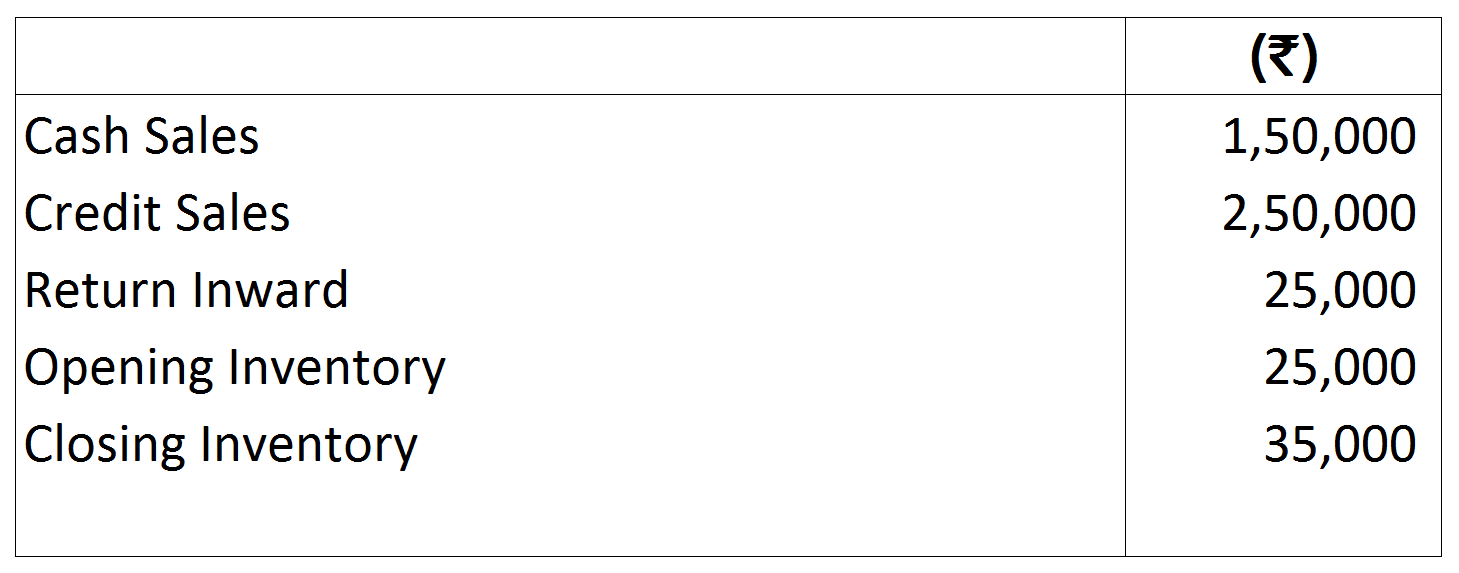
Question 454 Marks
From the following data, calculate 'Inventory Turnover Ratio' when gross profit ratio is given 20%:
Answer
Inventory Turnover Ratio $=\frac{\text{Cost of Revenue from Operations (Cost of Goods Sold)}}{\text{Average Inventory}}$
Revenue from Operations (Sales) = Cash Sales + Credit Sales - Return Inward
= ₹ 1,50,000 + ₹ 2,50,000 - ₹ 25,000
= ₹ 3,75,000
Cost of Revenue from Operations = Revenue from Operations (Sales) - Gross Profit
= ₹ 3,75,000 - 20% of ₹ 3,75,000
= ₹ 3,75,000 - ₹ 75,000 = ₹ 3,00,000
Average Inventory $=\frac{\text{Opening Inventory + Closing Inventory}}{2}$
$=\frac{₹\ 25,000 \ + \ ₹\ 35,000}{2}=₹\ 30,000$
Inventory Turnover Ratio $=\frac{₹\ 3,00,000}{₹\ 30,000}=10\text{ times}$
View full question & answer
Question 464 Marks
₹ 1,50,000 is the cost of Revenue from Operations, Inventory turnover 8 times Inventory at the beginning is 1.5 times more than the inventory at the end. Calculate the values of Opening & Closing Inventory.
Answer
Inventory Turnover Ratio $=\frac{\text{Cost of Revenue from Operations}}{\text{Average Inventory}}$
8 (Given) $=\frac{₹\ 1,50,000\text{ (Given)}}{\text{Average Inventory}}$
$\therefore$ Average Inventory $=\frac{₹\ 1,50,000}{8}=₹\ 18,750$
Opening Inventory + Closing Inventory = Average Inventory × 2
= ₹ 18,750 × 2 = ₹ 37,500
Since opening inventory is 1.5 times more than that at the end, ratio between opening inventory and closing inventory will be 2.5 : 1.
$\therefore$ Opening Inventory $=₹\ 37,500\times\frac{2.5}{3.5}=₹\ 26,786$
Closing Inventory $=₹\ 37,500\times\frac{1}{3.5}=₹\ 10,714$
View full question & answer
Question 474 Marks
Calculate Gross Profit Ratio from the following:
Opening Inventory ₹ 30,000; Closing Inventory ₹ 25,000; Purchases ₹ 3,05,000; Return Outwards ₹ 20,000; Wages ₹ 32,000; Cash Revenue from Operations ₹ 1,40,000; Return Inwards ₹ 10,000; Credit Revenue from Operations ₹ 3,30,000.
Answer
Gross Profit Ratio $=\frac{\text{Gross Profit}}{\text{Net Revenue from Operations}}\times100$
Gross Profit = Net Revenue from Operations - Cost of Revenue from Operations
Net Revenue from Operations = Cash Revenue from Operations + Credit Revenue from Operations - Return Inwards
= ₹ 1,40,000 + ₹ 3,30,000 - ₹ 10,000
= ₹ 4,60,000
Cost of Revenue from Operations = Opening Inventory + Purchases - Return Outwards + Wages - Closing Inventory
= ₹ 30,000 + ₹ 3,05,000 - ₹ 20,000 + ₹ 32,000 - ₹ 25,000 = ₹ 3,22,000
Gross Profit = ₹ 4,60,000- ₹ 3,22,000
= ₹ 1,38,000
Gross Profit Ratio $=\frac{₹\ 1,38,000}{₹\ 4,60,000}\times100=30\%$
View full question & answer
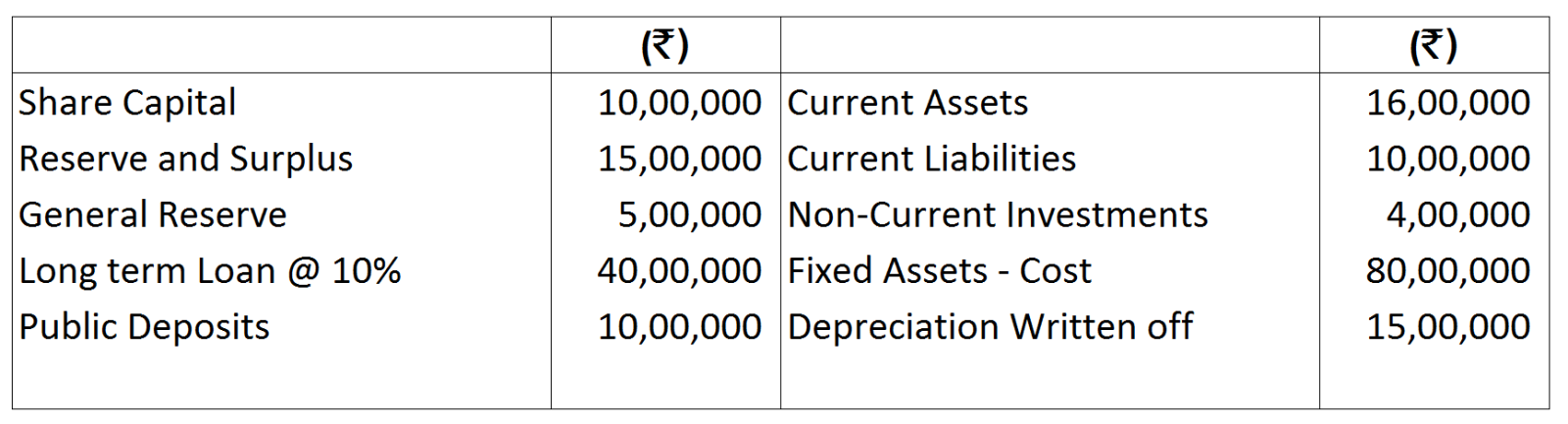
Question 484 Marks
Balance Sheet of X Ltd. shows the following information as at 31st March, 2016:

Calculate ratios indicating the Long-term and Short-term financial position of the Company.
Answer
  1. Long-term financial position of the Company can be assessed by calculating Debt-Equity Ratio.
Debt-Equity Ratio $=\frac{\text{Debt}}{\text{Equity}}\text{ or }\frac{\text{Long term Debts}}{\text{Shareholder's Funds}}$

Long term Debts = Long term Borrowings + Public Deposits.

= ₹ 40,00,000 + ₹ 10,00,000 = ₹ 50,00,000

Shareholder's Funds = Share Capital + Reserve and Surplus.

= ₹ 10,00,000 + ₹ 15,00,000 = ₹ 25,00,000

Debt Equity Ratio $=\frac{₹\ 50,00,000}{₹\ 25,00,000}=2:1$

Hint: General Reserve is already included in Reserve and Surplus.
  1. Short term financial position of the Company can be assessed by calculating.
Current Ratio

Current Ratio $=\frac{\text{Current Assets}}{\text{Current Liabilities}}$

$=\frac{₹\ 16,00,000}{₹\ 10,00,000}=1.6:1$
View full question & answer
Question 494 Marks
Accounting ratios ignore qualitative factors and are also not comparable if different firms follow different accounting policies.'' Comment.
Answer
Ratio analysis is the quantitative measurement of the performance of a business. It ignores the qualitative factors. For example, while conducting the credit analysis of a customer seeking credit, he may deserve the credit to be granted on the basis of financial statements submitted by him but in reality his character (i.e., his intention to pay) and credit worthiness may be doubtful. Further, different firms adopt different accounting policies for inventory valuation, estimating the working life of an asset and in selecting the method of depreciation (e.g., Straight Line or Written Down). Hence, the adoption of different policies by different firms will give different data which will give misleading results if compared.
View full question & answer
Question 504 Marks
Calculate Net Profit Ratio from the following information:
Revenue from Operations ₹ 25,00,000; Operating Ratio 90%; Loss on Sale of Fixed Assets ₹ 25,000; Interest on Long term Borrowings ₹ 30,000; Income from Investments ₹ 40,000.
Answer
Net Profit Ratio $=\frac{\text{Net Profit}}{\text{Revenue from Operations}}\times100$
  1. Operating Profit Ratio = 100 - Operating Ratio
= 100-90 = 10%
  1. Operating Profit $=₹ \ 25,00,000 \frac{10}{100} = ₹ \ 2,50,000$
  2. Net Profit = Operating Profit - Non Operating Expenses + Non Operating Income
=₹ 2,50,000 - ₹ 25,000 - ₹ 30,000 + ₹ 40,000

= ₹ 2,35,000
  1. Net Profit Ratio $=\frac{₹\ 2,35,000}{₹ \ 25,00,000}\times100=9.4\%$
View full question & answer
4 Marks Question - Accountancy STD 12 Commerce Questions - Vidyadip