Questions · Page 1 of 3

3 Marks Question

🎯

Test yourself on this topic

50 questions · timed · auto-graded

Question 13 Marks
What are the suggested reasons for population explosion?
Answer
  1. Increased health facilities along with better living conditions had an explosive impact on the growth of population.
  2. Decline in Death rate.
  3. Decline in Maternal Mortality Rate.
  4. Decline in Infant Mortality Rate.
  5. Increase in the number of people in the reproductive age.
View full question & answer
Question 23 Marks
Do you think that reproductive health in our country has improved in the past 50 years? If yes, mention some such areas of improvement.
Answer
Yes, the reproductive health has tremendously improved in India in the last 50 years. The areas of improvement are as follows.
  • Massive child immunization programme, which has lead to a decrease in the infant mortality rate.
  • Maternal and infant mortality rate, which has been decreased drastically due to better post natal care.
  • Family planning, which has motivated people to have smaller families.
  • Use of contraceptive, which has resulted in a decrease in the rate of sexually transmitted diseases and unwanted pregnancies.
View full question & answer
Question 33 Marks
Amniocentesis for sex determination is banned in our country. Is this ban necessary? Comment
Answer
Since Amniocentesis is misused to find out the sex of the foetus leading to female foeticides, it is necessary. It is the prenatal diagnostic technique, that helps to find out chromosomal (genetic) disorders, metabolic disorders of the foetus; in extreme cases where the foetus is found to be suffering from an incurable disorder Medical Termination of Pregnancy (MTP) is banned. The solution to the problem is not passing more laws, such as banning sex determination ultrasounds but raising the social & economic status of women.
View full question & answer
Question 43 Marks
What do you think is the significance of reproductive health in a society?
Answer
Reproductive health is the total well-being in all aspects of reproduction. It includes physical, emotional, behavioural, and social well-being. Sexually transmitted diseases such as AIDS, gonorrhoea, etc. are transferred from one individual to another through sexual contact. It can also lead to unwanted pregnancies. Hence, it is necessary to create awareness among people, especially the youth, regarding various reproduction related aspects as the young individuals are the future of the country and they are most susceptible of acquiring sexually transmitted diseases. Creating awareness about the available birth control methods, sexually transmitted diseases and their preventive measures, and gender equality will help in bringing up a socially conscious healthy family. Spreading awareness regarding uncontrolled population growth and social evils among young individuals will help in building up a reproductively healthy society.
View full question & answer
Question 53 Marks
Removal of gonads cannot be considered as a contraceptive option. Why?
Answer
Contraceptive devices are used to prevent unwanted pregnancy and to prevent the spreading of STDs. There are many methods, such as natural, barrier, oral, and surgical methods, that prevent unwanted pregnancy. However, the complete removal of gonads cannot be a contraceptive option because it will lead to infertility and unavailability of certain hormones that are required for normal functioning of accessory reproductive parts. Therefore, only those contraceptive methods can be used that prevent the chances of fertilization rather than making the person infertile forever.
View full question & answer
Question 63 Marks
  1. Name any of two copper releasing IUDs.
  2. Explain how do they act as effective contraceptives in human females.
Answer
  1. Intra Uterine Devices - CuT, Cu7, Multiload 375.
  2. Supress sperm motility, supress fertilizing capacity of sperms, increase phagocytosis of sperms within utreus.
View full question & answer
Question 73 Marks
A large number of married couples the world over are childless. It is shocking to know that in India the female partner is often blamed for the couple being childless.
  1. Why in your opinion the female partner is often blamed for such situations in India? Mention any two values that you as a biology student can promote to check this social evil.
  2. State any two reasons responsible for the cause of infertility.
  3. Suggest a technique that can help the couple to have a child where the problem is with the male partner.
Answer
  1. Female partner is blamed due to social mind set/inequality of sexes/lack of awareness/male dominated society.
  • Awareness to be created that abnormality can occur in both male and females and infertility issues with suitable examples.
  • Mutual respect towards both the partners in case of the problem and to find the remedy from medical experts instead of visiting quacks.
  • Educate them to find the reason and not believe in superstitions.
  1. Physical (abnormality in reproductive system), congenital, immunological or psychological.
  2. Intra cytoplasmic sperm injection (ICSI)/artificial insemination (AI)/Intra uterine insemination (IUI).
View full question & answer
Question 83 Marks
Your school has been selected by the Department of Education to organise and host an interschool seminar on "Reproductive Health - Problems and Practices". However, many parents are reluctant to permit their wards to attend it. Their argument is that the topic is "too embarrassing."
Put forth four arguments with appropriate reasons and explanation to justify the topic to be very essential and timely.
Answer
  1. The issue of puberty and adolescence need to be addressed effectively with the respective age group because many changes take place in the body during adolescence of which they are supposed to be aware of.
  2. To bring in awareness about their reproductive health and its effect on their physical, emotional and social being.
  3. To address the increase in sex abuse and sex crimes in our country.
  4. Myths and misconceptions related to reproductive issues.
View full question & answer
Question 93 Marks
If implementation of better techniques and new strategies are required to provide more efficient care and assistance to people, then why is there a statutory ban on amniocentesis? Write the use of this technique and give reason to justify.
Answer
To legally check female foeticide/Misuse of sex determination technique. To detect the abnormal chromosomes/genetic disorder.Justify: Prevent (female foeticide) change in sex ratio of the population.
View full question & answer
Question 103 Marks
In a maternity clinic, for some reasons the authorities are not able to hand over the two new-borns to their respective real parents. Name and describe the technique that you would suggest to sort out the matter.
Answer
ART-Assisted Reproductive Technologies: Specialised health case unit could help in diagnosis and corrective treatment of some of these disorder and enable these couples to have children. Because, still some disorders are found in these new-borns babies. So the maternity clinic uses the ART. Besides it, another individual will be partenering in raising your child it is important to choose a facility that fits your need and matches your values and goals for your child.
View full question & answer
Question 113 Marks
Reproductive and Child Healthcare (RCH) programmes are currently in operation. One of the major tasks of these programmes is to create awareness amongst people about the wide range of reproduction related aspects. As this is important and essential for building a reproductively healthy society.
  1. “Providing sex education in schools is one of the ways to meet this goal.” Give four points in support of your opinion regarding this statement.
  2. List any two ‘indicators’ that indicate a reproductively healthy society.
Answer
  1.  
  • Provide right information to the young so as to discourage children from believing in myths and misconception about sex-related aspects.
  • Proper information about reproductive organs.
  • Proper information about adolescence and related changes.
  • Safe, hygienic practices.
  • STDs/AIDS.
  • Available birth control options.
  • Care of pregnant mothers.
  • Postnatal care.
  • Importance of breastfeeding.
  • Equal opportunities for male and female child.
  • Awareness of problems due uncontrolled population growth.
  • Sex abuse.
  • Sex-related crimes.
  1. Better awareness about sex related matters/increase number of assisted deliveries/better postnatal care/decrease in IMR (Infant Mortality Rate)/decrease MMR (Maternal Mortality Rate)/increase number of couples with small families/better detection and cure of STDs/overall increased medical facilities for sex related problems/total well-being in all aspects of reproduction/physical - behavioural – social/physically and functionally normal reproductive organs/normal emotional and behavioural interaction among all sex-related aspects.
View full question & answer
Question 123 Marks
A large number of married couples the world over are childless. It is shocking to know that in India the female partner is often blamed for the couple being childless.
  1. Why in your opinion the female partner is often blamed for such situations in India? Mention any two values that you as a biology student can promote to check this social evil.
  2. State any two reasons responsible for the cause of infertility.
  3. Suggest a technique that can help the couple to have a child where the problem is with the male partner.
Answer
  1. In India, because of illiteracy, the females are blamed to give birth to female child. As a biology students one can explain the phenomenon of sex-determination in human to the couple.
Values:
  1. Awareness to be created that abnormality can occur in both males and females and about infertility issues.
  2. Mutual respect towards both the partners in case of the problem and to find the remedy from medical experts instead of visiting religious places.
  1. Causes of infertility could be:
  1. Sexually transmitted diseases both in males and females.
  2. Some physiological problems in females/ males so, gametes (sperm/ ova) are not produced.
  1. Artificial Inseminatin (AI), can be used if there is problem in male partner.
View full question & answer
Question 133 Marks
Your school has been selected by the Department of Education to organise and host an interschool seminar on 'Reproductive Health-Problems and Practices'. However, many parents are reluctant to permit their wards to attend it. Their argument is that the topic is 'too embarrassing'. Put forth four arguments with appropriate reasons and explanations to justify the topic to be very essential and timely.
Answer
The arguments that can be put forward to justify the topic are:
  1. Reduce misconceptions and increase accurate knowledge Students have various wrong and inaccurate information about sex-related and pubertal issues. Accurate knowledge will help them cope up with their bodily changes and hormonal effects easily.
  2. Clarify and strengthen positive values and attitudes It is only through healthy discussions that students can realise that women are not the weaker sex because of their body structure. Such discussions will inculcate feeling of equality amongst both sexes.
  3. Increase communication with parents or other trusted elders These seminars open up students to consult their elders in case of confusion and doubt. It will make them understand that reproduction is a normal phenomenon and there is nothing inappropriate in discussing about it with elders.
  4. Increase the skills and thinking needed to make informed decisions and act upon them Out of curiosity, students are often seen getting involved in drug use, unhygienic and unsafe sexual activities, etc. increasing the risk of STDs and other diseases. Making them well-informed through such seminars will help them to take correct decisions.
View full question & answer
Question 143 Marks
During a visit to Vaishno Devi, Rahul came across a young couple staying in the adjacent room in the hotel. He learnt that the couple had been visiting different temples and performing rituals to get a child. Rahul was astonished and explained to them about ART which he had recently studied in their wrong approach and thanked Rahul.
  1. What is ART? What are the various methods included in ART?
  2. What are the limitations for which ART is not commonly accepted?
  3. Identify the values which Rahul showed.
Answer
  1. Assisted reproductive technology. Various methods included in ARTs are:
  1. Test tube baby programme which includes IVF and zygote or embryo transfer.
  2. Gamete Intra Fallopian Transfer.
  3. Intra Cytoplasmic Sperm Injection
  1. Limitations of ARTs are as follows:
  1. These techniques require extremely high precision handling by specialised professionals and expensive instrumentation. Therefore, these facilities are presently available only in a very few centres in the country.
  2. Emotional, religious and social factors are also barriers in the adoption of these methods.
  1. Sympathetic attitude with alertness and practical approach.
View full question & answer
Question 153 Marks
Correct the following statements:
  1. Surgical methods of contraception prevent gamete formation.
  2. All sexually transmitted diseases are completely curable.
  3. Oral pills are very popular contraceptives among the rural women.
  4. In E. T. techniques, embryos are always transferred into the uterus.
Answer
  1. Surgical methods of contraception prevent the flow of gamete during intercourse.
  2. All sexually transmitted diseases are not completely curable.
  3. Oral pills are very popular contraceptives among the urban women.
  4. In E.T. technique, 8 celled embryos are transferred into the fallopian tube while more than 8 celled embryos are transferred into the uterus.
View full question & answer
Question 163 Marks
On world population day, Rohit and his friends arranged an awareness campaign on population explosion programme in their locality. Some elderly people tried to stop the children and asked them not to talk on such things in public. The children convinced the elders about the need for the programme and on understanding their point of view, the elders also joined the campaign.
  1. Why is such awareness programme necessary?
  2. What role has the government played in controlling population explosion?
  3. When were reproductive health programmes initiated in India?
  4. What values did Rohit and his friends show on the occasion?
Answer
  1. To understand the problem faced by the family and the nation due to increasing population and the benefits of having a small family.
  2. Role of government in controlling population explosion are:
  1. Creating public awareness through mass media.
  2. Education at all levels.
  3. Family planning.
  4. Increasing marriageable age (18 for girls and 21 for boys).
  1. In India, these programmes called 'family planning' were initiated in 1951.
  2. Rohit and his friends showed understanding about the problem of population explosion, team work and motivational capacity.
View full question & answer
Question 173 Marks
Mrs. Sharma was eager to know the sex of the foetus, which her daughter-in-law was carrying. She was so anxious that she could pay any amount for that. The doctor refused to disclose the result of the test.
  1. How can one know the sex of the foetus?
  2. Why is disclosing the sex of the foetus banned in our country?
  3. What value do you learn from the doctor's act?
Answer
  1. One can know the sex of the foetus by amniocentesis.
  2. Disclosing the sex of the foetus is banned in our country because in the past, there have been numerous cases, where the female foetus has been aborted. This discrimination for the girl child is considered a crime. The number of females to males ratio is thereby reduced.
  3. The doctor is devoted to his duties and has professional and moral ethics.
View full question & answer
Question 183 Marks
Some parents wrote a complaint letter to the local municipality to remove all the hoardings in the city, advertising the use of condoms and matters relating to AIDS prevention. The children of these parents came to know about the matter and raised their voice against removal of the hoardings. The parents were convinced by the awareness level of their children and withdrew the complaint.
  1. Parents considered the hoarding as inappropriate. Do you agree/ disagree with their view?
  2. What are the methods by which AIDS spreads?
  3. What is AIDS?
  4. What values are promoted by the children protesting against their parents?
Answer
  1. We disagree. Since, the awareness among people has not reached to the extent where everyone knows how and what causes AIDS, therefore, forceful and constant reminding is always required. Also, the number of AIDS cases are increasing too fast. So, awareness is necessary.
  2. Some methods by which AIDS spreads are:
  1. Unprotected sexual contact.
  2. Use of contaminated needles and syringes.
  3. Use of contaminated razors or other instruments used for piercing body parts, e.g. pinna.
  4. Transfusion of infected blood or blood products.
  5. From affected mother to her foetus.
  1. AIDS is Acquired Immuno Deficiency Syndrome. It is a type of STD caused by HIV.
  2. Sense of understanding towards AIDS application of knowledge in life, national responsibility and commitment towards society.
View full question & answer
Question 193 Marks
Reproductive and Child Healthcare (RCH) programmes are currently in operation. One of the major tasks of these programmes is to create awareness amongst people about the wide range of reproduction related aspects. As this is important and essential for building a reproductively healthy society.
  1. 'Providing sex education in schools is one of the way to meet this goal'. Give four points in support of your opinion regarding this statement.
  2. List any two 'indicators' that indicate a reproductively healthy society.
Answer
  1.  
  1. Introducing sex education in schools is a good step for providing right information to the adolescents so as to discourage them from believing in myths and misconceptions about sex-related issues.
  2. Better awareness about sex-related matters.
  3. Better detection and cure of STDs.
  4. Awareness of problems due to uncontrolled population growth.
  1.  
  1. Increased number of medically assisted deliveries and better post-natal care leading to decreased maternal and infant mortality rates.
  2. Awareness of problems due to uncontrolled population growth, social evils like sex abuse and sex-related crimes, etc. should be created to enable people to think and take up necessary steps to prevent them.
View full question & answer
Question 203 Marks
Suggest some methods to assist infertile couples to have children.
Answer
Some methods to assist infertile couples to have children are:
  • Test tube baby programme:
The ova from the wife/ donor (female) and sperms from the husband/ donor (male) are collected and are induced to form zygote under simulated conditions in the laboratory. Then, zygote produced is then transferred into the fallopian tube of a normal female.
  • Gamete Intra fallopian transfer (GIFT):
Transfer of an ovum collected from a donor into the fallopian tube of another female who cannot produce ova, but can provide suitable environment for fertilisation.
  • Intra cytoplasmic sperm injection (ICSI):
A sperm is directly injected into the ovum.
  • Artificial insemination (Al):
The semen collected either from the husband or a healthy donor is artificially introduced either into the vagina or into the uterus of the female.
View full question & answer
Question 213 Marks
Briefly explain IVF and ET What are the conditions in which these methods are advised?
Answer
IVF stands for in-vitro fertilization. In this technique, sperm from the male (or donor) and ovum from the female (or donor) are taken out. Ovum is then fertilized in the laboratory; usually in a petri dish. ET stands for embryo transfer and is the next procedure after IVF. Embryo up to 8 blastomere stage is transferred in the fallopian tube. Embryo with more than 8 blastomeres is transferred to the uterus. Since, the technique involves carrying out fertilization and some development of zygote in the laboratory hence babies born out of this method are often called test tube babies. These methods are parts of Assisted Reproductive Technologies (ART). These methods are employed when medical treatment and psychotherapy may have failed in helping the couple in conception. These methods require very high degree of precision and can only be carried out by highly specialized doctors. Moreover, employing these technologies require costly equipments. Hence, facilities for IVF or ET are available only at select centres across the country.
View full question & answer
Question 223 Marks
A large number of married couples the world over are childless. It is shocking to know that in India the female partner is often blamed for the couple being childless.
State any two reasons responsible for the cause of infertility.
Answer
Infertility is caused due to physical abnormality in reproductive system, congenital, immunological or psychological problems.
View full question & answer
Question 233 Marks
Describe vasectomy and tubectomy with diagram.
Answer
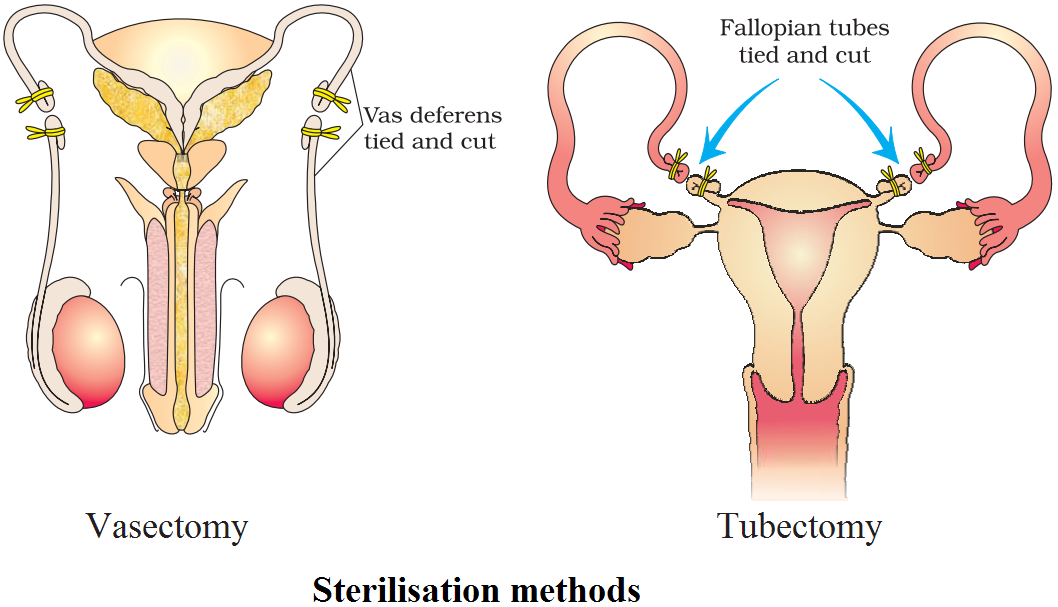
Vasectomy and tubectomy are permanent methods of contraception and are also known as sterilisation techniques. These methods are generally advised to male orfemale partner as a terminal method to prevent any more pregnancies. It blocks gamete transport and thereby prevents conception. In vasectomy, a small part of the vas deferens is removed and then tied up through a small incision on the scrotum whereasin tubectomy a small part of the fallopian tube is removed and then tied up through asmall incision in the abdomen or through vagina. These techniques are highly effective but their reversibility is very poor.
View full question & answer
Question 243 Marks
Mention the different ways in which people are made aware of the significance of reproductive health and a reproductively healthy society.
Answer
  1. Family Planning Programmes [Now called Reproductive and Child Health Care (RCH) programmes) create awareness among people about reproduction-related aspects.
  2. Audio-visual and print media give information about the nutrition for pregnant women lactating mothers and importance of breast feeding the infants.
  3. Governmental and non-governmental agencies have taken various steps to create awareness about the measures to be taken during pregnancy, immunization programmes, etc.
  4. Sex-education in schools has a major role in giving right information about reproduction-related problems.
  5. Health workers in villages also create awareness about the prenatal care for pregnant women and the importance of postnatal care and medically-aided deliveries.
View full question & answer
Question 253 Marks
A village health worker was taking a session with women. She tells the women that one has to be very careful while using oral pills as method of birth control. Wrong usage can actually promote conception.
Analyse the statement and compare the merits and demerits of using oral pills and surgical methods of birth control.
Answer
 
Contraceptive pills
Surgical methods
Merits
1. Pills are effective with lesser side effects and well accepted by females.
1. Surgical intervention block gamete transport.
2. Reversible method. 2. Highly effective.
Demerits
1. If not taken on right days they can promote conception.
1. Not reversible.
2. Can have side effects if taken for a long time. 2. Can affect health of a person if performed in unhygienic condition.
View full question & answer
Question 263 Marks
Briefly give an account of various intra uterine devices. How do they function? What is their advantage?
Answer
IUDs are inserted by doctors in the uterus through vagina. The use of IUD is most effective and popular. These are available as
  1. Non medicated IUDs (Lippes loop)
  2. Copper releasing IUDs (Cut, Cu7, Multiload 375)
  3. Hormone releasing IUDs (Progestasert, LNG-20)
Mode of Action. IUDs increase phagocytosis of sperms within the uterus and the copper ions released by them suppress sperm motility and the fertilising capacity of sperms. The hormone releasing IUDs, in addition, make the uterus unsuitable for implantation.
Advantage. IUDs are ideal contraceptives for the female who want to delay pregnancy and/ or space children.
View full question & answer
Question 273 Marks
Describe the various methods of birth control.
Answer
Birth Control: The most important step to control population growth is to motivate smaller families by using various contraceptive methods. An ideal contraceptive should be:
  • User–friendly.
  • Easily available.
  • Effective and reversible with no or least side–effects.
  • Non–interfering with the sexual drive/ desire and/ or the sexual act of the user.
Methods of Birth Control: The contraceptive methods are divided into following categories:
  1. Natural/ Traditional methods.
  2. Barrier methods.
  3. Intra uterine devices (IUDs).
  4. Oral contraceptives.
  5. Injections and implants.
  6. Surgical methods.
Natural methods:
  • These are natural methods that work on the principle of avoiding the meeting of ovum and sperm.
  1. Periodic abstinence is a method in which a couple avoids or abstains from coitus from day 10-17 of the menstrual cycle, when ovulation is expected to occur.
  2. Coitus interruptus or withdrawal is a method in which male partner withdraws his penis from the vagina just before ejaculation so as to avoid insemination.
  3. Lactational amenorrhea is based on the principle that during the period of lactation after parturition, ovulation does not occur.
Barrier methods:
  • These methods prevent the contact of sperm and ovum with the help of barriers. Such methods are available for both males and females.
  1. Condoms are barriers made of thin rubber/ latex sheath used to cover the penis in the male or vagina and cervix in females. It prevents the deposition of ejaculated semen into the vagina of the female.
  2. Diaphragms, cervical caps and vaults are the barriers made of rubber that are inserted into the female reproductive tract to cover the cervix during coitus. They prevent the entry of sperms through cervix.
  3. Spermicidal creams, jellies and foams are used along with these barriers to increase their contraceptive efficiency.
Intra uterine devices (IUDs):
  • These devices are inserted by doctors in the uterus through vagina.
  • There are three types of IUDs available:
  1. Non-medicated IUDs: These increase phagocytosis of sperms within the uterus, e.g., Lippes loop.
  2. Copper releasing IUDs: Along with phagocytosis of sperms, the copper ions released suppress sperm motility and fertilising capacity of sperms, e.g., CuT, Cu 7, Multiload 375.
  3. Hormone releasing IUDs: These make the uterus unsuitable for implantation and the cervix hostile to sperms, e.g., Progestasert, LNG-20.
Oral contraceptive:
  • This involves uptake of hormonal preparations of either progestogens or progestogen–estrogen combinations in the form of pills by females.
  • They inhibit ovulation and implantation as well as alter the quality of cervical mucus to prevent entry of sperms.
  • ‘Saheli’, an oral contraceptive for females containing a non-steroidal preparation was developed by scientists at Central Drug Research Institute (CDRI) in Lucknow.
  • Pills have high contraceptive value and few side effects.
Injections and implants:
  • Progestogens or progestogen–estrogen combination can also be used by females as injections or implants under the skin.
  • Their mode of action is similar to that of pills but their effective periods are longer.
Surgical methods (Sterilisation):
  • These are terminal and permanent methods which block the transport of gametes, thereby preventing conception.
  • In males, a small part of the vas deferens is removed and tied up through a small incision onthe scrotum. This is called vasectomy.
  • In females, a small part of the fallopian tube is removed and tied up through a small incision in the abdomen or vagina. This is called tubectomy.
View full question & answer
Question 283 Marks
How can education help in building up a socially responsible and reproductively healthy society? (Enumerate the aspects that should be emphasised).
Answer
  1. Counselling and creating awareness among people about the following aspects would help in building up a reproductively healthy society.
  1. Reproductive organs.
  2. Adolescence and associated changes.
  3. Safe and hygienic sexual practices.
  4. Sexually transmitted diseases.
  1. Educating people, especially fertile couples and those in marriageable age group about the following would help to raise a socially responsible society.
  1. Available birth control methods.
  2. Care of pregnant mothers.
  3. Importance of breast feeding.
  4. Equal opportunities for a girl child.
View full question & answer
Question 293 Marks
Village women were confused as to how a thin metallic copper loop can provide protection against pregnancy. Justify the use, explaining the mode of action of IUDs.
Answer
Mode of action of IUDs:
  1. Increase Phagocytosis of sperms within the uterus.
  2. $Cu^{++}$ released suppress sperm motility.
  3. Hormone releasing IUDs make uterus unsuitable for implantation.
View full question & answer
Question 303 Marks
A large number of married couples the world over are childless. It is shocking to know that in India the female partner is often blamed for the couple being childless.
Suggest a technique that can help the couple to have a child where the problem is with the male partner.
Answer
Intra cytoplasmic sperm injection (ICSI), Artificial insemination (AI), Intra uterine insemination (IUI) can help couples where the problem is with male partner.
View full question & answer
Question 313 Marks
How are assisted reproductive technologies helpful to humans? How are ZIFT and GIFT different from intra uterine transfers? Explain.
Answer
The infertile couples could be assisted to have children through certain special techniques known as assisted reproductive technologies (ART).
  1. ZIFT: The zygote or early embryo with up to 8 blastomeres is transferred into the fallopian tube. This is called zygote intra-fallopian transfer (ZIFT).
  2. GIFT: Gamete intra-fallopian transfer is the transfer of an ovum collected from a donor into the fallopian tube of another female who cannot produce one but can provide a suitable environment for fertilisation and further development of the embryo.
Intra-uterine transfer (IUT) refers to the introduction of an embryo with more than 8 blastomeres into the uterus of a female to complete its further development.
View full question & answer
Question 323 Marks
Expand the following:
  1. ART
  2. GIFT
  3. ICSI
  4. RTI
  5. IUI
Answer
  1. ART: Assisted Reproductive Technology.
  2. GIFT: Gamete Intra Fallopian Transfer.
  3. ICST: Intra Cytoplasmic Sperm Injection.
  4. RTI: Reproductive Tract Infections.
  5. IUI: Intra Uterine Insemination.
View full question & answer
Question 333 Marks
STDs are a threat to reproductive health. Describe any two such diseases and suggest preventive measures.
Answer
Sexually Transmitted Diseases (STDs):Infections or diseases that are transmitted through sexual intercourse are collectively called sexually transmitted diseases (STDs) or venereal diseases (VD) or reproductive tract infections (RTI). These include gonorrhoea, syphilis, genital herpes, chlamydiasis, genital warts, trichomoniasis, hepatitis – B, HIV.
Early symptoms: Itching, fluid discharge, slight pain and swellings in the genital region.
Complications due to chronic STDs: Pelvic inflammatory diseases (PID), abortions, still births, ectopic pregnancies, infertility, or even cancer of the reproductive tract.
Transmission of hepatitis – B and HIV occurs by the following ways:
  1. Sharing of injection needles or surgical instruments with infected persons;
  2. Transfusion of infected blood;
  3. Transfer from infected mother to the foetus through placenta.
By following simple principles, STDs can be prevented:
  1. Avoid sex with unknown partners/ multiple partners.
  2. Always use condoms during coitus.
  3. Contact a qualified doctor for any doubt, in early stage of infection.
View full question & answer
Question 343 Marks
What do you mean by reproductive health? Mention the different ways in which people are made aware of the significance of reproductively healthy society.
Answer
Reproductive health means total well being in all aspects of reproduction, i.e., physical, emotional, behavioural, social and physiological.
Following measures are needed to make people aware of reproductively healthy society:
  1. Providing infrastructural facilities and professional expertise to attain reproductive health.
  2. Educating people about birth control methods, care of pregnant mothers, importance of breast feeding, safe and hygienic sexual practices and safeguard against STDs.
  3. Introduction of sex education in schools to give proper information to the young minds about sex–related aspects.
  4. Help of audio–visual and print–media to create awareness among people about reproduction related aspects.
  5. Awareness of problems due to population explosion, social evils like sex abuse and sexrelated crimes.
  6. Statutory ban on amniocentesis to legally check female foeticides.
View full question & answer
Question 353 Marks
A large number of married couples the world over are childless. It is shocking to know that in India the female partner is often blamed for the couple being childless.
Why in your opinion the female partner is often blamed for such situations in India?
Answer
Female partner is often blamed due to following reasons:
  1. Social mind set.
  2. Inequality of sexes.
  3. Lack of awareness/ male dominated society.
  4. Awareness to be created that abnormality can occur in both male and females and infertility issues with suitable examples.
  5. Mutual respect towards both the partners in case of the problem and to find the remedy from medical experts.
  6. Educate them to find the reason and not believe in superstitions.
View full question & answer
Question 363 Marks
List any four major categories into which contraception methods could be broadly classified. Explain briefly each category giving one example of each.
Answer
  1. Barrier Methods: These methods prevent sperms and ovum from physically meeting in order to prevent fertilisation. These methods are available for both males and females.
These are as follows:
  1. Condoms: These are made of thin rubber or latex sheath and are used to cover the penis in males and vagina and cervix in females. These are used during coitus, so that ejaculated semen would not enter female reproductive tract. Use of condoms has increased in recent years due to its additional benefit of providing protection against STDs and AIDS. Moreover, condoms do not interfere with the coital act, are disposable and can be self-inserted. Nirodh is a popular condom used by males. Female condoms are known as femidoms.
  2. Cervical caps, diaphragms and vaults: These are also made of rubber and are inserted into the female reproductive tract to cover the cervix during intercourse. They prevent conception by blocking entry of sperms through cervix. These are reusable.
  3. Spermicidal creams, jellies and foams(chemica methods): These are usually used along with the above stated barrier methods to increase their contraceptive efficiency. These are applied at the surface of vagina before intercourse.
  1. Intra Uterine Devices (IUDs): These devices contain either copper or progesterone and are inserted by doctors in the uterus through vagina.
These are categorised as long term contraceptive methods and further divided into:
  1. Copper releasing IUDs, e.g. Cu-T, Cu-7, Multiload 375 and Paragard are some of the Cu-releasing IUDs.
  2. Hormone releasing IUDs, e.g. Progestasert, LNG-20, Mirena are some of the well known hormone releasing IUDs.
  3. Non-medicated IUDs, e.g. Lippes loop.
IUDs prevent contraception in the following ways:
  1. By increasing phagocytosis of sperms within the uterus.
  2. By suppressing the sperm motility and fertilizing ability of sperms by releasing Cu ions.
  3. The hormone releasing IUDs make the uterus unsuitable for implantation and the cervix hostile to sperms. IUDs are ideal contraceptives for females who want to maintain space among children and/ or delay pregnancy. It is one of most widely accepted methods of contraception in India.
  1. Oral Contraceptives: These are the preparations of hormones either progestogens or progestogen-oestrogen combinations in the form of pills (tablets), used by the females. They alter or inhibit ovulation and fertilisation and also modify the quality of cervical mucus to prevent or retard the entry of sperms. Oral pills are generally taken daily for a period of 21 days starting within the first five days of menstrual cycle. After a gap of 7 days (during which menstruation occurs), it has to be repeated in the same pattern till female desires to prevent conception. These are well-accepted as they are very effective with lesser side effects. They are very popular among urban women. Most common examples are ‘Mala-D' and 'Saheli'. Saheli is a new oral contraceptive for females that contains a non-steroidal preparation called centchroman. It is once a week pill with few side effects and high contraceptive value. It was developed by CDRI (Central Drug Research Institute), Lucknow.
  2. Injectables and Implants:
  1. Hormone injections (Depo-Provera) are progesterone -derivative or progestogen-oestrogen combination injections, given every three months as injections or as implants under skin. They release the hormone slowly and prevent ovulation.
  2. Implant (Norplant) as a contraception method refers to sub-cutaneous implantation of synthetic progesterone. Though, these act similarly to oral contraceptives by blocking ovulation and thickening the cervical mucus, to prevent sperm transport, their effective periods are longer. One implant is effective for about five years.
  1. Emergency Contraceptives (Morning After Pills): Most common form is a kit consisting high dose of birth control pills. These, if taken within 72 hours of coitus have been very effective as emergency contraceptives as they could avoid possible pregnancy due to rape or casual unprotected intercourse. Their side effects are menstrual irregulation, vomiting, etc., e.g. i-pill, pill 72, unwanted 72.
View full question & answer
Question 373 Marks
  1. Explain the steps involved in in vitro fertilisation, popularly known as test tube baby programme.
  2. State the importance of this programme.
Answer
  1. Test tube baby programme.
It involves two steps:
  1. In vitro fertilisation (IVF).
  2. Embryo transfer (ET).
  • In this method, the ovum of the woman or a healthy donor and the sperm of her husband or a donor, are made to fuse to form a zygote in the laboratory under conditions very similar to that in the body; it is called in vitro fertilization (IVF).
  • The zygote or early embryo with upto eight blastomeres is implanted in the fallopian tube or embryo with more than eight blastomeres is implanted in the uterus for further development.
  • This method is used when the female is not able to conceive but can provide suitable conditions for embryo development.
  1. This programme is to assist an infertile couple to bear a child, especially when the female is not able to conceive, but can provide suitable conditions for embryo development.
View full question & answer
Question 383 Marks
What do you understand by the term population explosion? What are the reasons for population explosion?
Answer
The rapid increase in population over a relatively short period is called population explosion. Population of India which was approximately 350 million at the time of our independence, crossed 1 billion in May 2000.Reasons:
  1. A rapid decline in death rate, maternal mortality rate and infant mortality rate.
  2. An increase in number of people in reproductive age.
  3. Better public health care and greater medical attention.
  4. Control of diseases.
  5. Protection from natural calamities.
  6. Development of agriculture, improvement in food storage conditions and better means of transport.
View full question & answer
Question 393 Marks
What are the Assisted Reproductive Techniques practised to help infertile couples? Describe any three techniques.
Answer
The infertile couples could be assisted to have children through certain special techniques called assisted reproductive technologies (ART), which are given below:
  1. Test Tube Baby Programmes:
In this method, ova from the wife/ donor (female) and the sperms from the husband/ donor (male) are collected and induced to form zygote under simulated conditions in the laboratory. This process is called in vitro fertilisation (IVF).

The zygote or early embryo with up to 8 blastomeres is transferred into the fallopian tube (process is called zygote intra fallopian transfer or ZIFT) and embryo with more than 8 blastomeres is transferred into the uterus (process is called intra uterine transfer or IUT).

In females who cannot conceive, embryos formed by fusion of gametes in another female (called in vivo fertilisation) are transferred.
  1. Gamete Intra Fallopian Transfer (GIFT):
It is the transfer of an ovum collected from a donor into the fallopian tube of another female who cannot produce one, but can provide suitable environment for fertilisation and further development of the embryo.
  1. Intra Cytoplasmic Sperm Injection (ICSI):
It is a procedure to form an embryo in the laboratory by directly injecting the sperm into an ovum.
  1. Artificial Insemination (AI):
In this method, the semen collected either from the husband or a healthy donor is artificially introduced into the vagina or into the uterus (intra uterine insemination or IUI).

This technique is used in cases where the male is unable to inseminate sperms in the female reproductive tract or due to very low sperm counts in the ejaculation.
View full question & answer
Question 403 Marks
Discuss the mode of action and advantages/ disadvantages of hormonal contraceptives.
Answer
Oral administration of small doses of either progestogens or progestogen estrogen combinations is another contraceptive method used by the females. Most important component of oral contraceptive is progesterone. They are used in the form of tablets and hence are popularly called the pills. Pills have to be taken daily for a period of 21 days starting preferably within the first 5 days of menstrual cycle. After a gap of 7 days (during which menstruation occurs) it has to be repeated in the same pattern. Oral contraceptive pills inhibit ovulation and implantation as well as alter (change) the quality of cervical mucus to prevent or retard entry of sperms. Progesterone present in OCP is meant for checking ovulation. Pills are very effective with lesser side effects and are well accepted by the females. Combination or IUDs within 72 hours of coitus have been found to be very effective as emergency contraceptives as they could be used to avoid possible Pregnancy due to rape or casual unprotected intercourse.
View full question & answer
Question 413 Marks
Enumerate and describe any five reasons for introducing sex education to school-going children.
Answer
Following are the five reasons for introducing sex education to school-going children.
  1. Addressing Curiosity of Adolescents: School going children are of impressionable age. At this age, any wrong information can create long lasting impressions on their mind. This can be highly counter-productive from them as far as reproductive health is concerned.
  2. Different Aspects of Reproductive Health: We know that reproductive health does not have physical health as the only aspect. Reproductive health also includes social, behavioural and psychological aspects.
  3. Preparing Better Adults: If children are given sex education at the right age, they will learn to understand the importance of right behavior, proper age of marriage and child bearing and of small family size. They will also learn to respect the privacy of other individuals.
  4. Reducing the Chances of STDs: Proper awareness about reproductive system can help in reducing the prevalence of STDs. This can also motivate people to give up stigma and go to a doctor at the right time.
  5. Family Planning: Proper awareness will help people understand the importance of small family. It will help in controlling the population growth in country.
View full question & answer
Question 423 Marks
Do you justify the statutory ban on aminocentesis in our country? Give reasons.
Answer
Intentional or voluntary termination of pregnancy before full term is called MTP or induced abortion. Nearly 45 to 50 millions MTPs are performed in a year all over the world which accounts to $1/5^{th}$ (20%) of the total number of conceived pregnancies in a year. MTP has a significant role in decreasing the population though it is not meant for this purpose.
Government of India legalized MTP in 1971 with some strict conditions to avoid its misuse. Such restrictions are more important to check indiscriminate and illegal female foeticides which reported to be high in India.
MTP is used to get rid of unwanted pregnancies either due to casual unprotected intercourse or failure of the contraceptive used during coitus or rapes. MTPs are also essential in certain cases where continuation of the pregnancy could be harmful or even fatal either to the mother or to the foetus or both. MTPs are considered relatively safe during the first trimester (up to 12 weeks of pregnancy). 2nd trimester abortions are much more risky. Another dangerous trend is the misuse of amniocentesis to determine the sex of unborn child.
Amniocentesis is a foetal sex determination test based on the chromosomal pattern in the amniotic fluid surrounding the developing embryo. Amniocentesis is employed for determining hereditary abnormality in embryo. Statutory ban on amniocentesis for sex-determination to legally check:
  • Increasing female foeticides.
  • Massive child immunisation.
View full question & answer
Question 433 Marks
Describe two natural methods of birth control, other than lactational amenorrhoea.
Answer
  1. Periodic abstinence and coitus interruptus (withdrawal method) are the natural methods of birth control.
  2. Periodic abstinence is the method in which the couples avoid or abstain from sexual intercourse from day 10 to 17 of the menstrual cycle, when chances of fertilisation are high.
  3. Coitus interruptus or withdrawal is a method in which the male partner withdraws his penis from the vagina just before ejaculation.
View full question & answer
Question 443 Marks
How is primary infertility different from secondary infertility?
Answer
Primary infertility refers to couples who have not become pregnant after at least 1 year having sex without using birth control methods. Secondary infertility refers to couples who have been able to get pregnant at least once, but now are unable.
View full question & answer
Question 453 Marks
Explain, why family planning methods are not adopted by all the people of our country.
Answer
In the last century an all-round development in various fields significantly improved the quality of life of the people. However, increased health facilities along with better living conditions had an explosive impact on the growth of population. The world population which was around 2 billion (2000 million) in 1900 rocketed to about 6 billions by 2000. A similar trend was observed in India too. Our population which was approximately 350 million at the time of our independence reached close to the billion mark by 2000 and crossed 1 billion in May 2000. That means, every sixth person in the world is an Indian. A rapid decline in death rate, maternal mortality rate (MMR) and infant mortality rate (IMR) as well as an increase in number of people in reproducible age are probable reasons for this. Through our RCH programmes, though we could bring down the population growth rate, it was only marginal. According to the 2001 census report, the population growth rate was still around 1.7 percent, i.e. 17/ 1000/ year, a rate at which our population could double in 33 years. Such an alarming growth rate could lead to an absolute scarcity of even the basic requirements, i.e., food, shelter and clothing, in spite of significant progress made in those areas. Therefore, the government was forced to take up serious measures to check this population growth rate.
View full question & answer
Question 463 Marks
Name and explain the surgical method advised to human males and females as a means of birth control. Mention its one advantage and one disadvantage.
Answer
Vasectomy in males & Tubectomy in females. Devoid of ill effects of contraceptive (like nausea, abdominal pain, breakthrough bleeding, irregular menstruation or breast cancer), reversibility is very poor.
The surgical methods of birth control are the operative procedures which block the passage of semen in males and ova in females and thus prevent conception. The techniques are also called as sterilization procedures.
These includes:
  1. Vasectomy: male sterilization.
  2. Tubectomy: Female sterilization.
Advantage: These are permanent methods of birth control and family planning and are period of ill effects of contraceptives like nausea, abdominal pain, etc.
Disadvantage: The process is irreversible or very poorly irreversible.
View full question & answer
Question 473 Marks
How are assisted reproductive technologies helpful to humans? How are ZIFT and GIFT different from intrauterine transfers? Explain.
Answer
  1. The assisted reproductive technologies enable the infertile couples to have children.
  2. ZIFT refers to the method of embryo transfer in the test tube baby programme, in which the zygote or embryo with upto 8-blastomeres is transferred into the fallopian tube.
  3. GIFT refers to the transfer of an ovum collected from a donor female into the fallopian tube of another female, who cannot produce an ovum, but can provide suitable conditions for fertilisation and pregnancy.
  4. Intrauterine transfer refers to the transfer of embryo with more than 8 blastomeres into the uterus of a female.
View full question & answer
Question 483 Marks
Describe any three steps taken up by our Governmentto check population growth rate.
Answer
The steps taken include:
  1. Motivating the couples to have small families byusing various contraceptive methods.
  2. Raising the marriageable age of the fem ales to 18 years and of males to 21 years.
  3. Providing incentives to couples with small families.
View full question & answer
Question 493 Marks
What is Vasectomy? Represent it diagrammatically.
Answer
Vasectomy is the sterilisation procedure in males by ligation of vas deferens.
Refer to Fig. 4.1 in text.
View full question & answer
Question 503 Marks
Suggest and explain any three Assisted Reproductive Technologies (ART) to an infertile couple.
Answer
The infertile couples could be assisted to have children through certain special techniques called assisted reproductive technologies (ART), which are given below.
  1. Test Tube Baby Programmes:
  • In this method, ova from the wife/ donor (female) and the sperms from the husband/ donor (male) are collected and induced to form zygote under simulated conditions in the laboratory. This process is called in vitro fertilisation (IVF).
  • The zygote or early embryo with up to 8 blastomeres is transferred into the fallopian tube (process is called zygote intra fallopian transfer or ZIFT) and embryo with more than 8 blastomeres is transferred into the uterus (process is called intra uterine transfer or IUT).
  • In females who cannot conceive, embryos formed by fusion of gametes in another female (called in vivo fertilisation) are transferred.
  1. Gamete Intra Fallopian Transfer (GIFT):
  • It is the transfer of an ovum collected from a donor into the fallopian tube of another female who cannot produce one, but can provide suitable environment for fertilisation and further development of the embryo.
  1. Intra Cytoplasmic Sperm Injection (ICSI):
  • It is a procedure to form an embryo in the laboratory by directly injecting the sperm into an ovum.
  1. Artificial Insemination (AI):
  • In this method, the semen collected either from the husband or a healthy donor is artificially introduced into the vagina or into the uterus (intra uterine insemination or IUI).
  • This technique is used in cases where the male is unable to inseminate sperms in the female reproductive tract or due to very low sperm counts in the ejaculation.
View full question & answer