MCQ 2011 Mark
- A
Can pass through a continuous charge distribution.
- ✓
Cannot pass through a continuous charge distribution.
- C
Can pass through any system of discrete charges.
- D
Can pass through a continuous charge distribution as well as any system of discrete charges.
AnswerCorrect option: B. Cannot pass through a continuous charge distribution.
View full question & answer→MCQ 2021 Mark
Coulomb's law is a confirmation of $........$
AnswerAccording to Coulomb's Law-
$\text{F}\propto\frac{1}{\text{r}^2}$
Hence, Coulomb's Law is a confirmation of inverse square law.
View full question & answer→MCQ 2031 Mark
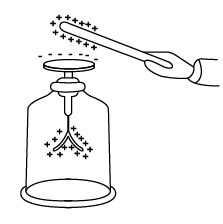
What happens when the end of the paper clip of electroscope is touched by hands?
- A
Electric current is produced.
- B
Foil strips remain as it is.
- ✓
- D
AnswerWhen the paper clip of electroscope is touched by hands, the foil strips collapse because the charges on foil strips gets discharged through our body.
View full question & answer→MCQ 2041 Mark
In electrolytes, the mobile charges are:
AnswerCorrect option: C. Both $a$ and $b.$
View full question & answer→MCQ 2051 Mark
If an object is positively charged, theoretically the mass of the object ______?
AnswerCorrect option: B. Decreases slightly by a factor of $9.11 \times 10^{-31} kg$.
b. Decreases slightly by a factor of $9.11 \times 10^{-31} kg$.
Explanation:
If an object is positively charged it loses some of its electrons. The mass of an electron is $9.11 \times 10^{-31} kg$. So, if a positively charged body loses $' n '$ number of electrons, it mass decrease by the amount $n \times 9.11 E ^{-31} kg$.
View full question & answer→MCQ 2061 Mark
Which one is not the property of charge?
- A
- B
- C
- ✓
A charge is self-destructive.
AnswerCorrect option: D. A charge is self-destructive.
Electric charge possesses the properties of quantization, conservation of charge. It cannot be destroyed i.e. it is not self$-$destructive.
View full question & answer→MCQ 2071 Mark
The force of repulsion between two point charges is $F$, when these are $1m$ apart. Now the point charges are replaced by conducting spheres of radii $5\ cm$ having the charge same as that of point charges. The distance between their centres is $1m$, then the force of repulsion will:
AnswerFrom Coulombs law
$\text{F}\propto\frac{\text{q}_1\text{q}_2}{\text{r}^2}$
As the charges and distance are same in either cases, the force between the charges remains constant.
View full question & answer→MCQ 2081 Mark
Two charges of $+1 μ\text{C} +5 μ\text{C}$ are placed $4\ cm$ apart, the ratio of the force exerted by both charges on each other will be$-$
- ✓
$1 : 1$
- B
$1 : 5$
- C
$5 : 1$
- D
$25 : 1$
AnswerCorrect option: A. $1 : 1$
From Newton's Third law of motion, force exerted by charge $1μ\text{C}$ on.
Charge $5μ\text{C}$ is equal to the force by charge $5μ\text{C}$ on charge.
$1μ\text{C}$ in magnitude.
View full question & answer→MCQ 2091 Mark
A charge $Q$ is uniformly distributed over a large plastic plate. The electric field at a point $P$ close to the centre of the plate is $10 Vm ^{-1}$. If the plastic plate is replaced by a copper plate of the same geometrical dimensions and carrying the same charge $Q$, the electric field at the point $P$ will become:
- ✓
- B
$5 Vm ^{-1}$
- C
$10 Vm ^{-1}$
- D
$20 Vm ^{-1}$
AnswerElectric field at centre of the plastic Platcis same as the centre of the copper plate.
View full question & answer→MCQ 2101 Mark
- A
- ✓
- C
- D
Electric field intensity.
View full question & answer→MCQ 2111 Mark
Which of the following are insulators.
MCQ 2121 Mark
Two like charges are placed a certain distance apart in air. If a brass plate is introduced between them, the force between the two charges will:
AnswerThey are like charges so they will repel each other.
If a metal plate is in between them, then its electrons will get pushed away if the two charges are negative and pulled if positive.
In both the cases, the brass plate's electrons undergo forces in opposite directions.
View full question & answer→MCQ 2131 Mark
If a body is charged by rubbing it, its weight
- A
Remains precisely constant.
- B
- C
- ✓
May increase slightly or may decrease slightly.
AnswerCorrect option: D. May increase slightly or may decrease slightly.
If a body is charged by rubbing it, its weight may increase slightly or may decrease slightly.
View full question & answer→MCQ 2141 Mark
A point charge $+q,$ is placed at a distance d from an isolated conducting plane. The field at a point $P$ on the other side of the plane is:
- ✓
Directed perpendicular to the plane and away from the plane.
- B
Directed perpendicular to the plane but towards the plane.
- C
Directed radially away from the point charge.
- D
Directed radially towards the point charge.
AnswerCorrect option: A. Directed perpendicular to the plane and away from the plane.
If a point positive charge is placed near an isolated conducting plane, free electrons are attracted towards the positive charge. Result of this some negative charge develops on the surface of the plane towards the positive charge side and an equal positive charge develops on opposite side of the plane. The electric field lines are away from positive charge and perpendicular to the surface. Hence the field at a point P on the other side of the plane is directed perpendicular to the plane and away from the plane, hence option $(a)$ is correct.
View full question & answer→MCQ 2151 Mark
Refer to the arrangement of charges in Fig. and a Gaussian surface of radius $R$ with $Q$ at the centre. Then:
- ✓
Total flux through the surface of the sphere is $\frac{-\text{Q}}{\in_0}$.
- B
Field on the surface of the sphere is $\frac{-\text{Q}}{4\pi\in_0\text{R}^2}$.
- C
Flux through the surface of sphere due to $5Q$ is zero.
- D
Field on the surface of sphere due to $-2Q$ is same everywhere.
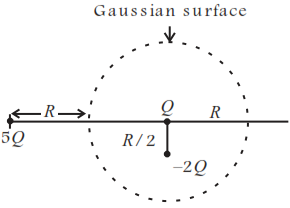
AnswerCorrect option: A. Total flux through the surface of the sphere is $\frac{-\text{Q}}{\in_0}$.
Gauss' law states that total electric flux of an enclosed surface is given by $\frac{\text{q}}{\in_0}$.
Here, $q$ is the net charge enclosed by the Gaussian surface.
From the figure,
Net charge inside the surface is $= Q - 2Q = -Q.$
Net flux through the surface of the sphere $=\frac{-\text{Q}}{\in_0}$
Here, charge $5Q$ lies outside the Gaussian surface, so it will not make no contribution to electric flux through the given surface.
View full question & answer→MCQ 2161 Mark
The ratio of electric force and gravitational force between a proton and electron is:
- A
$2.4 \times 10^{-39}$
- ✓
$2.4 \times 10^{39}$
- C
$2.4$
- D
$10^{39}$
AnswerCorrect option: B. $2.4 \times 10^{39}$
b. $2.4 \times 10^{39}$
View full question & answer→MCQ 2171 Mark
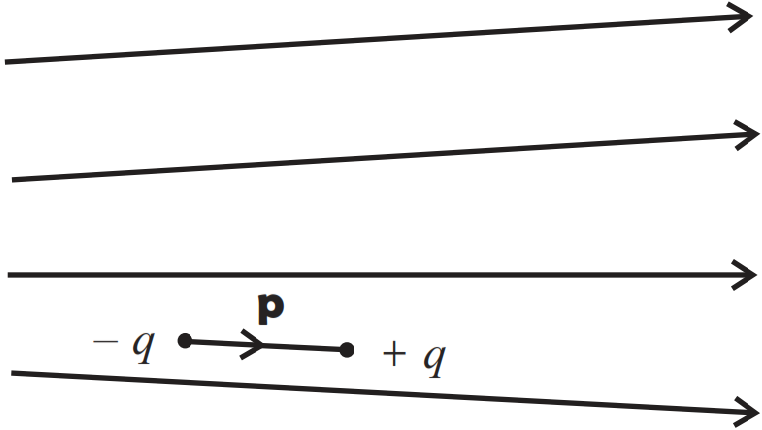
Figure shows electric field lines in which an electric dipole p is placed as shown. Which of the following statements is correct?
- A
The dipole will not experience any force.
- B
The dipole will experience a force towards right.
- ✓
The dipole will experience a force towards left.
- D
The dipole will experience a force upwards.
AnswerCorrect option: C. The dipole will experience a force towards left.
We know electric field emerges radially outward from positive point charge.
In the figure given above, space between field lines is increasing $($or density of electric field line is decreasing$)$. In other words, the electric force is decreasing while moving from left to right.
Thus, the force on charge $‒q$ is greater than the force on charge $+q$ in turn dipole will experience a force towards left direction.
View full question & answer→MCQ 2181 Mark
When an object possess electric charge then the object is said to be:
AnswerCorrect option: C. Both $a$ and $b.$
View full question & answer→MCQ 2191 Mark
The SI unit of surface charge density is:
- A
$C / m$
- ✓
$C / m ^2$
- C
$Cm$
- D
$Cm ^2$
AnswerCorrect option: B. $C / m ^2$
b. $C / m ^2$
View full question & answer→MCQ 2201 Mark
Two uncharged bodies on rubbing, get charged due to:
AnswerWhen two bodies are rubbed together, there is transfer of electrons because of friction.
Hence, two uncharged bodies on rubbing, gets equal and opposite charges.
View full question & answer→MCQ 2211 Mark
The rubber used in the wheels of aero$-$plane is $........$?
- A
- ✓
- C
Can be an insulator or conducting.
- D
AnswerDue to high friction during takeoff, a huge amount of charge is produced on the rubber of the wheel of a plane. This charge must be sent to the ground. So, the rubber used is slightly conducting, else the huge charge produced may produce a spark and can cause an accident.
View full question & answer→MCQ 2221 Mark
If a linear isotropic dielectric is placed in an electric field of strength $E$, then the polarization $P$ is:
- A
Independent of $E.$
- B
Inversely proportional to $E.$
- C
Directly proportional to $E.$
- ✓
Directly proportional to $E.$
AnswerCorrect option: D. Directly proportional to $E.$
View full question & answer→MCQ 2231 Mark
When a charged body is brought near an electroscope:
- ✓
The strips of foils opens up.
- B
The strips of foils close.
- C
The strips open and close simultaneously.
- D
The strips neither open nor close.
AnswerCorrect option: A. The strips of foils opens up.
When a charged body is brought near the top conducting disc of an electroscope, the disc gets induced with charges. These charges run down to the metal strips hanging from the paper clip. Now as both the strips get similar charge, those repel each other and thus open up.
View full question & answer→MCQ 2241 Mark
Two spheres $A$ and $B$ of exactly same mass are given equal positive and negative charges respectively. Their masses after charging.
AnswerCorrect option: C. Mass of $A <$ mass of $B.$
View full question & answer→MCQ 2251 Mark
In metals $........$ are the mobile charges.
View full question & answer→MCQ 2261 Mark
Like charges $........$ each other.
View full question & answer→MCQ 2271 Mark
The SI unit of volume charge density is:
- A
$C / m$
- B
$C / m ^2$
- ✓
$C / m ^3$
- D
$Cm.$
AnswerCorrect option: C. $C / m ^3$
c. $C / m ^3$.
View full question & answer→MCQ 2281 Mark
$+q, +2q, +3q, +4q, ……(up to +20q)$ charges are situated at coordinates $(0, 0), (1, 0), (2, 0), ….. ($Up to $20).$ What is the total charge stored in the system?
- A
$+20q$
- ✓
$+210q$
- C
$+420q$
- D
$+190q$
AnswerCorrect option: B. $+210q$
As charge is additive, total charge will be $(1+2+3+4+…. +20)\times\text{q}=\frac{20\times21}{2}\times\text{q}= 210\text{q}.$ But if the polarities of the charges are different i.e. some of them are positive and some are negative, then the result will be different. We have to add separately the positive charges and the negative charges.
View full question & answer→MCQ 2291 Mark
Number of electric lines of force emanating from $1C$ of positive charge in vacuum is:
AnswerCorrect option: D. $1.13 \times 10^{11}$
d. $1.13 \times 10^{11}$
Explanation:
$\phi \text { from } 1 C \text { of charge is }=\frac{ Q _{\text {enclosed }}}{\epsilon_{ o }}$
$=\frac{1}{8.8501 \times 10^{-12}}$
$=1.129 \times 10^{11}$
View full question & answer→MCQ 2301 Mark
Induction occurs due to $........$?
- ✓
- B
- C
- D
Uniform charge distribution.
AnswerWhen a positive or negative charged body comes close to another body, the electrons of the second body redistribute themselves. Electrons of the second body are attracted by the positively charged body and repelled by the negatively charged body.
View full question & answer→MCQ 2311 Mark
Which one of the following is similar between electrostatic force and gravitational force?
- A
Force can be attractive or repulsive.
- B
The force depends on the medium between the bodies.
- C
Both the forces are strong forces.
- ✓
Force is inversely proportional to the distance between the bodies.
AnswerCorrect option: D. Force is inversely proportional to the distance between the bodies.
Gravitational force cannot be repulsive and it is a very weak force. Gravitational force does not depend on the medium. But both the forces are inversely proportional to the distance between them.
View full question & answer→MCQ 2321 Mark
A solid sphere of radius $R_1$ and volume charge density $P=\frac{P_0}{r}$ is enclosed by a hollow sphere of radius $R_2$ with negative surface charge destiny $\sigma_2$ such that the total charge in the system is zero $P _0$ is positive constant and $r$ is the distance from the centre of sphere the ratio $\frac{ R _2}{ R _1}$ is:
- A
$\frac{\sigma}{\text{p}_0}$
- B
$\sqrt{\frac{2\sigma}{\text{p}_0}}$
- ✓
$\sqrt{\frac{\text{p}_0}{2\sigma}}$
- D
$\frac{\text{p}_0}{\sigma}$
AnswerCorrect option: C. $\sqrt{\frac{\text{p}_0}{2\sigma}}$
View full question & answer→MCQ 2331 Mark
What is the $\ce{C.G.S.}$ unit of charge?
AnswerThe $\ce{C.G.S}$. unit of charge is Stat Coulomb or $\ce{ESU}$ but in the $\ce{SI}$ system the unit is Coulomb. $\ce{EMU}$ is another unit of charge in the SI system. Pascal is the unit of pressure.
View full question & answer→MCQ 2341 Mark
If an electron has an initial velocity in a direction different from that of an electric field, the path of the electron is:
MCQ 2351 Mark
A hemisphere is uniformely charged positively. The electric field at a point on a diameter away from the centre is directed.
- ✓
Perpendicular to the diameter.
- B
Parallel to the diameter.
- C
At an angle tilted towards the diameter.
- D
At an angle tilted away from the diameter.
AnswerCorrect option: A. Perpendicular to the diameter.
View full question & answer→MCQ 2361 Mark
An electric dipole is placed at an angle of $30^\circ$ to a non-uniform electric field. The dipole will experience:
- A
A translational force only in the direction of the field.
- B
A translational force only in the direction normal to the direction of the field.
- ✓
A torque as well as a translational force.
- D
AnswerCorrect option: C. A torque as well as a translational force.
View full question & answer→MCQ 2371 Mark
The electric field in a region is directed outward and is proportional to the distance r from the origin. Taking the electric potential at the origin to be zero,
AnswerCorrect option: C. It is proportional to $r^2$.
c. It is proportional to $r^2$.
Explanation:
$DV =- E . dr$
Given $( E \propto r )$
$( V -0)=- E . dr$
$pE \propto r ^2$
View full question & answer→MCQ 2381 Mark
Conservation of electric charges means that the total charge of an isolated system remains $.........$ with time.
View full question & answer→MCQ 2391 Mark
What is the unit of surface charge density in the SI unit?
- A
$C$
- B
$C/ m$
- ✓
$C / m ^2$
- D
$C / m ^3$
AnswerCorrect option: C. $C / m ^2$
c. $C / m^2$
Explanation:
Surface charge density means how much charge is stored in the unit surface area of a conductor. So, it's unit will be $=\frac{\text { the unit of the charge }}{\text { the unit of area }}$. In SI the unit of charge is Coulomb and the unit of area is $m ^2$.
View full question & answer→MCQ 2401 Mark
Electric lines of force about a negative point charge are:
MCQ 2411 Mark
The branch of physics which deals with the study of forces, Fields and potential arising from static charges is called as:
MCQ 2421 Mark
A thin, metallic spherical shell contains a charge $Q$ on it. A point charge q is placed at the centre of the shell and another charge $q_1$ is placed outside it as shown in figure. All the three charges are positive. The force on the charge at the centre is: 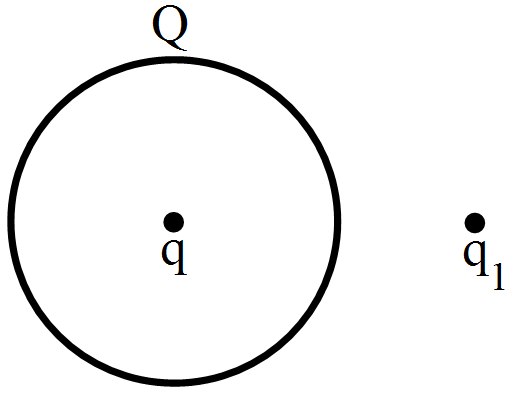
Answer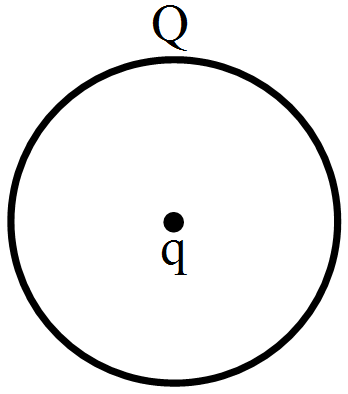
Electric field due to $Q\ \&\ q$, inside the spherical shell is zero. View full question & answer→MCQ 2431 Mark
An electron is released from rest in a region of space with a non-zero electric field. Which of the following statements is true?
- ✓
The electron will begin moving towards a region of higher potential.
- B
The The electron will begin moving towards a region of lower potential.
- C
The The electron will begin moving among a line of constant potential.
- D
Nothing can be concluded unless the direction of the electric field is known.
AnswerCorrect option: A. The electron will begin moving towards a region of higher potential.
Negative charge itself goes from low to high potential.
View full question & answer→MCQ 2441 Mark
What will be the nature of charge on the metal paper clip of electroscope when a negatively charged body is brought in contact with it?
AnswerThe nature of charge will be negative. When a negatively charged body come in context with uncharged metal paper clip then some amount of negative change will transfer from changed body to metal clip. This phenomenon of change transfer is called Conduction.
View full question & answer→MCQ 2451 Mark
An electric dipole is placed in an electric field generated by a point charge.
- A
The net electric force on the dipole must be zero.
- B
The net electric force on the dipole may be zero.
- C
The torque on the dipole due to the field must be zero.
- ✓
The torque on the dipole due to the field may be zero.
AnswerCorrect option: D. The torque on the dipole due to the field may be zero.
In the uniform Electric field the net electric force on the dipole is alwas zero.
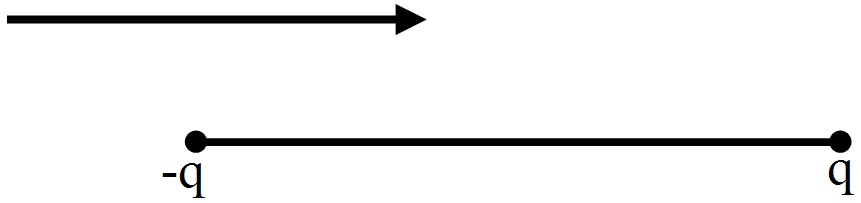
In uniform Electric field the torque on the dipole due to field may be zero.
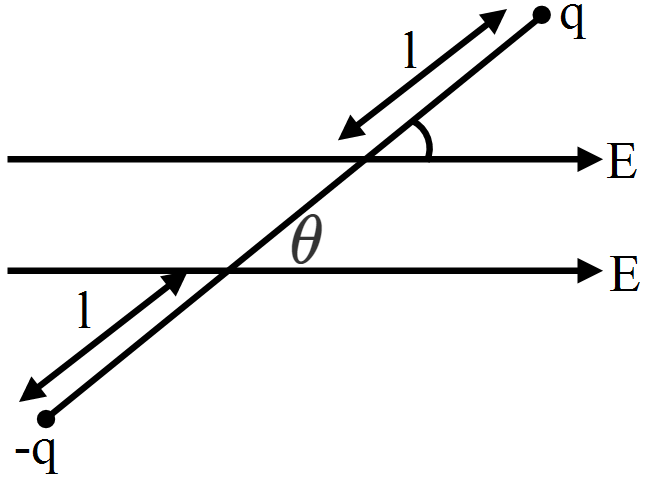
$T = 0$
Here $t Þ$ Torque
$\text{T}=2\text{qEl}\sin\text{q }\otimes\neq0$
View full question & answer→MCQ 2461 Mark
A metallic particle having no net charge is placed near a finite metal plate carrying a positive charge. The electric force on the particle will be:
AnswerSince there is no charge on the metallic particle therefore, force experienced by the particle is zero.
View full question & answer→MCQ 2471 Mark
Two small spheres with masses $M_1$ and $M_2$ hang on weightless, insulating threads with lengths $L_1$ and $L_2$. The two spheres carry a charge of $Q_1$ and $Q_2$ respectively. The spheres hang such that they are level with one another and the threads are inclined to the vertical at angles $\theta_1$ and $\theta_2$. Which of the following conditions is required if $\theta_1=\theta_2$.
AnswerCorrect option: A. $M_1=M_2$
a. $M _1= M _2$
Explanation:
$\theta_1=\theta_2$, if their masses are the same because the force of repulsion due to charges is the same.
The force $Mg \sin \theta$ opposes the force of repulsion. Even if $Q _1$ and $Q _2$ are different, the force of repulsion is the same for both as they are mutual.
View full question & answer→MCQ 2481 Mark
There exists an electric field of $1N/C$ along $Y$ direction. The flux passing through the square of $1m$ placed in $XY$ plane inside the electric field is?
- A
$1.0 Nm ^2 / C$
- B
$10.0 Nm ^2 / C$
- C
$2.0 Nm ^2 / C$
- ✓
AnswerThe flux passing through the square of $1m$ placed in $XY$ plane inside the electric field is zero because by Gauss theorem we can say here closed circuit not formed.
View full question & answer→MCQ 2491 Mark
A point charge is brought in an electric field. The electric field at a nearby point.
- A
Will increase if the charge is positive.
- B
May decrease if the charge is negative.
- C
May increase if the charge is positive.
- ✓
AnswerExplanation:
The electric field at a near by point may increase if the charge is positive or may decreases if the charge is negative.
View full question & answer→MCQ 2501 Mark
Electric charge is measured in:
AnswerThe standard unit of charge is coulomb $(C)$. Here ampere is the unit of current, volts is the unit of electric potential difference and watts is the unit of power.
View full question & answer→