Question 15 Marks
A series $\text{LCR}$ circuit is connected to an $a.c$. source having voltage $V=V_m \sin \omega t$. Derive the expression for the instantaneous current $I$ and its phase relationship to the applied voltage. Obtain the condition for resonance to occur. Define power factor. State the conditions under which it is
$i$. maximum and
$ii$. minimum.
$i$. maximum and
$ii$. minimum.
Answer
View full question & answer→Suppose resistance $R,$ inductance $L$ and capacitance $C$ are connected in series and an alternating source of voltage $V=V_0 \sin \omega t$ is applied across it. $($fig. $a)$ On account of being in series, the current $(i)$ flowing through all of them is the same.
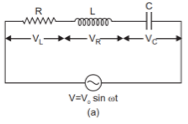
Suppose the voltage across resistance $R$ is $V _{ R }$, voltage across inductance $L$ is $V _{ L }$ and voltage across capacitance $C$ is $V _{ C }$.
The voltage $V _{ R }$ and current $i$ are in the same phase, the voltage $V _{ L }$ will lead the current by angle $90^{\circ}$ while the voltage $V _{ C }$ will lag behind the current by angle $90^{\circ}$.
Clearly $V _{ C }$ and $V _{ L }$ are in opposite directions,
therefore their resultant potential difference $= V _{ C }{ }^{-}\ V_L\left(\right.$ if $\left.V_C>V L\right)$.
Thus $V _{ R }$ and $\left( V _{ C }- V _{ L }\right)$ are mutually perpendicular and the phase difference between them is $90^{\circ}$.
As applied voltage across the circuit is $V, $ the resultant of $V _{ R }$ and $\left( V _{ C }- V _{ L }\right)$ will also be $V$ .
From fig.
$V ^2=V_R^2+\left(V_C-V_L\right)^2$
$ \Rightarrow V=\sqrt{V_R^2+\left(V_C-V_L\right)^2} \ldots \ldots . .( i )$
But $V_R=R i, V_C=X_C i$ and $V_L=X_L i \ldots. (ii)$
capacitance reactance and $X _{ L }=\omega L =$ inductive reactance
$\therefore V=\sqrt{(R i)^2+\left(X_C i-X_L i\right)^2}$
$\therefore$ Impedance of circuit, $Z=\frac{V}{i}=\sqrt{R^2+\left(X_C-X_L\right)^2}$
$Z=\sqrt{R^2+\left(X_C-X_L\right)^2}=\sqrt{R^2+\left(\frac{1}{\omega C}-\omega L\right)^2}$
Instantaneous current
$I=\frac{V_0 \sin (\omega t+\phi)}{\sqrt{R^2+\left(\frac{1}{\omega C}-\omega L\right)^2}}$
Condition for resonance to occur in series $\text{LCR}$ ac circuit:
For resonance, the current produced in the circuit and emf applied must always be in the same phase.
Phase difference $(\phi)$ in series $\text{LCR}$ circuit is given by
$\tan \phi=\frac{X_{C^{-}} X_L}{R}$
For resonance $\phi=0 $
$\Rightarrow X_C-X_L=0$
or $X_C=X_L$
If $\omega_r$ is resonant frequency, then
and $ X_L=\omega_r L$
$\ \therefore \frac{1}{\omega_r C}=\omega_r L$
$\Rightarrow \omega_r=\frac{1}{\sqrt{L C}}$
Power factor is the cosine of phase angle $\phi$, i.e., $\cos \phi= R / Z$.
For maximum power $\cos \phi=1$ or $Z = R$
i.e., circuit is purely resistive.
For minimum power $\cos \phi=0$ or $R =0$
i.e., circuit should be free from ohmic resistance.
Suppose the voltage across resistance $R$ is $V _{ R }$, voltage across inductance $L$ is $V _{ L }$ and voltage across capacitance $C$ is $V _{ C }$.
The voltage $V _{ R }$ and current $i$ are in the same phase, the voltage $V _{ L }$ will lead the current by angle $90^{\circ}$ while the voltage $V _{ C }$ will lag behind the current by angle $90^{\circ}$.
Clearly $V _{ C }$ and $V _{ L }$ are in opposite directions,
therefore their resultant potential difference $= V _{ C }{ }^{-}\ V_L\left(\right.$ if $\left.V_C>V L\right)$.
Thus $V _{ R }$ and $\left( V _{ C }- V _{ L }\right)$ are mutually perpendicular and the phase difference between them is $90^{\circ}$.
As applied voltage across the circuit is $V, $ the resultant of $V _{ R }$ and $\left( V _{ C }- V _{ L }\right)$ will also be $V$ .
From fig.
$V ^2=V_R^2+\left(V_C-V_L\right)^2$
$ \Rightarrow V=\sqrt{V_R^2+\left(V_C-V_L\right)^2} \ldots \ldots . .( i )$
But $V_R=R i, V_C=X_C i$ and $V_L=X_L i \ldots. (ii)$
capacitance reactance and $X _{ L }=\omega L =$ inductive reactance
$\therefore V=\sqrt{(R i)^2+\left(X_C i-X_L i\right)^2}$
$\therefore$ Impedance of circuit, $Z=\frac{V}{i}=\sqrt{R^2+\left(X_C-X_L\right)^2}$
$Z=\sqrt{R^2+\left(X_C-X_L\right)^2}=\sqrt{R^2+\left(\frac{1}{\omega C}-\omega L\right)^2}$
Instantaneous current
$I=\frac{V_0 \sin (\omega t+\phi)}{\sqrt{R^2+\left(\frac{1}{\omega C}-\omega L\right)^2}}$
Condition for resonance to occur in series $\text{LCR}$ ac circuit:
For resonance, the current produced in the circuit and emf applied must always be in the same phase.
Phase difference $(\phi)$ in series $\text{LCR}$ circuit is given by
$\tan \phi=\frac{X_{C^{-}} X_L}{R}$
For resonance $\phi=0 $
$\Rightarrow X_C-X_L=0$
or $X_C=X_L$
If $\omega_r$ is resonant frequency, then
and $ X_L=\omega_r L$
$\ \therefore \frac{1}{\omega_r C}=\omega_r L$
$\Rightarrow \omega_r=\frac{1}{\sqrt{L C}}$
Power factor is the cosine of phase angle $\phi$, i.e., $\cos \phi= R / Z$.
For maximum power $\cos \phi=1$ or $Z = R$
i.e., circuit is purely resistive.
For minimum power $\cos \phi=0$ or $R =0$
i.e., circuit should be free from ohmic resistance.