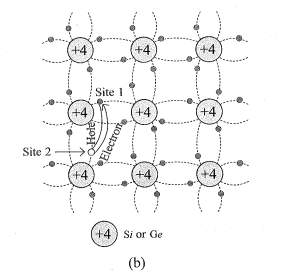
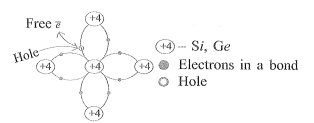
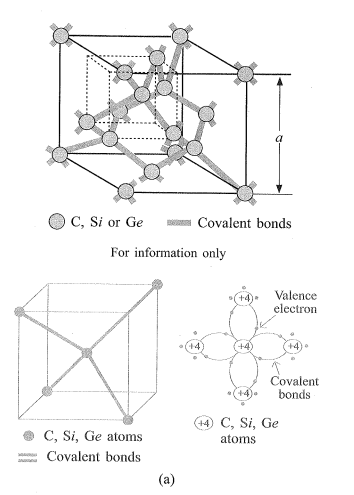
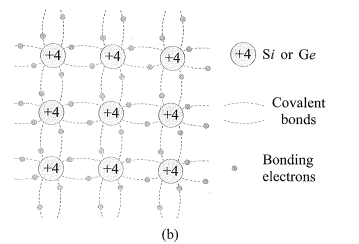
→In the crystalline structure of solids, molecules and atoms are arranged close to each other at specific positions.
→Inside the crystal each electron has a unique position and no two electrons have exactly same pattern of surrounding charges.
→Because of this, each electron will have a different energy level. These different energy levels with continuous energy variation form what are called energy bands.
→The energy band which includes the energy levels of the valence electrons is called the valence band.
→The energy band above the valence band is called the conduction band.
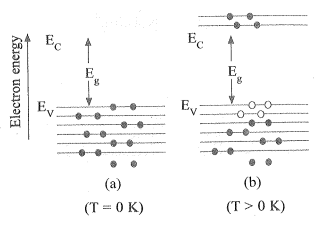
→With no external energy, (at 0 K temperature), all the valence electrons will reside in the valence band.
• Energy band in the case of the metallic conductors :
→If the lowest level in the conduction band happens to be lower than the highest level of the valence band (or when the conduction band overlaps with valence band) the electrons from the valence band can easily move into the conduction band.
→The electrons in the conduction band can move freely and take part in the phenomenon of conduction of electricity.
This is the case with the metallic conductors.
• Energy band in case of Insulators :
→If there is some gap between the conduction band and the valence band, electrons in the valence band all remain bound.
→No single electron can move to the conduction band, which means no free electrons are available in the conduction band.
→Therefore electricity can not flow (/conduct) through such material, hence it makes it insulator.
→But some of the electrons from the valence band may get external energy to cross the gap between the conduction band and the valence band. Then these electrons will move into the conduction band.