Question types

Graphical Representation of Statistical Data [NEW] question types

76 questions across 6 question groups — pick any mix to generate a Maths paper with step-by-step answer keys.

76
Questions
6
Question groups
5
Question types
Sample Questions

Graphical Representation of Statistical Data [NEW] questions

One sample from each question group in this chapter. Select any group above to see the full set with answer keys.

Q 1M.C.Q1 Mark
Which one of the following is not the graphical representation of statistical data?
  • A
    Bar graph
  • B
    Histogram
  • C
    Frequency polygon
  • Cumulative frequency distribution

Answer: D.

View full solution
Q 2M.C.Q1 Mark
In the 'less than' type of ogive the cumulative frequency is plotted against
  • A
    the lower limit of the concerned class interval
  • the upper limit of the concerned class interval
  • C
    the mid-value of the concerned class interval
  • D
    any value of the concerned class interval

Answer: B.

View full solution
Q 4M.C.Q1 Mark
In Fig. 17.4, the ratio between the number of students in the year 2016 and 2017 was
  • A
    107:145
  • B
    127:145
  • 29:36
  • D
    107: 127

Answer: C.

View full solution
Q 5M.C.Q1 Mark
In Fig. 17.4, the minimum difference between the number of boys and girls in any year in the given period was
  • A
    90
  • 70
  • C
    50
  • D
    30

Answer: B.

View full solution
Statement-1 (A): To draw the histogram of a continuous frequency distribution when class marks of class intervals are given, it is assumed that the frequency corresponding to the class mark a is spread over the interval
  • A
    Statement-1 is true, Statement-2 is true; Statement-2 is a correct explanation for Statement-3
  • B
    Statement-1 is true, Statement-2 is true; Statement-2 is not a correct explanation for Statement-1.
  • Statement-1 is true, Statement-2 is false.
  • D
    Statement-1 is false, Statement-2 is true.

Answer: C.

View full solution
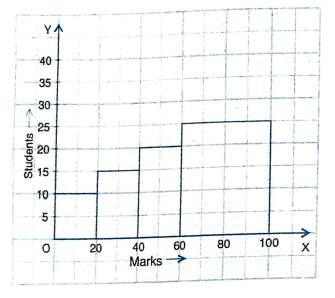
Statement-1 (A): The graphical representation of the frequency distribution
Marks:0 - 2020 - 4040 - 6060 - 100
Number of students:10152025
is as given in Fig.
Statement-2 (R): In a histogram, the areas of the rectangles are proportional to the frequencies.
Image
  • A
    Statement-1 and Statement-2 are True; Statement-2 is a correct explanation for Statement-1
  • B
    Statement-1 and Statement-2 are True; Statement-2 is not a correct explanation for Statement-1
  • Statement-1 is True, Statement-2 is False.
  • D
    Statement-1 is False, Statement-2 is True.

Answer: C.

View full solution
Statement-1 (A): In a histogram, the areas of each rectangle is proportional to the frequencies of its classes.
Statement-2 (R): In a histogram the lengths or heights of rectangles are proportional to the frequencies.
  • A
    Statement-1 is true, Statement-2 is true; Statement-2 is a correct explanation for Statement-1
  • B
    Statement-1 is true, Statement-2 is true; Statement-2 is not a correct explanation for Statement-1.
  • Statement-1 is true, Statement-2 is false.
  • D
    Statement-1 is false, Statement-2 is true.

Answer: C.

View full solution
Statement-1 (A): In a histogram, the area of each rectangle is proportional to the class size of the corresponding interval.
Statement-2 (R): To draw the histogram of a continuous frequency distribution with unequal class intervals, the frequencies of classes are adjusted by using the formula:
Adjusted frequency of a class $=\frac{\text { Minimum class size }}{\text { Class size }} \times$ Frequency of the class
  • A
    Statement-1 is true, Statement-2 is true; Statement-2 is a correct explanation for Statement-2
  • B
    Statement-1 is true, Statement-2 is true; Statement-2 is not a correct explanation for Statement-1.
  • C
    Statement-1 is true, Statement-2 is false.
  • Statement-1 is false, Statement-2 is true.

Answer: D.

View full solution
Statement-1 (A): A bar graph is a pictorial representation of the numerical data by a number of rectangles of uniform width erected horizontally or vertically with equal spacing between them.
Statement-2 (R): In order to draw the histogram when mid-points of class intervals are given, it is assumed that the frequency corresponding to the variate value a (say) is spread over the interval $a-\frac{h}{2}$ to $a+\frac{h}{2}$, where h is the jump from one value to other.
  • A
    Statement-1 and Statement-2 are True; Statement-2 is a correct explanation for Statement-2
  • Statement-1 and Statement-2 are True; Statement-2 is not a correct explanation for Statement-2
  • C
    Statement-1 is True, Statement-2 is False.
  • D
    Statement-1 is False, Statement-2 is True.

Answer: B.

View full solution
Q 113 Marks Question3 Marks
The monthly profits (in ₹) of 100 shops are distributed as follows:
Profits per shop:
0-50
50-100
100-150
150-200
200-250
250-300
No. of shops:
12
18
27
20
17
6
Draw a histogram for the data and show the frequency polygon for it.
View full solution
Q 123 Marks Question3 Marks
The following is the distribution of total household expenditure (in ₹) of manual worker in a city:
Expenditure (in ₹): 100-150 150-200 200-250 250-300 300-350 350-400 400-450 450-500
No. of manual workers: 25 40 33 28 30 22 16 8
Draw a histogram and a frequency polygon representing the above data.
View full solution
Q 133 Marks Question3 Marks
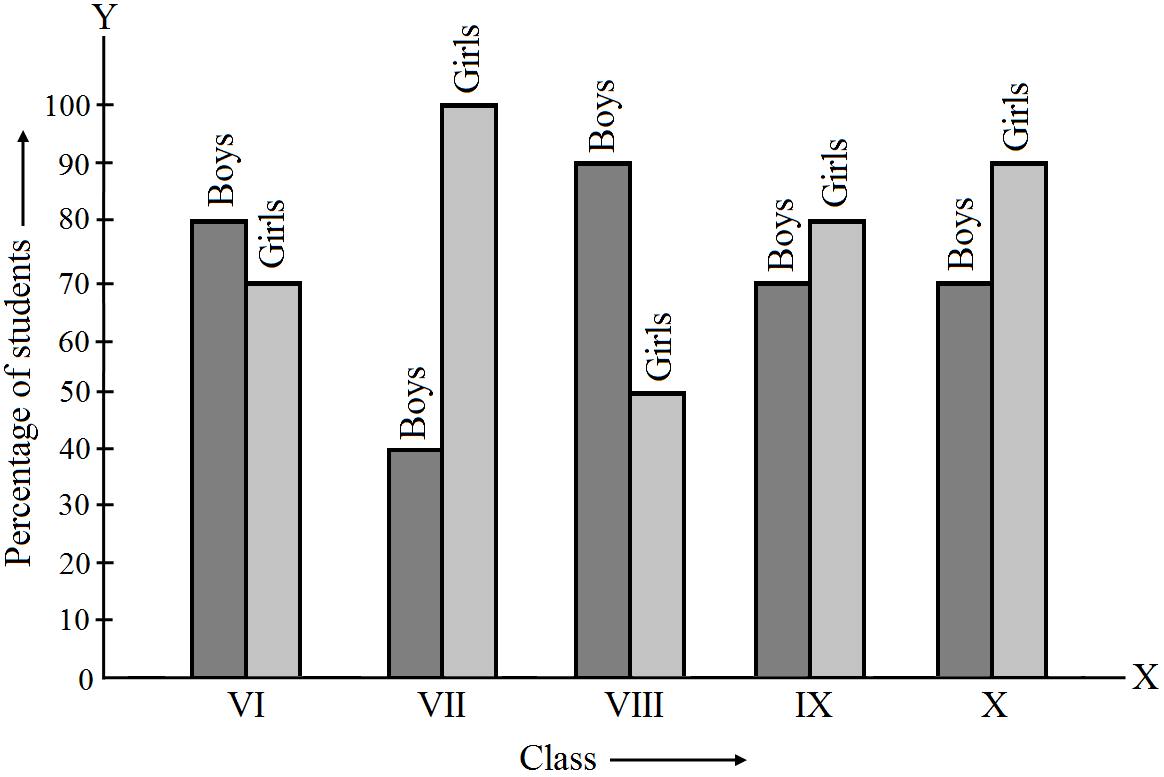
The following bar graph shows the results of an annual examination in a secondary school.
Read the bar graph and choose the correct alternative in each of the following:

  1. The pair of classes in which the results of boys and girls are inversely proportional are:
  1. VI, VIII
  2. VI, IX
  3. VII, IX
  4. VIII, X
  1. The class having the lowest failure rate of girls is:
  1. VI
  2. X
  3. IX
  4. VIII
  1. The class having the lowest pass rate of students is:
  1. VI
  2. VII
  3. VIII
  4. IX
View full solution
Q 143 Marks Question3 Marks
The distribution of height (in cm) of 96 children is given below. Construct a histogram and a frequency polygon on the same axes.
Height (in cm): 124 to 128 128 to 132 132 to 136 136 to 140 140 tom 144 144 to 148 148 to 152 152 to 156 156 to 160 160 to 164
No. of children: 5 8 17 24 16 12 6 4 3 1
View full solution
Q 153 Marks Question3 Marks
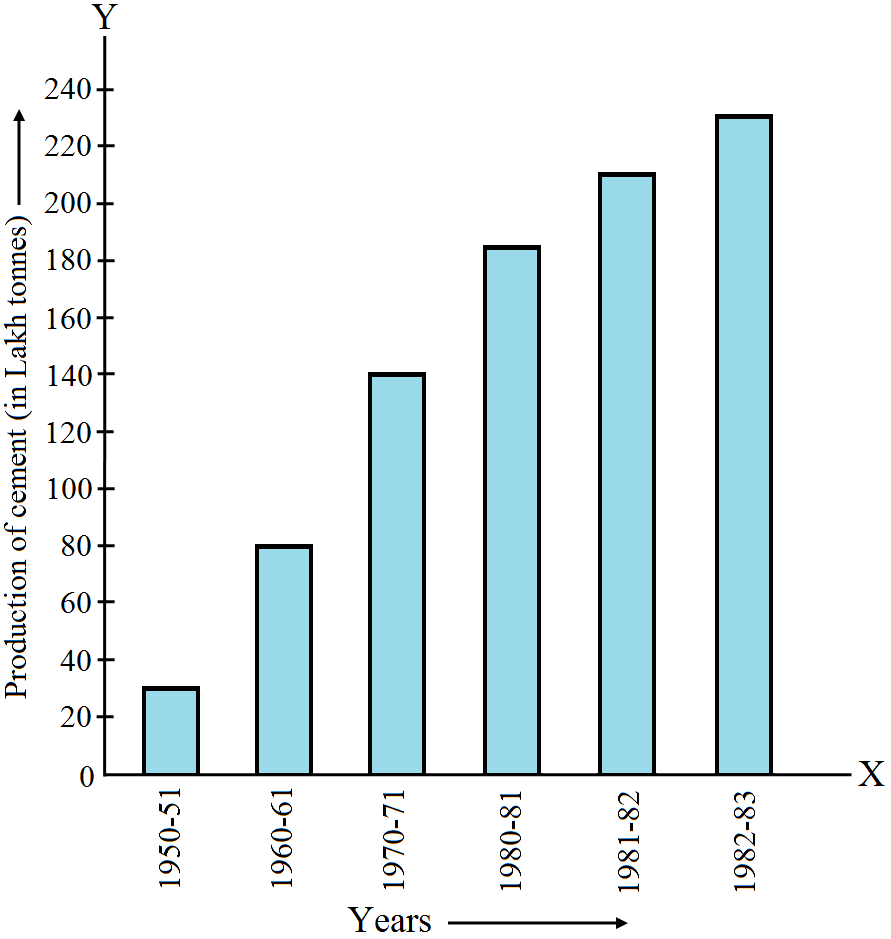
Read the graph given in figure and answer the following question:

  1. What information is given by the bar given?

  1. In which years the areas under the sugarcane crop were the maximum and the minimum?
  2. State whether true or false:

The area under sugarcane crop in the year 1982–83 is three times that of the year 1950–51.

View full solution
The time taken, in seconds, to solve a problem by each of 25 pupils is as follows:
16, 20, 26, 27, 28, 30, 33, 37, 38, 40, 42, 43, 46, 46, 46, 48, 49, 50, 53, 58, 59, 60, 64, 52, 20
  1. Construct a frequency distribution for these data, using a class interval of 10 seconds.
  2. Draw a histogram to represent the frequency distribution.
View full solution
The production of saleable steel in some of the steel plants of our country during 1999 is given below:
Plant
Bhilai
Durgapur
Rourkela
Bokaro
Production (in thousands)
160
80
200
150
Construct a bar graph to represent the above data on a graph paper by using the scale 1 big divisions = 20 thousand tones.
View full solution
The production of oil (in lakh tonnes) in some of the refineries in India during 1982 was given below:
Refinery
Barauni
Koyali
Mathura
Mumbai
Florida
Production of oil (in lakh tonnes)
30
70
40
45
25
Construct a bar graph to represent the above data so that the bars are drawn horizontally.
View full solution
The income and expenditure for 5 years of a family is given in the following data:
Years
1995–96
1996–97
1997–98
1998–99
1999–2000
Income (Rs. In thousands)
100
140
150
170
210
Expenditure (Rs. in thousands)
80
130
145
160
190
Represent the above data by a bar graph.
View full solution
The following table shows the number of Maruti cars sold by five dealers in a particular month:
Dealer
saya
Bagga links
D.D Motors
Bhasin Motors
Competent
Cars sold
60
40
20
15
10
Represent the above information by a pictograph.
View full solution
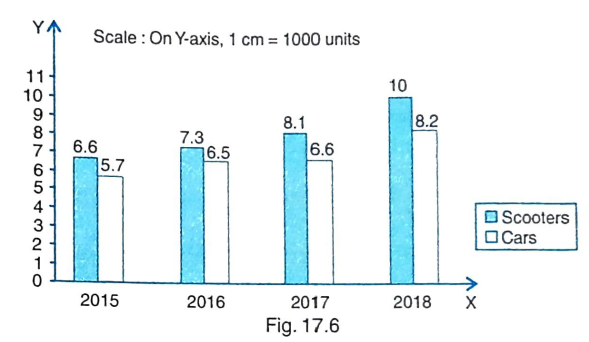
Read the following bar graph and answer the following questions:
Image
(i) In which year was the difference between the sales of the scooters and the sales of cars the least?
(a) 2015(\quad$ (b) 2016(\quad$ (c) 2017(\quad$ (d) 2018
(ii) Total number of vehicles (scooters and cars) sold in the year 2015 and 2016 was
(a) 26,100$\quad$ (b) 28,500$\quad$ (c) 25,100$\quad$ (d) 27,500
(iii) The maximum difference between the sales of scooters and cars, in any year, in the given period was
(a) 1500$\quad$ (b) 1700$\quad$ (c) 1800$\quad$ (d) 2000
(iv) The total number of scooters sold in the four years was
(a) 26,000$\quad$ (b) 27,000$\quad$ (c) 31,000$\quad$ (d) 32,000
(v) The ratio between the total number of vehicles sold (scooters and cars) in the year 2016 and that in the year 2018.
(a) 41:46$\quad$ (b) 69:91$\quad$ (c) 147:182$\quad$ (d) 46:49
View full solution
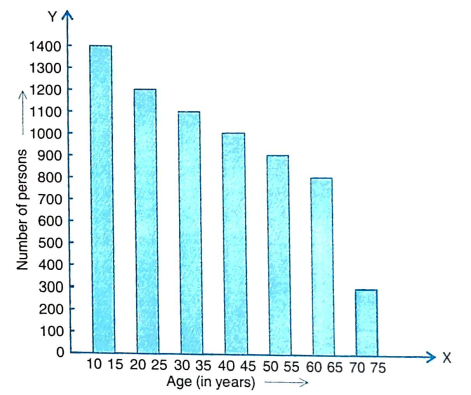
Population census in India is conducted every 10 years. The first complete census was taken in 1881 and the 15th decennial census was taken in 2011. The 16th decennial census was to be conducted in 2021 but due to COVID it will be taken in 2022. The data obtained from the census of a town has been represented by a bar graph shown in Fig. 17.2. It represents the number of persons in various age groups in the town. Observe the bar graph and answer the following questions:
Image

(i) What is the total number of persons living in the town in the age-groups 10-15 and 60 - 65?
(a) 2000$\quad$ (b) 2200$\quad$ (c) 2100$\quad$ (d) 1900
(ii) How many persons are more in the age-group 10 - 15 than in the age group 30-35?
(a) 200$\quad$ (b) 250$\quad$ (c) 300$\quad$ (d) 350
(iii) What is the total population of the town?
(a) 6700$\quad$ (b) 6400$\quad$ (c) 7700$\quad$ (d) 6600
(iv) What is the number of persons in the age-group 60-65?
(a) 900$\quad$ (b) 750$\quad$ (c) 850$\quad$ (d) 800
View full solution
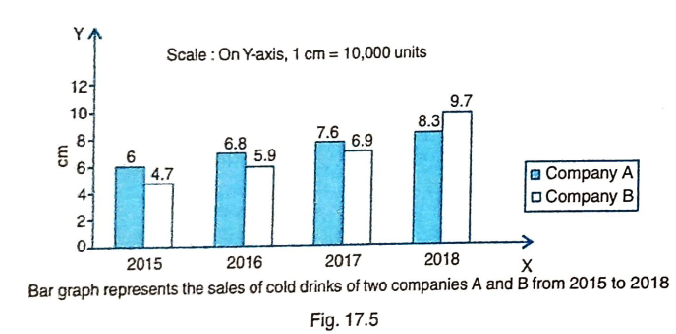
Following bar graph represents the sales of cold drinks of two companies A and B from 2015 to 2018.
Image
Read the above bar graph and answer the following questions:
(i) The year in which the difference between the sales of two companies was highest, was
(a) 2018$\quad$ (b) 2015$\quad$ (c) 2016$\quad$ (d) 2017$\quad$
(ii) Total sales of A and B in the year 2016 was
(a) 1,160,000 units$\quad$ (b) 1,270,000 units$\quad$ (c) 1,380,000 units$\quad$ (d) 1,490,000 units
(iii) The minimum difference between the sales of company A and B in any year in the given period was
(a) 90,000 units$\quad$ (b) 70,000 units$\quad$ (c) 50,000 units$\quad$ (d) 30,000 units
(iv) In which year was the sales of company B more than the sales of company A?
(a) 2015$\quad$ (b) 2016$\quad$ (c) 2017$\quad$ d) 2018
(v) The ratio of the total sales in the year 2017 and that in 2018 was
a) 107:145$\quad$ (b) 29:36$\quad$ (c) 127: 145$\quad$ (d) 107: 127
View full solution
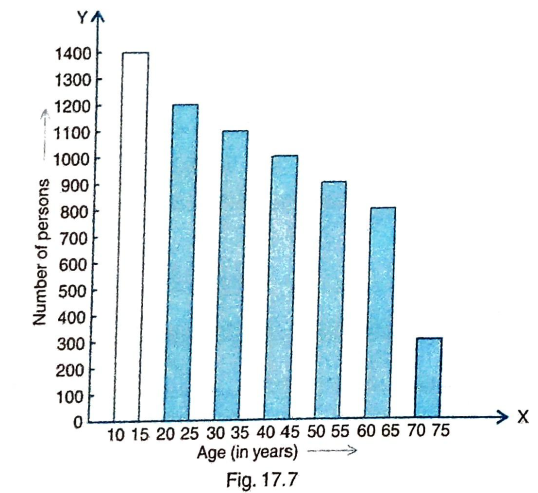
A healthcare survey was done by the State Health and Family Welfare Care Board of the State of Punjab. The data is collected by forming age groups i.e. 10-15, 20-25, 30-35, 40-45, 50-55, 60-65, 70-75. The overall data from a town is given below in the form of a bar graph. Read the data carefully and answer the question that follow:
Image
(i)How many persons are more in the age group 10 - 15 than in the age group 30 - 35?
(ii)What is the age group of exactly 1200 persons living in the town?
(iii)What is the percentage of the youngest age group persons over those in the oldest age group?
(iv) What is the total population of the town?
View full solution
The population of Delhi State in different census years is as given below:
Census year
1961
1971
1981
1991
2001
Population in Lakhs
30
55
70
110
150
Represent the above information with the help of a bar graph.
View full solution
The investments (in ten crores of rupees) of Life Insurance Corporation of India in different sectors is given below:
Sectors
Investment (in ten crores of rupess)
Central government securities
45
State government securities
11
Securities guaranteed by the government
23
Private sectors
18
Socially oriented sectors (plan)
46
Socially oriented sectors (Non–plan)
11
Represent the above data with the help of a bar graph.
View full solution
The following table gives the quantity of goods (in crores of rupees)
Year
1950–51
1960–61
1965–66
1970–71
1980–81
1982–83
Quantity of goods (in crore tonnes)
9
16
20
20
22
26
Represent this information with the help of a bar graph.
View full solution
The following data gives the value (in crores of rupees) of the Indian export of cotton textiles for different years: 
Years
1982–83
1983–84
1984–85
1985–86
1986–87
Value of exports of cotton textiles (in crores of rupees)
300
325
475
450
550
Represent the above data with the help of a bar graph. Indicate with the help of a bar graph the year in which the rate of increase in exports is maximum over the preceding year.
View full solution
The following data gives the demand estimates of the Government of India, Department of Electronics for the personnel in the Computer sector during the Eighth Plan period (1990–95):
Qualifications
MCA (Masters in Computer Applications)
DCA (Diploma in Computer Applications
DCE (Diploma in Computer Engineering)
CL (Certificate Level Course)
ST (Short Term Course)
Personnel required
40600
181600
18600
670600
1802900
Represent the data with the help of a bar graph. Indicate with the help of the bar graph the course where the estimated requirement is least.
View full solution

Generate a Graphical Representation of Statistical Data [NEW] paper free

Pick question groups from the list above, set marks and difficulty, and export a branded PDF with step-by-step answer keys. First 3 chapters free — no signup.

Download App