Questions · Page 1 of 5

M.C.Q

🎯

Test yourself on this topic

50 questions · timed · auto-graded

MCQ 11 Mark
The difference between the highest and lowest values of the observations is called:
  • A
    Range.
  • B
    Class-intervals.
  • C
    Mean.
  • D
    Frequency.
Answer
  1. Range.

Solution:

The difference between the highest and lowest value of observations is called 'Range' of observations.
View full question & answer
MCQ 21 Mark
In a frequency distribution, ogives are graphical representation of:
  • A
    Frequency.
  • B
    Relative frequency.
  • C
    Cumulative frequency.
  • D
    Raw data.
Answer
  1. Cumulative frequency.

Solution:

In a frequency distribution, ogives are graphical representation of cumulative frequency.

View full question & answer
MCQ 31 Mark
The mean of a, b, c, d and e is 28. If the mean of a, c, and e is 24, what is the mean of b and d?
  • A
    33
  • B
    34
  • C
    32
  • D
    31
Answer
  1. 34

Solution:

Given that the mean of a, b, c, d and e is 28. They are 5 in numbers.

Hence, we have

$\frac{\text{a}+\text{b}+\text{c}+\text{d}+\text{e}}{5}=28$

$\Rightarrow\frac{(\text{a}+\text{c}+\text{e})+(\text{b}+\text{d})}{5}=28$

$\Rightarrow\frac{(\text{a}+\text{c}+\text{e})}{5}+\frac{(\text{b}+\text{d})}{5}=28$

But, it is given that the mean of a, c and e is 24. Hence, we have

$\Rightarrow\frac{(\text{a}+\text{c}+\text{e})}{5}=24$

$\Rightarrow\text{a}+\text{c}+\text{e}=72$

Then We have

$\frac{72}{5}+\frac{(\text{b}+\text{d})}{5}=28$

$\Rightarrow\frac{\text{b}+\text{d}}{5}=28-\frac{72}{5}$

$\Rightarrow\frac{\text{b}+\text{d}}{5}=28-14.4$

$\Rightarrow\frac{\text{b}+\text{d}}{5}=13.6$

$\Rightarrow\text{b}+\text{d}=68$

$\Rightarrow\frac{\text{b}+\text{d}}{2}=\frac{68}{2}$

$\Rightarrow\frac{\text{b}+\text{d}}{2}=34$

Hence, the mean of b and d is 34.

View full question & answer
MCQ 41 Mark
In the class intervals 10-20, 20-30, 20 is taken in:
  • A
    The interval 10-20.
  • B
    The interval 20-30.
  • C
    Both intervals 10-20, 20-30.
  • D
    None of the intervals.
Answer
  1. The interval 20-30.

Solution:

The given class intervals are 10-20, 20-30. In these class intervals the value 20 is lies in the class interval 20-30.Hence, the correct choice is (b).

View full question & answer
MCQ 51 Mark
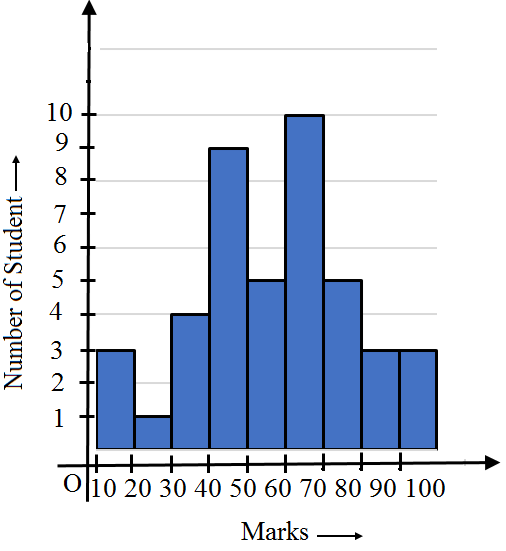
In the given graph, the number of students who scored 60 or more marks is:

  • A
    22
  • B
    20
  • C
    21
  • D
    19
Answer
  1. 21

Solution:

Add the values corresponding to the height of the bar from 60 to 100

10 + 5 + 3 + 3 = 21

View full question & answer
MCQ 61 Mark
The median of the numbers 84, 78, 54, 56, 68, 22, 34, 45, 39, 54 is:
  • A
    45
  • B
    49.5
  • C
    54
  • D
    56
Answer
  1. 54

Solution:

Arranging the points in an ascending order,

We have:

22, 34, 39, 45, 54, 56, 68, 78, 84

Here, n = 10, Which is even

$\therefore\ $median = mean of $\Big(\frac{10}{2}\Big)^\text{th}$ and $\Big(\frac{10}{2}+1\Big)^\text{th}$ terms

= mean of $\Big(\frac{10}{2}\Big)^\text{th}$ and $\Big(\frac{12}{2}\Big)^\text{th}$ term

= mean of 5th and 6th terms

$=\frac{1}{2}(54+54)$

$\frac{1}{2}\times108$

$=54$

View full question & answer
MCQ 71 Mark
The algebraic sum of the deviations of a set of n values from their mean is:
  • A
    n - 1
  • B
    n
  • C
    n + 1
  • D
    0
Answer
  1. 0

Solution:

If $\overline{\text{X}}$ be the mean of the n observations q X1, ......Xn Then we have

$\overline{\text{X}}=\frac{1}{\text{n}}\sum\limits_{\text{i}=1}^{\text{n}}\text{X}_\text{i}$

$\Rightarrow\sum\limits_{\text{i}=1}^{\text{n}}\text{X}_\text{i}=\overline{\text{X}}$

Let $\overline{\text{X}}$ be the mean of n Values Xi,.....Xn. so we have

$\overline{\text{X}}=\frac{1}{\text{n}}\sum\limits_{\text{i}=1}^{\text{n}}\text{X}_\text{i}$

$\Rightarrow\sum\limits_{\text{i}=1}^{\text{n}}\text{X}_\text{i}=\text{n}\overline{\text{X}}$

The sum of the deviations of n values Xi,......Xn from their mean $\overline{\text{X}}$ is

$(\text{x}_1-\overline{\text{X}})+(\text{x}_2-\overline{\text{X}})+.....+(\text{x}_\text{n}-\overline{\text{X}})$

$=\sum\limits_{\text{i}=1}^{\text{n}}(\text{x}_\text{i}-\overline{\text{X}})$

$=\sum\limits_{\text{i}=1}^{\text{n}}\text{x}_\text{i}-\sum\limits_{\text{i}=1}^{\text{n}}\overline{\text{X}}$

$=\text{n}\overline{\text{X}}-\text{n}\overline{\text{X}}$

$=0$

View full question & answer
MCQ 81 Mark
If each observation of the data is decreased by 8 then their mean:
  • A
    Remains the same.
  • B
    Is increased by 5.
  • C
    Is decreased by 8.
  • D
    Becomes 8 times the original mean.
Answer
  1. Is decreased by 8.

Solution:

Let the numbers be x1, x2 ....., xn

Now the new numbers after decrasing every number by 8: (x1 - 8), (x2 - 8).... (xn - 8)

New mean $=\frac{(\text{x}_1 - 8)+(\text{x}_2 - 8)+...+(\text{x}_\text{n} - 8)}{\text{n}}$

$=\frac{\text{x}_1+\text{x}_2+...+\text{x}_\text{n}-\text{8n}}{\text{n}}$

$=\frac{\text{x}_1+\text{x}_2+...+\text{x}_\text{n}}{\text{n}}-8$

New mean = mean -8

Hence, mean is decreased by 8.

View full question & answer
MCQ 91 Mark
The mean of 100 items was found to be 64. Later on it was discovered that two items were misread as 26 and 9 instead of 36 and 90 respectively. The correct mean is:
  • A
    64.91
  • B
    65.31
  • C
    64.61
  • D
    64.86
Answer
  1. 64.91

Solution:

Mean of 100 items = 64

Sum of 100 items = 64 × 100 = 6400

Correct sum = (6400 + 36 + 90 - 26 - 9) = 6491

Correct mean $=\frac{6491}{100}=64.91$

View full question & answer
MCQ 101 Mark
A grouped frequency distribution table with classes of equal sizes using 63-72 (72 included) as one of the class is constructed for the following data 30, 32, 45, 54, 74, 78, 108, 112, 66, 76, 88, 40, 14, 20, 15, 35, 44, 66, 75, 84, 95, 96, 102, 110, 88, 74, 112, 14, 34, 44. How many classes can we have?
  • A
    12
  • B
    11
  • C
    10
  • D
    9
Answer
  1. 10

Solution:

The given frequency varies from 14 to 112.

So the class intervals are:

13-22, 23-32, 33-42, 43-52, 53-62, 63-72, 73-82, 83-92, 93-102, 103-112.

Number of class interval = 10.

View full question & answer
MCQ 111 Mark
In a grouped frequency distribution, the class intervals are 1-20, 21-40, 41-60,.... then the class width is:
  • A
    19
  • B
    20
  • C
    30
  • D
    10
Answer
  1. 20

Solution:

The class width is the difference between the upper- or lower-class limits of consecutive classes.

In this case, class width equals to the difference between the lower limits of the first two classes.

Let, W be the class width

W = 21 - 1 = 20

So class width is 20

View full question & answer
MCQ 121 Mark
Let L be the lower class boundry of a class in a frequency distribution and m be the midpoint of the class. Which one of the following is the upper class boundry of the class?
  • A
    $\text{m}+\frac{(\text{m}+\text{L})}{2}$
  • B
    $\text{L}+\frac{\text{m}+\text{L}}{2}$
  • C
    $2\text{m}-\text{L}$
  • D
    $\text{m}-2\text{L}$
Answer
  1. $2\text{m}-\text{L}$

Solution:

Mid value $=\frac{\text{Lower}\ \text{limit}+\text{Upper}\ \text{limit}}{2}$

$\Rightarrow\text{m}=2\text{m}-\text{L}$

$\therefore$ Upper class boundry of the class = 2m - L.

View full question & answer
MCQ 131 Mark
Class size of a distribution having 28, 34, 40, 46 and 52 as its class marks is:
  • A
    6
  • B
    5
  • C
    4
  • D
    3
Answer
  1. 6

Solution:

Class size is the difference between two consecutive values of the class mark.

Here, the difference between two consecutive class mark is 6.

i.e., 34 - 28 = 6

View full question & answer
MCQ 141 Mark
If the mode of the data is 45 and the median is 33, then the mean is:
  • A
    33
  • B
    27
  • C
    None of these
  • D
    30
Answer
  1. 27

Solution:

Since, 3 Median = 2 Mean + Mode

$\therefore$ 3 × 33 = 2 Mean + 45

⇒ 2 Mean = 99 - 45

⇒ 2 Mean = 54

⇒ Mean = 27

View full question & answer
MCQ 151 Mark
The mean of 30 observations is 12. If 25 is subtracted from the sum of observations, then remaining sum is:
  • A
    385
  • B
    335
  • C
    365
  • D
    375
Answer
  1. 335

Solution:

Let sum of all the 30 observations be x.

The mean is equal to the sum of all the values in the data set divided by the number of values in the data set.

$\frac{\text{x}}{30}=12$

$\text{x}=360$

$360-25=335$

View full question & answer
MCQ 161 Mark
In a histogram the class intervals or the group are taken along:
  • A
    Y-axis.
  • B
    X-axis.
  • C
    Both of X-axis and Y-axis.
  • D
    In between X and Y axis.
Answer
  1. X-axis.

Solution:

In a histogram the class intervals or the groups are taken along the horizontal axis or X−axis.

View full question & answer
MCQ 171 Mark
The given cumulative frequency distribution shows the class intervals and their corresponding cumulative frequencies. Then the frequency of class interval 20-30 is:
Class
10-20
20-30
30-40
Cumulative frequency
5
14
25
  • A
    11
  • B
    20
  • C
    5
  • D
    9
Answer
  1. 9

Solution:

A cumulative frequency distribution is the sum of the class and all classes below it in a frequency distribution.

Subtract the previous cumulative frequency (c.f.) from the cumulative frequency of the current class.

So frequency of the class interval 20 - 30 is 14 - 5 = 9

View full question & answer
MCQ 181 Mark
Mode of the data 15, 17, 15, 19, 14, 18, 15, 14, 16, 15, 14, 20, 19, 14, 15 is:
  • A
    14
  • B
    15
  • C
    16
  • D
    17
Answer
  1. 15

Solution:

Arranging the marks in an ascending order,

We have:

14, 14, 14, 14, 15, 15, 15, 15, 16, 17, 18, 19, 19, 20

Clearly, 15 occurs maximum number of times.

Hence, mode = 15

View full question & answer
MCQ 191 Mark
Write the correct answer in the following:
If $\bar{\text{x}}$ represents the mean of n observations x1, x2, ... xn, then value of $\sum\limits_{\text{i}=1}^\text {b} \text{x}_\text{i}-\bar{\text{x}}$ is:
  • A
    -1
  • B
    0
  • C
    1
  • D
    n - 1
Answer
  1. 0

Solution:

We know that algebraic sun of deviations from mean is zero.

$\sum\limits_{\text{a}=1}^\text{b} (\text{x}_\text{t}-\bar{\text{x}})=(\text{x}_1-\bar{\text{x}})+(\text{x}_2-\bar{\text{x}})+(\text{x}_3-\bar{\text{x}})+\ ...\ +(\text{x}_\text{n}-\bar{\text{x}})$

$= (\text{x}_1+\text{x}_2+\text{x}_3+... +\text{x}_\text{n})- \text{n}\bar{\text{x}}$

$\Rightarrow\sum\limits_{\text{t}-1}^\text{b}\text{x}_\text{i}-\text{n}\bar{\text{x}}=\text{n}\bar{\text{x}}-\text{n}\bar{\text{x}}=0$ $\bigg[\because\sum\limits_{\text{i}=1}^\text{n} \text{x}_\text{i}=\text{n}\bar{\text{x}}\bigg]$

Hence, (b) is correct answer.

View full question & answer
MCQ 201 Mark
A set of data consists of six numbers: 7, 8, 8, 9, 9, and x. The difference between the modes when x = 9 and x = 8 is:
  • A
    1
  • B
    2
  • C
    4
  • D
    3
Answer
  1. 1

Solution:

The mode in a list of numbers refers to the integers that occur most number of times.

In the given list both 8 and 9 occur two times.

So the value of x will decide the mode

If x = 8, then the mode will be 8

If x = 9, then the mode will be 9

Hence, the difference between the two modes is 1.

View full question & answer
MCQ 211 Mark
Which of the following is not a measure of central tendency?
  • A
    Standard deviation
  • B
    Mode
  • C
    Median
  • D
    Arithmetic mean
Answer
  1. Standard deviation

Solution:

The most common measures of central tendency are mean, median and mode.

Standard deviation is a measure of the dispersion of a set of data from its mean. It is calculated as the square root of variance.

Hence standard deviation is not a measure of central tendency.

View full question & answer
MCQ 221 Mark
Mode is:
  • A
    Least frequent value.
  • B
    Middle most value.
  • C
    Most frequent value.
  • D
    None of these.
Answer
  1. Most frequent value.

Solution:

Most Frequent value is called mode.

View full question & answer
MCQ 231 Mark
Less than’ cumulative frequency table for a given data is as follows. Then, the frequency of class interval 20-30 is:
Marks
Less than 10
Less than 20
Less than 300
Less than 40
Cumulative frequency
3
17
37
92
  • A
    20
  • B
    14
  • C
    34
  • D
    55
Answer
  1. 20

Solution:

A cumulative frequency distribution is the sum of the class and all classes below it in a frequency distribution.

Less than 30 has the class interval 20-30. Frequency of this class interval will be corresponding to.

Marks
Cumulative frequency
Class
Frequency
Less than 10
3
1-10
3
Less than 20
17
10-20
14
Less than 30
37
20-30
20
Less than 40
92
30-40
55
View full question & answer
MCQ 241 Mark
If, for the set of observations 4, 7, x, 8, 9, 10 the mean is 8, then x is equal to:
  • A
    12
  • B
    8
  • C
    9
  • D
    10
Answer
  1. 10

Solution:

The mean is equal to the sum of all the values in the data set divided by the number of values in the data set.

$\frac{4+7+\text{x}+8+9+10}{5}=8$

$\frac{(38+\text{x})}{6}=8$

$\text{x}=48-38=10$

View full question & answer
MCQ 251 Mark
If the mean of x and $\frac{1}{\text{x}}$ is M, then the mean of x3 and $\frac{1}{\text{x}^3}$ is:
  • A
    3M3 + 4M
  • B
    4M3 - 3M
  • C
    3M3 - 4M
  • D
    4M3 + 3M
Answer
  1. 4M3 - 3M

Solution:

Given $\bigg(\frac{\text{x}+\frac{1}{\text{x}}}{2}\bigg)^2=(\text{M})^2$

Taking cube on both sides

$\bigg(\frac{\text{x}+\frac{1}{\text{x}}}{2}\bigg)^3=(\text{M})^3$

$\bigg(\text{x}+{\frac{1}{\text{x}}}\bigg)^3=(2\text{M})^3$

$\bigg(\text{x}^2+3\text{x}\times{\frac{1}{\text{x}}}\Big(\text{x}+\frac{1}{\text{x}}\Big)+\frac{1}{\text{x}^3}\bigg)=(2\text{M})^3$

$\bigg(\text{x}^3+{\frac{1}{\text{x}^3}}\bigg)={8\text{M}^3-3}\Big(\text{x}+\frac{1}{\text{x}}\Big)$

Divide by 2 on both sides to get mean

$\frac{\bigg(\text{x}^3+{\frac{1}{\text{x}^3}}\bigg)}{2}={4\text{M}^3-\frac{3}{2}}\Big(\text{x}+\frac{1}{\text{x}}\Big)$

$\frac{\bigg(\text{x}^3+{\frac{1}{\text{x}^3}}\bigg)}{2}={4\text{M}^3}-{3\text{M}}$

View full question & answer
MCQ 261 Mark
The class marks of a frequency distribution are 15, 20, 25, 30 ...., .
The class corresponding to the class mark 20 is:
  • A
    12.5-17.5
  • B
    17.5-22.5
  • C
    18.5-21.5
  • D
    19.5-20.5
Answer
  1. 17.5-22.5

Solution:

We are given frequency distribution 15, 20, 25, 30 ....

Class size = 20 - 15 = 5

Class marks = 20

Lower limit $=\Big(20-\frac{5}{2}\Big)$

$=\frac{35}{2}=17.5$

Upper limit $=\Big(20+\frac{5}{2}\Big)$

$=\frac{45}{2}=22.5$

Thus, the required class is 17.5-22.5.

View full question & answer
MCQ 271 Mark
A die is thrown 1000 times and the outcomes were recorded as follows:
Outcome
1
2
3
4
5
6
Frequency
180
150
160
170
150
190
find probability of?
  • A
    $\frac{9}{50}$
  • B
    $\frac{4}{25}$
  • C
    $\frac{7}{25}$
  • D
    $\frac{3}{20}$
Answer
  1. $\frac{3}{20}$

Solution:

$\frac{150}{1000}=\frac{3}{20}$

View full question & answer
MCQ 281 Mark
The class mark of the class 100-200 is:
  • A
    100
  • B
    110
  • C
    115
  • D
    120
Answer
  1. 110

Solution:

Class mark $=\frac{\text{Upper}\ \text{limit}+\text{Lower}\ \text{limit}}{2}$

$=\frac{120+100}{2}$

$=110$

View full question & answer
MCQ 291 Mark
Write the correct answer in the following:
A grouped frequency table with class intervals of equal sizes using 250-270 (270 not included in this interval) as one of the class interval is constructed for the following data:
268, 220, 368, 258, 242, 310, 272, 342, 310, 290, 300, 320, 319, 304, 402, 318, 406, 292, 354, 278, 210, 240, 330, 316, 406, 215, 258, 236.
The frequency of the class 310-330 is:
  • A
    4
  • B
    5
  • C
    6
  • D
    7
Answer
  1. 6

Solution:

The observation corresponding to class 310–330 (330 not included in this interval) are 310, 310, 320, 319, 318, 316, i.e., 6 observations.

View full question & answer
MCQ 301 Mark
The number of times a particular item occurs in a given data is called its:
  • A
    Variation.
  • B
    Frequency.
  • C
    Cumulative frequency.
  • D
    Class-size.
Answer
  1. Frequency.

Solution:

The number of times a particular item occurs in a given data is called the frequency of the item. Hence, the correct choice is (b).

View full question & answer
MCQ 311 Mark
The smallest of three consecutive even integers is 32. Then, the mean of the three integers is:
  • A
    34
  • B
    35
  • C
    33
  • D
    36
Answer
  1. 34

Solution:

32 is the smallest even integer.

So three consecutive even integers are 32, 34 and 36

The mean is equal to the sum of all the values in the data set divided by the number of values in the data set.

$\frac{32+34+36}{3}=34$

View full question & answer
MCQ 321 Mark
The following marks were obtained by the students in a test:
81, 72, 90, 90, 86, 85, 92, 70, 71, 83, 89, 95, 85, 79, 62
The range of the marks is:
  • A
    9
  • B
    17
  • C
    27
  • D
    33
Answer
  1. 33

Solution:

The marks obtained by the students are 81, 72, 90, 90, 86, 85, 92, 70, 71, 83, 89, 95, 85, 79 and 62.

The highest and lowest marks are 95 and 62 respectively. Therefore, the range of marks is

95 - 62

= 33

Hence, the correct option is (d).

View full question & answer
MCQ 331 Mark
Median of the following observations, arranged in an ascending order is 22. If the numbers are 8, 11, 13, 15, x + 1, x + 3, 30, 35, 40, 43. Then, the value of x is:
  • A
    20
  • B
    16
  • C
    18
  • D
    19
Answer
  1. 20

Solution:

The median is the middle score for a set of data that has been arranged in ascending or descending order of magnitude.

For even number of observations, median is calculated as average of two middle number

$22=\frac{(\text{x}+1)+(\text{x}+3)}{2}$

$44=2\text{x}+4$

$40=2\text{x}$

$\text{x}=20$

View full question & answer
MCQ 341 Mark
Write the correct answer in the following:
The range of the data: 25, 18, 20, 22, 16, 6, 17, 15, 12, 30, 32, 10, 19, 8, 11, 20 is:
  • A
    10
  • B
    15
  • C
    18
  • D
    26
Answer
  1. 26

Solution:

Maximum value of the variate = 32

And the minimum value of the variate = 6

Range = Maximum value of the variate-Minimum value of the variate = 32 - 6 = 26

View full question & answer
MCQ 351 Mark
If the less than ogive and the more than ogive intersect at (32, 48), then the median of the data is:
  • A
    48
  • B
    16
  • C
    32
  • D
    80
Answer
  1. 32

Solution:

If the less than ogive and the more than ogive intersect at (32, 48), then the median of the data is 32. Because on the graph, the point of the x-axis, where less than ogive and more than ogive intersects, is the median. Therefore, the Median of the data is 32.

View full question & answer
MCQ 361 Mark
A frequency polygon is constructed by plotting frequency of the class interval and the:
  • A
    Upper limit of the class.
  • B
    Lower limit of the class.
  • C
    Mid value of the class.
  • D
    Any values of the class.
Answer
  1. Mid value of the class.

Solution:

Frequency polygon is the plot of frequencies vs. the mid values of the classes.

View full question & answer
MCQ 371 Mark
The class-mark of the class 130-150 is:
  • A
    135
  • B
    145
  • C
    140
  • D
    130
Answer
  1. 140

Solution:

Class mark $=\frac{130+150}{2}=\frac{280}{2}=140$

View full question & answer
MCQ 381 Mark
There are 50 numbers. Each number is subtracted from 53 and the difference between the mean of the numbers so obtained is found to be -3.5. The mean of the given number is:
  • A
    49.5
  • B
    53.5
  • C
    56.5
  • D
    46.5
Answer
  1. 56.5

Solution:

Let the mean of the initial sequence is x.

Given that, after subtracting 53 from each number, the difference between the means is 3.5

So, x - 53 = 3.5

Mean of the number is x = 53 + 3.5 = 56.5

View full question & answer
MCQ 391 Mark
For a given data, the difference between the maximum and minimum observation is known as its.
  • A
    Class limit
  • B
    Class mark
  • C
    Class
  • D
    Range
Answer
  1. Range

Solution:

Difference between maximum and minimum value of observation is called as range.

View full question & answer
MCQ 401 Mark
The mean of 50 observations is 39. If one of the observations which was 23 was replaced by 43, the resulting mean will be:
  • A
    38.4
  • B
    39
  • C
    40.3
  • D
    39.4
Answer
  1. 39.4

Solution:

The mean of 50 observations is 39.

So sum of these 50 observations is 50 × 39 = 1950

After replacing the observation value 23 by 43,

Sum becomes 1970

So the mean is $\frac{1970}{50}=39.4$

View full question & answer
MCQ 411 Mark
$\text{Mode}+\frac{2}{3}(\text{Mean - Mode})=$
  • A
    Mode
  • B
    None of these
  • C
    Mean
  • D
    Median
Answer
  1. Median

Solution:

Since, 3 Median = Mode + 2 Mean

$\Rightarrow\text{Median}=\frac{\text{Mode}}{3}+\frac{2}{3}\text{Mean}$

$=\frac{\text{Mode}}{3}+\frac{2}{3}\text{Mean}-\frac{2}{3}\text{Mode}+\frac{2}{3}\text{Mode}$

$\text{Median}=\text{Mode}+\frac{2}{3}(\text{Mean - Mode})$

View full question & answer
MCQ 421 Mark
Which one of the following is not a measure of central tendency?
  • A
    Arithmetic mean
  • B
    Median
  • C
    Mode
  • D
    Variance
Answer
  1. Variance

Solution:

Median and Mode are the most common measures of central tendency.

These may be considered depending on the type of data and data distribution

Variance measures how far the data set is spread out and is not a measure of central tendency.

View full question & answer
MCQ 431 Mark
In a histogram, which of the following is proportional to the frequency of the corresponding class?
  • A
    Area of the rectangle.
  • B
    Perimeter of the rectangle.
  • C
    Width of the rectangle.
  • D
    Length of the rectangle.
Answer
  1. Area of the rectangle.

Solution:

In, Histogram each rectangle is drawn, where width equivalent to class interval and height equivalent to the frequency of the class.

Since class interval are same across the distribution table, area of the rectangle is corresponding to frequency or height of the rectangle.

View full question & answer
MCQ 441 Mark
Write the correct answer in the following:
To draw a histogram to represent the following frequency distribution:
Class intervai
5-10
10-15
15-25
25-45
45-75
Frequency
6
12
10
8
15
The adjusted frequency for the class 25-45 is:
  • A
    6
  • B
    5
  • C
    3
  • D
    2
Answer
  1. 2

Solution:

The adjusted frequency for the class 25 - 45 is

$= \frac{\text{Frequency of the class }}{\text{Class width }}\times \text{Minimum width }=\frac{8}{20} \times5=2$

View full question & answer
MCQ 451 Mark
For the set of numbers 2, 2, 4, 5 and 12, which of the following statements is true?
  • A
    Mean = Median.
  • B
    Mean > Mode.
  • C
    Mean > Mode.
  • D
    Mode = Median.
Answer
  1. Mean > Mode.

Solution:

Median = 4

Mode = 2

$\text{Mean}=\frac{2+2+4+5+12}{5}=\frac{25}{5}=5$

Hence, (Mean = 5) > (Mode = 2)

View full question & answer
MCQ 461 Mark
Write the correct answer in the following:
For drawing a frequency polygon of a continous frequency distribution, we plot the points whose ordinates are the frequencies of the respective classes and abcissae are respectively:
  • A
    Upper limits of the classes.
  • B
    Lower limits of the classes.
  • C
    Class marks of the classes.
  • D
    Upper limits of perceeding classes.
Answer
  1. Class marks of the classes.

Solution:

Abcissac are the class marks of the classes.

View full question & answer
MCQ 471 Mark
The class mark of the class 100-120 is:
  • A
    110
  • B
    115
  • C
    100
  • D
    120
Answer
  1. 110

Solution:

Class mark $=\frac{\text{Upper limit + lower limit}}{2}=\frac{120+100}{2}=110$

View full question & answer
MCQ 481 Mark
The empirical relation between mean, mode and median is:
  • A
    Mode = 3 Median - 2 Mean.
  • B
    Mode = 2 Median - 3 Mean.
  • C
    Median = 3 Mode - 2 Mean.
  • D
    Mean = 3 Median - 2 Mode.
Answer
  1. Mode = 3 Median - 2 Mean.

Solution:

The empirical Relation between mean, median and mode is:

Mode = 3 Median - 2 mean.

View full question & answer
MCQ 491 Mark
In the following distribution:
Wages(in Rs)
No of workers
More than 140
12
More than 130
27
More than 120
60
More than 110
105
More than 100
124
More than 90
141
More than 80
150
The number of workers having wage range (in Rs.) 110-120 is:
  • A
    45
  • B
    50
  • C
    55
  • D
    40
Answer
  1. 45

Solution:

Wages(in Rs)
No of workers
140–150
12
130–140
15
120–130
33
110–120
45
100–90
19
90–100
17
80–90
9

Therefore, the number of workers having a wage range (in Rs.) 110-120 is 45

View full question & answer
MCQ 501 Mark
If the arithmetic mean of 7, 5, 13, x and 9 is 10, then the value of x is:
  • A
    12
  • B
    10
  • C
    14
  • D
    16
Answer
  1. 16

Solution:

The given data is 7, 5, 13, x and 9. They are 5 in numbers.

The mean is $\frac{7+5+13+\text{x}+9}{5}=\frac{34+\text{x}}{5}$

But, it is given that the mean is 10. Hence, we have

$\frac{34+\text{x}}{5}=10$

⇒ 34 + x = 50

⇒ x = 50 - 34

⇒ x = 16

View full question & answer
M.C.Q - Maths STD 9 Questions - Vidyadip