Questions · Page 2 of 5

M.C.Q

MCQ 511 Mark
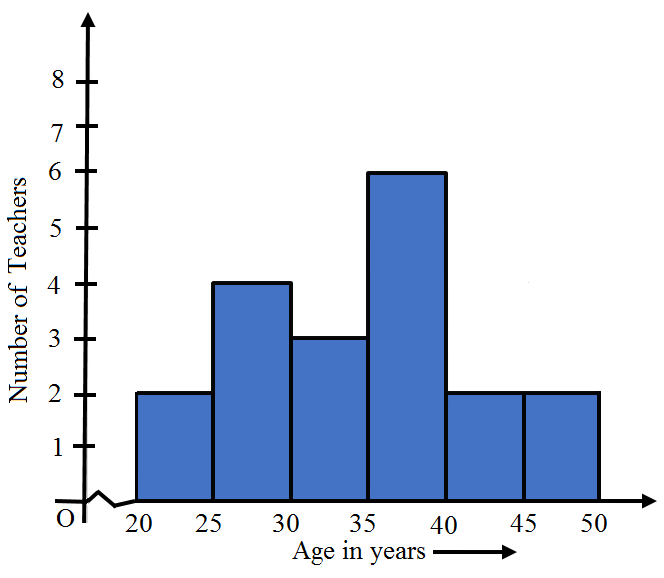
The graph given below shows the frequency distribution of the age of 22 teachers in a school. The number of teachers whose age is less than 40 years is:

  • A
    14
  • B
    15
  • C
    16
  • D
    17
Answer
  1. 15

Solution:

Add the values corresponding to the height of the bar before 40.

6 + 3 + 4 + 2 = 15

View full question & answer
MCQ 521 Mark
The range of the data 12, 25, 15, 18, 17, 20, 22, 6, 16, 11, 8, 19, 10, 30, 20, 32 is:
  • A
    26
  • B
    18
  • C
    15
  • D
    16
Answer
  1. 26

Solution:

Difference between the maximum & minimum value of the observation is called as range.

So, 32 - 6 = 26

View full question & answer
MCQ 531 Mark
Write the correct answer in the following:
The width of five continuous classes in a frequency distribution is 5 and the lower class-limit of the lowest class is 10. The upper class-limit of the highest class is:
  • A
    15
  • B
    25
  • C
    35
  • D
    40
Answer
  1. 35

Solution:

Sol. Width of each of the five continuous classes in a frequency distribution is 5.

Lower class limit of the lowest class = 10

Upper class limit of the lowest class is 10 + 5 = 15

So, the five continuous classes are

10 - 15, 15 - 20, 20 - 25, 25 - 30, 30 - 35

Hence, the upper-class limit of the height class is 35.

View full question & answer
MCQ 541 Mark
In a grouped frequency distribution, the class intervals are 0-10, 10-20, 20-30,... then the class width is:
  • A
    30
  • B
    10
  • C
    15
  • D
    20
Answer
  1. 10

Solution:

The class width is the difference between the upper- or lower-class limits of consecutive classes. In this case, class width equals to the difference between the lower limits of the first two classes.

w = 10 - 0

So, the class width is 10

View full question & answer
MCQ 551 Mark
Write the correct answer in the following:

In the class intervals 10–20, 20–30, the number 20 is included in:

  • A
    10–20
  • B
    2030
  • C
    Both the intervals.
  • D
    None of these intervals.
Answer
  1. 20–30

Solution:

The number 20 is included in 20–30.

Hence, (b) is the correct answer.

View full question & answer
MCQ 561 Mark
Let m be the mid-point and l be the upper class limit of a class in a continuous frequency distribution. The lower class limit of the class is:
  • A
    2m + I
  • B
    2I - m
  • C
    2m - I
  • D
    m - I
Answer
  1. 2m - I

Solution:

Let the lower limit = k

Mid-point = m

Upper limit = l

Mid-point $=\frac{\text{(upper limit + lower limit)}}{2}$

$\text{m}=\frac{(\text{k+l})}{2}$

$2\text{m}=\text{k}+\text{l}$

$\text{k}=2\text{m}-\text{l}$

Therefore, lower limit = 2m - l

View full question & answer
MCQ 571 Mark
To represent the more than type graphically, we plot the ________ on the x-axis.
  • A
    Class marks
  • B
    Upper limits
  • C
    Lower limits
  • D
    Class size
Answer
  1. Lower limits

Solution:

The lower limit for every class is the smallest value in that class on the other hand the upper limit for every class is the greatest value in that class. To represent ‘the more than type’ graphically, we plot the lower limits on the x-axis and cumulative frequency on the y-axis to find the median.

View full question & answer
MCQ 581 Mark
The mean of six numbers is 23. If one of the numbers is excluded, the mean of the remaining numbers becomes 20. The excluded number is:
  • A
    36
  • B
    37
  • C
    39
  • D
    38
Answer
  1. 38

Solution:

The mean of the six numbers is 23.

So the sum of six numbers is 23 × 6 = 138

After excluding one number, the mean of the remaining numbers is 20.

So the sum of five numbers is 20 × 5 = 100

The difference between them is

138 - 100 = 38

View full question & answer
MCQ 591 Mark
The number of times a particular item occurs in a given data is called its.
  • A
    Cumulative frequency.
  • B
    Variation.
  • C
    Frequency.
  • D
    Class-size.
Answer
  1. Frequency.

Solution:

The number of times a particular item occurs in a given data is called its Frequency.

View full question & answer
MCQ 601 Mark
If the mean of five observations x, x + 4, x + 6 and x + 8 is 11 then the value of x is:
  • A
    5
  • B
    6
  • C
    7
  • D
    8
Answer
  1. 7

Solution:

Mean of 5 observations = 11

$\text{Mean}=\frac{\text{Sum of all observations}}{\text{Total number of observation}}$

$\Rightarrow11=\frac{\text{x}+\text{x}+2+\text{x}+4+\text{x}+6+\text{x}+8}{5}$

$\Rightarrow11=\frac{5\text{x}+20}{5}$

$\Rightarrow55=5\text{x}+20$

$\Rightarrow5\text{x}=35$

$\Rightarrow\text{x}=7$

View full question & answer
MCQ 611 Mark
The median of the data arranged in ascending order 8, 9, 12, 18, (x + 2), (x + 4), 30, 31, 34, 39 is 24. The value of x is:
  • A
    20
  • B
    21
  • C
    24
  • D
    22
Answer
  1. 21

Solution:

The given data is in ascending order.

Here, n is 10, which is an even number. Thus, we have:

Median = mean of $\Big(\frac{\text{n}}{2}\Big)\text{th}$ and $\Big(\frac{\text{n}}{2}+1\Big)\text{th}$ observations $=\frac{1}{2}$ (5th observation + 6th observation)

$=\frac{1}{2}(\text{x}+2+\text{x}+4)=(\text{x}+3)$

= 24

Also, x + 3 = 24

⇒ x = 21

View full question & answer
MCQ 621 Mark
The mean of five observations is 15. If the mean of first three observations is 14 and that of last three is 17, then the third observation is:
  • A
    31
  • B
    18
  • C
    29
  • D
    32
Answer
  1. 18

Solution:

The mean of five observations is 15

So the sum of these five observations is 15 × 5 = 75

The mean of first three observations is 14

So the sum of the first three observations is 14 × 3 = 42

So the sum of the last two numbers is 75 - 42 = 33

The mean of the last three observations is 17.

So sum of last three observations is 17 × 3 = 51

So the middle number is 51 - 33 = 18.

View full question & answer
MCQ 631 Mark
Observe the table given below and choose the correct alternative: The class mark for R is:
Column
P
Q
R
S
T
E
Marks scored
30-40
40-50
50-60
6-70
70-80
80-90
Number if students
4
8
12
10
7
4
  • A
    50
  • B
    45
  • C
    55
  • D
    60
Answer
  1. 55

Solution:

Class mark $=\frac{\text{( upper limit + Lower limit ) }}{2}$

$=\frac{50+60}{2}$

$=\frac{110}{2}$

So class mark is 55.

View full question & answer
MCQ 641 Mark
The numbers 2, 3, 4, 4, 2x + 1, 7, 7, 8 and 9 are written in an ascending order. If the median is 7, then mode of this data is:
  • A
    8
  • B
    9
  • C
    7
  • D
    4
Answer
  1. 7

Solution:

The median is the middle score for a set of data that has been arranged in ascending or descending order of magnitude.

Since 2x + 1 is in the middle of the arranged numbers, so it is median

Hence, 2x + 1 = 7

Now since 7 occurs more number of times then other numbers so mode of the list is 7.

View full question & answer
MCQ 651 Mark
Sheila received x marks in two of her tests and y marks in three other tests. Her average score in all the five tests in terms of x and y is:
  • A
    $\frac{3\text{x}+2\text{y}}{5}$
  • B
    $\frac{2\text{x}+3\text{y}}{5}$
  • C
    $\frac{2\text{x}+3\text{y}}{2}$
  • D
    $\frac{3\text{x}+2\text{y}}{3}$
Answer
  1. $\frac{2\text{x}+3\text{y}}{5}$

Solution:

Average is equal to the sum of all the values in the data set divided by the number of values in the data set.

Average $=\frac{\text{x}+\text{x}+\text{y}+\text{y}+\text{y}}{5}$

Average $=\frac{2\text{x}+3\text{y}}{5}$

View full question & answer
MCQ 661 Mark
The mean weight ofa six boys in a group is 48kg. The individual weights of five of them are 51kg, 45kg, 49kg, 46kg and 44kg. The weight of the 6th boy is:
  • A
    52kg.
  • B
    52.8kg.
  • C
    53kg.
  • D
    47kg.
Answer
  1. 53kg.

Solution:

Let the weight of the 6th boy be x kg.

$\frac{51+45+49+46+44+\text{x}}{6}=48$

$\Rightarrow51+45+49+46+44+\text{x}=48\times6$

$\Rightarrow235+\text{x}=288$

$\Rightarrow\text{x}=53\text{kg}$

So, the weight of the 6th boy is 53kg.

View full question & answer
MCQ 671 Mark
If the mean of five observations x, x + 2, x + 4, x + 6, x + 8, is 11, then the mean of first three observations is:
  • A
    9
  • B
    11
  • C
    13
  • D
    None of these.
Answer
  1. 9

Solution:

Mean of first five observations $=\frac{\text{x}+\text{x}+2+\text{x}+4+\text{x}+6+\text{x}+8}{5}=11$

⇒ 5x + 20 = 55

⇒ x = 7

⇒ First three numbers are 7, 9, 11

$\text{Mean}=\frac{7+9+11}{3}=\frac{27}{3}=9$

View full question & answer
MCQ 681 Mark
The mean of a, b, c, d and e is 28. If the mean of a, c, and e is 24, What is the mean of b and d?
  • A
    31
  • B
    32
  • C
    33
  • D
    34
Answer
  1. 34

Solution:

$\text{Mean}=\frac{\text{a}+\text{b}+\text{c}+\text{d}+\text{e}}{5}=28$

⇒ a + b + c + d + e = 140 ...(1)

Also, $\text{Mean}=\frac{\text{a}+\text{c}+\text{e}}{3}=24$

⇒ a+ c + e = 72 ...(2)

Subtracting equation (2) from (1), we have

b + d = 68

$\text{Mean}=\frac{\text{b}+\text{d}}{2}=\frac{68}{2}=34$

View full question & answer
MCQ 691 Mark
Write the correct answer in the following:
The mean of 25 observations is 36. Out of these observations if the mean of first 13 observations is 32 and that of the last 13 observations is 40, the 13th observation is:
  • A
    23
  • B
    36
  • C
    38
  • D
    40
Answer
  1. 36

Solution:

Mean of first 13 observation = 32

$\therefore$ Sum of all first 13 observation = (32 × 13) = 416

Mean of last 13 observation = 40

$\therefore$ Sum of all last 13 observation = (40 × 13) = 520

Mean of 25 observation = 36

$\therefore$ Sum of all first 25 observation = (36 × 25) = 900

Hence, 13th observation = 416 + 520 - 900 = 36

View full question & answer
MCQ 701 Mark
If $\text{x}$ represents the mean of observations x1, x2 ...., xn, then value of $\displaystyle\sum_{\text{i=1}}^{\text{n}}\big(\text{x}_\text{i}-\text{x}\big)$ is.
  • A
    1
  • B
    n – 1
  • C
    0
  • D
    -1
Answer
  1. 0

Solution:

Since mean is equal to the sum of all the values in the data set divided by the number of values in the data set also called as average.

Hence, sum of difference of all the numbers & mean value will be zero.

View full question & answer
MCQ 711 Mark
Let $\bar{\text{x}}$ be thae mean of x1, x2, ......, xn, and $\bar{\text{y}}$ the mean of y1 , y2 , ... , yn . If $\bar{\text{z}}$ is the mean of x1 , x2 , ... , xn , y1 , y2, ... , yn, then $\bar{\text{z}}$ is equal to:
  • A
    $\bar{\text{x}}+\bar{\text{y}}$
  • B
    $\frac{\bar{\text{x}}+\bar{\text{y}}}{2}$
  • C
    $\frac{\bar{\text{x}}+\bar{\text{y}}}{\text{n}}$
  • D
    $\frac{\bar{\text{x}}+\bar{\text{y}}}{2\text{n}}$
Answer
  1. $\frac{\bar{\text{x}}+\bar{\text{y}}}{2}$

Solution:

We have $\bar{\text{x}}$ is the mean of x1, x2, ......, xn, and $\bar{\text{y}}$ is the mean of y1 , y2 , ... , yn

So, $\bar{\text{x}}=\frac{(\text{x}_1+\text{x}_2+\text{x}_3+\ ....\ +\text{x}_\text{n})}{\text{n}}$

$\Rightarrow\text{x}_1+\text{x}_2+\text{x}_3+\ .....\ +\text{x}_\text{n}=\text{n}\bar{\text{x}}$

And $\bar{\text{y}}=\frac{(\text{y}_1+\text{y}_2+\text{y}_3+\ ....\ +\text{y}_\text{n})}{\text{n}}$

$\Rightarrow\text{y}_1+\text{y}_2+\text{y}_3+\ ....\ +\text{y}_\text{n}=\text{n}\bar{\text{y}}$

If $\bar{\text{z}}$ is the mean of x1, x2, ...., y1 , y2 , ... , yn then,

$\bar{\text{z}}=\frac{\text{n}\bar{\text{x}}+\text{n}\bar{\text{y}}}{\text{n}+\text{n}}=\frac{\text{n}(\bar{\text{x}}+\bar{\text{y}})}{2\text{n}}=\frac{\bar{\text{x}}+\bar{\text{y}}}{2}$
View full question & answer
MCQ 721 Mark
If $\bar{\text{x}}$ is the mean of x1, x2, x3, ..., xn then $\sum\limits_{\text{i}=1}^\text{n}(\text{x}_\text{i}-\bar{\text{x}})=?$
  • A
    -1
  • B
    0
  • C
    1
  • D
    n - 1
Answer
  1. 0

Solution:

Given that $\bar{\text{x}}$ is the mean of x1, x2 x3, ..., xn.

$\Rightarrow\frac{\text{x}_1+\text{x}_2+\text{x}_3+_{\dots}+\text{x}_\text{n}}{\text{n}}=\bar{\text{x}}$

$\Rightarrow\text{x}_1+\text{x}_2+\text{x}_3+_{\dots}+\text{x}_\text{n}=\text{n }\bar{\text{x}}\ \dots\text{(i)}$

Consider,

$\big(\text{x}_1-\bar{\text{x}}\big)+\big(\text{x}_2-\bar{\text{x}}\big)+\big(\text{x}-\bar{\text{x}}\big)+_{\dots}+\big(\text{x}_\text{n}-\bar{\text{x}}\big)$

$=\big(\text{x}_1+\text{x}_2+\text{x}_3+_{\dots}+\text{x}_\text{n}\big)-\text{n }\bar{\text{x}}$

$=\text{n}\bar{\text{x}}-\text{n}\bar{\text{x}}\ \dots$ (from (i))

$=0$

View full question & answer
MCQ 731 Mark
The median for the digits 1, 2, 3, … 9 is:
  • A
    5
  • B
    5.5
  • C
    4
  • D
    4.5
Answer
  1. 5

Solution:

The median is the middle score for a set of data that has been arranged in ascending or descending order of magnitude.

So for numbers 1, 2, 3, ... 9

5 is the median.

View full question & answer
MCQ 741 Mark
The following is the data of wages per day : 5, 4, 7, 5, 8, 8, 8, 5, 7, 9, 5, 7, 9, 10, 8 The mode of the data is:
  • A
    7
  • B
    5
  • C
    8
  • D
    10
Answer
  1. 5
  2. 8

Solution:

In data 5, 4, 7, 5, 8, 8, 8, 5, 7, 9, 5, 7, 9, 10, 8,

We observe that values 5 and 8 both have maximum frequency i.e. 4

View full question & answer
MCQ 751 Mark
The weight of 10 students (in kg) are:
55, 40, 35, 52, 60, 38, 36, 45, 31, 44.
The median weight is.
  • A
    41kg
  • B
    42kg
  • C
    44kg
  • D
    40kg.
Answer
  1. 42kg

Solution:

Arranging the numbers in ascending order, we have:

31, 35, 36, 38, 40, 44, 45, 52, 55, 60

Here, n is 10, which is an even number. Thus, we have:

Median = Mean of $\Big(\frac{\text{n}}{2}\Big)\text{th}$ obervation & $\Big(\frac{\text{n}}{2}+1\Big)\text{th}$ obervation Median Weight = mean of the weights of $\Big(\frac{10}{2}\Big)\text{th}$ student & $\Big(\frac{10}{2}+1\Big)\text{th}$ student = mean of the weights of 5th student & 6th student$=\frac{1}{2}(40+44)=42$

Hence, the median weight is 42kg.

View full question & answer
MCQ 761 Mark
If $\bar{\text{x}}$ is the mean of x1, x2, ..., xn then for $\text{a}\neq0,$ the mean ax1, ax2, ..., axn$\frac{\text{x}_1}{\text{a}},\frac{\text{x}_2}{\text{a}},\ \dots,\frac{\text{x}_\text{n}}{\text{a}}$ is: 
  • A
    $\Big(\text{a}+\frac{1}{\text{a}}\Big)\bar{\text{x}}$
  • B
    $\Big(\text{a}+\frac{1}{\text{a}}\Big)\frac{\bar{\text{x}}}{2}$
  • C
    $\Big(\text{a}+\frac{1}{\text{a}}\Big)\frac{\bar{\text{x}}}{\text{n}}$
  • D
    $\frac{\Big(\text{a}+\frac{1}{\text{a}}\Big)\bar{\text{x}}}{2\text{n}}$
Answer
  1. $\Big(\text{a}+\frac{1}{\text{a}}\Big)\frac{\bar{\text{x}}}{2}$

Solution:

Required mean $=\frac{(\text{ax}_1+\text{ax}_2+_{\dots}+\text{ax}_\text{n})+(\frac{\text{x}_1}{\text{a}},\frac{\text{x}_2}{\text{a}},\ \dots,\frac{\text{x}_\text{n}}{\text{a}})}{2\text{n}}$

$=\frac{1}{2}\bigg[\frac{\text{a}(\text{x}_1+\text{x}_2+{\dots}+\text{x}_\text{n})}{\text{n}}+\frac{\frac{1}{2}(\text{x}_1+\text{x}_2+{\dots}+\text{x}_\text{n})}{\text{n}}\bigg]$

$=\frac{1}{2}\Big[\text{a}\bar{\text{x}}+\frac{1}{\text{a}}\bar{\text{x}}\Big]$

$=\Big[\text{a}+\frac{1}{\text{a}}\Big]\frac{\bar{\text{x}}}{2}$

View full question & answer
MCQ 771 Mark
If each observation of the data is increased by 3, then their mean:
  • A
    Becomes 3 times the original mean.
  • B
    Is increased by 3.
  • C
    Remains the same.
  • D
    Is decreased by 3.
Answer
  1. Is increased by 3.

Solution:

Since mean is equal to the sum of all the values in the data set divided by the number of values in the data set.

So increase in the value of each observation will also increase the mean (average) by 3.

View full question & answer
MCQ 781 Mark
An ogive is used to determine:
  • A
    Mode
  • B
    Mean
  • C
    Median
  • D
    None of these
Answer
  1. Median

Solution:

An ogive is used to determine how many data values lie above or below a particular value in a data set. In other words, it is used to determine the Median of a grouped data.

View full question & answer
MCQ 791 Mark
What is the upper limit of the interval: 20 - 23?
  • A
    20
  • B
    22
  • C
    23
  • D
    21.5
Answer
  1. 23

Solution:

Maximum value of an interval is called the upper limit.

View full question & answer
MCQ 801 Mark
Given the class intervals 0-10, 10-20, 20-30,… then 10 is considered in class:
  • A
    0-10
  • B
    10-20
  • C
    0-20
  • D
    10-30
Answer
  1. 10-20

Soultion:

As the classes are continuous, the upper limits do not include in that particular class.

View full question & answer
MCQ 811 Mark
If the arithmetic mean of 7, 5, 13, x and 9 is 10, then the value x is:
  • A
    10
  • B
    12
  • C
    14
  • D
    16
Answer
  1. 16

Solution:

$\text{Mean}=\frac{7+5+13+\text{x}+9}{5}=10$

$\Rightarrow34+\text{x}=50$

$\Rightarrow\text{x}=16$

View full question & answer
MCQ 821 Mark
The empirical relationship between the three measures of central tendencies is:
  • A
    3 mode = mean + 2 median
  • B
    Mode = 3 median - 2 mean
  • C
    None of these
  • D
    3 mean = median + 2 mode
Answer
  1. Mode = 3 median - 2 mean

Solution:

The empirical relationship between the three measures of central tendencies is 3 Median = Mode + 2 Mean.

The relationship is as per observation. A distribution in which the values of mean, median and mode coincide (i.e., mean = median = mode) is called symmetrical

Distribution. conversely, when the values of mean, median, mode are not equal, the distribution is called asymmetrical or skewed.

Knowing any two values, the third can be computed by this formula

3 median = 2 mean + mode

2 mean = 3 median – mode

$\text{Mean}=\frac{1}{2}(3 \text{ median - mode})$

View full question & answer
MCQ 831 Mark
In an examination, ten students scored the following marks:
60, 58, 90, 51, 47, 81, 70, 95, 87, 99. The range of this data is.
  • A
    52
  • B
    81
  • C
    51
  • D
    60
Answer
  1. 52

Solution:

Difference between the maximum and minimum value of the observation is called as range.

So, 99 - 47 = 52

View full question & answer
MCQ 841 Mark
If x1, x2, x3,.... xn are the means of n groups with n1, n2,...ni number of observations respectively, then the mean x of all the groups taken together is:
  • A
    $\displaystyle\sum_{\text{i=1}}^{\text{n}}\text{n}_\text{i}\text{x}_\text{i}$
  • B
    $\frac{\displaystyle\sum_{\text{i=1}}^{\text{n}}\text{n}_\text{i}\text{x}_\text{i}}{2\text{n}}$
  • C
    $\frac{\displaystyle\sum_{\text{i=1}}^{\text{n}}\text{n}_\text{i}\text{x}_\text{i}}{\displaystyle\sum_{\text{i=1}}^{\text{n}}\text{n}_\text{i}}$
  • D
    $\frac{\displaystyle\sum_{\text{i=1}}^{\text{n}}\text{n}_\text{i}\text{x}_\text{i}}{\text{n}^2}$
Answer
  1. $\frac{\displaystyle\sum_{\text{i=1}}^{\text{n}}\text{n}_\text{i}\text{x}_\text{i}}{\displaystyle\sum_{\text{i=1}}^{\text{n}}\text{n}_\text{i}}$

Solution:

The mean is equal to the sum of all the values in the data set divided by the number of values in the data set.

View full question & answer
MCQ 851 Mark
The class size of a distribution is 25 and the first class interval is 200-224. Then, the class marks of first two class intervals are:
  • A
    212, 262
  • B
    237, 262
  • C
    237, 287
  • D
    212, 237
Answer
  1. 212, 237

Solution:

For 1st class mark

Class mark $=\frac{\text{(upper limit +lower limit)}}{2}$

1st class mark = 212

Add the class size to get the class mark of the next class

2nd class mark = 212 + 25

2nd class mark = 237

Hence, the class mark of first two intervals are 212 and 237.

View full question & answer
MCQ 861 Mark
Find the median of the given data: 7, 8, 7, 7, 9, 10, 13.
  • A
    7
  • B
    8
  • C
    9
  • D
    10
Answer
  1. 8

Solution:

Median is the value separating the higher half of the data sample from the lower half.

Arrange the given data in ascending order.

Value of the middle term is the median of the given data sample.

7, 7, 7, 8, 9, 10, 13

Since 8 is in the centre so 8 is the median.

View full question & answer
MCQ 871 Mark
The difference between the upper and the lower class limits is called:
  • A
    Frequency.
  • B
    Mid-points.
  • C
    Class size.
  • D
    Mean.
Answer
  1. Class size.

Solution:

The difference between the upper class limit and the lower class limit is called class size.

View full question & answer
MCQ 881 Mark
The mean of first four prime numbers is:
  • A
    4.5
  • B
    3.75
  • C
    4
  • D
    4.25
Answer
  1. 4.25

Solution:

The mean is equal to the sum of all the values in the data set divided by the number of values in the data set.

The first 4 prime numbers are 2, 3, 5, 7

So, mean is $\frac{17}{4}=4.25$

View full question & answer
MCQ 891 Mark
A grouped frequency distribution table with classes of equal sizes using 105-120 (120 not included) as one of the class intervals is constructed for the following data: The number of classes in the distribution will be:
125
126
140
98
128
78
108
67
87
149
102
136
145
112
103
84
123
130
120
89
103
65
96
65
  • A
    5
  • B
    6
  • C
    4
  • D
    7
Answer
  1. 6

Solution:

Maximum value of the observation is 149 & minimum value is 65.

This range of data need to grouped into classes of equal sizes with 105-120 as one class.

Thus we need to construct classes of width 15.

Below 6 classes can be constructed

60-75, 75-90, 90-105, 105-120, 120-135, 135-150

View full question & answer
MCQ 901 Mark
The range of the data: 25, 18, 20, 22, 16, 6, 17, 15, 12, 30, 32, 10, 19, 8, 11, 20 is:
  • A
    10
  • B
    18
  • C
    15
  • D
    26
Answer
  1. 26

Solution:

Range = 32 - 6 = 26

View full question & answer
MCQ 911 Mark
Less than' cumulative frequency table for a given data is as follows. Then, the frequency of class interval 20-30 is:
Marks
Less than 10
Less than 20
Less than 300
Less than 40
Cumulative frequency
3
17
37
92
  • A
    34
  • B
    55
  • C
    14
  • D
    20
Answer
  1. 20

Solution:

A cumulative frequency distribution is the sum of the class and all classes below it in a frequency distribution.

Less than 30 has the class interval 20-30. Frequency of this class interval will be corresponding to

Marks
Cumulative Frequency
Class
Frequency
Less than 10
3
1-10
3
Less than 20
17
10-20
14
Less than 30
37
20-30
20
Less than 40
92
30-40
55

37 - 17 = 20

View full question & answer
MCQ 921 Mark
The width of each of five continuous classes in a frequency distribution is 5 and the lower-class limit of the lowest class is 10. The upper-class limit of the highest class is:
  • A
    35
  • B
    15
  • C
    40
  • D
    25
Answer
  1. 35

Solution:

The classes are 10-15, 15-20, 20-25, 25-30, 30-35 so that upper limit of the highest class is 35.

View full question & answer
MCQ 931 Mark
A data is such that its maximum value is 75 and range is 20, then the minimum value is:
  • A
    75
  • B
    20
  • C
    55
  • D
    95
Answer
  1. 55

Solution:

Difference between the maximum and minimum value of the observations is called as range.

Let, minimum value be 'x'

75 - x = 20

So, x = 55

View full question & answer
MCQ 941 Mark
Write the correct answer in the following:
The class marks of a frequency distribution are given as follows: 15, 20, 25, .... The class corresponding to the class mark 20 is:
  • A
    12.5 - 17.5
  • B
    17.5 - 22.5
  • C
    18.5 - 21.5
  • D
    19.5 - 20.5
Answer
  1. 17.5 - 22.5

Solution:

The class mark are 15, 20, 25, ….

The size of each class interval is 25 - 20 = 20 - 15 = 5

Hence, the class interval corresponding to the class mark 20 is,

(20 - 2.5) - (20 + 2.5) i.e., 17.5 - 22.5.

So, (b) is the correct answer.

View full question & answer
MCQ 951 Mark
If each observation of the data is increased by 5, then their mean.
  • A
    Remains the same.
  • B
    Is increased by 5.
  • C
    Is decreased by 5.
  • D
    Becomes 5 times the original mean.
Answer
  1. Is increased by 5

Solution:

Is increased by 5

Then old mean x old $=\frac{\displaystyle\sum_{\text{i}=1}^{\text{n}}\text{x}_{\text{i}}}{\text{n}}$

Now, adding 5 in each observation, the new mean becomes

$\overline{\text{x}}_\text{New}=\frac{(\text{x}_1+5)+(\text{x}_2+5)+....+(\text{x}_\text{n}+5)}{\text{n}}$

$\Rightarrow\overline{\text{x}}_\text{New}=\frac{(\text{x}_1 + \text{x}_2+....+\text{x}_\text{n})+5\text{n})}{\text{n}}$

$\Rightarrow\overline{\text{x}}_\text{New}=\frac{\displaystyle\sum_{\text{i}=1}^{\text{n}}\text{x}_{\text{i}}}{\text{n}}+5=\overline{\text{x }}{\text{old}}+5$

$\Rightarrow\overline{\text{x}}_\text{New}=\overline{\text{x}}_\text{old}+5$

View full question & answer
MCQ 961 Mark
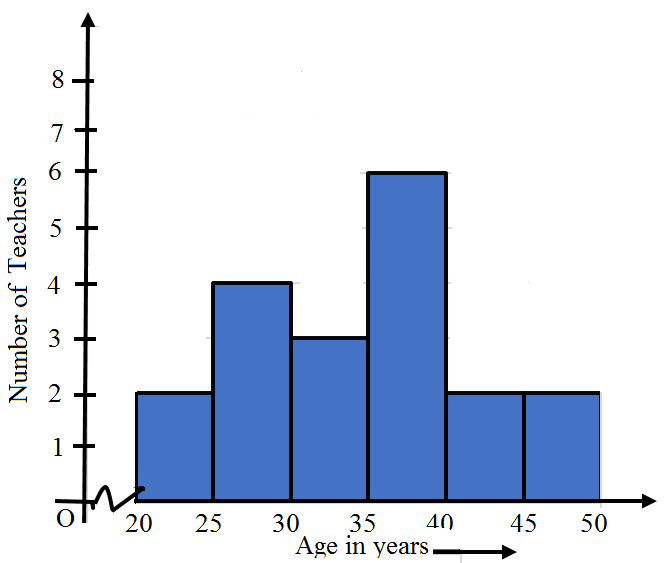
The graph given below shows the frequency distribution of the age of 22 teachers in a school. The number of teachers whose age is less than 40 years is:

  • A
    17
  • B
    16
  • C
    15
  • D
    14
Answer
  1. 15

Solution:

Add the values corresponding to the height of the bar before 40.

6 + 3 + 4 + 2 = 15.

View full question & answer
MCQ 971 Mark
The mean of prime numbers between 30 and 40 is:
  • A
    36
  • B
    34
  • C
    31
  • D
    37
Answer
  1. 34

Solution:

Prime numbers between 30 and 40 are 31 and 37.

Mean $=\frac{31+37}{2}$

Mean $=34$

View full question & answer
MCQ 981 Mark
Mean – Mode =
  • A
    3(Mode – Mean)
  • B
    3(Mean – Median)
  • C
    3(Median – Mean)
  • D
    3(Mean – Mode)
Answer
  1. 3(Mean – Median)

Solution:

Since, Mean – Mode + Mean + 2 Mode = 3 Median

⇒ Mean – Mode = 3 Median – Mean – 2 Mode

= 3 Median – Mean – 2 (3 Median – 2 Mean)

= 3 Median – Mean – 6 Median + 4 Mean

= 3 Mean – 3 Median

= 3 (Mean – Median)

View full question & answer
MCQ 991 Mark
To analyse the election results, the data is collected from a newspaper. The data thus collected is known as:
  • A
    Raw data.
  • B
    Secondary data.
  • C
    Primary data.
  • D
    Grouped data.
Answer
  1. Secondary data.

Solution:

Secondary data is the readily available data collected by someone else & published in newspapers or journals etc.

View full question & answer
MCQ 1001 Mark
Median of the following numbers: 4, 4, 5, 7, 6, 7, 7, 12, 3 is:
  • A
    7
  • B
    5
  • C
    6
  • D
    4
Answer
  1. 6

Solution:

The observations in ascending order can be written as:

3, 4, 4, 5, 6, 7, 7, 7, 12

Median $=\Big(\frac{9+1}{2}\Big)\text{th}$ term = 5th term = 6

View full question & answer
M.C.Q - Page 2 - Maths STD 9 Questions - Vidyadip