MCQ 1011 Mark
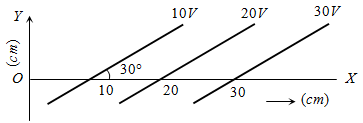
Equipotential surfaces are shown in figure. Then the electric field strength will be
- A
$100\ Vm^{–1}$ along $X-$axis
- B
$100\ Vm^{–1}$ along $Y-$axis
- ✓
$200\ Vm^{–1}$ at an angle $120^\circ$ with $X-$axis
- D
$50\ Vm^{–1}$ at an angle $120^\circ$ with $X-$axis
AnswerCorrect option: C. $200\ Vm^{–1}$ at an angle $120^\circ$ with $X-$axis
$200\ Vm^{–1}$ at an angle $120^\circ$ with $X-$axis
View full question & answer→MCQ 1021 Mark
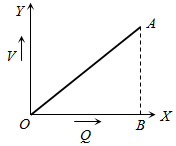
Change $Q$ on a capacitor varies with voltage $V$ as shown in the figure, where $Q$ is taken along the $X-$axis and $V$ along the $Y-$axis. The area of triangle $\text{OAB}$ represents
- A
- B
- C
Magnetic field between the plates
- ✓
Energy stored in the capacitor
AnswerCorrect option: D. Energy stored in the capacitor
Energy stored in the capacitor
View full question & answer→Question 1031 Mark
To form a composite 16Μf, 1000 V capacitor from a supply of identical capacitors marked 8 μF, 250 V we require a minimum number of capacitors(a) 40(b) 32(c) 8 (d) 2
MCQ 1041 Mark
A capacitor of capacitance $C_1 = 1mF$ can with stand maximum voltage $V_1 = 6kV ($kilo-volt$)$ and another capacitor of capacitance $C_2 = 3mF$ can withstand maximum voltage $V_2 = 4 kV.$ When the two capacitors are connected in series, the combined system can withstand a maximum voltage of
- A
$4kV$
- B
$6kV$
- ✓
$8kV$
- D
$10kV$
View full question & answer→MCQ 1051 Mark
A parallel plate capacitor is connected to a battery. The plates are pulled apart with a uniform speed. If $x$ is the separation between the plates, the time rate of change of electrostatic energy of capacitor is proportional to
- ✓
$x^{–2}$
- B
$x$
- C
$x^{–1}$
- D
$x^2$
AnswerCorrect option: A. $x^{–2}$
$x^{–2}$
View full question & answer→Question 1061 Mark
Capacitance of a capacitor made by a thin metal foil is 2μF. If the foil is folded with paper of thickness 0.15 mm, dielectric constant of paper is 2.5 and width of paper is 400 mm , then length of foil will be(a) 0.34 m(b) 1.33 m(c) 13.4 m(d) 33.9 m
MCQ 1071 Mark
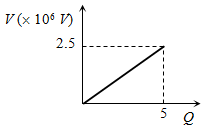
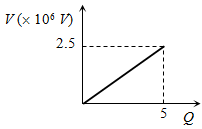
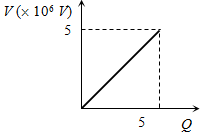
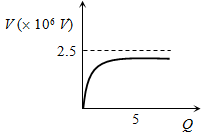
A condenser of $2\ mF$ capacitance is charged steadily from $0$ to $5$ Coulomb. Which of the following graphs correctly represents the variation of potential difference across its plates with respect to the charge on the condenser
View full question & answer→Question 1081 Mark
A dielectric slab of thickness d is inserted in a parallel plate capacitor whose negative plate is at x = 0 and positive plate is at x = 3d. The slab is equidistant from the plates. The capacitor is given some charge. As one goes from 0 to 3d(a) The magnitude of the electric field remains the same(b) The direction of the electric field remains the same(c) The electric potential increases continuously(d) b, c
Question 1091 Mark
A parallel plate air capacitor has a capacitance of 100 μμF. The plates are at a distance d apart. If a slab of thickness t( t ≤ d) and dielectric constant 5 is introduced between the parallel plates, then the capacitance will be(a) 50 μμF(b) 100 μμF(c) 200 μμF(d) 500 μμF
MCQ 1101 Mark
Four charges equal to $– Q$ are placed at the four corners of a square and a charge $q$ is at its centre. If the system is in equilibrium the value of $q$ is
- A
$\frac{Q}{4}(1+2 \sqrt{2})$
- ✓
$\frac{Q}{4}(1+2 \sqrt{2})$
- C
$-\frac{Q}{2}(1+2 \sqrt{2})$
- D
$\frac{Q}{2}(1+2 \sqrt{2})$
AnswerCorrect option: B. $\frac{Q}{4}(1+2 \sqrt{2})$
$\frac{Q}{4}(1+2 \sqrt{2})$
View full question & answer→MCQ 1111 Mark
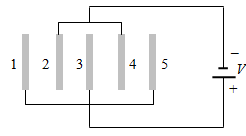
Five identical plates each of area $A$ are joined as shown in the figure. The distance between the plates is $d$. The plates are connected to a potential difference of $V$ volts. The charge on plates $1$ and $4$ will be
- A
$\frac{\varepsilon_0 A V}{d} \cdot \frac{2 \varepsilon_0 A V}{d}$
- B
$\frac{\varepsilon_0 A V}{d} \cdot \frac{2 \varepsilon_0 A V}{d}$
- ✓
$\frac{\varepsilon_0 A V}{d} \cdot \frac{-2 \varepsilon_0 A V}{d}$
- D
$\frac{-\varepsilon_0 A V}{d} \cdot \frac{-2 \varepsilon_0 A V}{d}$
AnswerCorrect option: C. $\frac{\varepsilon_0 A V}{d} \cdot \frac{-2 \varepsilon_0 A V}{d}$
$\frac{\varepsilon_0 A V}{d} \cdot \frac{-2 \varepsilon_0 A V}{d}$
View full question & answer→MCQ 1121 Mark
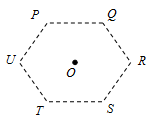
Six charges, three positive and three negative of equal magnitude are to be placed at the vertices of a regular hexagon such that the electric field at $\text{O}$ is double the electric field when only one positive charge of same magnitude is placed at $\text{R}$. Which of the following arrangements of charges is possible for $\text{P, Q, R, S, T}$ and $\text{U}$ respectively
- A
$+, -, +, -, -, +$
- B
$+, -, +, -, +, -$
- C
$+, +, -, +, -, -$
- ✓
$-, +, +, -, +, -$
AnswerCorrect option: D. $-, +, +, -, +, -$
$-, +, +, -, +, -$
View full question & answer→MCQ 1131 Mark
Two point charges $(+Q)$ and $(-2Q)$ are fixed on the $X-$axis at positions a and $2a$ from origin respectively. At what positions on the axis, the resultant electric field is zero
- A
Only $x=\sqrt{2} a$
- ✓
Only $x=-\sqrt{2} a$
- C
Both $x= \pm \sqrt{2} a$
- D
$x=\frac{3 a}{2}$ only
AnswerCorrect option: B. Only $x=-\sqrt{2} a$
Only $x=-\sqrt{2} a$
View full question & answer→MCQ 1141 Mark
A piece of cloud having area $25 \times 10^6 m^2$ and electric potential of $10^5$ volts. If the height of cloud is $0.75 \ km,$ then energy of electric field between earth and cloud will be
- A
$250 J $
- B
$750 J$
- C
$1225 J$
- ✓
$1475 J$
AnswerCorrect option: D. $1475 J$
$1475 J$
View full question & answer→MCQ 1151 Mark
Two condensers of capacities $2C$ and $C$ are joined in parallel and charged upto potential $V$. The battery is removed and the condenser of capacity $C$ is filled completely with a medium of dielectric constant $K$. The $p.d.$ across the capacitors will now be
- ✓
$\frac{3 V}{ K +2}$
- B
$\frac{3 V}{ K}$
- C
$\frac{ V }{ K +2}$
- D
$\frac{V}{ K }$
AnswerCorrect option: A. $\frac{3 V}{ K +2}$
$\frac{3 V}{ K +2}$
View full question & answer→Question 1161 Mark
A point charge of 40 stat coulomb is placed 2 cm in front of an earthed metallic plane plate of large size. Then the force of attraction on the point charge is(a) 100 dynes(b) 160 dynes(c) 1600 dynes(d) 400 dynes
Question 1171 Mark
A solid conducting sphere having a charge
Q is surrounded by an uncharged concentric conducting hollow spherical shell. Let the potential difference between the surface of the solid sphere and that of the outer surface of the hollow shell be
V. If the shell is now given a charge of –3
Q, the new potential difference between the same two surfaces is(a) V (b) 2V(c) 4V(d) – 2V
Question 1181 Mark
Assertion : The lightening conductor at the top of high building has sharp pointed ends.
Reason : The surface density of charge at sharp points is very high resulting in setting up of electric wind.(a) If both assertion and reason are true and the reason is the correct explanation of the assertion.(b) If both assertion and reason are true but reason is not the correct explanation of the assertion.(c) If assertion is true but reason is false.(d) If the assertion and reason both are false.
Answer(a) If both assertion and reason are true and the reason is the correct explanation of the assertion.
View full question & answer→MCQ 1191 Mark
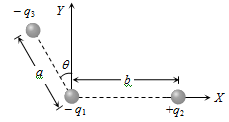
Three charges $- q_1 + q_2$ and $-q_3$ are placed as shown in the figure. The $x-$component of the force on $- q_1$ is proportional to
- A
$\frac{q_2}{b^2}-\frac{q_s}{a^2} \sin \theta$
- B
$\frac{q_2}{b^2}-\frac{q_s}{a^2} \cos \theta$
- ✓
$\frac{q_2}{b^2}+\frac{q_s}{a^2} \sin \theta$
- D
$\frac{q_2}{b^2}-\frac{q_s}{a^2} \cos \theta$
AnswerCorrect option: C. $\frac{q_2}{b^2}+\frac{q_s}{a^2} \sin \theta$
$\frac{q_2}{b^2}+\frac{q_s}{a^2} \sin \theta$
View full question & answer→MCQ 1201 Mark
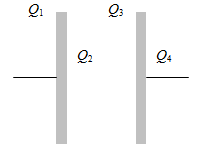
In an isolated parallel plate capacitor of capacitance $C,$ the four surface have charges $Q_1, Q_2, Q_3$ and $Q_4$ as shown. The potential difference between the plates is
AnswerCorrect option: C. $\frac{Q_2 - Q_3}{2C}$
$\frac{Q_2 - Q_3}{2C}$
View full question & answer→MCQ 1211 Mark
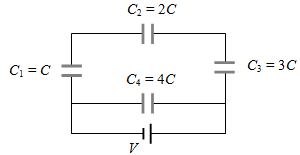
A network of four capacitors of capacity equal to $C_1=C, C_2=2 C, C_3=3 C$ and $C_4=4 C$ are conducted in a battery as shown in the figure. The ratio of the charges on $C _2$ and $C _4$ is
- A
$\frac{22}{3}$
- ✓
$\frac{3}{22}$
- C
$\frac{7}{4}$
- D
$\frac{4}{7}$
AnswerCorrect option: B. $\frac{3}{22}$
$\frac{3}{22}$
View full question & answer→MCQ 1221 Mark
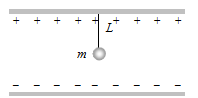
A small sphere carrying a charge $'q\ '$ is hanging in between two parallel plates by a string of length $L$. Time period of pendulum is $T_0$. When parallel plates are charged, the time period changes to $T$. The ratio $T / T_0$ is equal to
- A
$\left(\frac{g+\frac{q E}{m}}{g}\right)$
- B
$\left(\frac{g}{g+\frac{q E}{m}}\right)$
- ✓
$\left(\frac{g}{g+\frac{q E}{m}}\right)$
- D
AnswerCorrect option: C. $\left(\frac{g}{g+\frac{q E}{m}}\right)$
$\left(\frac{g}{g+\frac{q E}{m}}\right)$
View full question & answer→MCQ 1231 Mark
An electric dipole is situated in an electric field of uniform intensity $E$ whose dipole moment is $p$ and moment of inertia is $I$. If the dipole is displaced slightly from the equilibrium position, then the angular frequency of its oscillations is
- ✓
$\left(\frac{ pE }{ I }\right)^{1 / 2}$
- B
$\left(\frac{ pE }{ I }\right)^{1 / 2}$
- C
$\left(\frac{ I }{ pE }\right)^{1 / 2}$
- D
$\left(\frac{ p }{ IE }\right)^{1 / 2}$
AnswerCorrect option: A. $\left(\frac{ pE }{ I }\right)^{1 / 2}$
$\left(\frac{ pE }{ I }\right)^{1 / 2}$
View full question & answer→MCQ 1241 Mark
An elementary particle of mass $m$ and charge $+e$ is projected with velocity $v$ at a much more massive particle of charge $Ze,$ where $Z > 0$. What is the closest possible approach of the incident particle
- ✓
$\frac{ Ze ^2}{2 \pi \varepsilon_0 m v^2}$
- B
$\frac{ Ze ^2}{4 \pi \varepsilon_0 m v^2}$
- C
$\frac{ Ze ^2}{8 \pi \varepsilon_0 m v^2}$
- D
$\frac{ Ze ^2}{8 \pi \varepsilon_0 m v^2}$
AnswerCorrect option: A. $\frac{ Ze ^2}{2 \pi \varepsilon_0 m v^2}$
$\frac{ Ze ^2}{2 \pi \varepsilon_0 m v^2}$
View full question & answer→MCQ 1251 Mark
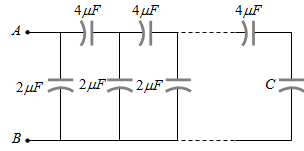
A finite ladder is constructed by connecting several sections of $2\ \mu F,4 \ \mu F$ capacitor combinations as shown in the figure. It is terminated by a capacitor of capacitance $C$. What value should be chosen for $C$ such that the equivalent capacitance of the ladder between the points $A$ and $B$ becomes independent of the number of sections in between
- ✓
$4\ \mu F$
- B
$2 \ \mu F$
- C
$18 \ \mu F$
- D
$6 \ \mu F$
AnswerCorrect option: A. $4\ \mu F$
$4\ \mu F$
View full question & answer→MCQ 1261 Mark
Two equal point charges are fixed at $x = -a$ and $x = +a$ on the x-axis. Another point charge $Q$ is placed at the origin. The Change in the electrical potential energy of $Q,$ when it is displaced by a small distance $x$ along the $x-$axis, is approximately proportional to
AnswerCorrect option: B. $x^2 $
$x^2 $
View full question & answer→MCQ 1271 Mark
The electric potential at a point $(x, y)$ in the $x - y$ plane is given by $V = -kxy$. The field intensity at a distance $r$ from the origin varies as
- A
$r^2$
- ✓
$r$
- C
$\frac{1}{r}$
- D
$\frac{1}{r^2} $
View full question & answer→MCQ 1281 Mark
A uniform electric field pointing in positive $x-$direction exists in a region. Let $A$ be the origin$, B$ be the point on the $x-$axis at $x = +1 \ cm$ and $C$ be the point on the $y-$axis at $y = +1 \ cm$. Then the potentials at the points $A, B$ and $C$ satisfy
- A
$V _{ A }< V _{ B }$
- ✓
$V _{ A }> V _{ B }$
- C
$V _{ A }< V _{ C }$
- D
$V _{ A }> V _{ C } $
AnswerCorrect option: B. $V _{ A }> V _{ B }$
$V _{ A }< V _{ C }$
View full question & answer→MCQ 1291 Mark
Consider two points $1$ and $2$ in a region outside a charged sphere. Two points are not very far away from the sphere. If $E$ and $V$ represent the electric field vector and the electric potential, which of the following is not possible
- A
$\left|\overrightarrow{ E _1}\right|=\left|\overrightarrow{ E _2}\right|, \quad V_1=V_2$
- B
$\left|\overrightarrow{ E _1}\right| \neq\left|\overrightarrow{ E _2}\right|, \quad V_1 \neq V_2$
- C
$\left|\overrightarrow{ E _1}\right| \neq\left|\overrightarrow{ E _2}\right|, \quad V_1=V_2$
- ✓
$\left|\overrightarrow{ E _1}\right|=\left|\overrightarrow{ E _2}\right|, \quad V_1 \neq V_2$
AnswerCorrect option: D. $\left|\overrightarrow{ E _1}\right|=\left|\overrightarrow{ E _2}\right|, \quad V_1 \neq V_2$
$\left|\overrightarrow{ E _1}\right|=\left|\overrightarrow{ E _2}\right|, \quad V_1 \neq V_2$
View full question & answer→MCQ 1301 Mark
Charge $q$ is uniformly distributed over a thin half ring of radius $R$. The electric field at the centre of the ring is
- ✓
$\frac{q}{2 \pi^2 \varepsilon_0 R^2}$
- B
$ \frac{q}{4 \pi^2 \varepsilon_0 R^2}$
- C
$\frac{q}{4 \pi \varepsilon_0 R^2}$
- D
$\frac{q}{2 \pi \varepsilon_0 R^2}$
AnswerCorrect option: A. $\frac{q}{2 \pi^2 \varepsilon_0 R^2}$
$\frac{q}{2 \pi^2 \varepsilon_0 R^2}$
View full question & answer→MCQ 1311 Mark
The electric field in a region is radially outward with magnitude $E = {A \gamma_0}$. The charge contained in a sphere of radius ${\gamma_0}$ centered at the origin is
- A
$\frac{1}{4 \pi \varepsilon_0} A \gamma_0{ }^3$
- ✓
$4 \pi \varepsilon_0 A \gamma_0{ }^3$
- C
$\frac{4 \pi \varepsilon_0 A}{\gamma_0} $
- D
$\frac{1}{4 \pi \varepsilon_0} \frac{A}{\gamma_0{ }^8} $
AnswerCorrect option: B. $4 \pi \varepsilon_0 A \gamma_0{ }^3$
$4 \pi \varepsilon_0 A \gamma_0{ }^3$
View full question & answer→MCQ 1321 Mark
Assertion : The force with which one plate of a parallel plate capacitor is attracted towards the other plate is equal to square of surface density per $\epsilon$ per unit area.
Reason : The electric field due to one charged plate of the capacitor at the location of the other is equal to surface density per $\epsilon$.
- A
If both assertion and reason are true and the reason is the correct explanation of the assertion.
- B
If both assertion and reason are true but reason is not the correct explanation of the assertion.
- C
If assertion is true but reason is false.
- ✓
If the assertion and reason both are false.
AnswerCorrect option: D. If the assertion and reason both are false.
If the assertion and reason both are false.
View full question & answer→MCQ 1331 Mark
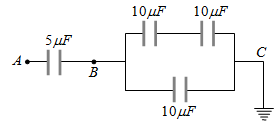
In the given circuit if point $C$ is connected to the earth and a potential of $+2000 V$ is given to the point $A,$ the potential at $B$ is
- A
$1500 V$
- B
$1000 V$
- ✓
$500 V$
- D
$400 V$
AnswerCorrect option: C. $500 V$
$500 V$
View full question & answer→MCQ 1341 Mark
The charge on $500\ cc$ of water due to protons will be
- A
$6.0 \times 10^{27}\ C$
- ✓
$2.67 \times 10^{7}\ C$
- C
$6 \times 10^{23}\ C$
- D
$1.67 \times 10^{23}\ C$
AnswerCorrect option: B. $2.67 \times 10^{7}\ C$
$2.67 \times 10^{7}\ C$
View full question & answer→MCQ 1351 Mark
A negatively charged plate has charge density of $2 \times 10^{-6}\ C/m^2$. The initial distance of an electron which is moving toward plate, cannot strike the plate, if it is having energy of $200\ eV$
- A
$1.77\ mm$
- B
$3.51\ mm.$
- ✓
$1.77 \ cm$
- D
$3.51 \ cm$
AnswerCorrect option: C. $1.77 \ cm$
$1.77\ mm$
View full question & answer→Question 1361 Mark
A non-conducting solid sphere of radius R is uniformly charged. The magnitude of the electric field due to the sphere at a distance r from its centre(a) Increases as r increases for r < R(b) Decreases as r increases for 0 < r < ∞(c) Decreases as r increases for R < r < ∞(d) a, c
MCQ 1371 Mark
An electric line of force in the xy plane is given by equation $x^2 + y^2 = 1$. A particle with unit positive charge, initially at rest at the point $x = 1, y = 0$ in the $xy$ plane
- A
- B
Will move along straight line
- ✓
Will move along the circular line of force
- D
Information is insufficient to draw any conclusion
AnswerCorrect option: C. Will move along the circular line of force
Will move along the circular line of force
View full question & answer→MCQ 1381 Mark
There is a uniform electric field of strength $10^3\ V / m$ along $y-$axis. A body of mass $1 g$ and charge $10^{-6} C$ is projected into the field from origin along the positive $x-$axis with a velocity $10\ m / s$. Its speed in $m / s$ after $10 s$ is $($Neglect gravitation$)$
- A
$10$
- B
$5^{\sqrt{2}}$
- ✓
$10^{\sqrt{2}}$
- D
$20$
AnswerCorrect option: C. $10^{\sqrt{2}}$
$10^{\sqrt{2}}$
View full question & answer→MCQ 1391 Mark
A solid metallic sphere has a charge $+3Q$. Concentric with this sphere is a conducting spherical shell having charge $-Q$. The radius of the sphere is a and that of the spherical shell is $b(b > a)$. What is the electric field at a distance $R(a < R < b)$ from the centre
- A
$\frac{Q}{2 \pi \varepsilon_0 R}$
- B
$\frac{3 Q}{2 \pi \varepsilon_0 R}$
- ✓
$\frac{3 Q}{4 \pi \varepsilon_0 R^2}$
- D
$\frac{4 Q}{4 \pi \varepsilon_0 R^2}$
AnswerCorrect option: C. $\frac{3 Q}{4 \pi \varepsilon_0 R^2}$
$\frac{3 Q}{4 \pi \varepsilon_0 R^2}$
View full question & answer→MCQ 1401 Mark
Two equal charges $q$ of opposite sign separated by a distance $2a$ constitute an electric dipole of dipole moment $p$. If $P$ is a point at a distance $r$ from the centre of the dipole and the line joining the centre of the dipole to this point makes an angle $\theta$ with the axis of the dipole, then the potential at $P$ is given by $(r >> 2a)\ ($Where $p = 2qa)$
- ✓
$V =\frac{ p \cos \theta}{4 \pi \varepsilon_0 r ^2}$
- B
$V=\frac{ p \cos \theta}{4 \pi \varepsilon_0 r }$
- C
$V=\frac{ p \sin \theta}{4 \pi \varepsilon_0 r }$
- D
$V=\frac{ p \cos \theta}{2 \pi \varepsilon_0 r ^2} $
AnswerCorrect option: A. $V =\frac{ p \cos \theta}{4 \pi \varepsilon_0 r ^2}$
$V =\frac{ p \cos \theta}{4 \pi \varepsilon_0 r ^2}$
View full question & answer→MCQ 1411 Mark
Two identical thin rings each of radius $R$ meters are coaxially placed at a distance $R$ meters apart. If $Q_1$ coulomb and $Q_2$ coulomb are respectively the charges uniformly spread on the two rings, the work done in moving a charge qfrom the centre of one ring to that of other is
- A
- ✓
$\frac{q\left(Q_1-Q_2\right)(\sqrt{2}-1)}{\sqrt{2} \cdot 4 \pi \varepsilon_0 R}$
- C
$\frac{q \sqrt{2}\left(Q_1+Q_2\right)}{4 \pi \varepsilon_0 R}$
- D
$\frac{q\left(Q_1+Q_2\right)(\sqrt{2}+1)}{\sqrt{2} \cdot 4 \pi \varepsilon_0 R}$
AnswerCorrect option: B. $\frac{q\left(Q_1-Q_2\right)(\sqrt{2}-1)}{\sqrt{2} \cdot 4 \pi \varepsilon_0 R}$
$\frac{q\left(Q_1-Q_2\right)(\sqrt{2}-1)}{\sqrt{2} \cdot 4 \pi \varepsilon_0 R}$
View full question & answer→MCQ 1421 Mark
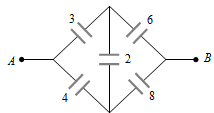
Effective capacitance between $A$ and $B$ in the figure shown is $($all capacitance are in $mF)$
- A
$21\ mF$
- B
$23\ mF$
- C
$\frac{3}{14} \mu F$
- ✓
$\frac{14}{3} \mu F$
AnswerCorrect option: D. $\frac{14}{3} \mu F$
$\frac{14}{3} \mu F$
View full question & answer→MCQ 1431 Mark
Three capacitors $2, 3$ and $6\ mF$ are joined in series with each other. What is the minimum effective capacitance
- A
$\frac{1}{2} \mu F $
- ✓
$1\ mF$
- C
$2\ mF$
- D
$3\ mF$
AnswerCorrect option: B. $1\ mF$
$1\ mF$
View full question & answer→MCQ 1441 Mark
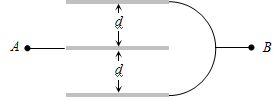
Three plates of common surface area $A$ are connected as shown. The effective capacitance will be
- A
$\frac{\varepsilon_0 A}{d}$
- B
$\frac{3 \varepsilon_0 A}{d}$
- C
$\frac{3}{2} \cdot \frac{\varepsilon_0 A}{d}$
- ✓
$\frac{2 \varepsilon_0 A}{d}$
AnswerCorrect option: D. $\frac{2 \varepsilon_0 A}{d}$
$\frac{2 \varepsilon_0 A}{d}$
View full question & answer→MCQ 1451 Mark
All six capacitors shown are identical, Each can withstand maximum $200$ volts between its terminals. The maximum voltage that can be safely applied between $A$ and $B$ is
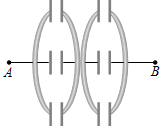
- A
$1200 V$
- ✓
$400 V$
- C
$800 V$
- D
$200 V$
AnswerCorrect option: B. $400 V$
$400 V$
View full question & answer→MCQ 1461 Mark
In the figure, three capacitors each of capacitance $6\ pF$ are connected in series. The total capacitance of the combination will be
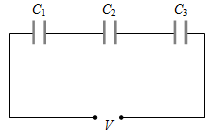
- A
$9 \times 10^{-12} F $
- B
$6 \times 10^{-12} F $
- C
$3 \times 10^{-12} F $
- ✓
$2 \times 10^{-12} F $
AnswerCorrect option: D. $2 \times 10^{-12} F $
$2 \times 10^{-12} F$
View full question & answer→MCQ 1471 Mark
Two capacitors $A$ and $B$ are connected in series with a battery as shown in the figure. When the switch $S$ is closed and the two capacitors get charged fully, then
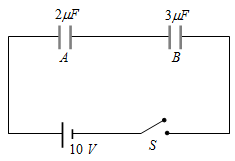
- A
The potential difference across the plates of $A$ is $4V$ and across the plates of $B$ is $6V$
- ✓
The potential difference across the plates of $A$ is $6V$ and across the plates of $B$ is $4V$
- C
The ratio of electrical energies stored in $A$ and $B$ is $2 : 3$
- D
The ratio of charges on $A$ and $B$ is $3 : 2$
AnswerCorrect option: B. The potential difference across the plates of $A$ is $6V$ and across the plates of $B$ is $4V$
The potential difference across the plates of $A$ is $6V$ and across the plates of $B$ is $4V$
View full question & answer→Question 1481 Mark
Two capacitors of capacitance 2 μF and 3μF are joined in series. Outer plate first capacitor is at 1000 volt and outer plate of second capacitor is earthed (grounded). Now the potential on inner plate of each capacitor will be(a) 700 Volt(b) 200 Volt(c) 600 Volt(d) 400 Volt
MCQ 1491 Mark
A series combination of three capacitors of capacities $1\ \mu F, 2\ \mu F$ and $8\ \mu F$ is connected to a battery of $\text{e.m.f.}\ 13$ volt. The potential difference across the plates of $2\ \mu F$ capacitor will be
- A
$1 V$
- B
$8V$
- ✓
$4V$
- D
$\frac{13}{3} V $
View full question & answer→MCQ 1501 Mark
An ellipsoidal cavity is carved within a perfect conductor. A positive charge $q$ is placed at the centre of the cavity. The points $A$ and $B$ are on the cavity surface as shown in the figure. Then
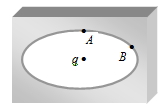
- A
Potential at $A =$ Potential at $B$
- B
Total electric field flux through the surface of the cavity is $q/ \varepsilon_0$
- C
Electric field near $A$ in the cavity $=$ Electric field near $B$ in the cavity
- ✓
$a, b$
AnswerCorrect option: D. $a, b$
$a, b$
View full question & answer→