Questions · Page 2 of 5

M.C.Q

Question 511 Mark
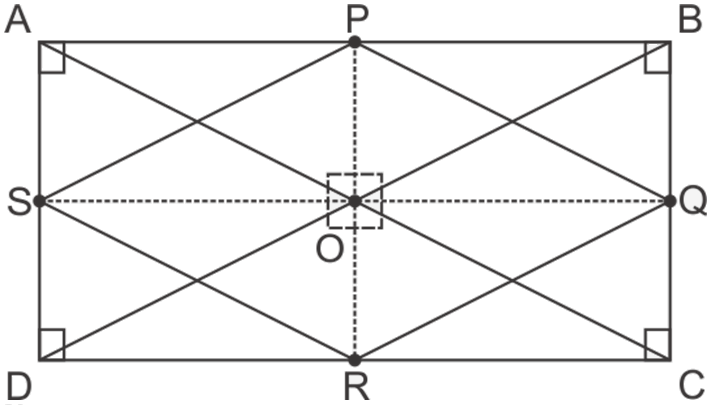
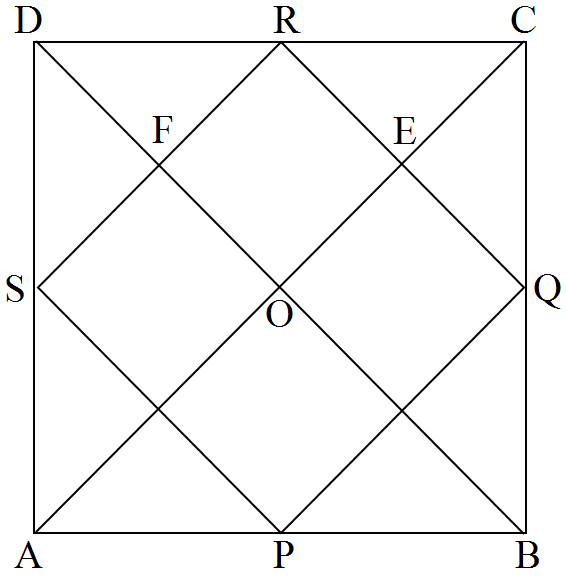
The figure formed by joining the mid-points of the sides of a quadrilateral ABCD, taken in order, is a square only if:
Answer
  1. Diagonals of ABCD are equal and perpendicular.
    Solution:
    A quadrilateral formed by joining the mid points of a square is a square. So, ABCD is a square. In Square, diagonals are equal and perpendicular.
View full question & answer
Question 531 Mark
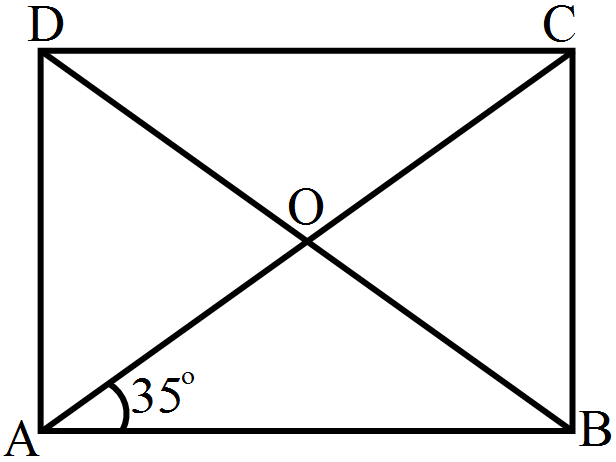
A diagonal of a rectangle is inclined to one side of the rectangle at 35º. The acute angle between the diagonals is:
Answer
  1. 70º
    Solution:
    $\angle\text{OAD} = 90^\circ - (\angle\text{OAB})$
    $= 90^\circ - 35^\circ = 55^\circ.$
    Now, $\angle\text{ODA} = \angle\text{OAD} = 55^\circ$ [$∵$ OA = OD since diagonals of a rectangles are equal and bisect each other].
    $\angle\text{AOD} = 180^\circ - (\angle\text{OAD} + \angle\text{ODA})$
    $= 180^\circ - (55^\circ + 55^\circ) = 70^\circ.$
View full question & answer
Question 541 Mark
If the diagonals of a quadrilateral bisect each other at right angles then the figure is a:
Answer
  1. Rhombus
    Solution:
    Rhombus is the correct answer. As we know that from all the quadrilaterals given in other options the diagonals of rhombus bisect each other at right angles.
View full question & answer
Question 551 Mark
If the degree measures of the angles of quadrilateral are 4x, 7x, 9x and 10x, what is the sum of the measures of the smallest angle and largest angle?
Answer
  1. 168º
    Solution:
    Given,
    ABCD is a parallelogram,
    Angles of quadrilateral 4x, 7x, 9x, 10x
    ⇒ 4x + 7x + 9x + 10x = 360° [angle sum property of quadrilateral]
    ⇒ 30x = 360°
    $\Rightarrow\text{x}=\frac{360^\circ}{30}=12^\circ$
    Hence, sum of smallest and largest angles = 4x + 10x = 4 × 12º + 10 × 12º
    = 48º + 120º = 168º
View full question & answer
Question 561 Mark
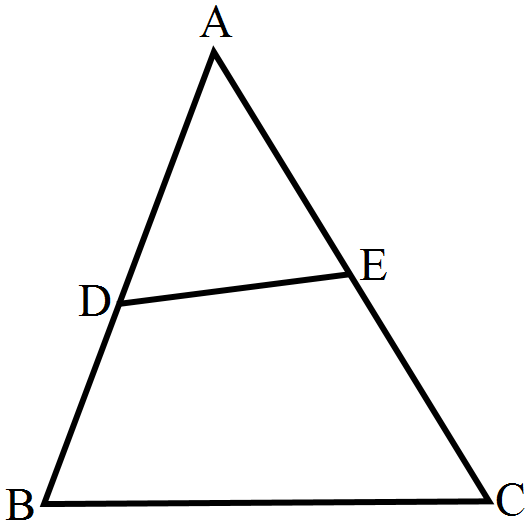
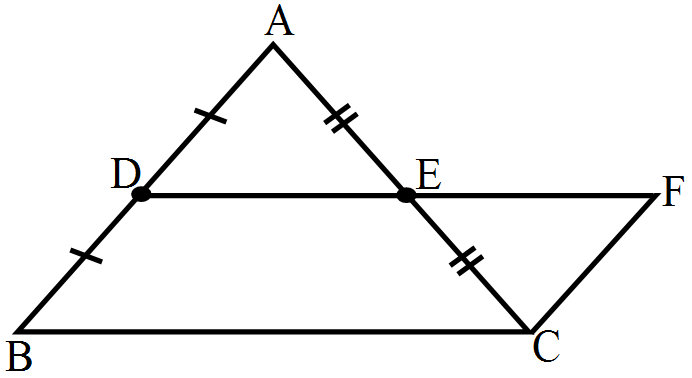
E Divides AB in the ratio 1 : 3 and also, F divides AC in the ratio 1 : 3. EF = 2.8cm, Find BC = ?
Answer
  1. 11.2cm
    Solution:
    Let AE = x and EB = 3x, AF = y and FC = 3y.
    EF = 2.8cm
    AE + AF = 2.8 implies x + y = 2.8
    BC = CF + FA + AE + EB
    = 3y + y + x + 3x
    = 4(x + y) = 4(2.8) = 11.2cm
View full question & answer
Question 571 Mark
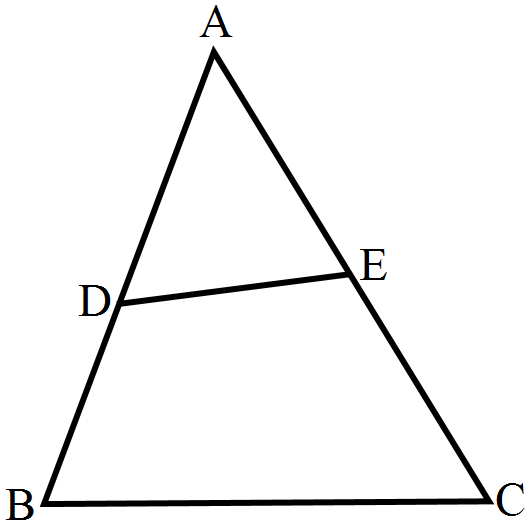
The Parallel sides of a trapezium are ‘a’ and ‘b’ resp. The line joining the mid-points of its non-parallel sides will be.
Answer
  1. $\frac{1}{2}(\text{a+b})$
    Solution:
    Join one of the diagonals which intersects the line joining mid points of the non parallel sides. This point of intersection become midpoint of the diagonal by using converse of midpoint theorem and we know that by mid point theorem that the line joining midpoints of any two sides of triangle measures half of the third side.so, by combining the results of two triangles we get above result.
View full question & answer
Question 581 Mark
The angles of a quadrilateral are in the ratio 3 : 4 : 5 : 6. The smallest of these angles is:
Answer
  1. 60°
    Solution:
    Let tha common multipal be x.
    $\therefore$ The angle measure 3x, 4x, 5x and 6x.
    Since the sum of the angles of a quadrilateral being 360°, we have
    3x + 4x + 5x + 6x = 360°
    ⇒18x = 360°
    ⇒ x = 20°
    $\therefore$ The angles of the quadrilateral are
    3x = 3(20) = 60°,
    4x = 4(20) = 80°,
    5x = 5(20)= 100°,
    6x = 6(20) = 120°,
    $\therefore$ The smallest angle is 60°.
View full question & answer
Question 591 Mark
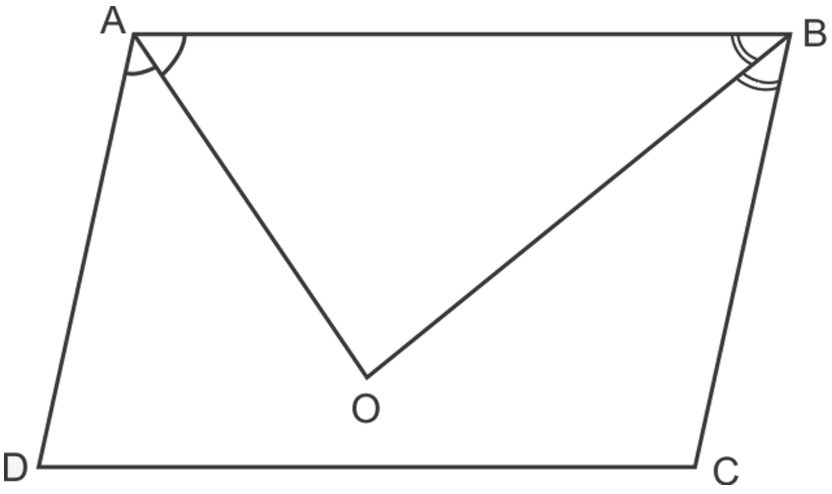
The bisectors of any two adjacent angles of a parallelogram intersect at:
View full question & answer
Question 611 Mark
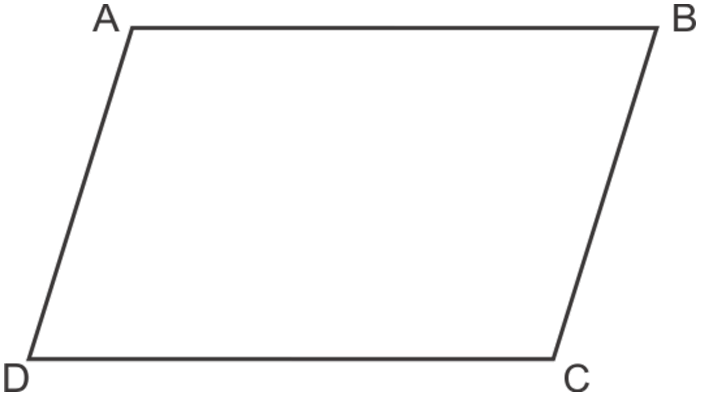
If one angle of a parallelogram is $24^\circ$ less than twice the smallest angle, then the measure of the largest angle of the largest angle of the parallelogram is:
Answer

Let the smallest angle $=\angle\text{ADC}=\text{x}^\circ$
Other angle $\angle\text{BCD}$
$\Rightarrow\angle\text{BCD}=2\text{x}^\circ-24^\circ$
Also, $\angle\text{ACD}+\angle\text{BCD}=180^\circ ($Sum of adjacent angles in $||$gram $= 180°)$
$\Rightarrow\text{x}^\circ+2\text{x}^\circ-24^\circ=180^\circ$
$\Rightarrow3\text{x}^\circ=204^\circ$
$\Rightarrow\text{x}=68^\circ$
⇒ Largest angle $=\angle\text{BCD}=2\times68^\circ-24^\circ=112^\circ$
View full question & answer
Question 621 Mark
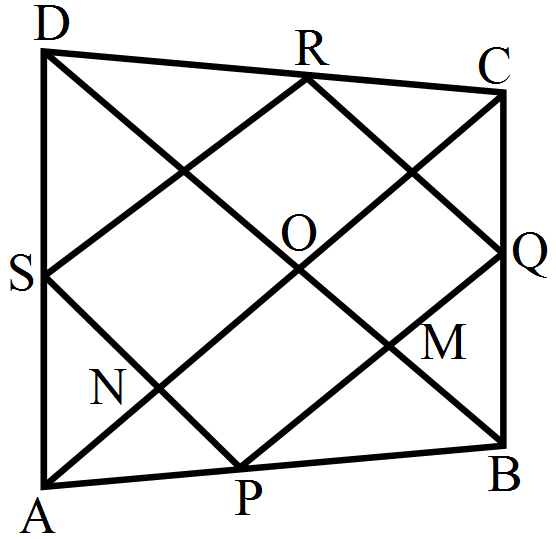
The quadrilateral formed by joining the midpoints of the sides of a quadrilateral ABCD, taken in order, is a rectangle, if:
View full question & answer
Question 631 Mark
If one angle of a parallelogram is 24° less than twice the smallest angle, then the largest angle of the parallelogram is:
Answer
  1. 112°
    Solution:
    Let the smallest angle be x°
    ⇒ its adjacent angle = (2x - 24)
    Since sum of the adjacent angles = 180°
    ⇒ x + 2x - 24 = 180
    ⇒ 3x = 204
    ⇒ x = 68°
    So, its adjacent angle = 2(68) - 24 = 136 - 24 = 112°.
    Hence, the largest angle of the parallelogram is 112°.
View full question & answer
Question 641 Mark
Which of the following is not true for the Parallelogram?
Answer
  1. Opposite angles are bisected by the diagonals.
    Solution:
    If opposite angles are bisected by diagonals in parallelogram, all four bisected angles become equal which leads to equal adjacent side. That is not true in case of parallelogram.
View full question & answer
Question 651 Mark
A diagonal of a parallelogram divides it into:
Answer
  1. Two congruent triangles.
    Solution:
    By SSS congruence condition, opposite sides are equal and common diagonal.
View full question & answer
Question 661 Mark
If ABCD is a Parallelogram with 2 Adjacent angles $\angle\text{A}=\angle\text{B},$ then the parallelogram is a:
Answer
  1. Rectangle
    Solution:
    The sum of the adjacent angles of a parallelogram is 180º. Opposite sides of a parallelogram are equal. Hence it is a rectangle.
View full question & answer
Question 671 Mark
A diagonal of a rectangle is inclined to one side of the rectangle at 35°. The acute angle between the diagonals is:
View full question & answer
Question 691 Mark
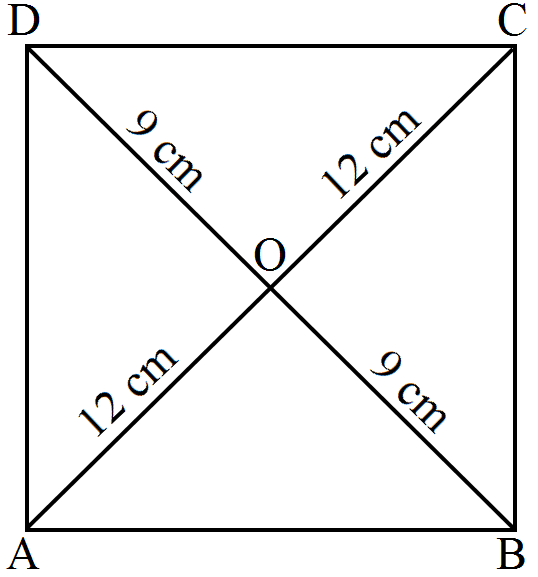
If the diagonals of a rhombus are $18\ cm$ and $24\ cm$ respectively, then its side is equal to:
Answer
Given,
$\text{ABCD}$ is a rhombus

$AC = 24\ cm, BD = 18\ cm$
$AB = BC = CD = DA \ [$side of rhombus$]$
We know that diagonals of rhombus bisect each other at $90^\circ .$
In right $\triangle\text{AOB}$
$AB^2 = BO^2 + AO^2$
$AB^2 = 122 + 92 = 144 + 81 = 225$
$\text{AB} = \sqrt{225}$
$= 15\ cm$
Side of rhombus $= 15\ cm$
View full question & answer
Question 701 Mark
Digonals necessarily bisect opposite angles in a:
Answer
  1. Square.
    Solution:
    Diagonals necessarily bisect opposite angles in a square.
View full question & answer
Question 711 Mark
The figure formed by joining the mid-points of the adjacent sides of a parallelogram is a:
Answer
  1. Parallelogram.
    Solution:
    The figure formed by joining the mid points of the adjacent sides of a parallelogram is a parallelogram.
View full question & answer
Question 721 Mark
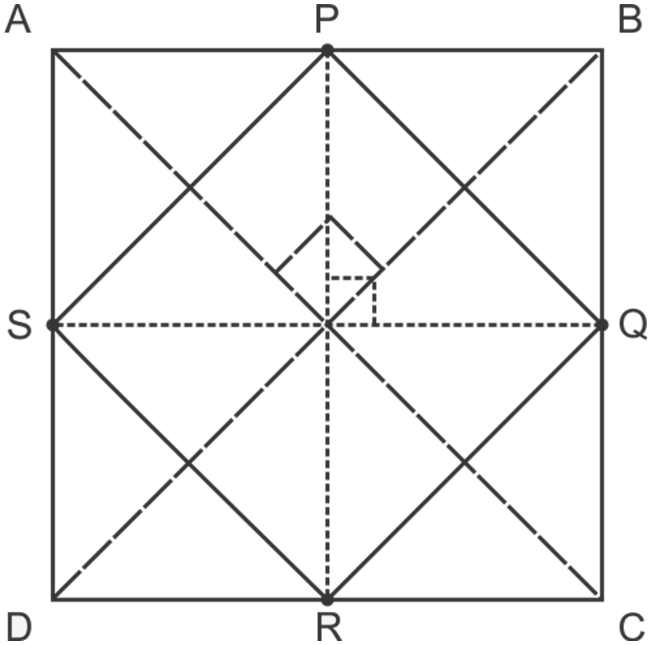
The figure formed by joining the mid-points of the adjacent sides of a Square is a:
View full question & answer
Question 751 Mark
The area of a quadrilateral whose diagonals measure $48m$ and $32m$ respectively and bisect each other at right angles is:
Answer
According to the question,
$\text{Area of given quadrilateral}=\frac{1}{2}\times\text{Product of diagonals}$
$=\frac{1}{2}\times48\times32$
$=768\text{m}^2$
View full question & answer
Question 761 Mark
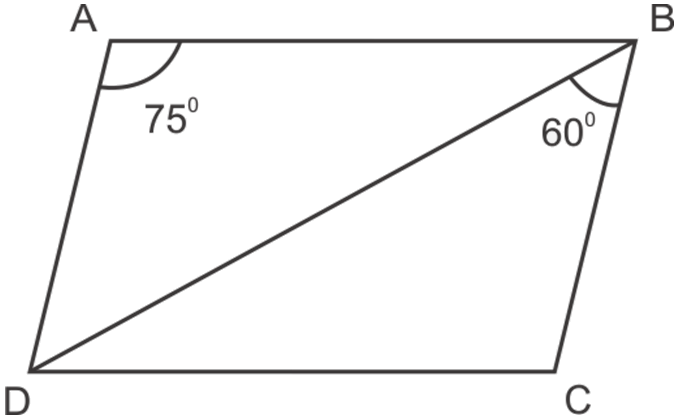
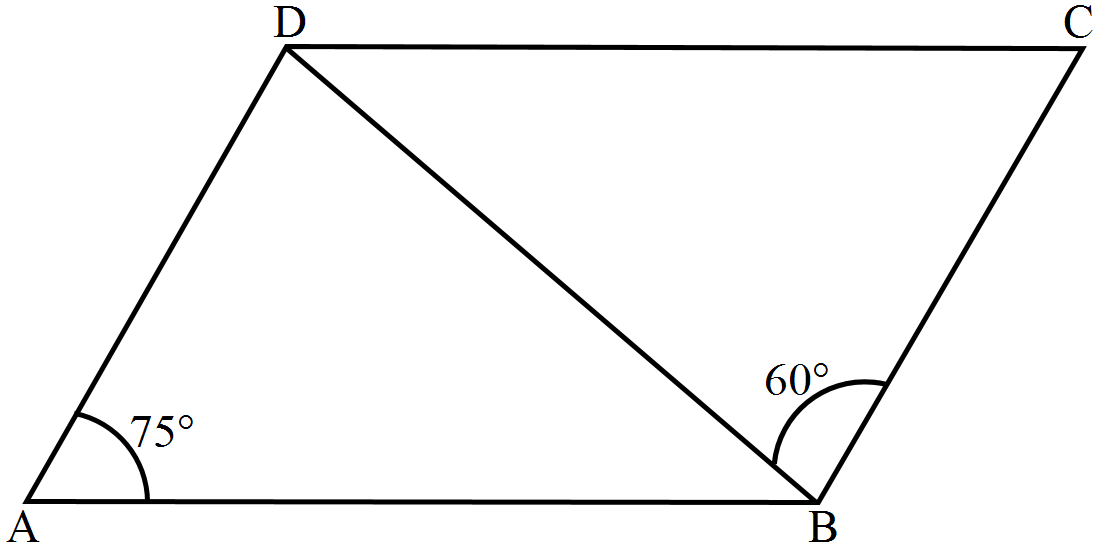
In a parallelogram ABCD, if $\text{DAB} = 75^\circ$ and $\angle\text{DBC} = 60^\circ,$ then $\angle\text{BDC} =\ ?$
View full question & answer
Question 771 Mark
Consecutive angles of a Parallelogram are:
Answer
  1. Supplementary
    Solution:
    In parallelogram, both pair of opposite sides are parallel. So, consecutive angles form a pair of co-interior angles. Co-interior angles add up to 180. It means they are supplementary.
View full question & answer
Question 781 Mark
The Diagonals AC and BO of a Parallelogram ABCD intersect each other at the point O such that $\angle\text{DAC} = 30^\circ$ and $\angle\text{AOB} = 70^\circ.$ Then $\angle\text{DBC}?$
Answer
  1. 40º
    Solution:
    $\angle\text{DAC} = \angle\text{ACB} = 30$ (alternate angles)
    $\angle\text{BOA} = \angle\text{BOC} = 180$ (linear pair)
    $\angle\text{BOC}= 180 - 70 = 110$
    In $\triangle\text{BOC}, \ \angle\text{BOC} + \angle\text{OCB} + \angle\text{CBO} = 180$ (angle sum property)
    $110 + 30 + \angle\text{CBO} = 180$
    $\angle\text{CBO} = 180 - 140 =40$
    $\Rightarrow \angle\text{DBC}=40^\circ$
View full question & answer
Question 791 Mark
The figure forms by joining the mid-points of the sides of a Rhombus, taken in order are:
Answer
  1. A Rectangle
    Solution:
    In rhombus, diagonals bisect each other at right angles. Which proves that all the angles of quadrilateral formed by joining the mid points of rhombus is equal to 90. A quadrilateral with both pair of opposite angles equal is a parallelogram.
    A parallelogram having one right angle is a rectangle.
View full question & answer
Question 801 Mark
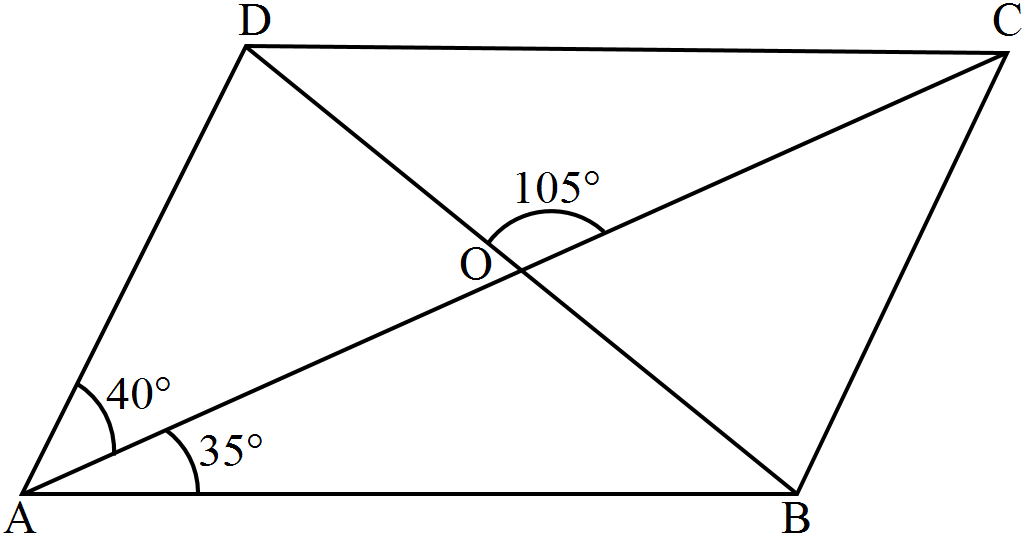
ABCD is a Parallelogram in which $\angle\text{BAO}=35^\circ, \ \angle\text{DAO}=40^\circ$ and $\angle\text{COD}=105^\circ.$ Find $\angle\text{ABO}=\ ?$
View full question & answer
Question 811 Mark
PQRS is a quadrilateral. PR and QS intersect each other at O. In which of the following cases, PQRS is a parallelogram?
Answer
  1. $\angle\text{P} = 100^\circ, \angle\text{Q} = 80^\circ, \angle\text{R} = 100^\circ$
    Solution:
    $\angle\text{P} = 100^\circ, \angle\text{Q} = 80^\circ, \angle\text{R} = 100^\circ$
    Since, sum of all the internal angles of a quadrilateral is 360, we have
    $\angle\text{P} + \angle\text{Q} + \angle\text{R} + \angle\text{S} = 360$
    $⇒ 100 + 80 + 100 + \angle\text{S} = 360$
    $⇒ 280 + \angle\text{S} = 360$
    $⇒ \angle\text{S} = 80$
    So, it follows that opposite angles of the quadrilateral are equal.
    Hence it is a parallelogram.
View full question & answer
Question 821 Mark
ABCD is a Rectangle, diagonals AC and BD intersect each other at P. If $\angle\text{APD} = 52^\circ,$ find $\angle\text{ACB}$ and $\angle\text{DBA}=\ ?$
Answer
  1. 64º and 26º
    Solution:
    In Rectangle, diagonals are equal and bisect each other.
    In $\triangle\text{APD, AP = PD}$
    $⇒ \angle\text{ADP} = \angle\text{PAD} = \text{x}$ (angle opposite to equal sides are equal)
    In $\triangle\text{APD}, \angle\text{APD} + \angle\text{PDA} + \angle\text{DAP} = 180^\circ$ (angle sum property)
    $52^\circ + \text{x} + \text{x} = 180^\circ$
    $2\text{x} = 180^\circ - 52^\circ = 128^\circ$
    $\text{x} = 64^\circ$
    $\angle\text{DAC} = \angle\text{BCA} = 64^\circ$ (alternate angles)
    In $\triangle\text{ADB}, \angle\text{ADB} + \angle\text{DBA} + \angle\text{BAD} = 180^\circ$ (angle sum property)
    $64^\circ + \angle\text{DBA} + 90^\circ = 180^\circ$
    $\angle\text{DBA} = 180^\circ - 154^\circ = 26^\circ$
View full question & answer
Question 831 Mark
Write the correct answer in the following:
If angles A, B, C and D of the quadrilateral ABCD, taken in order, are in the ratio 3 : 7 : 6 : 4, then ABCD is a:
View full question & answer
Question 841 Mark
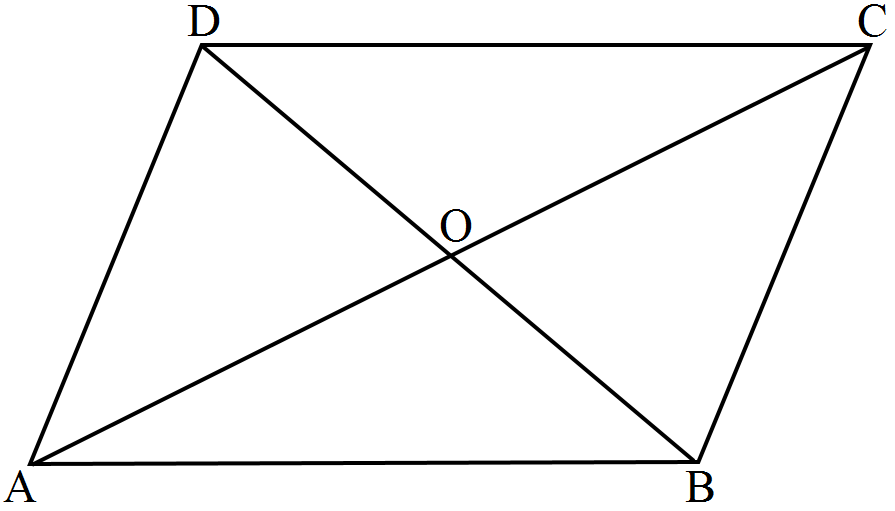
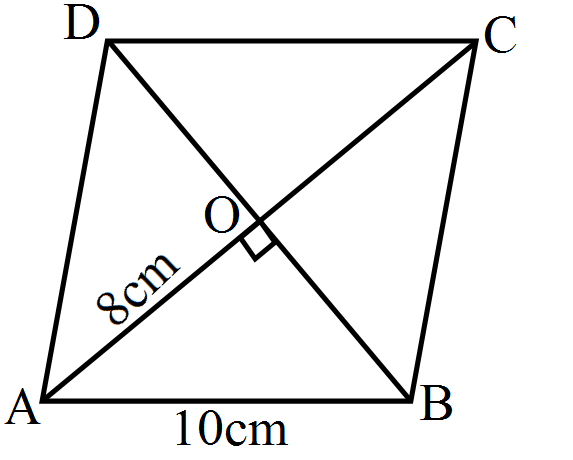
In the given figure$, \text{ABCD}$ is a Rhombus. Then,
Answer
$\text{ABCD}$ is a rhombus.
$AB = BC = CD = DA$
In Rhombus, diagonals bisect each other at right angles.
So$, AO = CO$ and $BO = DO$
In triangle $AOB, AO^2 + BO^2 = AB^2 ($Pythagoras theorem$)$
$\Big(\frac{1}{2} \text{AC}\Big)^2 + \Big(\frac{1}{2} \text{BD}\Big)^2 = \text{AB}^2$
$\frac{\text{AC}^2}{4} + \frac{\text{BD}^2}{4} = \text{AB}^2$
$\text{AC}^2 + \text{BD}^2 = 4\text{AB}^2$
View full question & answer
Question 851 Mark
The length of each side of a rhombus is 10cm and one if its diagonals is of length 16cm. The length of the other diagonal is:
View full question & answer
Question 871 Mark
If area of a || gm with sides a and b is A and that of a rectangle with sides a and b is B, then:
Answer
  1. A < B
    Solution:
    Let h be the heigth of the parallelogram.
    Then, h < b.
    We konw that, area of a parallelogram = base × height
    If a is the base of the parallelogram, then area of a parallelogram = a × h
    ⇒ A = a × h
    We know that, area of a rectangle = length × breadth
    ⇒ A = a × b
    So, a × h < a × b
    Hence, A < B.
View full question & answer
Question 881 Mark
Given 4 points A, B, C, D such that 3 Points A, B, C are collinear. By joining these points in order, we get
Answer
  1. A Triangle
    Solution:
    If three or more points lie on same line then they are called collinear points. A, B and C are collinear means they form a line. Point D is outside the line. Point D can be join with the end points of the line formed by points A, B, and C. For this we need total three lines to form a closed figure. A closed figure with three sides is called triangle.
View full question & answer
Question 901 Mark
Three angles of a quadrilateral are 75º, 90º and 75º. The fourth angle is:
Answer
  1. 120º
    Solution:
    We know that The sum of angles of quad = 360º
    4th angle = 360º - (75º + 90º + 75º)
    = 360º - 240º
    = 120º
View full question & answer
Question 911 Mark
Two parallelograms stand on same base and between the same parallels. The ratio of their areas is:
Answer
  1. 1 : 1
    Solution:
    Parallelograms on the same base and between the same parallels are equal in area. Hence the ration of two parallelograms will be 1 : 1.
View full question & answer
Question 921 Mark
If the degree measures of the angles of quadrilateral are 4x, 7x, 9x and 10, what is the sum of the measures of the smallest angle and largest angle?
Answer
  1. 168°
    Solution:
    Sum of all angles of a Quadrilateral = 360°
    4x + 7x + 9x + 10x = 360°
    30x = 360°
    x = 12°
    So, sum of smallest and largest angle,
    i.e. 4x + 10x = 14x = 14 × 12 = 168°
View full question & answer
Question 931 Mark
Write the correct answer in the following:
The figure obtained by joining the mid-points of the sides of a rhombus, taken in order, is:
Answer
  1. A rectangle.
    Solution:
    The figure will be a rectangle.
    Hence, (b) is the correct answer.
View full question & answer
Question 941 Mark
The length of each side of a rhombus is 10cm and one of its diagonal is of length 16cm. The Length of the other Diagonal is:
Answer
  1. 12cm
    Solution:
    Use pythagoras theorem in right triangle,
    $102 -\Big[\frac{16}{2}\Big]^2 = 100 - 64 = 36 = [6]^2$
    Hence, the other diagonal = 6 × 2 = 12cm
View full question & answer
Question 961 Mark
One Angle of a quadrilateral is of 108º and the remaining three angles are equal. Find each of the three equal angles.
Answer
  1. 84º, 84º, 84º
    Solution:
    Let ABCD be a quadrilateral with $\angle\text{A} = 108^\circ$ and $\angle\text{B} = \angle\text{C} = \angle\text{D} = \text{x}$
    $\angle\text{A} + \angle\text{B} + \angle\text{C} + \angle\text{D} = 360^\circ$ (angle sum property)
    108º + x + x + x = 360º
    3x = 360º - 108º
    3x = 252º
    x = 84º
View full question & answer
Question 971 Mark
Three angles of a quadrilateral are in the ratio 3 : 4 : 5 : 6. The smallest of these angles is:
Answer
  1. 60º
    Solution:
    Let the angles be 3x, 4x, 5x and 6x
    3x + 4x + 5x + 6x = 360º (Sum of angles of a quadrilateral)
    18x = 360º
    $\text{x}=\frac{360}{18}$
    x = 20º
    $∴$ Angles of the quadrilateral are: 3x = 3 × 20º = 60º
    4x = 4 × 20º = 80º
    5x = 5 × 20º = 100º
    6x = 6 × 20º = 120º
    Hence, the smallest angle is 60º.
View full question & answer
Question 981 Mark
If the diagonals of a quadrilateral bisect each other, and opposite sides are parallel and equal, then the quadrilateral must be.
Answer
  1. Parallelogram
    Solution:
    By theorm diagonals of quadrilateral bisect each other if and only if it is a parallelogram.For a quadrilateral to be parallelogram some other properties are required: Opposite sides are equal and parallel. Opposite angles are equal. Sum of any adjacent angles is 180.
View full question & answer
Question 991 Mark
The figure formed by joining the mid-points of the adjacent sides of a square is a:
View full question & answer
Question 1001 Mark
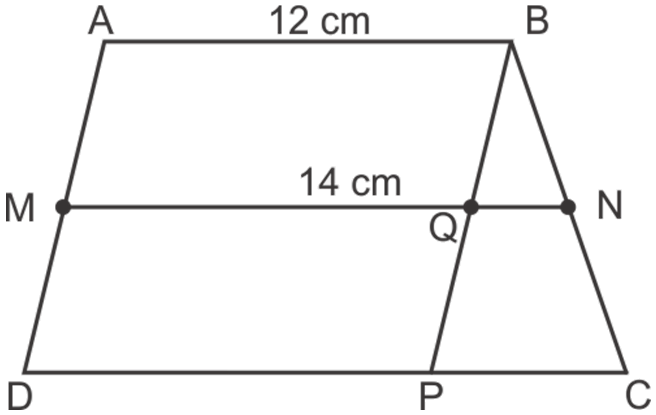
ABCD is a trpezium in which AB || DC. M and N are then mid-points of AD and BC respectively. If AB = 12cm, MN = 14cm, then CD =
View full question & answer
M.C.Q - Page 2 - MATHS STD 9 Questions - Vidyadip