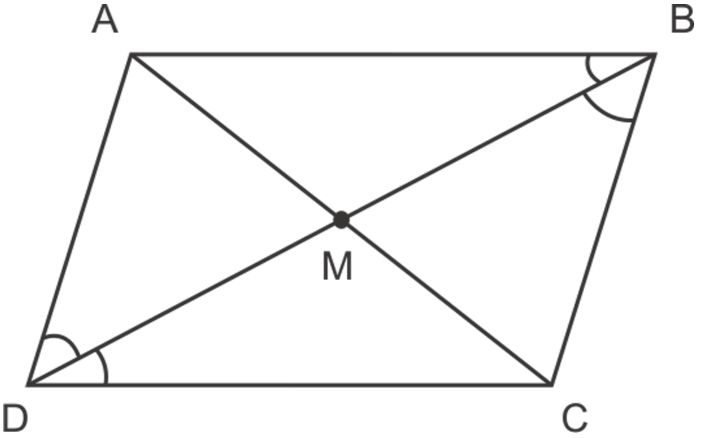
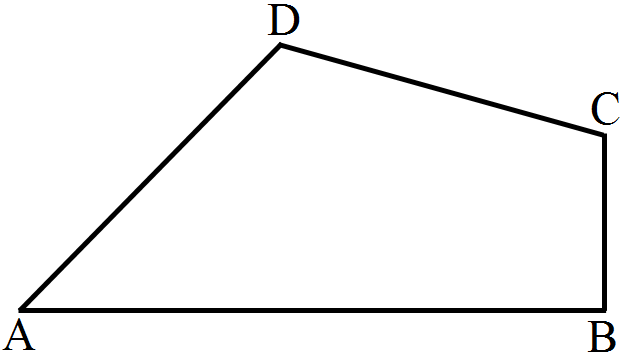
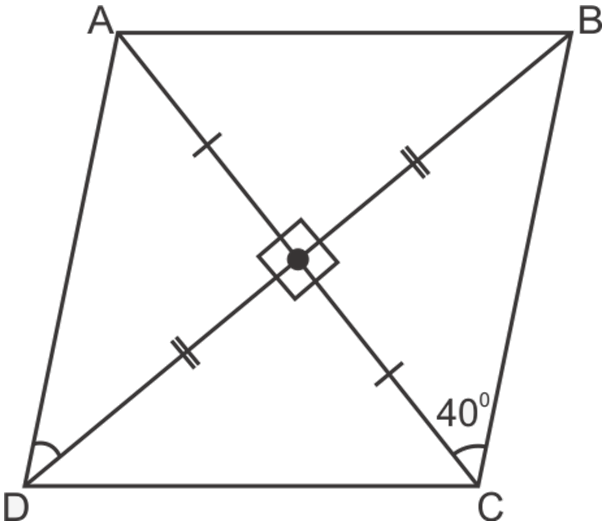
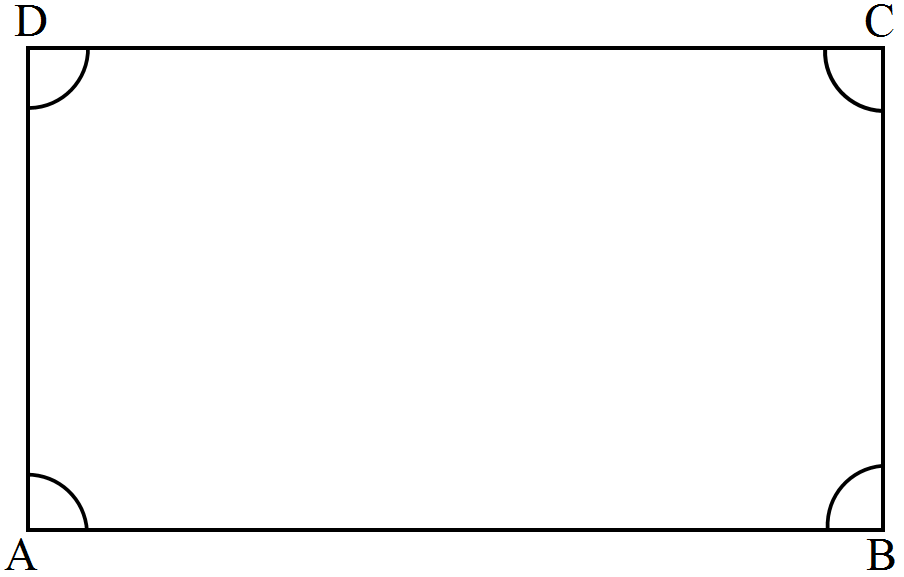
In each of the questions one question is followed by two statements I and II. Choose the correct option. Is quadrilateral ABCD a parallelogram?
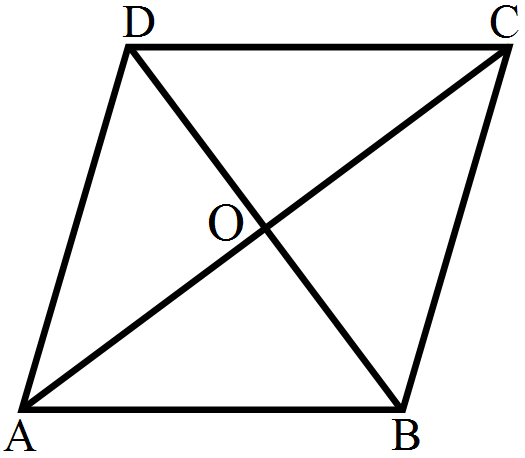
Diagonals AC and BD bisect each other.
Diagonals AC and BD are equal.
Answer
If the question can be answered by one of the given statements alone and not by the other. Solution: Here, as we know that if the diagonals of a quadrilateral bisects each other, then it is a parallelogram. But as per II, if the diagonals of a quadrilateral are equal, then it is not necessarily a parallelogram which is not true. Thus, II does not give the answer. So the question can be answered by the one of the given statement alone and not by the other.
The angle between two altitudes of a Parallelogram through the vertex of an obtuse angle of the Parallelogram of 60º. Find the angles of the Parallelogram?
Answer
120º, 60º, 120º, 60º Solution: Let ABCD be a parallelogram and AP and CQ are the altitudes drawn from vertex A on sides DC and BC. In quadrilateral APCQ, sum of the all angles= 360º So, $60^\circ + 90^\circ + \angle\text{C} + 90^\circ = 360^\circ$ $\angle\text{C} = 360^\circ - 240^\circ = 120^\circ$ $\angle\text{C} + \angle\text{B} = 180^\circ$ (co-interior angles) $\angle\text{B} = 180^\circ - 120^\circ = 60^\circ$ In parallelogram, opposite angles are equal. So, $\angle\text{A} = \angle\text{C} = 120^\circ$ and $\angle\text{B} = \angle\text{D} = 60^\circ$
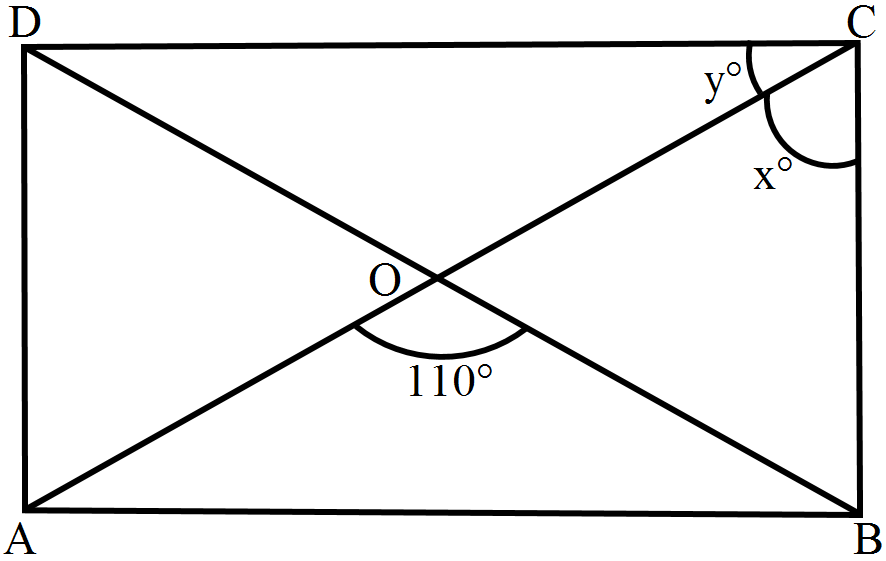
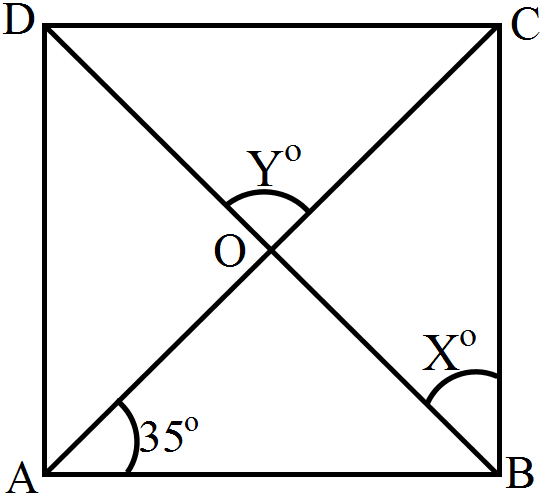
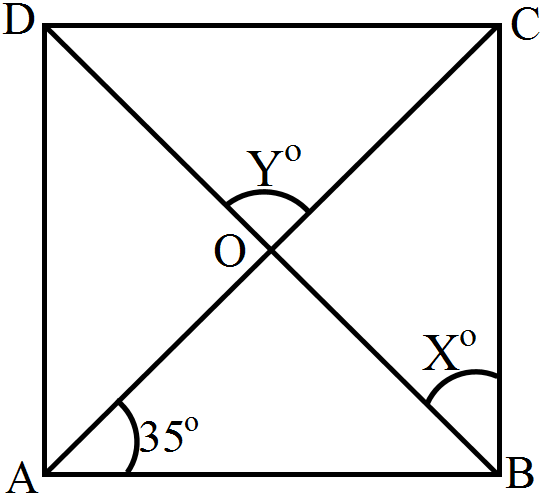
x = 55º and y = 110º Solution: ABCO is a rectangle The diagonals of a rectangle are congruent and bisect each other. Therefore, in $\triangle\text{AOB},$ we have: OA = OB $\angle\text{OAB} = \angle\text{OBA} = 35^\circ$ $\text{x} = 90^\circ - 35^\circ = 55^\circ$ and $\angle\text{AOB} = 180^\circ - (35^\circ + 35^\circ) = 110^\circ$ $\text{y} = \angle\text{AOB} = 110^\circ$ [Vertically opposite angles] Hence, x = 55° and y = 110°
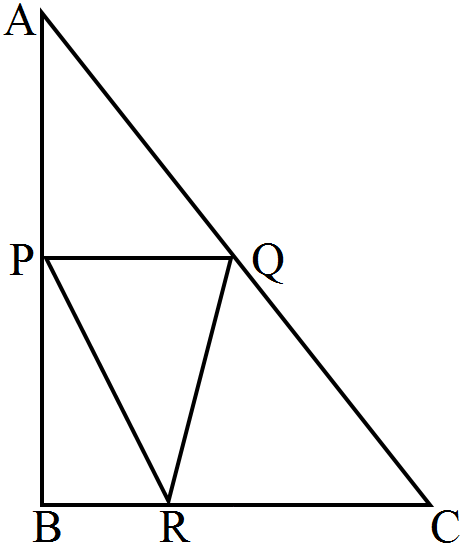
15cm Solution: In triangle ABC, P, Q and R are the midpoints. By midpoint theorem, PQ is parallel to BC and $\text{PQ} = \frac{1}{2}$ of BC QR is parallel to AB and $\text{QR} = \frac{1}{2}$ of AB PR is parallel to AC and $\text{PR} = \frac{1}{2}$ of AC. So, perimeter of triangle $\text{PQR} = \text{PQ} + \text{QR} + \text{PR} = \frac{1}{2}$ of $\text{(AB + BC + AC)}$ $= \frac{1}{2}$ of $(10 + 8 + 12) =\frac{1}{2} $ of $30=15.$
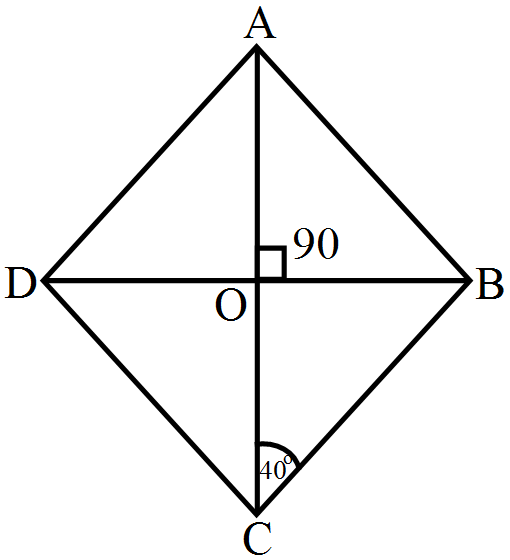
40º Solution: $40^\circ, \ \angle\text{C} = 60^\circ$ as opposite angles of a parallelogram are equal and $\angle\text{COB} = 40^\circ$ angle sum property of a triangle. [In $\triangle\text{COB}, \ \angle\text{C} + \angle\text{COB} + \angle\text{OBC} = 180^\circ$]
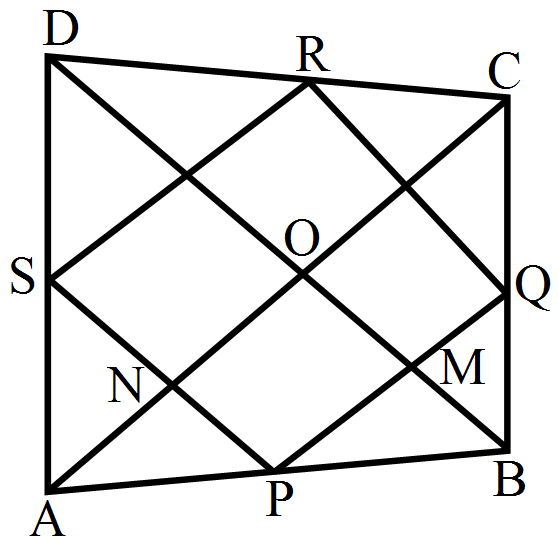
Given Rectangle ABCD and P, Q, R and S are the mid-points of the sides AB, BC, CD and DA respectively. If length of a diagonal of Rectangle is 8cm, then the quadrilateral PQRS is a:
Answer
Rhombus with each side 4cm. Solution: A quadrilateral formed by joining midpoints of the sides of the rectangle is a Rhombus. In Rhombus, all sides are equal. In triangle ABC, P and Q are midpoints of the sides AB and BC respectively. By midpoint theorem, PQ is parallel to AC and PQ is half of the AC. Let diagonal AC = 8cm. So, PQ = 4cm. Therefore, PQRS is a rhombus which all sides equal to 4cm.
Opposite angles of a Quadrilateral ABCD are equal. If AB = 4cm, find the length of CD.
Answer
4cm Solution: A quadrilateral with both pair of opposite angles equal is a parallelogram. In a parallelogram, opposite sides are equal. So, AB = CD = 4cm
The angle between two altitudes of a Parallelogram through the vertex of an obtuse angle of the Parallelogram of 60º. Find the angles of the Parallelogram.
Answer
120º, 60º, 120º, 60º Solution: Let ABCD be a parallelogram and AP and CQ are the altitudes drawn from vertex A on sides DC and BC. In quadrilateral APCQ, sum of the all angles = 360º So, $60^\circ + 90^\circ + \angle\text{C} + 90^\circ = 360^\circ$ $\angle\text{C} = 360^\circ - 240^\circ = 120^\circ$ $\angle\text{C} + \angle\text{B} = 180^\circ$ (co-interior angles) $\angle\text{B} = 180^\circ - 120^\circ = 60^\circ$ In parallelogram, opposite angles are equal. So, $\angle\text{A} = \angle\text{C} = 120^\circ$ and $\angle\text{B} = \angle\text{D} = 60^\circ$
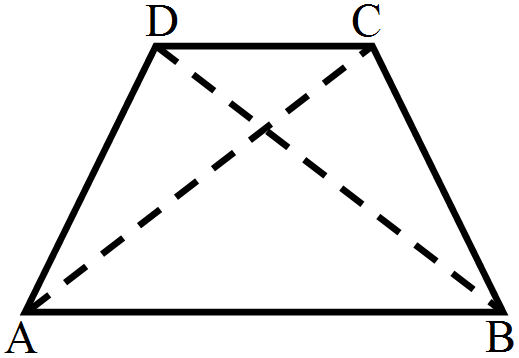
ABCD is a Trapezium in which $\text{AB || DC}$ and $\angle\text{A}=\angle\text{B} = 45^\circ.$ Find $\angle\text{C}$ and $\angle\text{D}$ of the Trapezium.
Answer
135º, 135º Solution: AB is parallel to DC. $\angle\text{A} + \angle\text{D} = 180^\circ$ (co-interior angle) $\angle\text{D} = 180^\circ - 45^\circ = 135^\circ$ Similarly by following same argument, $\angle\text{C} = 135^\circ.$
The diagonal AC and BD of quadrilateral ABCD are equal and are perpendicular bisector of each other then quadrilateral ABCD is a:
Answer
Square Solution: The triangles formed by the perpendicular bisectors are congruent to each other by SAS congruence. so the sides are equal hence it is a square.
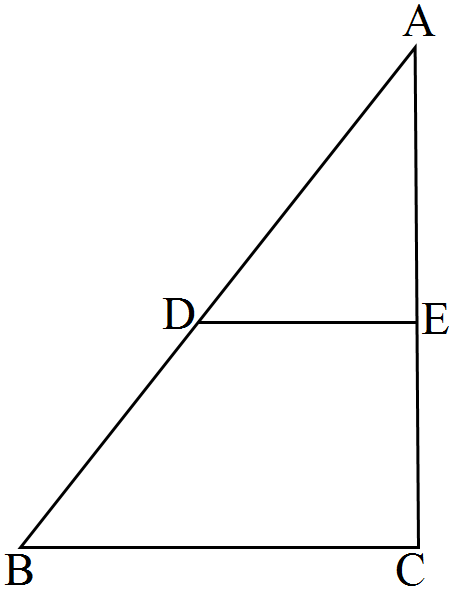
D and E are the mid-points of the sides AB and AC res. Of $\triangle\text{ABC}.$ DE is produced to F. To prove that CF is equal and parallel to DA, we need an additional information which is:
Answer
$\text{DE = EF}$ Solution: If DE = EF then triangle AED becomes congruent to triangle CEF by SSS congruence rule. By $\text{CPCT}, \ \angle\text{ECF} = \angle\text{EAD}$ which forms a pair of alternate angles. Which proves that AD is parallel to CF.
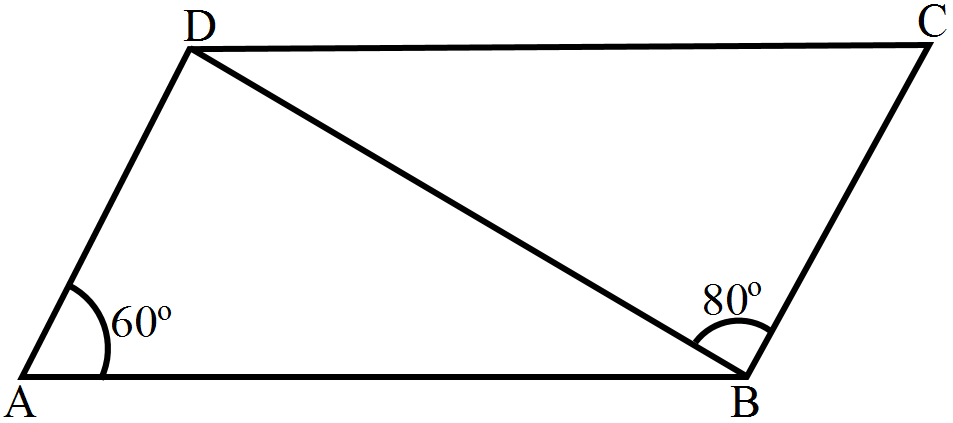
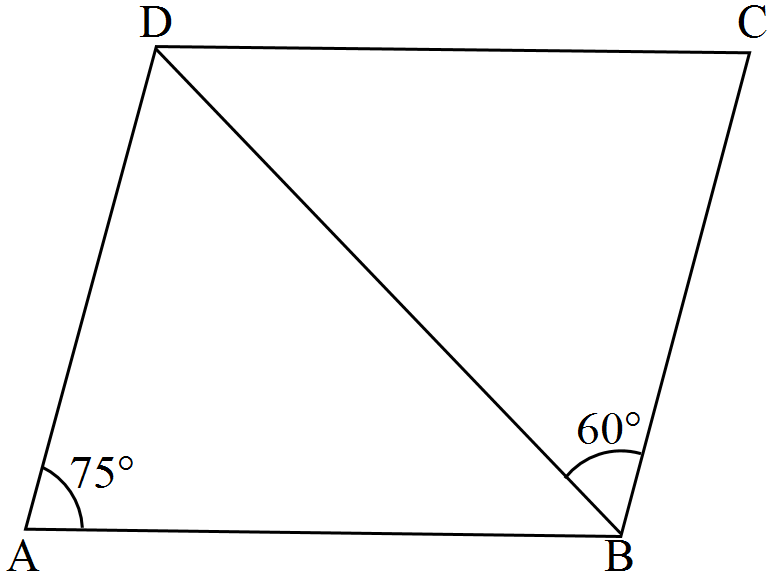
45º Solution: It is given in the question that, In parallelogram ABCD: $\angle\text{BAD} = 75^\circ, \ \angle\text{CBD} = 60^\circ$ Now, $\angle\text{DAB} = \angle\text{DCB} = 75^\circ$ (Opposite angles) Also, in triangle DBC we know that sum of angles of a triangle is 180º $\angle\text{DBC} + \angle\text{BDC} + \angle\text{DCB} = 180^\circ$ $60^\circ + \angle\text{BDC} + 75^\circ= 180^\circ$ $135^\circ + \angle\text{BDC} = 180^\circ$ $\angle\text{BDC} = 180^\circ – 135^\circ$ $\angle\text{BDC} = 45^\circ$ Hence, 45º is correct.
In a quadrilateral ABCD, AO and BO are the bisectors of $\angle\text{A}$ and $\angle\text{B}$ respectively, $\angle\text{C} = 70^\circ$ and $\angle\text{D} = 30^\circ.$ Then, $\angle\text{AOB} =\ ?$
Answer
50º Solution: It is given in the question that, ABCD is a quadrilateral where AO and BO are the bisectors of $\angle\text{A}$ and $\angle\text{B}.$ We know that, sum of all angles of a quadrilateral is equal to 360º $∴ \angle\text{A} + \angle\text{B} + \angle\text{C} + \angle\text{D} = 360^\circ$ $\angle\text{A} + \angle\text{B} + 70^\circ + 30^\circ = 360^\circ$ $\angle\text{A} + \angle\text{B} = 360^\circ - 100^\circ$ $\angle\text{A} + \angle\text{B} = 260^\circ$ $=\frac{1}{2}(\angle\text{A}+\angle\text{B})=\frac{1}{2}\times260^\circ$ $=\frac{1}{2}(\angle\text{A}+\angle\text{B})=160^\circ$ Now, in triangle AOB $=\frac{1}{2}(\angle\text{A}+\angle\text{B})+\angle\text{AOB}=160^\circ$ $130^\circ + \angle\text{AOB} = 180^\circ$ $\angle\text{AOB} = 180^\circ - 130^\circ$ $\angle\text{AOB} = 50^\circ$
If an angle of a parallelogram is two$-$third of its adjacent angle, the smallest angle of the parallelogram is:
Answer
Let $x$ be one angle. Then $\text{x}+\frac{2}{3\text{x}}+23\text{x} =180$ um of the adjacent angles of a parallelogram is $180^\circ$
$x = 108,$ adjacent angle $= 180 - 108 = 72^\circ$
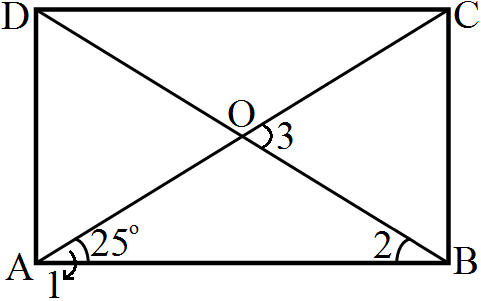
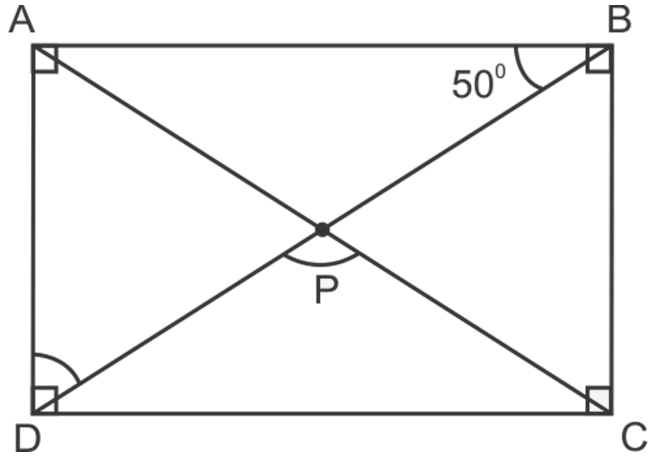
Write the correct answer in the following: A diagonal of a rectangle is inclined to one side of the rectangle at 25º. The acute angle between the diagonals is:
In a Quadrilateral ABCD, $\angle\text{A} = 90^\circ$ and AB = BC = CD = DA, Then ABCD is a:
Answer
Square Solution: A quadrilateral with pair of opposite sides equal and having one right angle is called Rectangle and a rectangle with all sides equal is called Square. So, ABCD is a Square.
x = 55º and y = 110º Solution: ABCD is a rectangle The diagonals of a rectangle are congruent and bisect each other. Therefore, in $\triangle\text{AOB},$ we have: OA = OB $\angle\text{OAB} = \angle\text{OBA} = 35^\circ$ $\text{x} = 90^\circ – 35^\circ = 55^\circ$ and $\angle\text{AOB} = 180^\circ – (35^\circ + 35^\circ) = 110^\circ$ $\text{y} = \angle\text{AOB} = 110^\circ$ [Vertically opposite angles] Hence, x = 55° and y = 110°
If angles A, B, C and D of the quadrilateral ABCD, taken in order, are in the ratio 3 : 7 : 6 : 4, then ABCD is a:
Answer
Trapezium Solution: Let the angles be 3x, 7x, 6x, 4x then 3x + 7x + 6x + 4x = 360 $\text{x}=\frac{360}{20}=18$ So angles are, 54º, 126º, 108º & 72º Hence it is a trapezium.
In which diagonals bisect opposite angles. Solution: Let ABCD be a rhombus. Join BD which forms two triangles ABD and DCB. In $\triangle\text{ABD, AB = AD}.$ So, $\angle\text{ADB} = \angle\text{ABD}$ (angles opposite to equal sides are equal) ...(i) But, $\angle\text{ABD} = \angle\text{BDC}$ and $\angle\text{ADB} = \angle\text{CBD}$ (alternate angles) ...(ii) So, from (i) and (ii) $\angle\text{ADB} = \angle\text{ABD}=\angle\text{BDC} = \angle\text{CBD}$ $\therefore$ diagonal BD bisects $\angle\text{B}$ and $\angle\text{D}.$
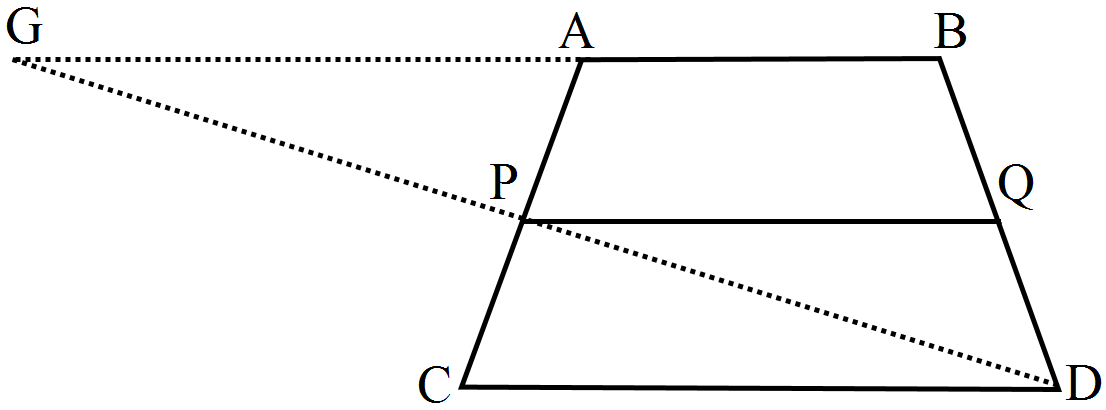
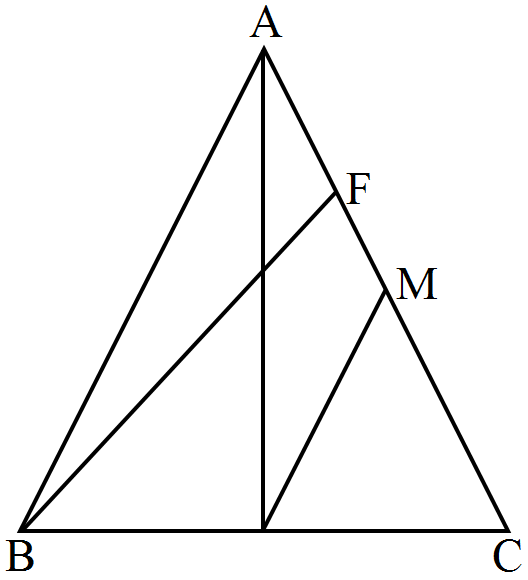
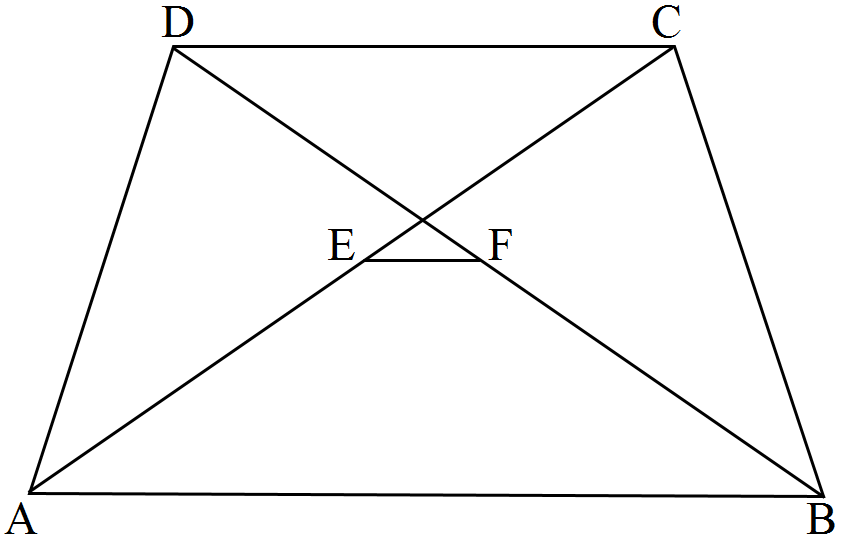
$\frac{1}{2}(\text{AB} - \text{CD})$ Solution: Construction: Join CF and extent it to cut AB at point M Firstly, in triangle MFB and triangle DFC DF = FB (As F is the mid-point of DB) $\angle\text{DFC} = \angle\text{MFB}$ (Vertically opposite angle) $\angle\text{DFC} = \angle\text{FBM}$ (Alternate interior angle) $∴$ By ASA congruence rule $\triangle\text{MFB} ≅ \triangle\text{DFC}$ Now, in triangle CAM E and F are the mid-points of AC and CM respectively. $\therefore\ \text{EF}=\frac{1}{2}(\text{AM})$ $\text{EF}=\frac{1}{2}(\text{AB} - \text{MB})$ $\text{EF}=\frac{1}{2}(\text{AB} - \text{CD})$
In quadrilateral $\text{ABCD},$ if $\angle\text{A} = 60^\circ$ and $\angle\text{B} : \angle\text{C} : \angle\text{D} = 2 : 3 : 7,$ then $\angle\text{D}$ is:
Answer
In quadrilateral, the sum of the all four angles equal to $360^\circ $. let $\angle\text{B} = 2\text{x},\ \angle\text{C} = 3\text{x}$ and $\angle\text{D} = 7\text{x}.$
$\angle\text{A} + \angle\text{B} + \angle\text{C} +\angle\text{D} = 360^\circ$
$60 + 2x + 3x + 7x = 360$
$12x = 300^\circ$
$x = 25^\circ$
So, $\angle\text{D} = 7\text{x} = 7(25^\circ) = 175^\circ$
In quadrilateral ABCD, if $\angle\text{A}= 60^\circ$ and $\angle\text{B}: \angle\text{C}: \angle\text{D} = 2:3:7,$ then $\angle\text{D}$ is:
Answer
175º Solution: In quadrilateral, the sum of the all four angles equal to 360º. Let $\angle\text{B} = 2\text{x}, \ \angle\text{C} = 3\text{x}$ and $\angle\text{D} = 7\text{x}.$ $\angle\text{A} + \angle\text{B} + \angle\text{C} + \angle\text{D} = 360^\circ$ 60 + 2x + 3x + 7x = 360 12x = 300 x = 25 So, $\angle\text{D} = 7\text{x} = 7 (25) = 175^\circ$
If area of a Parallelogram with sides ‘a’ and ‘b’ is A and that of a rectangle with sides ‘a’ and ‘b’ is B, then
Answer
A < B Solution: Area of Parallelogram = Base × Height If 'a' is the side and 'b' is the base the height will be less than 'a' using Pythagoras theorem, a as Hypotenuse, h as height, A < B.
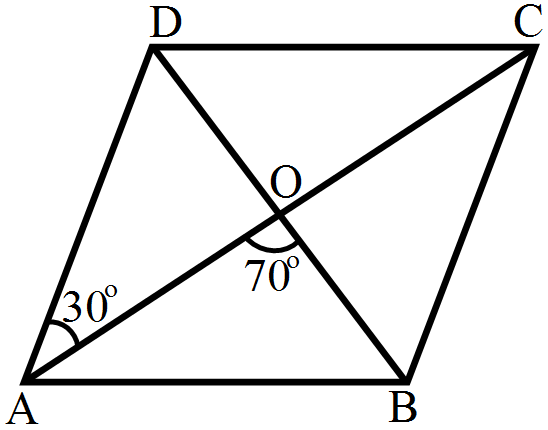
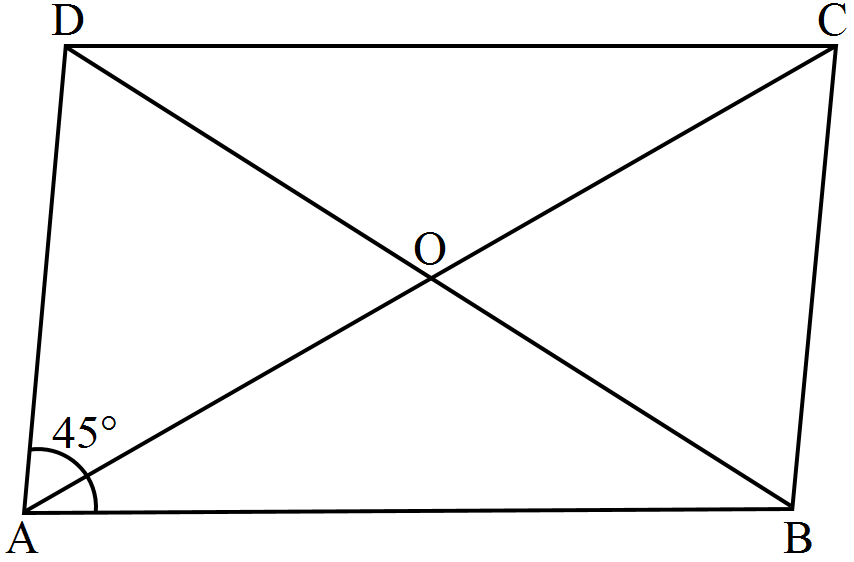
The Diagonals AC and BD of a Parallelogram ABCD intersect each other at point O. If $\angle\text{DAC}=32^\circ$ and $\angle\text{AOB}=70^\circ,$ then $\angle\text{DBC}$ is equal to:
Length of the line segment joining the mid-points of two sides of a triangle is ________ the third side of the Triangle.
Answer
Half the length of. Solution: According to mid point theorem, A line segment joining mid points of any two sides of a triangle is parallel to third side and length of that line segment is half of the third side.
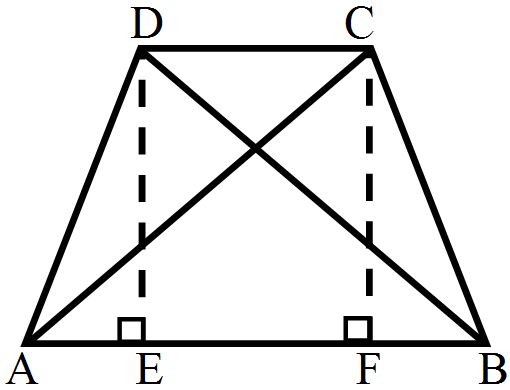
In a trapezium$ \text{ABCD},$ if $AB || CD,$ then $(AC^2 + BD^2) =$ ?
Answer
Construction: Draw perpendicular from $D$ and $C$ on $AB$ which meets $AB$ at $E$ and $F,$ respectively.
So, $\text{DEFC}$ is a parallelogram, since one pair of opposite sides are parallel and equal.
In $\triangle\text{ABC},$
$\angle\text{B}$ is an acute angle.
$\Rightarrow\text{AC}^2=\text{BC}^2+\text{AB}^2-2\text{AB}\times\text{AE}$
In $\triangle\text{ABD},$
$\angle\text{A}$ is an acute angle.
$\Rightarrow\text{BD}^2=\text{AD}^2+\text{AB}^2-2\text{AB}\times\text{AF}$
$\Rightarrow\text{AC}^2+\text{BD}^2=\text{BC}^2+\text{AD}^2+2\text{AB}(\text{AB}-\text{BE}-\text{AF})$
$=\text{BC}^2+\text{AD}^2+2\text{AB}\times\text{EF}$
$=\text{BC}^2+\text{AD}^2+2\text{AB}\times\text{CD}$