Questions

[ 2 Marks Questions ]

🎯

Test yourself on this topic

50 questions · timed · auto-graded

Question 12 Marks
Describe the preparation of potassium dichromate.
Answer
Preparation of potassium dichromate:
1. Potassium dichromate is prepared from chromite ore. The ore $FeO \cdot Cr _2 O _3$ is concentrated by the gravity separation process.
2. The concentrated ore is mixed with excess sodium carbonate and lime and roasted in a reverberatory furnace.
$4 FeCr_2 O_4+8 Na_2 CO_3+7 O_2 \xrightarrow{900-1000^{\circ} C} 8 Na_2 CrO_4+2 Fe_2 O_3+8 CO_2 \uparrow$
3. The roasted mass is treated with water to separate soluble sodium chromate form insoluble iron oxide. The yellow solution of sodium chromate is treated with concentrated sulphuric acid which converts sodium chromate into sodium dichromate.
$\underset{\text { Sodium chromate (yellow)] }}{2 Na_2 CrO_4}+H_2 SO_4 \longrightarrow \underset{\text { [Sodium dichromate (orange red)] }}{Na_2 Cr_2 O_7}+Na_2 SO_4+H_2 O$
4. The above solution is concentrated to remove less soluble sodium sulphate. The resulting solution is filtered and concentrated. It is cooled to get the crystals of $Na _2 SO _2 \cdot 2 H _2 O$.
5. The saturated solution of sodium dichromate in water is mixed with KCl and then concentrated to get crystals of NaCl . It is filtered while hot and the filtrate is cooled to obtain $K _2 Cr _2 O _7$ crystals.
$\underset{\text { [Sodium dichromate (orange red)] }}{Na_2 Cr_2 O_7}+2 KCl \longrightarrow \underset{\text { [Potassium dichromate (orange red)] }}{K_2 Cr_2 O_7}+2 NaCl$
View full question & answer
Question 22 Marks
Justify the position of lanthanides and actinides in the periodic table.
Answer
Lanthanides:1. The actual position of lanthanides in the periodic table is group number 3 and period number 6.
2. In the sixth period, the electrons are preferentially filled in the inner 4f sub shell.
3. The fourteen elements following lanthanum (Ce to Lu) show similar chemical properties.
4. Hence they are grouped together and placed at the bottom of the periodic table.
5. This position is justified as follows:
  • General electronic configuration: $[ Xe ] 4 f ^{1-14} 5 d^{0-1} 6 S^2$
  • Common Oxidation state: +3
  • They have similar physical and chemical properties.
Actinides:
1. The actual position of actinides in the periodic table is group number 3 and period number 7.
2. In the seventh period, the electrons are preferentially filled in the inner 5f Sub shell.
3. The fourteen elements following actinides (Th to Lr) show similar chemical properties.
4. Hence they are grouped together and placed at the bottom of the periodic table.
5. This position is justified as follows:
  • General electronic configuration: $:[R n] 5 f^{2-14} 6 d^{0-2} 7 s^2$
  • Common oxidation state: +3
  • They have similar physical and chemical properties.
View full question & answer
Question 32 Marks
What are inner transition elements?
Answer
The inner transition elements have two series of elements.
  • Lanthanoids
  • Actinoids
1. Lanthanoid series consists of 14 elements from Cerium $(58 Ce )$ to Lutetium ( 71 Lu $)$ following Lanthanum ( 57 La $)$. These elements are characterised by the preferential filling of 4 f orbitals.
2. Actinoids consist of 14 elements from Thorium ( 90 Th ) to Lawrencium ( 103 Lr ) following Actinium ( 89 Ac ). These elements are characterised by the preferential filling of $5 f$ orbital.
The elements which in their elemental or ionic form have partly filled f-orbitals are called f-block elements.
As the f-orbitals lie inner to the penultimate shell, therefore these elements having partially filled f-orbitals, are also called inner transition elements.
View full question & answer
Question 42 Marks
Transition metals show high melting points why?
Answer
  1. All the transition metals are hard.
  2. Most of them are hexagonal close-packed, cubic close-packed (or) body-centered cubic which are characteristics of true metals.
  3. The maximum melting point at about the middle of the transition metal series indicates that the $d^5$ configuration of favourable for strong inter-atomic attraction.
  4. Due to the strong metallic bonds, atoms of the transition elements are closely packed and held together. This leads to a high melting point and boiling point.
View full question & answer
Question 52 Marks
Why first ionization enthalpy of chromium is lower than that of zinc?
Answer
The first ionization enthalpy of chromium is lower than that of zinc. $Cr (Z=24)$ Electronic configuration $[ Ar ] 3 d^5 4 s^1$. In the case of Cr , the first electron has to be removed easily from the $4 s$ orbital to attain the more stable half-filled configuration. So Cr has lower ionization enthalpy. But in the case of $Zinc (Z=30)$, electronic configuration $[ Ar ] 3 d^{10}$ $4 s^2$. The first electron has to be removed from the most stable fully filled electronic configuration becomes difficult and requires more energy.
View full question & answer
Question 62 Marks
The $E _{ M ^{2+} / M }^0$ value for copper is positive. Suggest a possible reason for this.
Answer
  1. 1. Copper has a positive reduction potential. Elemental copper is more stable than $Cu ^{2+}$.
    2. Copper having a positive sign for electrode potential merely means that copper can undergo reduction at a faster rate than the reduction of hydrogen.
    3. The electron-giving reaction (oxidation) of copper is slower than that of hydrogen. It is determined from the result of the S.H.E (Standard Hydrogen Electrode) potential value experiment.
View full question & answer
Question 72 Marks
Why europium (II) is more stable than Cerium (II)?
Answer
$Eu ( Z =63)$ Electronic configuration $-[ Xe ] 4 f ^7 5 d^0 6 s^2$
$Eu ^{2+}$ - Electronic configuration Electronic $6 s^1$
$Ce (Z=58)$
Electronic configuration - $[ Xe ] 4 f ^{2+} 5 d^0 6 s^{2+}$
$Ce ^{2+}$ - Electronic confluration $-[ Xe ] 4 f ^2 5 d^0$
According to the Aufbau principle, half-filled and completely filled d (or) forbitals are more stable than partially filled f orbitals.
Hence $Eu ^{2+}[ Xe ] 4 f ^7 5 d^0$ is more stable than $Ce ^{2+}[ Xe ] 4 f ^2 5 d^0$
View full question & answer
Question 82 Marks
What are transition metals? Give four examples.
Answer
  1. Transition metal is an element whose atom has an incomplete d sub shell or which can give rise to cations with an incomplete d sub shell.
  2. They occupy the central position of the periodic table, between s-block and p-block elements.
  3. Their properties are transitional between highly reactive metals of s-block and elements of p-block which are mostly non-metals.
  4. Example: Iron, Copper, Tungsten, Titanium.
View full question & answer
Question 92 Marks
Out of $Lu(OH)_3$ and La(OH)_3$ which is more basic and why? 
Answer
1. As we move from $Ce ^{3+}$ to $Lu ^{3+}$, the basic character of $Lu ^{3+}$ ions decreases.
2. Due to the decrease in the size of $Lu ^{3+}$ ions, the ionic character of the $Lu - OH$ bond decreases, covalent character increases which results in the decrease in the basicity.
3. Hence, $La ( OH )_3$ is more basic than $Lu ( OH )_3$.
View full question & answer
Question 102 Marks
Actinoid contraction is greater from element to element than the lanthanoid contraction, why?
Answer
  1. Actinoid contraction is greater from element to element than lanthanoid contraction. The 5f orbitals in Actinoids have a very poorer shielding effect than 4f orbitals in lanthanoids.
  2. Thus, the effective nuclear charge experienced by electrons in valence shells in the case of actinoids is much more than that experienced by lanthanoids.
  3. In actinoids, electrons are shielded by 5d, 4f, 4d and 3d whereas in lanthanoids, electrons are shielded by 4d, 4f only.
  4. Hence, the size contraction in actinoids is greater as compared to that in lanthanoids.
View full question & answer
Question 112 Marks
Compare the ionization enthalpies of the first series of the transition elements.
Answer
Ionization enthalpies of first transition series:
  1. Ionization energy of the transition element is intermediate between those of s and p block elements.
  2. As we move from left to right in a transition metal series, the ionization enthalpy increases as expected. This is due to an increase in nuclear charge corresponding to the filling of d electrons.
  3. The increase in first ionisation enthalpy with increase in atomic number along a particular series is not regular. The added electron enters (n-1) d-orbital and the inner electrons act as a shield and decrease the effect of nuclear charge on valence ‘ns’ electrons. Therefore, it leads to variation in the ionization energy values.
View full question & answer
Question 122 Marks
Explain why $Cr ^{2+}$ is strongly reducing while $Mn ^{3+}$ is strongly oxidizing.
Answer
$Cr ^{2+}$ is strong reducing while $Mn ^{3+}$ is strongly oxidising.
$
\begin{aligned}
& E _{ Cr ^{3+} / Cr ^{2+}}^0 \text { is }-0.41 V \\
& Cr ^{2+}+2 e ^{-} \longrightarrow Cr \\
& E ^0=-0.91 V
\end{aligned}
$
If the standard electrode potential $E ^0$ of metal is large and negative, the metal is a powerful reducing agent because it loses electrons easily.
$
\begin{gathered}
Mn \longrightarrow Mn ^{3+}+3 e ^{-} \\
Mn ^{3+}+ e ^{-} \longrightarrow Mn ^{2+}
\end{gathered}
$
$
\begin{aligned}
& Mn ^{3+}[ Ar ] 3 d ^4 \\
& E ^0=+1.51 V
\end{aligned}
$
If the standard electrode potential $E ^0$ of metal is large and positive, the metal is a powerful oxidising agent because it gains electrons easily.
View full question & answer
Question 132 Marks
Which is more stable? $Fe ^{3+}$ or $Fe ^{2+}$ - explain.
Answer
$e(Z=26)$
$Fe \longrightarrow F e^{2+}+2 e^{-}$
$Fe \longrightarrow F e^{3+}+3 e^{-}$
$Fe ^{2+}$ [Number of electrons 24]
Electronic configuration $=[ Ar ] 3 d^6$
$Fe ^{3+}$ [Number of electrons 23]
Electronic configuration $=[ Ar ] 3 d^5$
Among $Fe ^{3+}$ and $Fe ^{2+}, Fe ^{3+}$ is more stable due to half-filled d-orbital. This can be explained by the Aufbau principle. Half filled and completely filled d-orbitals are more stable than partially filled d-orbitals. So $Fe ^{3+}$ is more stable than $Fe ^{2+}$
View full question & answer
Question 142 Marks
Explain briefly how +2 states become more and more stable in the first half of the first-row transition elements with increasing atomic numbers.
Answer
In the elements of the first half of the first row, with the removal of valance 4 s electrons ( +2 oxidation state) the 3 d orbital gets gradually occupied. Since the number of empty d orbital decreases, the stability of the cations $\left( M ^{2+}\right)$ increases from $Sc ^{2+}$ to $Mn ^{2+}$.
View full question & answer
Question 152 Marks
Write the electronic configuration of $Ce ^{4+}$ and $Co ^{2+}$.
Answer
Electronic cofiguration of $Ce ^{4+}=[ Xe ] 4 f ^0 5 d^0 6 s^0$ Electronic configuration of $Co ^{2+}=[ Ar ] 3 d^7$
View full question & answer
Question 162 Marks
Explain about the causes of lanthanide contraction.
Answer
1. As we move from one element to another in 4 f series ( Ce to Lu ) the nuclear charge increases by one unit and an additional electron is added into the same inner 4 f sub-shell.
2. 4 f sub-shell have a diffused shapes and therefore the shielding effect of 4 f electrons are relatively poor. Hence, with increase of nuclear charge, the valence shell is pulled slightly towards nucleus.
3. As a result, the effective nuclear charge experienced by the 4 f elelctoms increases and the size of $Ln ^{3+}$ ions decreases.
View full question & answer
Question 172 Marks
Among $HCl , HNO _3$ and $H _2 SO _4$, which is the suitable medium for $KMnO _4$ in oxidising reaction?
Answer
$HCl$ and $HNO _3$ cannot be used. $HCl$ react with $KMnO _4$. $HNO _3$ is itself a good oxidising agent.
However, $H _2 SO _4$ is found to be most suitable since it does not react with potassium permanganate.
View full question & answer
Question 182 Marks
$HNO _3$ cannot be used as an acid medium along with KMnO . Why?
Answer
$HNO _3$ cannot be used since it is a good oxidising agent and it reacts with reducing agents in the reaction.
View full question & answer
Question 192 Marks
$KMnO _4$ does not act as oxidising agent in the presence of HCl . Why?
Answer
$HCl$ cannot be used for making acidified $KMnO _4$ as oxidising agent, since it reacts with $KMnO _4$ as follows.
$
2 MnO _4^{-}+10 Cl ^{-}+16 H ^{+} \rightarrow 2 Mn ^{2+}+5 Cl _2+8 H _2 O
$
View full question & answer
Question 202 Marks
Acidified $KMnO _4$ is a very strong oxidising agent. Prove it.
Answer
1. In the presence of dilute sulphuric acid, potassium permanganate acts as a very strong oxidising agent. Permanganate ion is converted into $\mathrm{Mn}^{2+}$ ion.
$
\mathrm{MnO}_4^{-}+8 \mathrm{H}^{+}+5 \mathrm{e}^{-} \rightarrow \mathrm{Mn}^{2+}+4 \mathrm{H}_2 \mathrm{O}
$
2. Permanganate oxidises ferrous salt to ferric salt.
$
2 \mathrm{MnO}_4^{-}+10 \mathrm{Fe}^{2+}+16 \mathrm{H}^{+} \rightarrow 2 \mathrm{Mn}^{2+}+10 \mathrm{Fe}^{3+}+8 \mathrm{H}^2 \mathrm{O}
$
View full question & answer
Question 212 Marks
What is Baeyer’s reagent? Where it is used?
Answer
  1. Cold dilute alkaline $KMnO_4$ is known as Baeyer’s reagent. It is used to oxidise alkene into diols.
  2. For example, ethylene can be converted into ethylene glycol and this reaction is used as a test for unsaturation.
View full question & answer
Question 222 Marks
What happens when thiosuiphate ion is treated with permanganate ion?
Answer
Permanganate ion oxidises thiosulphate into sulphate.
$
8 MnO _4^{-}+3 S _2 O _3^{2-} \rightarrow 6 SO _4^{2-}+8 MnO _2+2 OH ^{-}
$
View full question & answer
Question 242 Marks
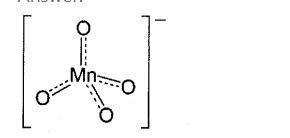
Draw and explain about the structure of permanganate ion.
Answer
Image
Permanganate ion has tetrahedral geometry in which the central $Mn ^{7+}$ is $sp ^3$ hybridised.
View full question & answer
Question 252 Marks
What are the uses of potassium dichromate?
Answer
$K _2 Cr _2 O _7$ is used
1. as a strong oxidising agent
2. in dyeing and printing
3. in leather tanneries for chrome plating
4. in quantitative analysis for the estimation of iron compounds and iodides
View full question & answer
Question 262 Marks
Prove that acidified potassium dichromate is a powerful oxidising agent.
Answer
$K _2 Cr _2 O _7$ act as power oxidising agent in acidic medium. In the presence of $H ^{+}$ions, the oxidation state of $Cr$ froms $Cr ^{6+}$ is changed to $Cr ^{3+}$
$
Cr _2 O _7^{2-}+14 H ^{+}+6^{-} \rightarrow 2 Cr ^{3+}+6 Fe ^{3+}+7 H _2 O
$
Example:
Acidified $K _2 Cr _2 O _7$ oxidises Ferrous salts to Ferric salts.
$
Cr _2 O _7^{2-}+6 Fe ^{2+}+14 H ^{+} \rightarrow 2 Cr ^{3+}+6 Fe ^{3+}+7 H _2 O \text {. }
$
View full question & answer
Question 272 Marks
d-block elements readily form complexes. Give reason.
Answer
1. Transition elements ( $d$-block elements) have a tendency to form coordination compounds (complexes) with a species that has an ability to donate an electron pair to form a coordinate
2. Transition metal ions are small and highly charged and they have vacant low energy orbitals to accept an electron pair donated by other groups. Due to these properties, transition metals form large number of complexes.
3. Examples - $\left[ Fe ( CN )_6\right]^{4-},\left[ CO \left( NH _3\right)_6\right]^{3+}$
View full question & answer
Question 282 Marks
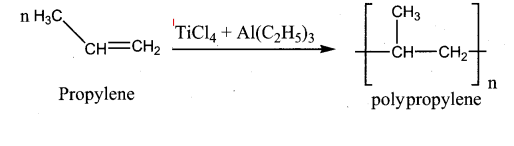
What is Zeigler -Natta catalyst? In which reaction it is used? Give equation.
Answer
A mixture of $TiCl_4$ and trialkyl aluminium is Zeigler – Natta catalyst. It is used in the polymerization
Image
View full question & answer
Question 312 Marks
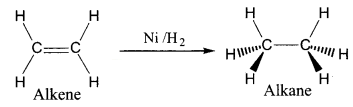
Explain the catalytic hydrogenation of alkene to alkane with equation.
Answer
The σ bond in the hydrogen molecule breaks, and each hydrogen atom forms a bond with a d electron on an atom in the catalyst Nickel. The two hydrogen atoms then bond with the partially broken π -bond in the alkene to form an alkane.
Image
View full question & answer
Question 322 Marks
Most of the transition metals act as catalyst. Justify this statement.
Answer
1. Many industrial processes use transition metals or their compounds as catalysts. Transition metal has energetically available d orbitals that can accept electrons from reactant molecule or metal can form bond with reactant molecule using its ‘d’ electrons.
2. For example, in the catalytic hydrogenation of an alkene, the alkene bonds to an active site by using its n electrons with an empty d orbital of the catalyst.
View full question & answer
Question 332 Marks
$Cu ^{+}, Zn ^{2+}$ are diamagnetic. Prove it.
Answer
$Cu ^{+}, Zn ^{2+}$ electronic configuration $[ Ar ] 3 d ^{10}$
The number of unpaired electron is 0 .
$\mu=\sqrt{0(0+2)}=0 \mu_{ B }$. $Cu ^{+}, Zn ^{2+}$ are diamagnetic.
View full question & answer
Question 342 Marks
Calculate the magnetic moment and the number of unpaired electrons in $Cu ^{2+}$.
Answer
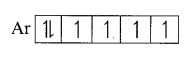
$Cu ( Z =29)$ Electronic configuration $[ Ar ] 3 d ^{10} 4 s ^1$
$Cu ^{2+}$ Electronic configuration $[ Ar ] 3 d ^9$
The number of unpaired electrons
Image is 1.
Magnetic moment $\mu=\sqrt{1(1+2)}=\sqrt{3}=1.732 \mu_{ B }$
View full question & answer
Question 352 Marks
How many unpaired electrons are present in $CO ^{3+}, Fe ^{2+}$ ? Calculate their magnetic moment.
Answer
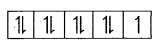
$ CO ( Z =27) CO ^{3+}[ Ar ] 3 d ^6$
$Fe ( Z =26) Fe ^{2+}[ Ar ] 3 d ^6$
Image
Their magnetic moment is $\mu=\sqrt{4(4+2)}=\sqrt{24}=4.89 \mu_{ B }$
View full question & answer
Question 362 Marks
$Mn ^{2+}, Fe ^{3+}$ have high magnetic moment. Prove it.
Answer
1. $Mn ^{2+}, Fe ^{3+}$ configuration is $d ^5$.
2. $\mu=\sqrt{5(5+2)}=\sqrt{35}=5.916 \mu_{ B }$
Among $3 d$ series, $Mn ^{2+}, Fe ^{3+}$ have high magnetic moment as $5.916 \mu_{ B }$.
View full question & answer
Question 372 Marks
$Cr ^{3+}, Mn ^{4+}, V ^{2+}$ are paramagnetic. Calculate their magnetic moment values.
Answer
$Cr ^{3+}, Mn ^{4+}, V ^{2+}$ Configuration is $d ^3$. Due to 3 unpaired electrons, they are paramagnetic. $\mu=\sqrt{3(3+2)}=\sqrt{35}=3.87 \mu_{ B }$
View full question & answer
Question 382 Marks
Calculate the magnetic moment of $Ti^{3+}$ and $V^{4+}.$
Answer
$Ti (Z=22) Ti ^{3+} 3 d ^1 $
$ V ( Z =23) V ^{4+} 3 d ^1 $
$ \mu=\sqrt{ 1 (1+2)}=\sqrt{ 3 5 }=1.73 \mu_{ B } \text {. So they are paramagnetic. }$
View full question & answer
Question 392 Marks
$Sc ^{3+}, Ti ^{4+}, V ^{5+}$ are diamagnetic. Give reason.
Answer
1. $Sc ^{3+}, Ti ^{4+}, V ^{5+}$ have $d ^{\circ}$ electronic configuration, $n =0$
2. $\mu=\sqrt{0(0+2)}=0 \mu_B$ So they are diamagnetic.
View full question & answer
Question 402 Marks
Which metal is used to reduce $Cr ^{3+}$ ion? Why?
Answer
A stable $Cr ^{3+}$ ion, strong reducing agent which has high negative value for reduction potential like metallic zinc $\left(E^{\circ}=\right.$ -0.76 V ) is required. Metallic zinc is a powerful reducing agent due to its large negative values.
View full question & answer
Question 412 Marks
Define – Standard electrode potential.
Answer
Standard electrode potential is the value of the standard emf of a cell in which molecular hydrogen under standard pressure (latm) and temperature (273K) is oxidised to solvated protons at the electrode.
View full question & answer
Question 422 Marks
Copper is unique in 3d series. Prove this statement.
Answer
Copper is unique in 3d series having a stable +1 oxidation state. It is prone to disproportionate to the +2 and 0 oxidation states.
View full question & answer
Question 432 Marks
Ru and Os have highest oxidation state in which compounds? Explain with example.
Answer
1. Ru and Os have +8 as the highest oxidation state.
2. The highest oxidation state of 4 d and 5 d elements are found in their compounds with the higher electronegative elements like $O , F$ and Cl . For example: $RuO _4, OsO _4$​​​​​​​
View full question & answer
Question 442 Marks
$Mn ^{2+}$ is more stable than $Mn ^{4+}$. Why?
Answer
1. The relative stability of different oxidation states of 3 d metals is correlated with the extra stability of half-filled and fully filled electronic configurations.
2. Example $- Mn ^{2+}\left(3 d^5\right)$ is more stable than $Mn ^{4+}\left(3 d^3\right)$
View full question & answer
Question 452 Marks
Write a not about oxidation state of 3d series.
Answer
  1. The number of oxidation states increases with the number of electrons available, and it decreases as the number of paired electrons increases.
  2. Hence, the first and last elements show less number of oxidation states and the middle elements with more number of oxidation states.
  3. For example, the first element Sc has only one oxidation state +3, the middle element Mn has six different oxidation states from +2 to +7. The last element Cu shows +1 and +2 oxidation states only.
View full question & answer
Question 462 Marks
Write a note about atomic radius of Zinc.
Answer
At the end of 3d series, d-orbitals of Zinc contain 10 electrons in which the repulsive interaction between the electrons is more than the effective nuclear charge and hence the orbitals slightly expand and atomic radius slightly increases.
View full question & answer
Question 472 Marks
Applying Aufbau principle, write down the electronic configuration of Sc (Z = 21) and Zn (Z = 30).
Answer
1. According to Aufbau principle, the electron first fills the $4 s$ orbital before $3 d$ orbital.
2. Sc $(Z=21) I s^2 2 s^2 2 p^6 3 s^2 3 p^6 4 s^2 3 d^1$
- $Z n(Z=30) I s^2 2 s^2 2 p^6 3 s^2 3 p^6 4 s^2 3 d^{10}$
View full question & answer
Question 482 Marks
Zn, Cd, Hg belong to d-block elements even though they do not have partially filled d-orbitals. Give reason.
Answer
1. Zn, Cd, Hg belong to d-block elements even though they do not have partially filled d-orbitals either in their elemental state or in their normal oxidation states.
2. However they are treated as transition elements, because their properties are an extension of the properties of the respective transition elements.
View full question & answer
Question 492 Marks
How many series are in d-block elements? What are they?
Answer
  • There are 4 series in d-block e1ements They are,
  • 3d series – 4th period – Scandium to Zinc
  • 4d series – 5th period – Yttrium to Cadmium
  • 5d series – 6th period – Lanthanum to Mercury
  • 6d series – 7th period – Actinium to Californium
View full question & answer
Question 502 Marks
d-block elements are called transition elements. Justify this statement.
Answer
1. d-block elements occupy the central position of the periodic table, between s and p block elements.
2. Their properties are transitional between highly reactive metals of s-block and elements of p-block which are mostly non-metals. That is why d-block elements are called transitional elements.
View full question & answer
[ 2 Marks Questions ] - Chemistry STD 12 Questions - Vidyadip