A $1\,m$ long copper wire carries a current of $1\,A$. If the cross section of the wire is $2.0\,mm ^{2}$ and the resistivity of copper is $1.7 \times 10^{-8}\,\Omega\,m$. the force experienced by moving electron in the wire is $\times 10^{-23}\,N$. (charge on electron $=1.6 \times 10^{-19}\,C$ )
JEE MAIN 2022, Medium


Download our appand get started for free
Experience the future of education. Simply download our apps or reach out to us for more information. Let's shape the future of learning together!No signup needed.*
Similar Questions
- 1View SolutionThe brightness of a bulb will be reduced, if a resistance is connected in
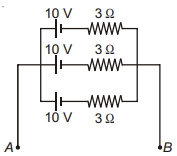
- 2Three identical cells are connected in parallel across $A B$. Net emf across $A B$ is .......... $V$View Solution
- 3View SolutionThe material of fuse wire should have
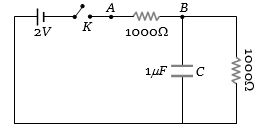
- 4When the key $K$ is pressed at time $t = 0$, which of the following statements about the current $I$ in the resistor $AB$ of the given circuit is trueView Solution
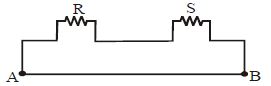
- 5In a meter bridge, the null point is found at a distance of $25\, cm$ from $A$. If now a resistance of $10\,\Omega $ is connected in parallel with $S$, the null point occurs at mid point of $AB$. The value of $R$ is ................. $\Omega$View Solution
- 6Four wires of the same diameter are connected in turn between two points, maintained at a constant potential difference. Their resistivities are; $\rho $ and $L$ (wire $1$ )., $1.2\,\rho $ and $1.2\,L$ (wire $2$ ), $0.9\,\rho $ and $0.9\,L$ (wire $3$ ) and $\rho $ and $1.5\,L$ (wire $4$ ). Rank the wires according to the rates at which energy is dissipated as heat, greatest firstView Solution
- 7If $n,\,e,\,\tau $ and $m$ respectively represent the density, charge relaxation time and mass of the electron, then the resistance of a wire of length $l$ and area of cross-section $A$ will beView Solution
- 8A coil develops heat of $800\, cal/sec$. When $20\, volts$ is applied across its ends. The resistance of the coil is .............. $\Omega$ ($1$ $cal$ = $4.2$ $joule$)View Solution
- 9If a wire of resistance $20\,\Omega $ is covered with ice and a voltage of $210\, V$ is applied across the wire, then the rate of melting of ice is .................. $g/s$View Solution
- 10The drift velocity of free electrons in a conductor is ‘$v$’ when a current ‘$i$’ is flowing in it. If both the radius and current are doubled, then drift velocity will beView Solution