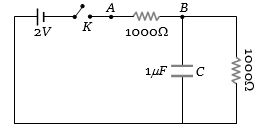
When the key $K$ is pressed at time $t = 0$, which of the following statements about the current $I$ in the resistor $AB$ of the given circuit is true
AIPMT 1995,AIIMS 2008, Medium
Download our app for free and get started
(d) At time $t = 0$ i.e. when capacitor is charging, current $i = \frac{2}{{1000}} = 2\,mA$
When capacitor is full charged, no current will pass through it, hence current through the circuit $i = \frac{2}{{2000}} = 1\,mA$
When capacitor is full charged, no current will pass through it, hence current through the circuit $i = \frac{2}{{2000}} = 1\,mA$

Download our appand get started for free
Experience the future of education. Simply download our apps or reach out to us for more information. Let's shape the future of learning together!No signup needed.*
Similar Questions
- 1A bulb has specification of one kilowatt and $250\, volts$, the resistance of bulb is .................. $\Omega$View Solution
- 2At what rate the potential difference between the plates of a capacitor be changed to set up a displacement current of $1\, A$ in a capacitor of $2\,\mu F$ ?View Solution
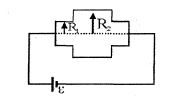
- 3A cylindrical resistance is connected across battery $\varepsilon $ . Cylinder has uniform free electron density, mid part of cylinder has larger radius as shown in figure. Then $V_d$ (drift velocity) $V/S$ (distance across the length of the resistance)View Solution
- 4Two bulbs of $(40 \;W, 200\; V)$ and $(100\; W, 200 \;V)$. Then correct relation for their resistanceView Solution
- 5In a potentiometer arrangement, a cell of $emf$ $1.25\; V$ gives a balance point at $35.0\; cm$ length of the wire. If the cell is replaced by another cell and the balance point shifts to $63.0\; cm ,$ what is the $emf$ of the second cell in $V$?View Solution
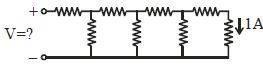
- 6Each element in the finite chain of resistors shown in the figure is $1\,\Omega $. A current of $1\, A$ flows through the final element. Then what is the potential difference $V$ across input terminals of the chain ............... $\mathrm{volt}$View Solution
- 7Three resistances $4\,\Omega $ each of are connected in the form of an equilateral triangle. The effective resistance between two corners isView Solution
- 8A uniform wire of resistance $9$ $\Omega$ is cut into $3$ equal parts. They are connected in the form of equilateral triangle $ABC$. A cell of $e.m.f.$ $2\,V$ and negligible internal resistance is connected across $B$ and $C$. Potential difference across $AB$ is ............... $V$View Solution
- 9The current flowing through a lamp marked as $50\, W$ and $250\, V$ is ............. $amp$View Solution
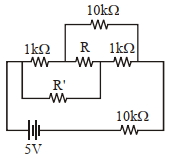
- 10When the resistance $R$ (indicated in the figure below) is changed from $1 \,k \Omega$. to $10 \,k \Omega$, the current flowing through the resistance $R'$ does not change. What is the value of the resistor $R'?$View Solution