A coil develops heat of $800\, cal/sec$. When $20\, volts$ is applied across its ends. The resistance of the coil is .............. $\Omega$ ($1$ $cal$ = $4.2$ $joule$)
Medium


Download our appand get started for free
Experience the future of education. Simply download our apps or reach out to us for more information. Let's shape the future of learning together!No signup needed.*
Similar Questions
- 1One end of a Nichrome wire of length $2\,L$ and cross-sectional area $A$ is attatched to an end of another Nichrome wire of length $L$ and cross-sectional area $2\,A$. If the free end of the longer wire is at an electric potential of $8.0$ $\mathrm{volts}$, and the free end of the shorter wire is at an electric potential of $1.0$ $\mathrm{volt}$, the potential at the junction of the two wires is equal to ............. $V$View Solution
- 2View SolutionA potential difference is applied across the ends of a metallic wire. If the potential difference is doubled, then the drift velocity
- 3Incandescent bulbs are designed by keeping in mind that the resistance of their filament increases with the increase in temperature. If at room temperature, $100 \mathrm{~W}, 60 \mathrm{~W}$ and $40 \mathrm{~W}$ bulbs have filament resistances $\mathrm{R}_{100}, \mathrm{R}_{60}$ and $\mathrm{R}_{40}$, respectively, the relation between these resistances isView Solution
- 4View SolutionIf in the experiment of Wheatstone's bridge, the positions of cells and galvanometer are interchanged, then balance points will
- 5View SolutionCorrect set up to verify Ohm's law is
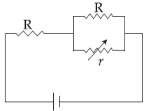
- 6In the circuit shown, the resistance $r$ is a variable resistance. If for $r = fR,$ the heat generation in $r$ is maximum then the value of $f$ isView Solution
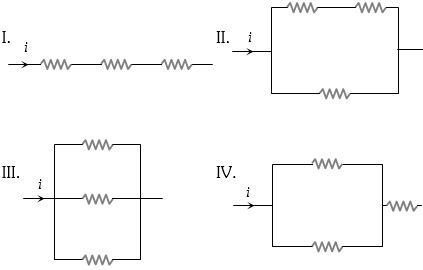
- 7View SolutionThe three resistance of equal value are arranged in the different combinations shown below. Arrange them in increasing order of power dissipation.
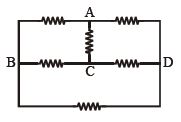
- 8View SolutionIn the following circuit composed of identical resistors, across which terminals would you connect a battery in order to dissipate energy in all resistors
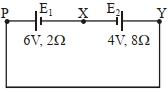
- 9A cell $E _{1}$ of $emf 6 V$ and internal resistance $2 \Omega$ is connected with another cell $E _{2}$ of $emf 4 V$ and internal resistance $8 \Omega$ (as shown in the figure). The potential difference across points $X$ and $Y$ is............ $V$View Solution
- 10View SolutionThe material of wire of potentiometer is