A $2\, volt$ battery, a $15\,\Omega $ resistor and a potentiometer of $100\, cm$ length, all are connected in series. If the resistance of potentiometer wire is $5\,\Omega $, then the potential gradient of the potentiometer wire is ............... $V/cm$
AIIMS 1982, Medium
Download our app for free and get started
Potential gradient $ = \frac{e}{{(R + {R_h} + r)}}.\frac{R}{L}$
$ = \frac{2}{{(15 + 5 + 0)}} \times \frac{5}{1}$$ = 0.5\frac{V}{m} = 0.005\,\frac{V}{{cm}}$

Download our appand get started for free
Experience the future of education. Simply download our apps or reach out to us for more information. Let's shape the future of learning together!No signup needed.*
Similar Questions
- 1$10$ wires (same length, same area, same material) are connected in parallel and each has $1$ $\Omega$ resistance, then the equivalent resistance will be .............. $\Omega$View Solution
- 2A $200\,\Omega $ resistor has a certain color code. If one replaces the red color by green in the code, the new resistance will be .............. $\Omega$View Solution
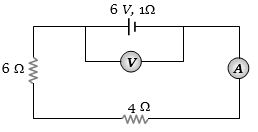
- 3View SolutionIn the circuit shown here, the readings of the ammeter and voltmeter are
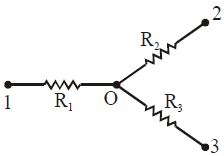
- 4.............. $A$ the current flowing through the resistance $R_2$ of the circuit shown in fig if the resistance are equal to $R_1 = 20\ \Omega, R_2 = 30 \ \Omega$ and $R_3 = 60 \ \Omega$ and potentials of points $1, 2$ and $3$ are equal to $V_1= 20\, V,$ $V_2 = 30\ V$ and $V_3 = 60\ V$View Solution
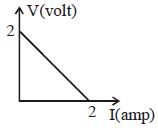
- 5Potential difference across a cell and current through a cell is shown in graph. A battery consists of such identical $40$ cells. Max current supplied by the battery through a load of $2.5\,\Omega $ equal to .............. $A$View Solution
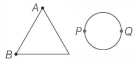
- 6A uniform metallic wire of length $L$ is mounted in two configurations. In configuration $1$ (triangle), it is an equilateral triangle and a voltage $V$ is applied to corners $A$ and $B$. In configuration $2$ (circle), it is bent in the form of a circle and the potential $V$ is applied at diametrically opposite points $P$ and $Q$. The ratio of the power dissipated in configuration $1$ to configuration $2$ isView Solution
- 7When a resistor of $11 \,\Omega$ is connected in series with an electric cell, the current flowing in it is $0.5\, A$. Instead, when a resistor of $5 \,\Omega$ is connected to the same electric cell in series, the current increases by $0.4\, A$. The internal resistance of the cell is ................ $\Omega$View Solution
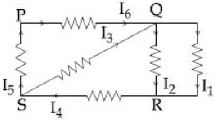
- 8In the given circuit diagram, the currents, ${I_1} = - \,0.3\,A,\,{I_4} = 0.8\,A$ and ${I_5} = 0.4\,A,$ are flowing as shown. The currents $I_2,\,I_3$ and $I_6,$ respectively areView Solution
- 9The $n$ rows each containing $m$ cells in series are joined in parallel. Maximum current is taken from this combination across an external resistance of $3 \,\Omega$ resistance. If the total number of cells used are $24$ and internal resistance of each cell is $0.5 \,\Omega$ thenView Solution
- 10A cell of negligible resistance and $e.m.f.$ $2$ $volts$ is connected to series combination of $2$, $3$ and $5\, ohm$. The potential difference in volts between the terminals of $3\, ohm$ resistance will beView Solution